String of hearts
Ceropegia woodii
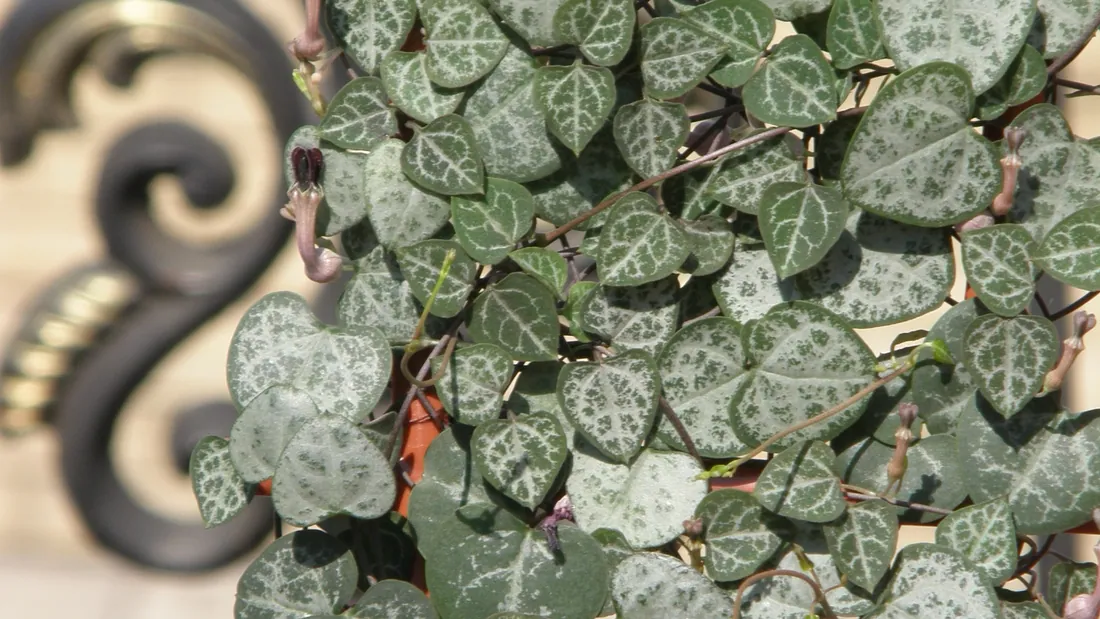

The string of hearts (Ceropegia woodii) is a trailing succulent from southern Africa, easily recognised by its thin purple stems dotted with small heart-shaped leaves marbled in silvery grey. It is a plant made to hang: its vines cascade down and can reach more than a metre. In a temperate climate it lives indoors all year round because it is frost-tender and dislikes the cold. Easy and undemanding, its only real trap is watering: like every succulent it rots quickly if you give it too much water, and it gets by on very little.
Light and exposure
The string of hearts wants bright light to stay compact and colourful. The more it gets, the tighter and more marbled its leaves become, and the more its stems take on that beautiful purple tone. A bright spot near a window is ideal, with a little gentle morning sun that it enjoys, sheltered from the full summer sun that can scorch its thin leaves.
Starved of light, it stretches quickly: the leaves spread out along the stem, lose their marbling and the plant goes bare. In a dim interior through the dark season, give it the brightest window in the house. Hung in front of an east- or west-facing bay window, it feels at home and unfolds like a curtain over the months.
Watering
Keep one thing in mind: the string of hearts would always rather be thirsty than overwatered. Its stems and small tubers store water, and it sails through long dry spells with ease. Water only when the substrate is completely dry, then give it a proper soak before letting all the excess drain away and emptying the saucer. In between, forget about it.
In autumn and winter, cut back to almost nothing; watering every three or four weeks is more than enough in the weak light. Overwatering is by far the number one cause of death: the stems go soft, blacken at the base and collapse. Slightly hollowed leaves point to normal thirst, easy to fix, whereas soft translucent stems signal rot that has already set in.
Soil and repotting
A very free-draining substrate is essential. Use a mix for cacti and succulents, or make your own by cutting indoor potting soil with a third of coarse sand, perlite or lava rock. Water must pass through fast and never sit around the tubers.
The pot matters as much as the soil. Choose a container with drainage holes, rather small, because the plant likes to be a little cramped and a large volume of soil stays wet too long. Terracotta is a good choice: it lets the substrate dry between waterings and limits the risk of rot, the main enemy of this succulent.
Temperature and humidity
The string of hearts is happy in ordinary household temperatures, between 18 and 24 degrees in spring and summer. It tolerates a little winter coolness, around 15 degrees, which marks a useful pause, but no lower than that.
The rule is clear: it is frost-tender and cannot take the cold. You never leave it outside for long, and a spot in the garden in the warm season is only worth trying in real heat, bringing it back in well before nights drop back below 15 degrees. Below 10 degrees it suffers, so keep it away from icy panes in winter and from cold draughts near doors.
Pruning and upkeep
Upkeep comes down to very little. You shorten a stem that has grown too long or bare by cutting just above a pair of leaves, which pushes the plant to branch out and thicken. Do not throw away the cut pieces, they all root.
If the plant has stretched from lack of light, a firm prune in spring rejuvenates it: it comes back denser from the base. You can also wind the long vines around the pot or a support, or replant their tips in the same pot to fill it out. Remove the few dry leaves that stay clinging on as you go.
Pests and diseases
Indoors it is very healthy and most problems come from water. Overwatering causes the stems and tubers to rot: the base blackens, the vines go soft and drop off. At the first signs, cut away everything affected, let it dry and repot dry in fresh substrate, or save the plant by taking cuttings from still-firm sections.
As for pests, watch for mealybugs, those white cottony clusters hidden in the leaf axils and along the stems, common in the dry air of heating. A cotton bud soaked in alcohol deals with them, to be repeated each week. Aphids may target the rare flower buds, without harm, a rinse is enough.
Propagation
It is one of the easiest plants to propagate, almost child’s play. The simplest method: spot the small aerial tubers, those round swellings that form along the stems, and lay them on a moist free-draining substrate without detaching them from the mother plant. They root within a few weeks, then you cut the link.
Stem sections work just as well. Cut a piece with several leaves, let the cut dry for a day, then lay the stem on the substrate, burying the nodes, where the roots will emerge. Spring and summer are the best season. Within a few months, a handful of cuttings gives a well-filled pot, ideal to give away.
Climate and hardiness
Where and in which climate it thrives
Wherever winter freezes, the string of hearts is an indoor plant from one end of the year to the other. Frost-tender and cold-sensitive, it has no business outside: a single cool autumn night is enough to damage it, and frost kills it. You keep it hanging in front of a window, where its cascade of hearts is its whole charm.
Its rhythm follows the light. Through the four or five darkest months, grey days slow it down: place it at the brightest window and almost stop watering, once every three or four weeks at the very most. It is then, with heating drying out the air, that mealybugs appear, to be watched closely. When the light returns, the plant starts up again: resume watering gently, prune what has stretched and take cuttings freely. The only real risk is not the cold, against which keeping it indoors is enough, but the combination of overwatering and lack of winter light, a mix that makes it rot. Keep it dry and bright, and it is a hard-wearing plant that lengthens year after year.
Growing string of hearts?
Green Hub keeps a dated history of your own plant: its photos, its progress, its repottings. An AI answers about yours specifically, not a generic sheet, for free.
Identify my plantMonth-by-month care calendar
| January | Rest. Water very little, once every three to four weeks, only if the substrate has been dry for a long time. Brightest window and watch for mealybugs near the heating. |
|---|---|
| February | Still slowed down, the light stays short. Keep up the rare waterings. Inspect the leaf axils and clean with an alcohol-soaked cotton bud at the slightest white cottony cluster. |
| March | The restart is near with the return of light. Gradually resume watering. A good time to prune stretched stems and repot if needed into a free-draining mix. |
| April | Growth picking up again. Water as soon as the substrate is thoroughly dry. Take cuttings from pruned sections and lay the aerial tubers on the substrate to fill out the pot. |
| May | Full growth. The vines lengthen fast, guide them or wind them around the support. First feed with heavily diluted cactus fertiliser. |
| June | A fine period. Bright light sheltered from the scorching midday sun. Spaced but thorough waterings when the soil is dry. Keep taking cuttings, they root within a few weeks. |
| July | Active growth and sometimes curious little lantern-shaped flowers. Light feed every fortnight. Watch for spider mites in hot, dry weather. |
| August | The plant spreads out. Keep up measured waterings. If you had put it out in real heat, get ready to bring it in, the nights turn cool at the end of the month. |
| September | Slowing down. Bring it in for good if it was outside, well before the first cool spells. Space out waterings and gradually stop feeding. |
| October | Entering rest. Cut water back sharply, no more fertiliser. Move the plant closer to the window to catch the fading light. |
| November | Rest settled in. Very rare waterings. Keep the vines away from icy panes and the cold draughts of doors. |
| December | Full rest. Leave it dry and bright. A gentle coolness around 15 degrees suits it and prepares the spring restart. |
Green Hub tips
- When in doubt, do not water. The string of hearts dies far more often from overwatering than from drought, especially in winter.
- To propagate it effortlessly, lay its small aerial tubers on the soil without detaching them: they root on their own within a few weeks.
- A plant that goes bare and loses its marbling is asking for more light: move it closer to the brightest window.
- Hang it or raise the pot to let the vines trail down, that is when it looks its best.
- Always use a well-draining cactus soil and a pot with holes: soil that stays wet is its worst enemy.
Related species
Hoya
Hoya carnosa
The hoya (Hoya carnosa) is a climbing succulent from the tropical forests of Asia, where it lives clinging to trees…
Aglaonema
Aglaonema commutatum
The aglaonema (Aglaonema commutatum) is a robust, easy houseplant, prized for its foliage variegated with green,…
Alocasia
Alocasia
The alocasia, nicknamed elephant ear, charms with its large, dramatically veined leaves. It is a demanding tropical…
Aloe vera
Aloe vera
Aloe vera (Aloe vera) is a succulent from the Arabian Peninsula, grown since antiquity for the soothing gel of its…
Anthurium
Anthurium andraeanum
The anthurium (Anthurium andraeanum) is a tropical houseplant known for its smooth, waxy red spathe, which people often…
Areca palm
Dypsis lutescens
The areca (Dypsis lutescens) is a tropical palm from Madagascar, frost-tender, grown indoors wherever winter freezes.…
Updated on
How this sheet is written
Written for Green Hub with the help of language models, then reviewed. It offers gardening guidance, not professional advice: if you are unsure whether a plant is toxic to a child or an animal, ask a vet, a doctor or your national poison centre.