Hoya
Hoya carnosa
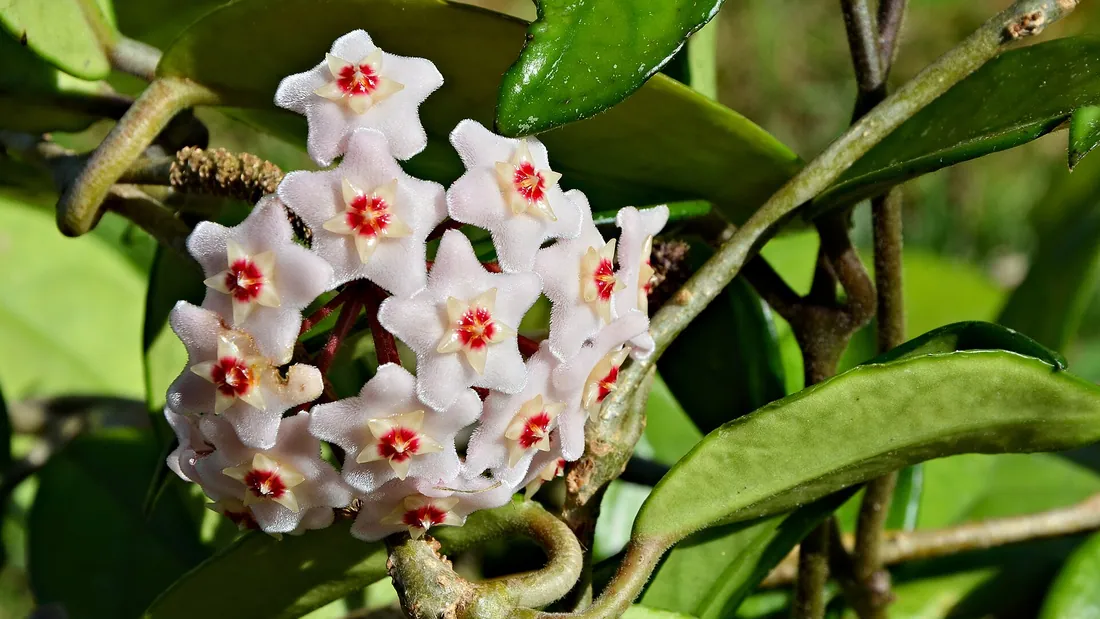

The hoya (Hoya carnosa) is a climbing succulent from the tropical forests of Asia, where it lives clinging to trees without ever touching the ground. It is called the porcelain flower because of its umbels of waxy, almost unreal stars that smell of honey in the evening. It is an indoor plant all year round: it is genuinely cold-sensitive and suffers as soon as the thermometer drops below 12 degrees. Its reputation as a fussy plant is undeserved, it is actually among the easiest, as long as you let it dry out between waterings and never cut off its flowering spurs.
Light and exposure
The hoya wants plenty of light, but no scorching midday sun. The ideal spot is an east-facing window or a bright place near a south-facing bay, screened by a light curtain during the hottest hours. Without enough light it survives but never flowers, and that is almost always the reason behind a hoya that stays tidy without ever producing its umbels.
In winter, light is cruelly lacking through the darkest months. Move it closer to the brightest pane in the house during that period, even if it means shifting it from one room to another. A well-lit hoya develops thick, glossy foliage, while one starved of light grows long, floppy stems with wide gaps between the leaves.
Watering
This is where everything is decided. The hoya is a succulent: its fleshy leaves store water, and it far prefers dryness to excess. Water only when the substrate is thoroughly dry over several centimetres, then give it a good soak and let the water drain away completely. Always empty the saucer, a hoya left standing in water rots at the roots within a few days.
From autumn to early spring, space waterings out even more. In the low light and cool temperatures of winter it drinks very little, and watering once every two or three weeks is plenty. Slightly wrinkled foliage signals genuine thirst and is quickly put right, whereas soft, yellowing leaves almost always betray overwatering, which is far harder to correct.
Soil and repotting
Since the hoya is an epiphyte, it hates heavy, compact potting soil that holds moisture. Give it a very free-draining mix: an indoor potting soil lightened by half with pine bark, a little perlite and a handful of clay pebbles. A substrate for orchids or for cacti and succulents also works very well, on its own or cut with potting soil.
A detail that often surprises: the hoya likes to be cramped in its pot. It flowers better with tight roots, so only repot it every two or three years, when it is truly overflowing. Choose a pot barely larger, in terracotta if possible, which lets the substrate breathe and dry out between waterings.
Temperature and humidity
The hoya is happy in the temperatures of a normal home, between 18 and 25 degrees, which suits it well since we keep it indoors all year. It tolerates a little coolness in winter, around 15 degrees, which even helps it prepare to flower, but never any lower.
The real rule is simple: below 12 degrees it suffers, and the cold leaves lasting marks on its foliage. Do not put it out in the garden for the warm season except during a genuine heatwave, and if you do, bring it back in well before the first cool nights. Also beware of cold draughts near a door and of direct contact with an icy pane in the depths of winter.
Pruning and upkeep
The hoya needs almost no pruning. You simply remove a damaged stem or shorten a vine that has become too invasive, cutting just above a pair of leaves. Its long bare stems that set off in search of a support are not a flaw, they will bear leaves and flowers, so guide them onto a hoop or a trellis rather than cutting them.
The golden rule, and the only truly serious mistake, concerns the flowering spurs. After blooming, the hoya leaves short, dry little stems where the flowers appeared, known as spurs. Never cut them: it reblooms exactly on them the following year, often in the same spot for years on end. Cutting these spurs means depriving yourself of the flowers to come, and it is the number one beginner’s mistake.
Pests and diseases
Indoors, the hoya is tough and rarely falls ill. The real danger remains overwatering, which causes rot in the roots and at the base of the stems. A hoya that yellows, goes soft and loses its leaves from the base almost always suffers from this, and the only way out is to take it out of the pot, cut away the black roots and repot it dry, or take a cutting from a healthy stem.
As for pests, watch out for mealybugs, those small white cottony clusters tucked into the leaf axils and on the stems, encouraged by the dry air of heated rooms in winter. Remove them with a cotton bud soaked in alcohol and repeat every week until they are gone. Spider mites can also appear in very dry conditions, and foliage rinsed off now and then keeps them at bay.
Propagation
The hoya roots from cuttings with disarming ease, it is the best way to share it. Cut a section of stem bearing two or three pairs of leaves, including a small node if possible, since that is where the roots will emerge. Let the cut dry for a few hours, then plant in a barely moist, free-draining substrate, or place the cutting in a glass of water.
Rooting takes a few weeks and works best in warmth, between March and September when the light returns. Once the roots are well formed, repot into a small pot and treat the cutting like an adult. Be patient though: a young hoya often takes two to three years before flowering for the first time, the time it needs to settle in.
Climate and hardiness
Where and in which climate it thrives
In a temperate climate, the hoya lives entirely indoors. There is no question of putting it in the garden for any length of time: frost-tender and cold-sensitive, it marks the cold from 12 degrees and would not survive a single cool night outside. It is a housemate, not a terrace plant.
The challenge is light rather than cold. Through the dark season, short grey days put it to rest: you press it against the brightest window, almost stop watering, and leave it alone. The heating dries out the air and attracts mealybugs, to watch for at that time. As soon as the light returns, the plant starts again and it is time to resume watering and to take cuttings. Two things make all the difference: giving it the best spot in filtered sun so it flowers, and never cutting its flowering spurs, on which its porcelain umbels return every summer. Well cared for, a hoya lives for decades and grows larger year after year, it is a plant you keep for a lifetime.
Growing hoya?
Green Hub keeps a dated history of your own plant: its photos, its progress, its repottings. An AI answers about yours specifically, not a generic sheet, for free.
Identify my plantMonth-by-month care calendar
| January | Winter rest. Place it at the brightest window and water very little, only when the substrate has been dry for a while. Watch for mealybugs near the heating. |
|---|---|
| February | Still resting, the light stays weak. Continue sparing waterings. Check the leaf axils with a cotton bud soaked in alcohol if you see any white cottony patches. |
| March | The light returns and the plant starts up again. Gradually resume watering. A good time to repot if it is truly overflowing, into a barely larger pot and a free-draining mix. |
| April | Active growth. Water as soon as the substrate is dry and guide the new vines onto a hoop or trellis. First feed with a very diluted fertiliser for flowering plants. |
| May | Full growth. This is the ideal time to take a stem cutting. Watch for the flowering spurs appearing and above all do not cut them. |
| June | The first umbels may open on the spurs. Do not move the plant while it flowers, it easily drops its buds if disturbed. Water regularly but let it dry out between waterings. |
| July | Full flowering possible, fragrant in the evening. Screen the midday sun if the window gets too hot. Keep up a light feed every fortnight and measured watering. |
| August | Flowering continues. Rinse the foliage now and then against spider mites, which are encouraged by dry heat. Never remove the spurs from the faded flowers. |
| September | The season slows. Bring it well inside if you had put it out during a heatwave, before the cool nights. Space out waterings as the light fades. |
| October | Entering rest. Stop feeding and cut water right back. Move the plant closer to the window to catch what little light is available. |
| November | Rest settled in. Rare waterings, no fertiliser. Keep it away from cold draughts and from direct contact with an icy pane. |
| December | Full rest. Leave it alone in the light, water barely at all. A slight coolness around 15 degrees at this time favours the following summer’s flowering. |
Green Hub tips
- Never cut the small dry spurs left by faded flowers: the hoya reblooms exactly on them each year, often in the same spot for a long time.
- Keep it cramped in its pot. With tight roots it flowers far better, so repot as rarely as possible.
- When in doubt about watering, wait. The hoya forgives a missed watering but rarely an excess, which makes it rot fast.
- A hoya that grows without flowering almost always lacks light: give it the brightest spot in the house.
- To multiply it, take a two-node cutting in spring in a glass of water or a free-draining substrate, it works every time.
Related species
String of hearts
Ceropegia woodii
The string of hearts (Ceropegia woodii) is a trailing succulent from southern Africa, easily recognised by its thin…
Aglaonema
Aglaonema commutatum
The aglaonema (Aglaonema commutatum) is a robust, easy houseplant, prized for its foliage variegated with green,…
Alocasia
Alocasia
The alocasia, nicknamed elephant ear, charms with its large, dramatically veined leaves. It is a demanding tropical…
Aloe vera
Aloe vera
Aloe vera (Aloe vera) is a succulent from the Arabian Peninsula, grown since antiquity for the soothing gel of its…
Anthurium
Anthurium andraeanum
The anthurium (Anthurium andraeanum) is a tropical houseplant known for its smooth, waxy red spathe, which people often…
Areca palm
Dypsis lutescens
The areca (Dypsis lutescens) is a tropical palm from Madagascar, frost-tender, grown indoors wherever winter freezes.…
The guides that mention it
Updated on
How this sheet is written
Written for Green Hub with the help of language models, then reviewed. It offers gardening guidance, not professional advice: if you are unsure whether a plant is toxic to a child or an animal, ask a vet, a doctor or your national poison centre.