Aglaonema
Aglaonema commutatum
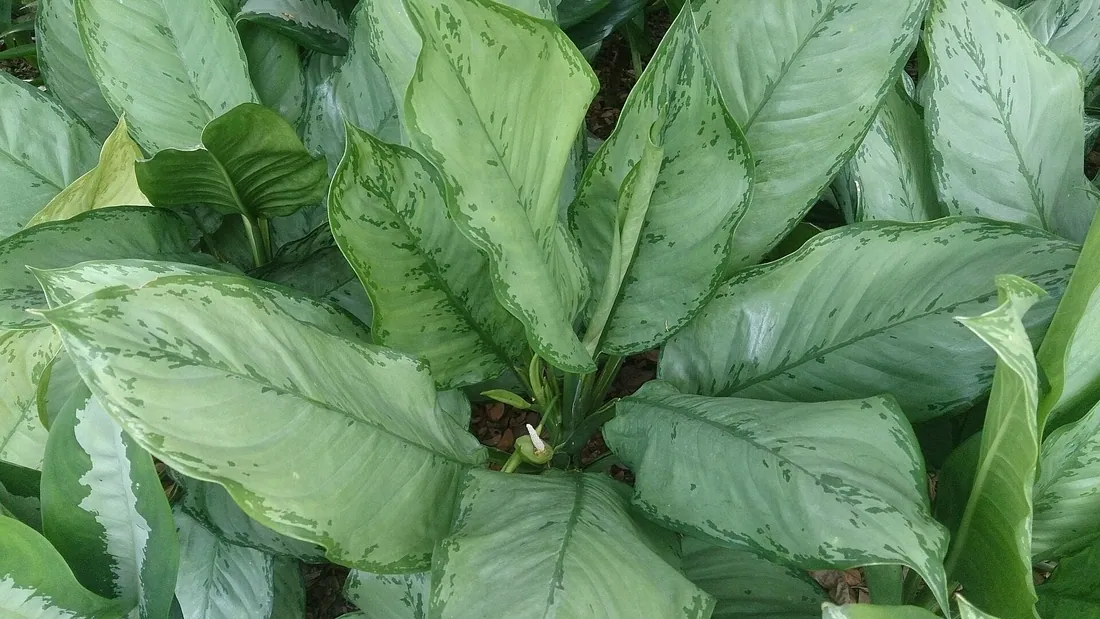

The aglaonema (Aglaonema commutatum) is a robust, easy houseplant, prized for its foliage variegated with green, silver, cream and sometimes pink. Native to the tropical understorey of Southeast Asia, it has one rare quality: it tolerates low light, which makes it one of the few plants genuinely at ease in a dark room or a hallway. It asks for little: warmth, moderate watering and to be left alone. Beware though, its sap is irritating and toxic if chewed, and belongs out of reach of children and pets.
Light and exposure
This is the aglaonema’s great asset: it tolerates low light far better than most green plants. A corner of the room away from the window, a hallway, an office without direct sun, all places where it keeps living while another plant would stretch and fade. It needs little to hold on.
That said, low light does not mean total darkness, and the heavily variegated or pink-tinged varieties keep their colours with a little more brightness. Bright but indirect light remains ideal. Avoid direct sun, though, which bleaches and scorches the foliage. Through a dark stretch of short days and grey skies, a spot near a window does it good without being essential.
Watering
The aglaonema likes moderate, regular watering, without excess. Let the top third of the substrate dry out between waterings, then water generously, letting the water drain away. Always empty the saucer: a plant left sitting in water ends up with rotten roots.
In winter, when growth slows and light is scarce, space out the waterings clearly. This plant forgives a slight lapse more easily than an excess of water. When in doubt, better to wait an extra day. Water at room temperature suits it better than cold water straight from the tap.
Soil and repotting
A standard, well-draining houseplant potting mix does the job perfectly. To improve aeration, add a handful of perlite or fine bark, which stops the rootball from compacting and holding too much water.
The pot must have a hole in the bottom. Repot only every two to three years, in spring: the aglaonema grows slowly and is even happy a little cramped. Choose a container barely larger so as not to drown the roots in a volume of soil that stays wet too long.
Temperature and humidity
Like all tropicals, the aglaonema likes warmth and hates the cold. Its comfort zone lies between 18 and 27 degrees, that is, the temperature of a lived-in home, all year round. It cannot take dropping below 15 degrees and quickly shows it with spots on the leaves.
Protect it from cold draughts and never leave it against an icy pane in the heart of winter. Keep it away too from the hot, dry air of a radiator, and from the direct blast of an air conditioner, which produces the same drying out in the hot season. A heated, stable room, even poorly lit, remains its favourite environment.
Pruning and upkeep
The aglaonema needs very little pruning. Simply remove yellowed or damaged leaves by cutting them at the base with clean scissors. Wear gloves, as the cut sap is irritating. This cleanup is enough to keep the plant neat and healthy.
Over the years, the stem can go bare at the base and the plant stretch out. You can then cut back the tallest stems to force it to branch and come back bushier. The cut tops will serve as cuttings. Occasionally dusting the leaves with a damp sponge helps the plant capture light better, precious in winter.
Pests and diseases
The aglaonema is little prone to disease, which adds to its reputation as an easy plant. The main risk comes from overwatering: rotting roots, softening stem base, leaves yellowing and dropping. The remedy is simple, space out waterings and empty the saucers.
As for pests, watch for mealybugs, small cottony clusters or brown shells along the stems and under the leaves, and spider mites when the air turns very dry in winter. A cotton bud soaked in 70-degree alcohol deals with isolated mealybugs. Brown spots on the foliage often betray a chill or a draught rather than a disease.
Propagation
Division is the simplest route. When repotting in spring, gently separate the offsets growing around the edge of the clump, each with its own roots, and repot them individually. Wear gloves to handle the cut parts.
Tip cuttings also work on specimens that have stretched out. Cut a stem about ten centimetres long bearing a few leaves, let the wound dry for an hour or two, then place it in water or straight into a light substrate kept moist and warm. Rooting takes a few weeks. A warm, humid atmosphere clearly speeds up recovery.
Toxicity
The aglaonema belongs to the Araceae family, like the dieffenbachia or the philodendron, and its sap contains calcium oxalates in the form of tiny needle-shaped crystals. Chewed or nibbled, a leaf releases these crystals, which immediately irritate the mouth, tongue and throat: a burning sensation, tingling, drooling, sometimes swelling that makes swallowing difficult. Even contact of the sap with skin or eyes can cause redness and itching.
The plant should therefore be kept out of reach of young children and pets, cats and dogs first of all, who sometimes like to nibble the leaves. Serious cases stay rare because the immediate burning cuts off the urge to keep chewing, but the discomfort is real. In case of ingestion, rinse the mouth with water, have the person drink, and contact your national poison centre or a vet depending on the victim. Keep that number somewhere you can see it: in an emergency there is no time to look it up. Wear gloves if you prune or take cuttings, and wash your hands afterwards.
Climate and hardiness
Where and in which climate it thrives
The aglaonema does not leave the house. It suffers as soon as nights fall below 15 °C, takes 10 °C only briefly and under shelter, and is happiest between 18 and 27 °C, which is simply the temperature of a lived-in room. Outdoors it only holds in frost-free tropical and subtropical climates, USDA zones 10 to 12; everywhere else it is a year-round houseplant.
Its strength is low light. Under a temperate sky, when the winter day shrinks to eight or nine hours, a window that never gets direct sun is still enough for it, where most plants grow leggy. Conversely, in strong light or in high summer, direct sun bleaches and scorches its variegation: it then needs a sheer curtain, or a metre of setback.
The real enemy of the cold season is not the cold, it is heated air. A radiator underneath the plant, or air conditioning aimed at it, browns the leaf tips; humidity of 40 to 60 %, that of an ordinary home, suits it without any device at all. In dim light and cool air it drinks very little: wait until the substrate has dried out over three to four centimetres, as excess water remains its leading cause of death. A summer spell outdoors in the shade is still possible once nights stay above 15 °C, but it brings the plant almost nothing.
Growing aglaonema?
Green Hub keeps a dated history of your own plant: its photos, its progress, its repottings. An AI answers about yours specifically, not a generic sheet, for free.
Identify my plantMonth-by-month care calendar
| January | Winter rest. Water little, letting the substrate dry out well. Keep the plant away from radiators and cold panes. Watch for spider mites in the dry air. |
|---|---|
| February | Still resting, minimal watering. The light is starting to return, cleaning the leaves with a damp sponge helps to capture it. |
| March | Growth resumes. A good time to repot or divide clumps that are too tight. Resume slightly more regular watering. |
| April | Active growth. Repotting and division still possible. Start a diluted green-plant fertiliser, once a month. |
| May | Fine flush of leaves. Continue light feeding and moderate watering. Keep it sheltered from the rising direct sun. |
| June | Peak season. The plant enjoys the warmth and the longer light. Keep up regular watering without excess. |
| July | Summer heat, the substrate dries faster: check more often and water as needed. Still in bright shade. |
| August | End of summer. Continue watering and light feeding. Dust the foliage. Watch for mealybugs under the leaves. |
| September | Growth slows gently. Space out the feeding and start reducing watering a little. |
| October | The heating starts up again. Keep the plant away from the dry air of radiators. Reduce watering further. |
| November | Rest settling in. Stop feeding, water little. Give it the brightest spot possible despite its shade tolerance. |
| December | Full rest. Minimal watering but without letting it dry out completely. Keep it away from the cold draughts of the festive season. |
Green Hub tips
- It is the plant for dark rooms: where almost everything wastes away for lack of light, the aglaonema holds firm. Perfect for a hallway or a poorly lit office.
- Overwatering is its only real enemy. In winter especially, let the substrate dry out well and always empty the saucer.
- Its sap is toxic and irritating: place it up high, out of reach of children and pets, and wear gloves to prune or take cuttings from it.
- The pink-tinged varieties keep their colours better with a little more light; the green and silver forms get by in shade.
- A cotton bud with 70-degree alcohol removes mealybugs spotted early, before they colonise the plant.
Related species
Alocasia
Alocasia
The alocasia, nicknamed elephant ear, charms with its large, dramatically veined leaves. It is a demanding tropical…
Anthurium
Anthurium andraeanum
The anthurium (Anthurium andraeanum) is a tropical houseplant known for its smooth, waxy red spathe, which people often…
Dieffenbachia
Dieffenbachia seguine
Dieffenbachia (Dieffenbachia seguine) is a houseplant with large foliage variegated in cream and green, native to the…
Heartleaf philodendron
Philodendron hederaceum
The heartleaf philodendron (Philodendron hederaceum), also known as the sweetheart plant, is a vine from the tropical…
Peace lily
Spathiphyllum
The peace lily (Spathiphyllum) is a tropical understorey plant from Central America, prized for its glossy green…
Pothos
Epipremnum aureum
The pothos (Epipremnum aureum), also called devil’s ivy, is a tropical vine from the Solomon Islands that has become…
The guides that mention it
Updated on
How this sheet is written
Written for Green Hub with the help of language models, then reviewed. It offers gardening guidance, not professional advice: if you are unsure whether a plant is toxic to a child or an animal, ask a vet, a doctor or your national poison centre.