Pothos
Epipremnum aureum
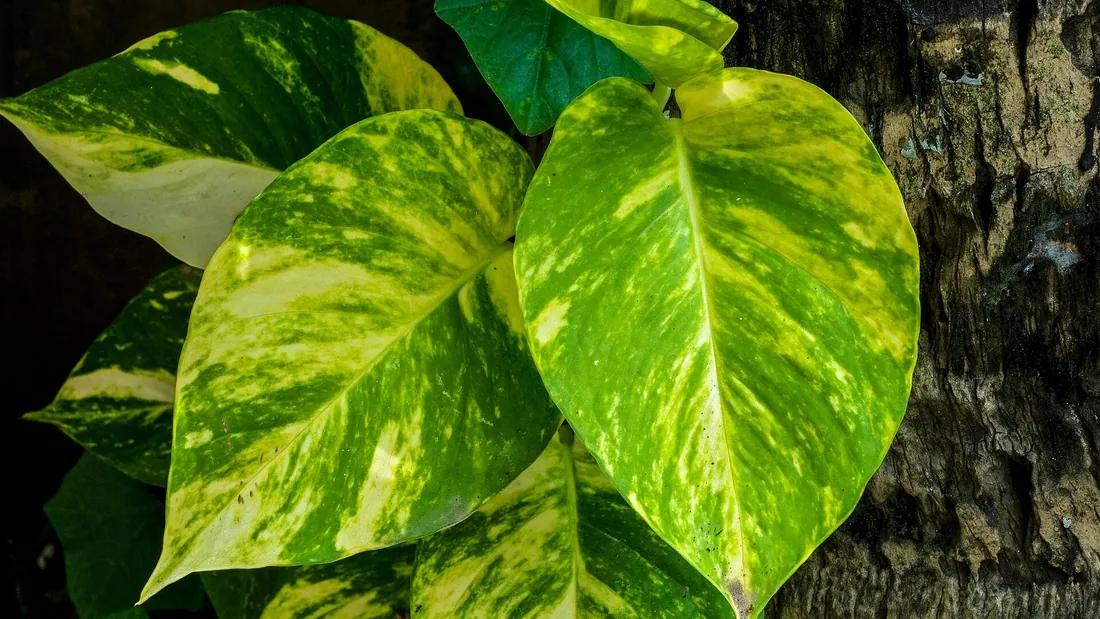

The pothos (Epipremnum aureum), also called devil’s ivy, is a tropical vine from the Solomon Islands that has become the most forgiving houseplant there is. It is nicknamed devil’s ivy because it survives almost anything, including a forgotten watering and dim light. Wherever winter drops below freezing, it is grown in a pot indoors: it tolerates no frost, but it takes the weak light of the dark season without flinching, which makes it the ideal plant for beginners.
Light and exposure
The pothos accepts almost any position, from bright filtered light to a fairly dark corner. In bright filtered light, the variegated varieties keep their handsome cream or yellow marbling. In dim light, the plant keeps growing but its leaves turn green again and lose their markings.
Avoid only the direct summer sun, which fades and scorches the foliage. It is precisely this tolerance of shade that makes the pothos a perfect candidate for poorly lit rooms, and for the short, grey winters of temperate latitudes, where other plants become drawn.
Watering
Let the top half of the pot dry out before watering again. The pothos vastly prefers a slight lack of water to an excess: it is one of the few plants that forgives you a lapse, but never an overwatering. Reckon on one watering a week in summer, one every ten to fifteen days in winter.
The plant warns you itself. When its leaves go soft and droop, it is thirsty: a good watering perks it up within a few hours. Leaves that yellow in numbers, on the contrary, almost always signal an excess of water. Always empty the saucer after watering.
Soil and repotting
A classic green-plant compost, light and well-drained, is amply enough. Add a handful of perlite if your compost is heavy, so the water drains away fast. The pot must have holes.
The pothos makes do for a long time with a slightly cramped pot. Repot in spring every two or three years, or when the roots come out of the drainage holes, into a container only slightly larger. There is no need to repot it every year, it grows very well when snug.
Temperature and humidity
The comfortable range runs from 18 to 26 degrees. Below 10 degrees, growth stops and the leaves may blacken. The pothos tolerates no frost and hates cold draughts.
In a heated home, the cold season poses a problem of dry air more than of cold, since the plant lives at room temperature. Air dried out by the heating throughout the heating season can brown the tips of the leaves. A pothos set on a shelf above a radiator suffers: move it, or mist it now and then. This is a minor constraint compared with its overall tolerance.
Pruning and upkeep
Prune without fear in spring or summer to make the plant denser. Cut a stem just above a node, that little bump from which a leaf and a root grow: the plant will send out two new shoots below the cut and become bushier.
Do not throw away the cut pieces, they root all by themselves. You can also redirect the long trailing stems upwards along a moss pole: the pothos is a climbing vine, and on a support its leaves become distinctly larger than when hanging.
Pests and diseases
The pothos is very little prone to diseases. The rare troubles come from mealybugs, small cottony clusters in the leaf axils, favoured by the dry air of winter. A cotton bud soaked in diluted methylated spirits deals with them easily.
The real danger remains an excess of water. Stems that blacken at the base and leaves that yellow in numbers announce root rot. Take out the root ball, cut off the soft, brown roots, let it dry, and repot in fresh compost. Better a slightly thirsty pothos than a drowned one.
Propagation
It is one of the easiest plants to take cuttings from. Cut a ten-centimetre stem bearing at least one node and one leaf, remove the bottom leaf, and plunge the node into a glass of clean water. Change the water each week: roots appear within one to two weeks.
As soon as the roots reach a few centimetres, repot the cutting into soil. You can plant several cuttings in the same pot to obtain a nice bushy plant more quickly. A cutting without a node will never make roots, it is the node that counts, not the leaf.
Toxicity
The whole plant contains calcium oxalate crystals. Chewed, a leaf strongly irritates the mouth, tongue and throat. Keep the pothos out of reach of cats, dogs and young children, all the more so as it often hangs at the height of the curious.
Climate and hardiness
Where and in which climate it thrives
The pothos holds between 10 and 32 °C and is at its best between 18 and 29 °C. Below 10 °C it stalls, and prolonged exposure under that mark leaves lasting damage; the slightest frost kills it. In the open ground it can only be grown in a frost-free climate, USDA zones 10 to 12, where it in fact becomes an invasive vine best kept contained. Anywhere winter falls below zero, it is a year-round houseplant.
Its real strength is getting through the dark season without complaint. Where many plants grow leggy once the day is down to eight hours, the pothos simply carries on, and the least sunny window in the home is enough for it. It even accepts the artificial lighting of an office. In exchange, the lower the light, the more its variegation fades in favour of plain green: that is the price, not a disease.
Heated air, on the other hand, browns its leaf tips. It is content with 40 to 70 % humidity, so with an ordinary home, but it likes neither sitting on a radiator nor the draught of an air conditioner. In winter, in low light, it drinks far less: let the top centimetre of substrate dry out before each watering, and remember that it always forgives drought better than excess water.
Growing pothos?
Green Hub keeps a dated history of your own plant: its photos, its progress, its repottings. An AI answers about yours specifically, not a generic sheet, for free.
Identify my plantMonth-by-month care calendar
| January | Light rest. Water every 12 to 15 days, when the top half of the pot has dried out. Keep the plant away from the burning air of the radiator. |
|---|---|
| February | Still ticking over slowly. Watch out for mealybugs favoured by the dry air. A damp cloth on the leaves does them good. |
| March | Growth picks up with the light. Resume slightly more regular watering. A good time to repot if the roots are overflowing. |
| April | Full recovery. Prune to make it denser, take cuttings from the cut pieces. First light feeding of the year. |
| May | Active growth. Water about once a week. Feed every 15 days with a diluted green-plant fertiliser. |
| June | Fine growth. Guide the long stems onto a moss pole for larger leaves, or let them trail. |
| July | High summer. Water as soon as the surface has dried out. Avoid the direct sun that fades the variegated foliage. |
| August | Growth still sustained. Continue the light feeding. It is the right time to propagate by water cuttings. |
| September | Growth slows with the declining light. Space out the waterings a little and ease off the feeding. |
| October | Entering the quiet season. Last light feeding. Clean the foliage before winter. |
| November | Rest. Reduce the water, cut off the feeding. Move the plant closer to a window to catch the weak daylight. |
| December | Winter rest. Water sparingly. Keep the pot away from the radiator to avoid brown tips. |
Green Hub tips
- The pothos talks to you: soft, drooping leaves want water and perk up within a few hours after a watering.
- For larger leaves, let it climb a moss pole rather than leaving it to trail: it is a vine, not a trailing plant.
- Plant several cuttings in the same pot to obtain a nicely full plant much faster than with a single specimen.
- When in doubt, do not water. The pothos forgives a lapse but rarely an excess of water.
Related species
Aglaonema
Aglaonema commutatum
The aglaonema (Aglaonema commutatum) is a robust, easy houseplant, prized for its foliage variegated with green,…
Alocasia
Alocasia
The alocasia, nicknamed elephant ear, charms with its large, dramatically veined leaves. It is a demanding tropical…
Anthurium
Anthurium andraeanum
The anthurium (Anthurium andraeanum) is a tropical houseplant known for its smooth, waxy red spathe, which people often…
Dieffenbachia
Dieffenbachia seguine
Dieffenbachia (Dieffenbachia seguine) is a houseplant with large foliage variegated in cream and green, native to the…
Heartleaf philodendron
Philodendron hederaceum
The heartleaf philodendron (Philodendron hederaceum), also known as the sweetheart plant, is a vine from the tropical…
Peace lily
Spathiphyllum
The peace lily (Spathiphyllum) is a tropical understorey plant from Central America, prized for its glossy green…
The guides that mention it
Indestructible Houseplants: Tolerating Drought Is Not Tolerating Shade
Tolerating drought and tolerating shade are two different adaptations, and almost every list mixes them up. What these…
Watering Plants Properly: Deciding Rather Than Following a Schedule
Beginners water too often and too little at the same time. How to read the soil instead of the calendar, tell thirst…
Toxic Plants for Cats and Dogs: Recognising the Danger Rather Than Memorising a List
A list of toxic plants is easily forgotten and always incomplete. What actually protects a cat or dog is recognising…
How to Compost in an Apartment with Worm Composting
Tiered bin, red worms and worm tea: how to compost your kitchen scraps without a garden or odor, even in a city…
Updated on
How this sheet is written
Written for Green Hub with the help of language models, then reviewed. It offers gardening guidance, not professional advice: if you are unsure whether a plant is toxic to a child or an animal, ask a vet, a doctor or your national poison centre.