Dieffenbachia
Dieffenbachia seguine
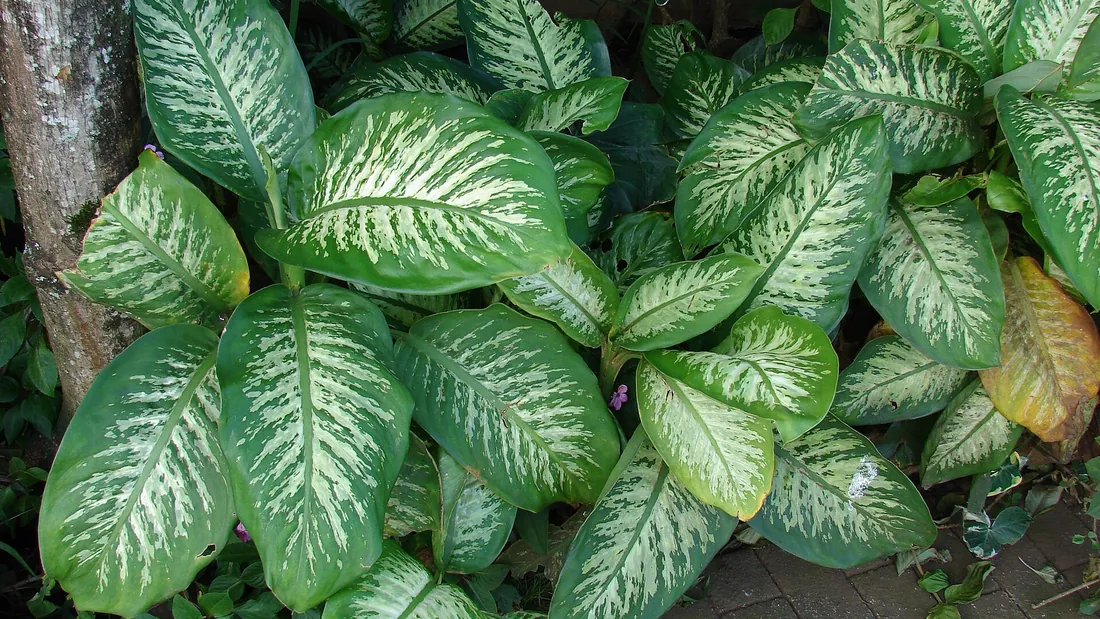

Dieffenbachia (Dieffenbachia seguine) is a houseplant with large foliage variegated in cream and green, native to the tropical undergrowth of America. In a temperate climate it lives strictly indoors: frost-tender, it survives no winter outside. Two points sum it up: it demands bright but filtered light, and its sap is frankly toxic. Keep it away from children and pets.
Light and exposure
Dieffenbachia wants bright but indirect light, never direct sun. Behind a south-facing pane during the hot hours, its large leaves scorch and develop bleached patches. The ideal is a bright room, one or two metres from an east or west window, or behind a sheer curtain.
Beware the opposite excess: in a corner that is too dark, the lovely cream variegation fades, the leaves turn green again and the stems stretch towards the light, becoming spindly. Where winter light is weak, move it closer to the window through the dark season and turn the pot a quarter turn each week to keep the plant upright and even.
Watering
Dieffenbachia likes a substrate that stays fresh, without ever sitting in water. Water as soon as the first one or two centimetres of the potting mix are dry to the touch, soaking the root ball thoroughly, then empty the saucer. Water standing at the bottom of the pot rots the roots, which is the leading cause of losing this plant.
In winter, cut back sharply: growth slows and the substrate dries more slowly, so watering every ten to fifteen days is often enough. Preferably use water at room temperature, as cold water straight from the tap shocks the tropical roots. Leaves that yellow and soften almost always signal too much water, not too little.
Soil and repotting
A potting mix for green plants, rich and light, loosened with a handful of perlite or bark, suits it well. The mix should hold moisture while letting water pass through. A pot with a drainage hole at the bottom is essential, with a layer of clay pebbles to keep the roots from sitting in water.
Repot in spring, roughly every two years, or when the roots come out through the drainage holes. Move up to a barely larger pot, as too vast a container holds too much water. Take the chance to renew the top layer of potting mix each year. Put your gloves on for this operation: breaking the roots or a stem releases the irritant sap.
Temperature and humidity
Dieffenbachia is a warm-climate plant. It thrives between 18 and 24 degrees all year and does not like to drop below 15 degrees. Below 10 degrees it suffers quickly, the leaves browning and dropping. Keep it away from draughts, slamming doors and cold windows in winter.
Air humidity is its real Achilles heel here. It comes from a humid environment and hates air dried out by central heating: the leaf edges brown and dry out as soon as the atmosphere becomes too dry. Mist the foliage several times a week in winter, set the pot on a bed of damp clay pebbles, or group your plants together to create a more humid microclimate.
Pruning and upkeep
Routine care is light. Remove yellow or damaged leaves at the base as they appear, with clean secateurs and gloves. Regularly wipe the top of the large leaves with a damp cloth: dust dulls the variegation and clogs the plant’s breathing.
Over time, dieffenbachia goes bare at the bottom and takes on a cane-like habit, a naked stem topped with leaves. You can then cut the stem back hard to fifteen or twenty centimetres in spring: it will regrow from the base. Do not throw away the cut sections, as they serve to propagate the plant. A useful reminder with every cut: the sap is toxic and irritant, gloves are mandatory and hands washed afterwards.
Pests and diseases
The real trouble comes mainly from too much water. A waterlogged substrate rots the roots and the collar: the plant softens, the stems turning soft and brown at the base. The answer is prevention, a drained pot and measured watering. Brown spots on the leaves can also appear in cold, damp weather combined with wet foliage.
As for pests, the dry air of the heating favours spider mites, tiny mites that spin fine webs and speckle the underside of the leaves with yellow dots. Mealybugs, whether floury or armoured, also settle in the leaf axils as white cottony clusters or small brown shells. Inspect the underside of the leaves each week in winter, raise the air humidity against spider mites, and clean off mealybugs with a cotton swab soaked in methylated spirits.
Propagation
Propagation is done in spring, on the occasion of a repotting or a pruning. The simplest method is cutting from stem sections: cut the bare stem into segments of five to eight centimetres, each bearing at least one node, let the sections dry for a day, then lay them half-buried in a light, moist potting mix, kept warm between 22 and 25 degrees. New shoots emerge from the nodes within a few weeks.
For a specimen that has grown too tall and bare, air layering gives excellent results: notch the stem below the crown of leaves, wrap the wound in a ball of damp moss held with plastic film, and wait for roots to form in the moss before cutting below the roots and repotting the head. Wear gloves for all these operations, as each cut releases the irritant sap.
Toxicity
A plant that is very toxic through all its sap. The tissues contain calcium oxalate crystals (raphides) that lodge in the mucous membranes the moment a piece of leaf is chewed: intense and immediate pain, burning, salivation, swelling of the mouth, tongue and throat, and sometimes a temporary loss of voice. It is this loss of voice that earned it the name dumb cane. Dangerous for children, cats and dogs, who may nibble at it out of curiosity. Mere contact with the sap also irritates the skin and eyes. Place it out of reach, wear gloves to prune or repot it, and wash your hands after handling.
Climate and hardiness
Where and in which climate it thrives
In a temperate climate, dieffenbachia is a houseplant all year round. Nothing to hope for outside: frost-tender, it would not survive a night on the terrace, even in a cool, damp summer. So it is never put out, except perhaps in the shade on a fine day above 18 degrees, and brought back in for the evening.
The real trap is the heating. Through the heating season, the air in houses dries out and browns the leaf edges, a classic symptom. The countermeasure comes down to two gestures: move the pot away from radiators and heat vents, and raise the air humidity by misting or damp clay pebbles. The other difficulty of the dark season is the lack of light: in deep winter, the low light makes the variegation pale and the plant grow leggy, so move it firmly closer to the window during this period.
As for watering, winter calls for caution: less light and growth at a standstill mean less water, on pain of root rot. Save generous watering for the fine season, when the plant truly picks up again.
Growing dieffenbachia?
Green Hub keeps a dated history of your own plant: its photos, its progress, its repottings. An AI answers about yours specifically, not a generic sheet, for free.
Identify my plantMonth-by-month care calendar
| January | Full heating season. Move the pot away from radiators, mist several times a week and watch for spider mites under the leaves. |
|---|---|
| February | Still dry air and little light. Move the plant closer to the window, turn the pot a quarter turn, water sparingly. |
| March | Light returns and growth restarts. Resume slightly more regular watering. A good time to prepare a repotting. |
| April | Repot if the roots come out of the holes, with gloves. It is also the season to take stem cuttings or start an air layering. |
| May | Active growth. Resume a liquid fertiliser for green plants every two to three weeks, diluted. Wipe the dust off the leaves. |
| June | Fine season. Water as soon as the top of the potting mix dries. Possible outing in the shade in mild weather above 18 degrees, to bring in for the evening. |
| July | Heat and light at their peak. Check that the substrate stays fresh without waterlogging, always empty the saucer after watering. |
| August | Keep up watering and light feeding. Cut back a bare stem if the plant has stretched too much, it will regrow from the base. |
| September | End of active growth. Gradually space out watering and lighten the feeding. Bring in any specimen taken outside. |
| October | The days shorten. Move the plant closer to the window and stop feeding until spring. |
| November | The heating starts again. Resume misting, move away from radiators and cut back watering sharply. |
| December | Winter rest. Weak light, dry air: humidify, water little, and inspect the underside of the leaves against mealybugs and spider mites. |
Green Hub tips
- Toxic sap: keep the dieffenbachia out of reach of children, cats and dogs, and always put on gloves to prune or repot it.
- Leaf edges browning in winter? It is the heating drying the air. Move it away from radiators and mist, or set the pot on damp clay pebbles.
- Variegation that pales and stems that stretch signal a lack of light. Move closer to the window, especially from December to February.
- Yellow, soft leaves: nine times out of ten it is too much water. Let the top of the potting mix dry between waterings and empty the saucer.
Related species
Aglaonema
Aglaonema commutatum
The aglaonema (Aglaonema commutatum) is a robust, easy houseplant, prized for its foliage variegated with green,…
Alocasia
Alocasia
The alocasia, nicknamed elephant ear, charms with its large, dramatically veined leaves. It is a demanding tropical…
Anthurium
Anthurium andraeanum
The anthurium (Anthurium andraeanum) is a tropical houseplant known for its smooth, waxy red spathe, which people often…
Heartleaf philodendron
Philodendron hederaceum
The heartleaf philodendron (Philodendron hederaceum), also known as the sweetheart plant, is a vine from the tropical…
Peace lily
Spathiphyllum
The peace lily (Spathiphyllum) is a tropical understorey plant from Central America, prized for its glossy green…
Pothos
Epipremnum aureum
The pothos (Epipremnum aureum), also called devil’s ivy, is a tropical vine from the Solomon Islands that has become…
The guides that mention it
Updated on
How this sheet is written
Written for Green Hub with the help of language models, then reviewed. It offers gardening guidance, not professional advice: if you are unsure whether a plant is toxic to a child or an animal, ask a vet, a doctor or your national poison centre.