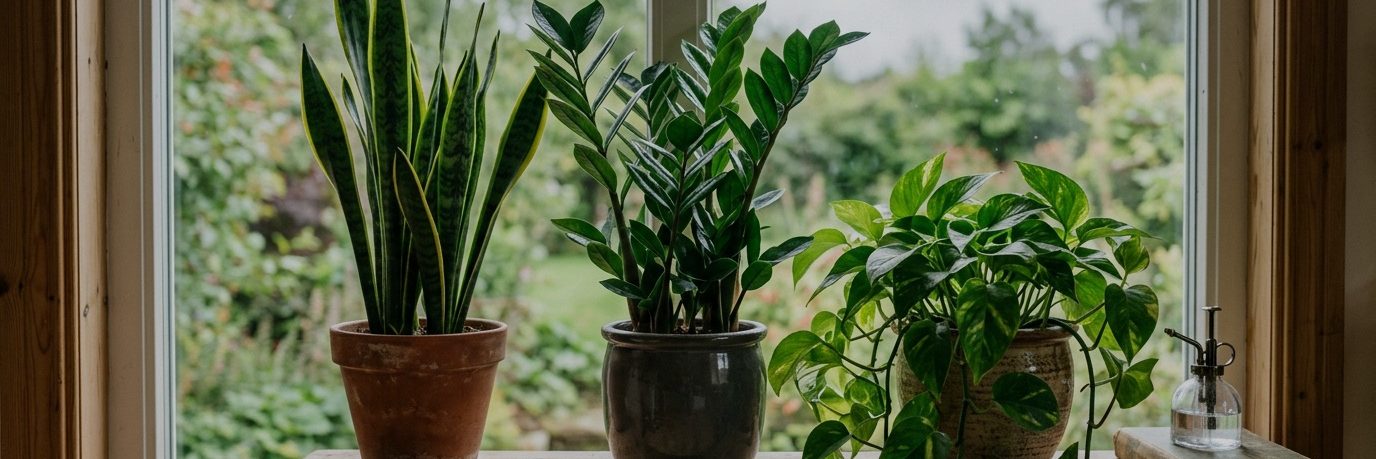
Indestructible Houseplants: Tolerating Drought Is Not Tolerating Shade
Indestructible is a catch-all word: it covers two unrelated adaptations, tolerating drought and tolerating shade, and a plant that excels at one can be mediocre at the other. Lists across the web confuse them constantly, which is how a succulent ends up in a dark hallway, where it eventually drowns without ever having been overwatered in the usual sense. Separating the two changes everything: which plant to choose, the watering rhythm, and the room it will actually live in.
Indestructible covers two distinct tolerances that need separating before you choose. The first is drought resistance: it comes from a storage tissue, succulent leaves, thick rhizomes or tuberous roots, often paired with CAM metabolism, which opens the stomata at night and lets the plant produce the same biomass with up to 80 percent less water than an ordinary plant. The second is shade tolerance: it comes from understory-plant traits, thin, broad leaves, low respiration, a low light compensation point. Aloe, crassula, echeveria and kalanchoe belong to the first group and are mediocre at the second; pothos, philodendron, peace lily and Chinese evergreen belong to the second and have no water reserve at all; only snake plant and ZZ plant genuinely combine both, which is why they top every list. The light threshold can be measured: the interior plantscaping trade sets the floor for the toughest foliage plants at around 25 foot-candles, or about 270 lux, and a 2024 study maintained pothos growth at 6.8 micromoles of photons per square metre per second for 9 hours a day, which comes out to the same order of magnitude. Finally, what kills these plants is almost always too much water, not neglect: deprived of oxygen, a root stops absorbing, and a drowned plant wilts exactly like a thirsty one.
Indestructible Means Two Things That Have Nothing to Do With Each Other
The word covers two adaptations that arose in opposite environments. On one side, plants from dry, bright regions that learned to store water and spend it drop by drop: aloe, crassula, haworthia, echeveria, kalanchoe, snake plant, ZZ plant. Hoya is a case apart: a tropical-forest epiphyte, it developed the same succulence without coming from a dry habitat. On the other side, tropical understory plants that learned to live under the canopy, with very little light and constant water: pothos, philodendron, monstera, peace lily, Chinese evergreen, arrowhead vine, calathea, Boston fern. Nothing guarantees that a plant gifted in one register is gifted in the other, and most are not.
The confusion has a very concrete consequence. A peace lily holds up for months in a dark corner but collapses within about ten days if you forget it; an echeveria goes a month without water but, in that same dark corner, stretches, pales, then rots. Both are sold as easy, and a buyer who treats them the same way is bound to lose one. The right question is never which plant is the toughest, but tough against what, and what exactly do my room and my habits expose this plant to.
Only two species genuinely combine both tolerances, which is why they sit at the top of every list: snake plant and ZZ plant. But it is worth seeing that they do not combine them for the reasons people assume. Snake plant comes from dry, rocky habitats; ZZ plant comes from the understory and wooded savannas of East Africa, where it grows equally well in shade or in bright light. Neither one, though, is a specialist of dim light: their shade tolerance does not come from an adaptation to dimness but from slowness, a metabolism so frugal that their upkeep bill is tiny. It is tolerance by indifference, not by vocation, and it comes at a price: they barely grow at all.
| Plant | Water reserve | Performance in low light | Distinguishing trait | Its limit |
|---|---|---|---|---|
| Snake plant | Succulent leaves, CAM metabolism | Very good, holds at the measured floor | The only one with ZZ plant to genuinely combine both tolerances | Rots quickly if the growing medium stays moist as light drops |
| ZZ plant | Thick rhizomes, leaves at 91 percent water | Very good, even under prolonged artificial lighting | Three to four months without watering, measured in horticultural production | Tiny growth, one to two leaves per season |
| Pothos | None | Excellent, growth maintained at 6.8 micromoles over 9 hours | The most shade-tolerant plant on the whole list | Wilts within days if genuinely forgotten |
| Philodendron | None | Excellent, a true understory plant | Handles severe pruning and regrows from the stem | Same vulnerability to drought as pothos |
| Peace lily | None | Good | Signals thirst dramatically, then recovers within hours | Will not flower in low light, and every full wilt costs it leaves |
| Chinese evergreen | None | Excellent, ranked among the extreme-shade plants | Keeps its shape and colours where pothos would stretch out | Very sensitive to cold and cool draughts |
| Spider plant | Fleshy tuberous roots 5 to 10 cm long | Medium | Ordinary photosynthesis but a genuine reserve: the most balanced compromise | Frequent brown tips, and plantlets drain the mother plant |
| Aloe vera | Very succulent leaves, CAM | Low | Huge reserve for a small footprint | Grows leggy then rots in a dark corner, despite its reputation |
| Crassula | Succulent leaves, CAM | Low | Lives for decades in the same spot asking for nothing | Drops its leaves at the first overwatering in the low-light season |
| Haworthia | Succulent leaves, CAM | Low to medium | Small enough to sit on a narrow, brightly lit windowsill | Scorches behind full-sun glass without a gradual transition |
| Hoya carnosa | Thick leaves, confirmed CAM even when well watered | Medium | Both a climber and a succulent, a rare combination | Only flowers in bright light, and takes years to settle in |
| Christmas cactus | Succulent stems, CAM | Medium | A forest epiphyte, a CAM plant that dislikes full sun, like hoya | Buds when nights lengthen or temperature drops: an evening lamp can prevent this |
| Boston fern | None | Good | Non-toxic to dogs and cats, which is rare for a dark living room | Does not forgive a single missed watering: the exact opposite of indestructible |
What Keeps a Succulent Alive: Storing Water, and Breathing at Night
The water reserve is the visible part, and the least interesting one. The real mechanism is CAM metabolism, named after the group in which it was first described, the Crassulaceae. An ordinary plant opens its stomata during the day to let in carbon dioxide, and loses water vapour through those same openings, at the hottest, driest point of the day. A CAM plant shifts that exchange into the night: it opens its stomata when the air is cool and the vapour-pressure gap is at its smallest, captures carbon dioxide with a dedicated enzyme, and stores it in the vacuole as malic acid. The next day, with its stomata sealed shut, it releases that carbon dioxide internally and re-fixes it normally. The measured result: these plants produce comparable biomass with up to 80 percent less water than plants using ordinary photosynthesis.
This feat comes with a trade-off that rarely gets mentioned. The amount of carbon dioxide that can be captured in one night is capped by the volume of the vacuole: a CAM plant cannot speed up. Its growth is structurally slow. That is exactly why it also survives in a dimly lit room, not because it is adapted to it, but because it consumes so little that it can still cover its costs there. Slowness and frugality are the same property seen from two angles.
Snake plant is a textbook case. A study covering ten species of the genus detected CAM in seven of them, and counter-intuitively, the correlation with leaf thickness is negative: it is not the water-swollen storage layer that produces CAM, it is the succulence spread across all the cells. Incidentally, a taxonomic revision published in 2018 folded the genus Sansevieria into the genus Dracaena: botanically, a snake plant is now a dracaena. That is not a nomenclature footnote, it explains why the two share the same toxic principle, saponins.
ZZ plant is even more unusual: it is the only aroid in which CAM has been described. But it is a weak CAM, one that ramps up under water stress: in a well-watered plant, nighttime carbon dioxide uptake accounts for less than 1 percent of daily carbon gain. Its real weapon is mechanical. Its leaves contain about 91 percent water, its petioles 95 percent, its glossy waxy cuticle drastically cuts transpiration, and its thick rhizomes act as a cistern. Under prolonged drought, it sacrifices its leaflets and the upper part of the rachis, keeping only the swollen base of the petiole. Horticultural production data give the measure of this strategy: three to four months without watering.
Not every drought-resistant plant is a CAM plant, and that is worth knowing. Spider plant uses ordinary photosynthesis; its reserve lies elsewhere, in fleshy tuberous roots 5 to 10 cm long that store water and sugars. Hence its typical behaviour: it wilts visibly, then perks back up after a watering, where a CAM plant shows nothing for weeks. Conversely, the stars of shade tolerance have no reserve at all: pothos, philodendron, peace lily, calathea, Boston fern live day to day. They tolerate dim light, not drought.
What Keeps an Understory Plant Alive: Spending Almost Nothing
Shade tolerance runs on a budget, not a reserve. A leaf spends energy constantly just to stay alive, day and night; it only produces energy in the light. The light compensation point is the light level at which photosynthesis just barely covers that respiration. Below it, the leaf spends more sugars than it makes and lives off the plant’s reserves. Genuinely shade-tolerant species show compensation points on the order of 3 to 20 micromoles of photons per square metre per second, against 30 to 90 in full-sun plants. Everything else follows from that gap.
To stay within that budget, an understory plant invests in surface area rather than thickness. Its leaves are thin and broad, with low mass per unit area, often under 50 grams per square metre in the most tolerant species: more capturing surface per gram of tissue to maintain. It lowers its respiration and adjusts its pigments, with a lower chlorophyll a to b ratio, which helps it make use of light already filtered by the foliage above it. A succulent does exactly the opposite: thick, dense tissue, costly to maintain, profitable only in full light.
There is one more reason, a purely industrial one, why your pothos holds up in a dimly lit living room: it was prepared for it. The houseplant trade practises acclimatisation, a gradual, deliberate reduction of light, fertiliser and irrigation before the plant goes on sale, which slows the plant down anatomically and physiologically so it can survive indoors. Two consequences follow. The plant you buy arrives already tuned for shade, which makes the first month deceptively easy. And it scorches if you move it abruptly into full sun, not because it hates sun, but because it was never reacclimatised to it.
The corollary nobody writes down is this: a succulent placed in a dark corner does not die of darkness. It grows leggy, produces pale, widely spaced shoots, loses its compact shape, and above all it stops drinking. The growing medium, watered at the old rhythm, no longer dries out. It is the roots that give way, not the leaves. In the shade, a succulent dies of water.
Measuring Light, Because the Eye Cannot
This is the most useful point in this guide, and the most counter-intuitive one: your eye is a compressor, not an instrument. Perceived brightness roughly follows the cube root of actual light level, which means physical light has to be divided by eight for the eye to report half as bright. A room that looks barely dimmer than outdoors is actually receiving a fraction of a percent of that light. Full sun runs around 2,000 micromoles of photons per square metre per second, or about 108,000 lux. An interior that everyone would call well-lit sits around a few hundred lux. The ratio is two to three hundred to one, and your eye tells you it is just a bit less bright.
Second misunderstanding: the unit. Lux measures what the eye perceives: it weights each wavelength by the sensitivity of human vision, which peaks in green, precisely the colour chlorophyll absorbs least well. The unit that matters to the plant is the flux of useful photons, in micromoles per square metre per second, and above all its accumulation over the day, in moles per square metre. A lux meter remains usable provided you apply the right divisor: for daylight, divide lux by 54 to get micromoles. Under a cool-white fluorescent tube, the divisor is around 74, meaning the same lux figure is worth noticeably fewer useful photons. That is why a desk reading 500 lux on your phone is not the same as 500 lux of daylight.
The real floor, meanwhile, has been reached by two independent routes. The interior plantscaping trade sets the minimum for the toughest foliage plants at 25 foot-candles, or about 270 lux, which works out, depending on whether the source is daylight or a fluorescent tube, to 3.6 to 5 micromoles per square metre per second, and over a 12-hour lighting day, to a daily total of between 0.16 and 0.22 mole per square metre. And an experiment published in 2024 in a growth chamber maintained pothos growth at 6.8 micromoles per square metre per second for 9 hours a day, or a daily total of 0.22 mole. Two methods, two eras, the same order of magnitude. That is the survival threshold for an acclimatised foliage plant, and it is very low: a properly lit hallway exceeds it. What the hallway lacks is not intensity, it is duration.
| Situation | Illuminance | Photon flux, in micromoles per square metre per second | 12-hour total, in moles per square metre | What survives there |
|---|---|---|---|---|
| Full outdoor sun | About 108,000 lux | About 2,000 | More than 50 on a fine summer day | Nothing straight from a store without a gradual transition |
| High-light category, preferred value | 500 to 1,000 foot-candles, or 5,400 to 10,800 lux | 100 to 200 | 4.3 to 8.6 | Aloe, crassula, haworthia, echeveria, kalanchoe, and flowering for the others |
| Medium-light category, preferred value | 200 to 500 foot-candles, or 2,150 to 5,400 lux | 40 to 100 | 1.7 to 4.3 | Spider plant, hoya, Christmas cactus, dracaena, yucca |
| Low-light category, preferred value | 75 to 200 foot-candles, or 800 to 2,150 lux | 15 to 40 | 0.6 to 1.7 | Pothos, philodendron, peace lily, Chinese evergreen, arrowhead vine |
| The measured floor | 25 foot-candles, or about 270 lux | About 5 | About 0.22 | Pothos maintained growth here in a growth chamber; snake plant and ZZ plant survive, but stop growing |
| Office lit from the ceiling | Typically 300 to 500 lux | Less than the lux figure suggests, since the conversion is less favourable under tube or LED lighting | Depends entirely on how long the light stays on | ZZ plant and pothos, if the light stays on 9 to 10 hours a day |
| Windowless bathroom or hallway | A few hundred lux, but only a few minutes a day | Not applicable, duration cancels everything out | Close to zero | No plant |
What remains is understanding why moving away from a window costs so much. It is not the inverse-square law: a window is not a point source. What decides the outcome is the portion of sky the plant can see through the opening. Sitting on the windowsill, it sees almost the entire dome of the sky. Moved back two metres and off to the side, the wall and the window frame block nearly all of that sky, leaving only what bounces off the walls. Hence the test that beats any amount of reasoning: crouch down to the plant’s height, in its exact spot, and look at the window. If you cannot see a patch of sky, neither can it.
To measure without buying anything, your phone’s ambient light sensor, located near the top edge of the screen, can be read with a free lux-meter app. Lay the phone flat where the plant sits, screen facing the direction the leaves face, in the middle of the day. Calibration varies a lot from one model to another: use it as a comparison tool between two spots rather than as an absolute value, and apply the divisor that matches the light source. One significant caveat: only Android phones expose this sensor to apps. On iPhone, lux-meter apps go through the camera instead, which changes both the method and the accuracy. Without a phone, there is still the shadow test: a sheet of white paper where the plant sits, a hand held about thirty centimetres above it, in the middle of the day. A sharp shadow with crisp edges means direct light; a soft but clearly readable shadow means the medium category; a shadow that is barely detectable or absent means low light, whatever impression the room gives.
What Actually Kills an Indestructible Plant, and Why It Looks Thirsty
In the vast majority of cases, it is not neglect, it is too much water. The mechanism has nothing to do with roots drinking too much, it is a story about gas. Oxygen diffuses roughly ten thousand times more slowly in water than in air. As soon as the growing medium’s pores fill up, gas exchange stops, and the dissolved oxygen that remains gets used up within hours by the roots themselves and by micro-organisms in the medium. But a root needs energy to actively absorb water: without oxygen, it stops doing so.
Hence the scene that traps everyone. The plant wilts, the leaves go soft, the first instinct is to water it, and that watering finishes it off. A drowned plant looks exactly like a thirsty one, because from the leaf’s point of view the outcome is identical in both cases: it stops receiving water. The foliage never lets you tell the two apart. What settles it is the growing medium, the collar, the smell, and the roots.
Next comes infection, which turns a reversible accident into a total loss. The root-rot pathogens Pythium and Phytophthora produce mobile spores that travel through water films: it is the waterlogging itself that carries them to roots already weakened. The signs to look for are consistent. Growing medium still soaked long after the last watering, a collar that darkens and turns slimy, a smell of stagnant water right at pot level, brown, soft roots whose outer sheath slides off between your fingers, leaving a central thread behind. On a succulent, there is an additional, very recognisable signature: the base turns translucent, waterlogged and soft, while the tips still look normal.
On this specific point, the plants on this list are more fragile than average, not tougher. Their roots come from substrates that drain in minutes and dry out completely between rains: they have no tolerance at all for prolonged oxygen deprivation. A pothos handles overwatering far better than an aloe does, which is the exact opposite of what their shared reputation for being indestructible would suggest.
Remember the asymmetry, because it is what should dictate your caution: a thirsty plant perks back up within hours of a good watering, a drowned plant takes weeks and often does not make it. With these species, then, you should systematically err on the side of dry. The second killer is slower and less dramatic: fertiliser given to a plant that is not growing. The salts are not taken up, they accumulate, and it shows as a whitish crust on the surface or the rim of the pot, and as dry, brown leaf tips.
Watering Rhythm Follows the Light, Not the Calendar
Water only leaves a plant through open stomata, and stomata only open to let in the carbon dioxide needed for photosynthesis. Less light therefore mechanically means less transpiration, less uptake, and a growing medium that stays moist for much longer. This has nothing to do with temperature or the calendar sense of season: light is what calls the shots, and watering has to follow it.
The drop-off is enormous, and nobody measures it. Outdoors, a fine summer day delivers on the order of 50 to 60 moles of photons per square metre; at high temperate latitudes, the shortest days fall to 2 to 10 moles. A factor of five to ten before the window has even taken its cut. And its cut grows: when the sun sits low, its rays hit the glass at a very oblique angle, and a growing share gets reflected instead of transmitted. Add it all up, and the plant that used to empty its pot in a week now takes a month. Same watering can, same gesture, same interval: the growing medium never dries out again, and the roots give way.
No specific month can be written here, and that is deliberate: the low-light season does not fall at the same time depending on the hemisphere. The marker to remember is relative. When the days shorten and the plant stops producing new leaves, space watering out; when they lengthen and growth resumes, tighten it back up. The trigger is visible growth, not the date.
The method that replaces any fixed frequency comes down to the weight of the pot. Water is heavy, a litre weighs a kilogram, and a container that has used up half its reserve has lost several hundred grams, which you can feel instantly by hand. Weigh it once right after it has drained, then again the moment the plant is genuinely asking for water: after that, the comparison takes a second, cachepot included, and it works exactly where the finger-in-the-soil test tells you nothing, because the surface of a snake plant’s pot can be dry while the bottom is still saturated.
For water-storing plants, the rule is a notch stricter: let the growing medium dry out completely, all the way through, before watering thoroughly again. No fixed interval is worth anything here, because it depends on the pot’s volume, its material, the temperature, and the light at that moment; it can double or triple between the bright season and the dim one. Two adjustments round out the picture. Fertiliser is suspended for as long as nothing is growing. And watch out for the fact that a single room can house two opposite rhythms at once: a pot sitting above a heat source dries quickly without receiving any more light, which is the worst possible combination, a high water demand paired with zero production.
Repotting: Rarely Useful, Often Harmful, Sometimes Necessary
The default answer is not to. These plants grow slowly, some produce only one or two leaves a season, and their growing medium stays functional for years. Repotting is a trauma to the roots: it is only justified by a specific reason, never by an anniversary.
The real reasons are observable. Water runs straight through in a few seconds without wetting anything and the pot stays light, a sign that the root ball has become mostly roots with almost no growing medium left to hold onto anything. Roots come out through the drainage holes and spiral around at the bottom. The pot, which used to take a week to dry out during active growth, now dries in a day or two. The growing medium has collapsed, compacted, and no longer drains. Or, a case specific to ZZ plant, the rhizomes deform the container, sometimes to the point of splitting it.
The false reasons are more numerous. The plant has been there for two years: that means nothing by itself. It looks unhappy: that is almost always light or water, and repotting a declining plant adds a cost it cannot afford. It was bought yesterday: the production pot is suitable, there is nothing to fix as long as nothing is actually wrong.
That leaves the point lists never go into: why repotting into something too big causes harm. The volume of growing medium able to hold water is fixed by the pot; the volume that actively empties out is fixed by the roots. Put a small root ball in the centre of a large pot, and most of the growing medium contains not a single root to dry it out. All that is left is slow evaporation, and that zone stays saturated for weeks. It turns anaerobic, and instead of spreading into it, the roots rot there. That is precisely the mechanism of overwatering, achieved without adding a single extra drop, and that is why a plant repotted into something too large declines for no apparent reason.
The practical rule is modest: go up 2 to 4 cm in diameter, and only 5 to 10 cm for containers that are already over 25 cm. Repot during the growth phase, never during the low-light season, otherwise you are surrounding roots that will not grow into it with fresh, moist growing medium. A drainage hole is non-negotiable: without one, no layer of clay pebbles will ever create an exit for the water.
Cats, Dogs and Toxicity: The Point Every List Glosses Over
It needs to be said plainly: the safe bets that open every indestructible-plant list mostly fall on the wrong side of the ASPCA database, the veterinary reference used by animal poison control centres. This is not an unlucky coincidence. What makes these plants tough, saponins, oxalate crystals, cardiac glycosides, are chemical defences. Toughness and harmlessness do not go together; if anything, they go in opposite directions.
Two very different things get lumped together under the word toxic, and they need separating. The first is a local, mechanical assault. Aroids contain insoluble, needle-shaped calcium oxalate crystals, called raphides, which get shot into soft tissue the moment an animal bites the leaf. The pain is immediate: irritation and swelling of the mouth, tongue and lips, heavy salivation, difficulty swallowing, vomiting. It is brutal, generally self-limiting, rarely fatal, and it often discourages the animal from continuing. This applies to pothos, philodendron, monstera, peace lily, Chinese evergreen and arrowhead vine. ZZ plant falls into the same case: it is absent from the ASPCA database, but it is an aroid, and a university extension fact sheet attributes the same calcium oxalate crystals to it, with vomiting and diarrhoea if ingested in quantity. Saying nothing about it would be more misleading than grouping it with its relatives.
The second category is of a different nature entirely: genuine systemic toxicity. Only one genus on this list belongs to it, kalanchoe, and it is the one nobody flags. Its bufadienolides are cardiac glycosides: they inhibit the sodium-potassium pump in heart-muscle cells, which disrupts the heart’s electrical conduction. The ASPCA fact sheet lists vomiting, diarrhoea and abnormal heart rhythm, the last one noted as rare; the veterinary literature on Kalanchoe poisoning in companion animals describes arrhythmias, atrioventricular block, severe weakness and collapse in serious cases, with the flowers being the most concentrated part. This case cannot be handled with a high shelf: if an animal roams freely, this genus does not belong in the house.
Between the two sit the saponins, which cause digestive upset. They affect snake plant, dracaenas, yucca and aloe vera. The Dracaena fragrans fact sheet is the most detailed: vomiting, sometimes with blood, depression, loss of appetite, excessive salivation, and dilated pupils in cats. Aloe calls for an honest caveat: the ASPCA lists it as toxic to dogs, cats and horses via saponins and anthraquinones, while noting that the gel is considered edible. The fraction responsible, which the fact sheet does not name but pharmacology identifies, is the yellow latex just beneath the leaf’s rind, not the clear gel at the centre. The distinction is real, and practically useless: an animal that chews a leaf swallows the rind, the latex and the gel together. As for crassula, its fact sheet is instructive for what it does not say: toxic to dogs, cats and horses, with vomiting, depression and incoordination, but no established toxic principle.
The good news is that a genuinely verified list on the safe side does exist, and it is larger than people assume. Still, two caveats need stating clearly. Non-toxic does not mean edible: the ASPCA itself notes that any plant material can cause vomiting and digestive upset in a dog or cat. And the fact sheet covers the species, not the growing medium, fertiliser or systemic insecticide the plant arrived with from the store. Finally, none of these plants is a remedy, either for you or for your animal: nothing on this list should be ingested or applied to a wound.
| Plant | Verdict | Responsible compound | Reported signs | What this means at home |
|---|---|---|---|---|
| Kalanchoe | Toxic to dogs and cats | Bufadienolides, cardiac glycosides | Vomiting, diarrhoea, abnormal heart rhythm reported as rare; the veterinary literature describes arrhythmias and atrioventricular block in serious cases | The only genuinely serious case on the list: no kalanchoe in a home where an animal roams |
| Snake plant | Toxic to dogs and cats | Saponins | Nausea, vomiting, diarrhoea | Keep out of reach; its upright leaves attract little attention, but a kitten will nibble them |
| Dracaena | Toxic to dogs, cats and horses | Saponins | Vomiting, sometimes with blood, depression, loss of appetite, excessive salivation, dilated pupils in cats | Keep out of reach; it is now the same genus as snake plant |
| Yucca | Toxic to dogs, cats and horses | Saponins | Vomiting in dogs and cats; liver damage and dermatitis in horses | Keep out of reach |
| Aloe vera | Toxic to dogs, cats and horses | Saponins and anthraquinones | Vomiting, lethargy, diarrhoea; the fact sheet notes that the gel is considered edible, with the responsible fraction being the yellow latex beneath the rind | Keep out of reach: an animal that chews a leaf swallows rind, latex and gel together |
| Crassula | Toxic to dogs, cats and horses | Not established by the fact sheet | Vomiting, depression, incoordination | Keep out of reach, especially since the mechanism remains unknown |
| Pothos | Toxic to dogs and cats | Insoluble calcium oxalates | Irritation and burning of the mouth, tongue and lips, heavy salivation, vomiting, difficulty swallowing | Must be hung high: a trailing stem is a toy for a cat |
| Philodendron | Toxic to dogs, cats and horses | Insoluble calcium oxalates | Same signs as pothos | Keep out of reach |
| Monstera | Toxic to dogs and cats | Insoluble calcium oxalates | Same signs as pothos | Keep out of reach, which is difficult given how large it grows on the floor |
| Peace lily | Toxic to dogs and cats | Insoluble calcium oxalates | Same signs as pothos | Keep out of reach |
| Chinese evergreen | Toxic to dogs, cats and horses | Insoluble calcium oxalates | Same signs, with mouth swelling | Keep out of reach |
| Arrowhead vine | Toxic to dogs, cats and horses | Insoluble calcium oxalates | Same signs, with mouth swelling | Keep out of reach |
| Tradescantia | Toxic to dogs, cats and horses | Not specified by the fact sheet | Dermatitis | Keep out of reach; skin contact is the issue here, not just ingestion |
| ZZ plant | Absent from the ASPCA database | Calcium oxalate crystals documented in aroids, its family | Oral irritation of the same type as the listed aroids | Treat as a toxic aroid, so keep out of reach |
| Spider plant | Non-toxic to dogs and cats | No compound listed | None | No toxic risk, but the runners excite cats: hanging it is advisable for the plant’s sake, not the animal’s |
| Haworthia | Non-toxic to dogs and cats | No compound listed | None | The succulent to choose when an animal roams the house |
| Echeveria | Non-toxic to dogs, cats and horses | No compound listed | None | Place it anywhere, provided it gets full light |
| Hoya carnosa | Non-toxic to dogs and cats | No compound listed | None | The climber to choose instead of a pothos, but only where the light is better |
| Peperomia | Non-toxic to dogs and cats | No compound listed | None | Place it anywhere, compact size |
| Christmas cactus | Non-toxic to dogs, cats and horses | No compound listed | None | Place it anywhere, including within reach |
| Calathea and maranta | Non-toxic to dogs, cats and horses | No compound listed | None | Place them anywhere; demanding on water and humidity, never on light |
| Areca palm, Dypsis lutescens | Non-toxic to dogs, cats and horses | No compound listed | None | The large floor specimen compatible with a dog |
| Boston fern | Non-toxic to dogs and cats | No compound listed | None | Place it anywhere, but it does not forgive a single missed watering |
| Pilea | Non-toxic for Pilea involucrata; Pilea peperomioides, the trendy species, does not appear in the database | No compound listed for the referenced species | None | Check exactly which species it is before drawing any conclusion |
Choosing by Room: What the Hallway, the Bathroom and the Window Really Offer
The room’s label tells you nothing. What decides the outcome is the light level at the plant’s exact spot and height, multiplied by the number of hours that light is present. Two living rooms can differ by a factor of a hundred, and so can two spots within the same living room.
A windowless bathroom: no, without qualification. Yet it is not the absence of a window that condemns it, it is the lighting schedule. A bathroom is lit for a few minutes a day. A plant living on ten minutes of ceiling light gets a daily total that is practically zero, far below any compensation point: it burns through its reserves day after day until they run out. It will take longer with a ZZ plant than with a calathea, but the outcome is the same. And the humidity argument does not make up for anything: shower steam lasts about twenty minutes, and the rest of the day the room is as dry as the rest of the home, while light is missing constantly. If you want greenery there, either the plant rotates in and out and spends most of its time in a lit room, or the light stays on.
A windowless office is a radically different case, and the most interesting one. A ceiling light on for 9 or 10 hours a day is not nothing: about 270 lux for 9 hours already puts the plant at the measured floor for the toughest foliage plants, and university extension fact sheets describe ZZ plant as able to grow under very low light levels, including in rooms lit by fluorescent tube alone. Two conditions apply, though. The light genuinely has to stay on that long, every working day, which leaves weekends and holidays as a black hole. And a lux reading taken under a tube or LED translates into fewer useful photons than a lux of daylight, so the figure should be read on the low side. A small lamp aimed at the plant and plugged into a timer settles the question for good, at almost no cost.
A hallway stacks both handicaps: rarely a window, lighting switched on for a few seconds while someone passes through, and draughts every time a door opens. It is the spot people choose for decoration and the worst one for the plant. If it has a window at one end, do not think in metres: apply the sky test, at the exact spot and at leaf height.
Behind a window on the sunniest side, everything changes. Be careful not to confuse orientation with quality: the sunniest side is south in the northern hemisphere and north in the southern hemisphere, exactly the reverse. This spot is the only one in the house where succulents truly get what they need, and it comes with four constraints. The air trapped between the glass and the foliage climbs far above room temperature, and a leaf touching the glass can get marked. A plant fresh from the store was acclimatised to shade in the nursery: it scorches within days if placed there all at once, it needs to be brought there gradually over two to three weeks. The pot dries out several times faster there than three metres away in the same room, which rules out watering every plant in a room on the same schedule. And during the cold season, that same spot against the glass can become the coldest zone in the home at night, especially with single glazing: leave a gap between the pot and the glass.
The method that replaces every piece of room-by-room advice comes down to three steps. Measure at the intended spot, at plant height, in the middle of the day. Compare it against the category table and keep only the plants whose needs match it. Then, within that subset, keep only the ones the household’s animals can live with safely. The order matters: choosing the plant first and looking for where to put it afterward is the surest way to kill an indestructible plant.
Common pitfalls to avoid
MistakeReading tolerates shade as needs no light, and putting the plant in the hallway.
Why :Tolerating means surviving below the optimum, not doing without it entirely. Below the light compensation point, photosynthesis no longer covers respiration, and the plant burns through its reserves continuously, including at night. Because those reserves are large in a snake plant or a ZZ plant, nothing shows for months, then the collapse is sudden, and the previous month’s watering gets blamed for it.
Do this instead :Measure before placing the plant, at its exact spot and at plant height. Below about 270 lux over a genuine lighting duration of several hours, there is no good plant for that spot: there is a lamp to add or another spot to find.
MistakeKeeping the light-season watering rhythm going as the days grow shorter.
Why :Water only leaves the plant through stomata opened for photosynthesis. Outdoors, the daily light total drops from around fifty moles per square metre at the height of summer to two to ten at high temperate latitudes when the days are shortest, and the window takes its own cut too, since a grazing ray is partly reflected. Same dose applied, consumption divided by several times over: the growing medium stays saturated for weeks and the roots give way.
Do this instead :Decide by weight, not by the calendar. Weigh the pot right after it has drained, then again when the plant genuinely asks for water; after that, the comparison takes a second, cachepot included. And suspend fertiliser for as long as nothing is growing.
MistakeRepotting into a much bigger pot to avoid having to do it again.
Why :The volume of growing medium that holds water is fixed by the pot, the volume that actively empties out is fixed by the roots. A small root ball at the centre of a large pot leaves most of the growing medium with not a single root to dry it out: all that is left is evaporation, and that zone stays saturated for weeks. It turns anaerobic and the roots rot there instead of spreading into it. That is the mechanism of overwatering, achieved without watering any more than before.
Do this instead :Go up only 2 to 4 cm in diameter, 5 to 10 cm beyond a 25 cm container. Repot during active growth, never during the low-light season, and only for an observable reason: roots coming out through the holes, water running through in seconds without wetting anything, collapsed growing medium.
MistakeBuying a houseplant to purify the air in a room.
Why :The idea comes from a 1989 study conducted in a sealed chamber of one cubic metre or less, in which a single volatile compound was injected. Transposed to a real home, it does not hold up: a 2019 review by Drexel researchers, which revisited about a dozen studies spanning thirty years, concludes it would take 10 to 1,000 plants per square metre of floor to match what the building’s normal air exchange already achieves. Simple exchange with outdoor air dilutes volatile compounds far faster than plants can extract them.
Do this instead :Ventilate for the air, and keep the plant for what it genuinely offers. If a specific volatile compound is an identified problem, treat the source, not the decor.
MistakeChoosing a plant with a reputation for being indestructible and assuming it will also be safe for the cat or dog.
Why :The two properties are not linked, and if anything run in opposite directions: what makes these plants tough, saponins, oxalate crystals, cardiac glycosides, are chemical defences. The three safe bets on every list, snake plant, ZZ plant and pothos, all fall on the wrong side. Counting on the animal not touching it does not work either: a trailing pothos stem is a toy, and a bored cat chews.
Do this instead :Check the species in the ASPCA database before buying, not after. If an animal roams freely, choose from the verified non-toxic list: spider plant, haworthia, echeveria, hoya, peperomia, Christmas cactus, calathea, maranta, areca palm, Boston fern. And treat kalanchoe as a separate case, its cardiac glycosides cannot be managed with a high shelf.
The care sheets to read next
Every plant mentioned has its full sheet: watering, light, soil, pests and a month-by-month calendar.
Snake plant
Dracaena trifasciata
The snake plant (Dracaena trifasciata), long classed under the name Sansevieria trifasciata and nicknamed…
ZZ plant
Zamioculcas zamiifolia
The ZZ plant (Zamioculcas zamiifolia) is a perennial from East Africa with upright stems lined with glossy, deep-green…
Pothos
Epipremnum aureum
The pothos (Epipremnum aureum), also called devil’s ivy, is a tropical vine from the Solomon Islands that has become…
Heartleaf philodendron
Philodendron hederaceum
The heartleaf philodendron (Philodendron hederaceum), also known as the sweetheart plant, is a vine from the tropical…
Swiss cheese plant
Monstera deliciosa
The Monstera deliciosa, or Swiss cheese plant, is a tropical liana from Central America that has become the star of…
Peace lily
Spathiphyllum
The peace lily (Spathiphyllum) is a tropical understorey plant from Central America, prized for its glossy green…
Aglaonema
Aglaonema commutatum
The aglaonema (Aglaonema commutatum) is a robust, easy houseplant, prized for its foliage variegated with green,…
Syngonium
Syngonium podophyllum
The syngonium (Syngonium podophyllum) is a climbing plant from the tropical forests of the Americas, grown strictly…
Madagascar dragon tree
Dracaena marginata
The Madagascar dragon tree (Dracaena marginata) is a houseplant with a slender trunk and a tuft of strap-like leaves…
Yucca
Yucca elephantipes
The indoor yucca (Yucca elephantipes) is a shrub from Central America with a thick swollen trunk, without the prickly…
Aloe vera
Aloe vera
Aloe vera (Aloe vera) is a succulent from the Arabian Peninsula, grown since antiquity for the soothing gel of its…
Jade plant
Crassula ovata
The jade plant (Crassula ovata) is a shrubby succulent that comes from the dry zones of South Africa. Its thick, glossy…
Kalanchoe
Kalanchoe blossfeldiana
The kalanchoe (Kalanchoe blossfeldiana) is a flowering succulent from Madagascar, with fleshy leaves and small clusters…
Haworthia
Haworthia
The haworthia is a small rosette succulent from South Africa, most often the species fasciata or attenuata,…
Echeveria
Echeveria
The echeveria is a rosette-forming succulent, born on the rocky plateaus of Mexico, that stores water in its thick,…
Hoya
Hoya carnosa
The hoya (Hoya carnosa) is a climbing succulent from the tropical forests of Asia, where it lives clinging to trees…
Peperomia
Peperomia
The peperomia (genus Peperomia) brings together a large family of small houseplants with thick, fleshy foliage, such as…
Chinese money plant
Pilea peperomioides
The Pilea (Pilea peperomioides) is an easy houseplant, recognisable by its round, fleshy leaves that look like little…
Christmas cactus
Schlumbergera
The Christmas cactus (Schlumbergera) is a spineless cactus, but not a desert cactus: it comes from the mountain forests…
Spider plant
Chlorophytum comosum
The spider plant (Chlorophytum comosum), also called ribbon plant, is a South African perennial that has become the…
Calathea (peacock plant)
Goeppertia (anciennement Calathea)
The calathea (genus Goeppertia, long classified under Calathea), or peacock plant, brings together tropical understorey…
Prayer Plant
Maranta leuconeura
The prayer plant (Maranta leuconeura) is a houseplant with striking foliage, veined in red or marbled in light and dark…
Areca palm
Dypsis lutescens
The areca (Dypsis lutescens) is a tropical palm from Madagascar, frost-tender, grown indoors wherever winter freezes.…
Boston fern
Nephrolepis exaltata
The Boston fern (Nephrolepis exaltata) is a hanging indoor fern, born in the humid undergrowth of the tropics. Here,…
Inch plant
Tradescantia zebrina
The inch plant (Tradescantia zebrina) is a trailing plant with foliage streaked in purple and silver, one of the most…
Frequently asked questions
What is the easiest houseplant for a beginner?
The question only has an answer once you specify which failure you want to be protected against. If you are afraid of forgetting to water and the room is dark, get a snake plant or a ZZ plant: they are the only two that genuinely combine both tolerances, and a ZZ plant lasts three to four months without water. If the room is dark but you water willingly, pothos and philodendron are even more shade-tolerant, provided you do not let them dry out for long. If you have a very bright window and a tendency to forget, a haworthia or an echeveria suit better, with the added advantage of being classified non-toxic to dogs and cats.
Can a plant live in a room with no window?
In a windowless bathroom or hallway, no, and it is better to say so plainly: the light there is only switched on for a few minutes a day, the daily light total is practically zero, and the plant burns through its reserves until they are exhausted. It will take longer with a ZZ plant than with a calathea, but the ending is the same. Yet it is not the absence of a window that condemns it, it is the lighting schedule: a windowless office lit 9 to 10 hours a day exceeds the measured floor for the toughest foliage plants, and a ZZ plant does very well there. The difference between the two rooms is not the window, it is the duration.
How do you measure a room’s light without buying any equipment?
Your phone has an ambient light sensor near the top edge of the screen, which a free lux-meter app can read directly. Lay the phone flat at the plant’s exact spot, screen facing the direction the leaves face, in the middle of the day. Calibration varies a lot between models: use it as a comparison tool between two spots rather than as an absolute value. One significant caveat: only Android phones expose this sensor to apps. On iPhone, lux-meter apps go through the camera instead, which changes both the method and the accuracy. Without a phone, the shadow test is enough to settle it: a hand held about thirty centimetres above a sheet of white paper gives a sharp shadow in direct light, a soft but readable shadow in the medium category, and a barely detectable shadow in low light. And check the sky: crouch down to the plant’s spot, if you cannot see a patch of sky through the window, neither can it.
Which indestructible plants are safe for a cat or dog?
The ASPCA database classifies spider plant, haworthia, echeveria, hoya carnosa, peperomia, Christmas cactus, calathea and maranta, areca palm and Boston fern as non-toxic to dogs and cats. Conversely, the most commonly cited safe bets are listed there as toxic: snake plant, dracaena, yucca and aloe via saponins, pothos, philodendron, monstera, peace lily, Chinese evergreen and arrowhead vine via oxalate crystals that cause immediate oral burning. Kalanchoe is the only genuinely serious case, with cardiac glycosides that act on the heart’s rhythm. Two caveats: non-toxic does not mean edible, since any plant material can cause vomiting, and the fact sheet covers the species, not the fertiliser or insecticide received at the store.
How often should you water an indestructible plant?
There is no fixed frequency, and that is exactly the trap with these plants: the same species can need water every two weeks in a small, brightly lit pot, and once a month or much less in a dark corner as the days shorten. What stays fixed is not the rhythm but the rule: let the growing medium dry out completely, then water thoroughly until it runs out the bottom, then empty the saucer. To decide, weigh the pot: a container that has used up half its reserve has lost several hundred grams, which you can feel immediately, even through a cachepot. The finger-in-the-soil test is not enough here, because the surface of a snake plant’s pot can be dry while the bottom is still saturated.
My leaves are yellowing and going soft, should I water more?
Almost certainly the opposite. A drowned plant looks exactly like a thirsty one: deprived of oxygen, a root stops actively absorbing water, and the foliage droops even though the root ball is soaked. One more watering finishes the plant off. Touch before you pour, and look somewhere other than the leaves. Growing medium still soaked long after watering, a collar that darkens and turns slimy, a smell of stagnant water, brown, soft roots whose sheath slides off: that is an excess. On a succulent, the signature is a translucent, soft base while the tips still look normal. In that case, unpot it, cut back to clean tissue anything that is soft, repot into fresh, barely moist growing medium, without fertiliser, and wait for it to start growing again.
Green Hub looks after your plants
Photograph a plant: Green Hub identifies it and writes its care sheet, with no account. Sign in afterwards to keep its dated photos and history over time.
Identify a plantUpdated on
How this sheet is written
Written for Green Hub with the help of language models, then reviewed. It offers gardening guidance, not professional advice: if you are unsure whether a plant is toxic to a child or an animal, ask a vet, a doctor or your national poison centre.