Jade plant
Crassula ovata
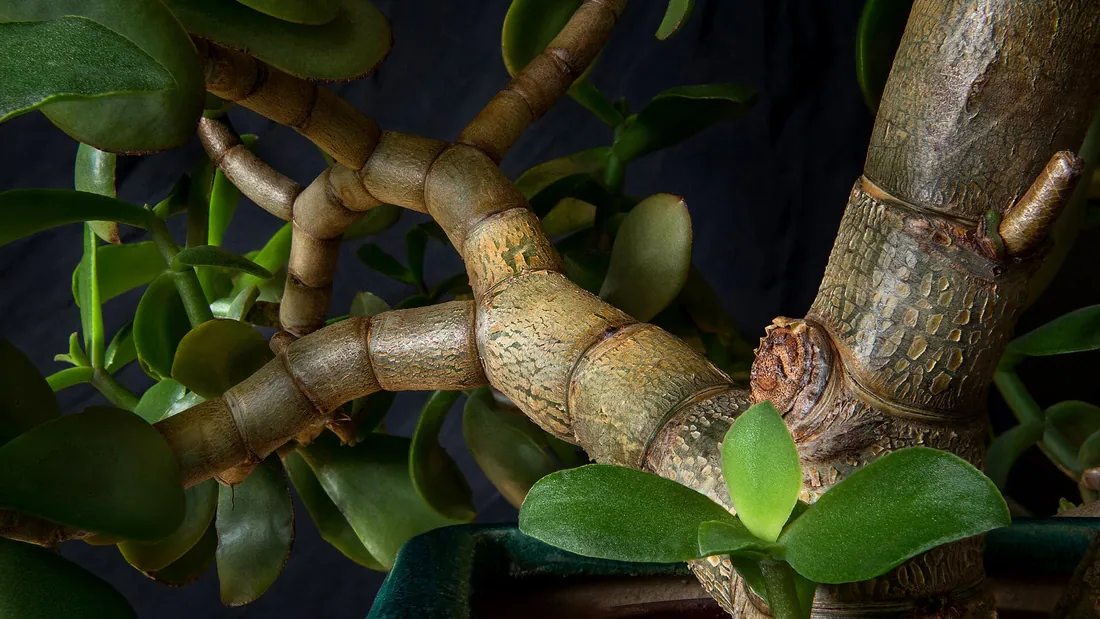

The jade plant (Crassula ovata) is a shrubby succulent that comes from the dry zones of South Africa. Its thick, glossy leaves store water, which makes it an almost indestructible houseplant, provided you understand its single requirement. Here, it is frost-tender: it spends the whole year under cover, with at most an outing on the terrace in summer. Its enemy is not the cold but excess water, which silently rots the base.
Light and exposure
The jade plant demands plenty of light. Place it in front of the brightest window in the house, ideally the one that catches the midday and afternoon sun, where it receives several hours of direct sun. It is in this light that it keeps a compact habit, tightly packed leaves and sometimes a red edge on the rim.
In the shade or too far from a window, it stretches: the stems lengthen, spread out, the plant goes bare at the bottom and leans towards the light. A soft, gangly jade plant is almost always a jade plant short of light, not water. Turn the pot a quarter turn each week so that it grows straight.
Watering
This is where everything is decided. The jade plant stores its water reserve in its leaves and withstands drought very well. Water rarely, and only when the substrate is completely dry all the way down: in summer, this amounts to watering every ten to fifteen days, sometimes less. Soak the root ball well, let the excess drain away, then empty the saucer. Never let water stagnate underneath.
Excess water is the fatal mistake. A plant that stays damp rots at the base, and the first signs are deceptive: the leaves become soft, translucent, yellowish, then fall at the slightest touch. Many people react by watering more, which finishes off the plant. Faced with soft leaves, the answer is almost always to stop watering, not to add more.
Soil and repotting
Drainage takes priority over everything else. Use a special potting mix for cacti and succulents, or an ordinary potting soil lightened with a good third of coarse sand, perlite or lava rock. The aim is a substrate that dries quickly and does not hold water around the roots.
Repot every two to three years, in spring, into a pot barely bigger and above all with a hole in the bottom. A terracotta pot is ideal: porous, it lets the substrate breathe and dry faster than a plastic pot. As the jade plant becomes top-heavy with age, a slightly weighted container prevents it from toppling over.
Temperature and humidity
The jade plant is happy indoors, between 18 and 24 degrees in full growth. It tolerates heat without trouble, but it is frost-tender: below 5 degrees it suffers, and the slightest frost destroys its water-filled tissues. So it never overwinters outdoors where it freezes.
The real lever is a cool winter rest. Through the darkest months, place it in a bright but cool room, between 8 and 12 degrees if possible, and cut off almost all watering. This cold, dry rest keeps it compact and sometimes triggers a flowering of pinkish-white stars at the end of winter. Air humidity has no importance for this plant: it does not care about the dry air of a heated home.
Pruning and upkeep
The jade plant prunes very well and benefits from being trained. Pinch or cut the tips of the stems to make it branch and give it the habit of a dense, balanced shrub. A cut just above a pair of leaves sends out two new shoots. This is how, over time, you obtain a fine little-tree silhouette.
Everyday care is minimal. Remove the faded or fallen leaves at the bottom of the pot to prevent them rotting in contact with the substrate. From time to time, dust the leaves with a soft cloth: clean, they capture light better and keep their fine glossy appearance. Do not over-fertilise; a diluted cactus feed once or twice during the growing season is amply enough.
Pests and diseases
In a damp climate, the number one danger is root and collar rot, caused by excessive watering or a substrate that does not drain. It is insidious: the plant seems fine then collapses all at once, the base gone soft and brown. Excess water also attracts fungus gnats, those little black flies whose larvae swarm in a too-damp substrate, another sign that you are watering too much.
As for pests, watch out for the mealybug, that little cottony white cluster nestled in the leaf axils and on the stems. It thrives in the stale air of a heated winter interior. Dab it with 70-degree alcohol on a cotton swab and isolate the plant while you get the better of the colony. Scale insects and red spider mites, rarer, are treated in the same way.
Propagation
This is one of the jade plant’s great assets: it multiplies with disconcerting ease. Take a stem cutting of ten centimetres, let the cut dry and callus over two to three days in the open air, then plant it in a barely moist, free-draining substrate. It roots on its own within a few weeks, without hormone or any special precaution.
Simpler still, a leaf is enough. Detach a healthy leaf, simply lay it flat on the substrate without burying it, in a bright spot, and water very lightly from time to time. A small rosette and roots eventually appear at its base, giving a new plant. Spring and summer, the period of active growth, are the best times to take cuttings.
Toxicity
Slightly toxic to cats and dogs if ingested. The fleshy leaves can cause vomiting, excessive salivation and lethargy in the animal. No real danger for an adult, but keep young children away from fallen leaves, which they might put in their mouths.
Climate and hardiness
Where and in which climate it thrives
In a temperate climate, the jade plant is a year-round houseplant. An oceanic zone 8a climate, with its damp winters and late frosts possible until mid-spring, suits a water-filled South African succulent in no way at all, and it would burst at the first frost. So it is never planted in open ground in the garden.
The only outing to consider is a warm-season one. Once the last frosts have passed, you can set the pot outside in full sun, on a terrace sheltered from the rain. There it takes on fine colours and toughens up. Bring it in without fail before the first cold nights, and gradually acclimatise it to the stronger light so that direct sun does not scorch the leaves used to being indoors.
The cold season is the decisive moment. The classic trap is to keep watering it like a green plant in a heated living room: in a warm, dark room, it stretches and its base ends up rotting. The right course is the opposite: a bright, cool room, an unheated windowsill, a frost-free veranda, and almost no water through the darkest months. It is excess winter watering, far more than the cold of a house, that kills jade plants.
Growing jade plant?
Green Hub keeps a dated history of your own plant: its photos, its progress, its repottings. An AI answers about yours specifically, not a generic sheet, for free.
Identify my plantMonth-by-month care calendar
| January | Winter rest. Keep it cool and in the light, with almost no watering. A glass of water at most if the leaves clearly wrinkle. |
|---|---|
| February | Still at rest. Watch for a possible flowering of pinkish-white stars if it has spent the winter cold and dry. Minimal watering. |
| March | Growth restarts. Resume cautious watering when the substrate is well dry. Repot if the pot is too cramped, into a free-draining cactus mix. |
| April | Full resumption. First stem or leaf cuttings. Move it closer to the brightest window to keep it compact. |
| May | Once the last frosts are past, put the pot out on the terrace sheltered from the rain, in light shade at first to acclimatise it to direct sun. |
| June | Full growth outdoors or in a bright interior. Water every ten to fifteen days when everything is dry. Pinch the stems to make it branch. |
| July | Active period. A very diluted cactus feed once in the month. Check that the rain does not drown the pot left outside, empty the saucers. |
| August | Continue the spaced-out watering and shaping pruning. Watch for the mealybug in the leaf axils. |
| September | Bring the pot in before the first cold nights, by the end of the month at the latest. Clean the leaves and inspect the plant before it returns to the house. |
| October | Markedly reduce the watering. Place it in a bright and increasingly cool room to prepare the rest. |
| November | Start of the winter rest. Place it cool, between 8 and 12 degrees if possible, in the light, and cut off almost all watering. |
| December | Complete rest. No feed, almost no water. Keep it away from radiators and the cold draughts of the windows. |
Green Hub tips
- Faced with soft, translucent leaves, stop watering, do not add more: it is almost always an excess of water, never a lack.
- A detached leaf laid flat on free-draining potting soil roots all by itself. It is the simplest way to obtain new plants for free.
- In winter, put it in a bright, cool room with almost no water. It is winter watering in a heated living room that kills it here.
- If it stretches and goes bare, it is not feed it needs but light: move it closer to the sunniest window.
Related species
Echeveria
Echeveria
The echeveria is a rosette-forming succulent, born on the rocky plateaus of Mexico, that stores water in its thick,…
Kalanchoe
Kalanchoe blossfeldiana
The kalanchoe (Kalanchoe blossfeldiana) is a flowering succulent from Madagascar, with fleshy leaves and small clusters…
Aglaonema
Aglaonema commutatum
The aglaonema (Aglaonema commutatum) is a robust, easy houseplant, prized for its foliage variegated with green,…
Alocasia
Alocasia
The alocasia, nicknamed elephant ear, charms with its large, dramatically veined leaves. It is a demanding tropical…
Aloe vera
Aloe vera
Aloe vera (Aloe vera) is a succulent from the Arabian Peninsula, grown since antiquity for the soothing gel of its…
Anthurium
Anthurium andraeanum
The anthurium (Anthurium andraeanum) is a tropical houseplant known for its smooth, waxy red spathe, which people often…
The guides that mention it
Updated on
How this sheet is written
Written for Green Hub with the help of language models, then reviewed. It offers gardening guidance, not professional advice: if you are unsure whether a plant is toxic to a child or an animal, ask a vet, a doctor or your national poison centre.