Echeveria
Echeveria
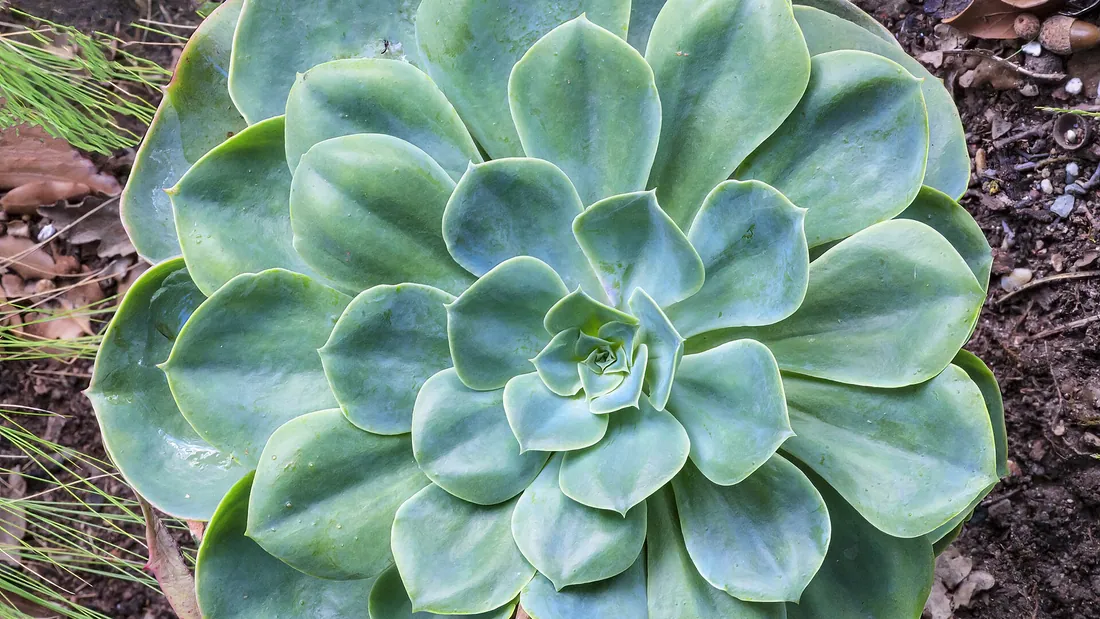
_Echeveria_secunda.jpg)
The echeveria is a rosette-forming succulent, born on the rocky plateaus of Mexico, that stores water in its thick, fleshy leaves. It is one of the easiest succulents to grow, as long as you keep two things in mind: it wants full sun and hates excess water. Where winter freezes we treat it as a houseplant that can get some fresh air in the warm season but has to come back inside before the frosts. A very sunny windowsill and sparing watering are enough to keep it looking good for years.
Light and exposure
The echeveria demands as much light as possible. Put it on the brightest windowsill in the house, ideally the one that catches the midday sun, where it gets several hours of direct sun. It is this bright light that keeps the rosette compact and brings out the bluish, pink or purplish tones depending on the variety.
When light is lacking, the plant stretches: the stem lengthens, the leaves spread apart and the beautiful rosette reaches out toward the window. If you see this stretching, move it closer to the glass. Outdoors in the warm season, a full-sun spot suits it very well once it has been gradually acclimatised.
Watering
This is where most echeverias are lost, almost always from too much water. Water only when the substrate is dry deep down, then give it a good soaking and let all the excess drain away. During active growth, from spring to summer, that works out to roughly one watering every ten to fifteen days; in winter you cut back to almost nothing, once a month or even less.
Always water at the base, right at soil level, never into the heart of the rosette. Water that sits between the central leaves rots the plant from the inside, often without anyone understanding why. A saucer that you empty after watering is better than a pot left soaking.
Soil and repotting
The echeveria needs a very free-draining soil that does not hold moisture. A special mix for cacti and succulents does the job, and is improved further if you lighten it with coarse sand, pozzolan or perlite, up to a third of the mix. The aim is for water to pass through quickly and for the roots never to sit in water.
The pot must have a drainage hole, no exception. A porous terracotta pot is ideal because it lets the substrate dry faster than plastic. A layer of clay pebbles or gravel at the bottom is not essential if the mix already drains well, but it does no harm.
Temperature and humidity
The echeveria is happy with the ordinary temperatures of a home, between 18 and 25 degrees in the growing season. It easily handles the heat of a sunny windowsill in the warm season. In winter it tolerates the cool of a lightly heated room, around 10 to 15 degrees, which actually suits it very well for a slight rest.
The real danger is frost. The echeveria is frost-tender: it does not survive a frosty night, its water-filled leaves burst and collapse. In practice it never spends the winter outdoors where it freezes. Do not count on its hardiness, count on your calendar.
Pruning and upkeep
The echeveria is not really pruned in the classic sense. Routine care means removing the lower leaves as they dry and fade naturally, which is normal: the rosette renews itself from the centre and thins out at the base. Take off these dead leaves so they do not mould against the stem.
If the plant has stretched and grown leggy, you can rejuvenate it by cutting off the head of the rosette with a bit of stem, letting the cut dry for two or three days, then replanting it. The cut base often starts up again by producing new offsets on the side.
Pests and diseases
The main enemy of the echeveria is not a disease but overwatering: rot. A heart that blackens or turns soft, translucent and mushy leaves at the base, are the signs of soil left too wet or of water that fell into the rosette. You then have to dry the plant out, remove the rotten parts and often save the head by taking a cutting.
As for pests, watch out for mealybugs, those little white cottony clumps that lodge between the leaves and in the crook of the rosettes. You remove them with a cotton bud soaked in rubbing alcohol. Aphids can attack the flower stalks in spring. A well-lit plant that is not overwatered generally stays healthy.
Propagation
The echeveria multiplies very easily, which is even one of its great qualities. The simplest method is by leaf: detach a healthy leaf by twisting it off cleanly at the base, let the cut heal for two to three days in the air, then lay it on a barely damp, free-draining substrate. A small rosette and roots appear after a few weeks.
Offsets are even more direct. Adult plants produce small side rosettes that you simply detach, let dry for a day or two and replant separately. That is the quickest way to get a new plant identical to the parent. In both cases, be patient with watering: too much water at the start rots the cutting before it roots.
Climate and hardiness
Where and in which climate it thrives
In a climate with a freezing winter, the echeveria leads a double life through the year. In the warm season it can go outdoors, on a terrace or a sunny ledge, where full sun and open air give it colour and a nice tight rosette. Put it out once the nights are genuinely mild and the last frosts have passed, and acclimatise it gradually to avoid scorching foliage that has spent the cold season behind glass.
The vital move is bringing it in for autumn. The echeveria is frost-tender and one first frost is all it takes, often well before you expect it. Bring it in before then, without waiting, because a single frosty night is enough to destroy it. In the cold season, set it on the brightest possible windowsill and almost stop watering: it is a waterlogged soil, even more than the indoor cold, that makes it rot. The grey months are its test: less light, so a risk of stretching, to be offset by the brightest spot in the house and zero excess water.
Growing echeveria?
Green Hub keeps a dated history of your own plant: its photos, its progress, its repottings. An AI answers about yours specifically, not a generic sheet, for free.
Identify my plantMonth-by-month care calendar
| January | Winter rest indoors. Almost no watering, once in the month at most if the substrate is completely dry. Keep the plant as close to the light as possible. |
|---|---|
| February | Still resting. Watch for stretching due to short days and turn the pot a quarter turn to balance the rosette facing the window. |
| March | Light returns, growth restarts gently. Resume light watering when the soil is dry. This is a good time to repot into a free-draining mix if the pot is too small. |
| April | Active growth. Water a little more regularly but always at the base. Start acclimatising the plant to more light before a possible move outdoors. |
| May | Once the last frosts are past, you can put the echeveria outside in the sun. Get it used to it gradually to avoid scorching. This is also the peak season for leaf and offset cuttings. |
| June | Full growth outdoors or in bright indoor light. Water generously but spaced out, letting it dry well between waterings. Watch for flower stalks rising on well-lit plants. |
| July | High summer. The plant enjoys the direct sun. Check that rain does not soak pots left outside, move them out of prolonged downpours if needed. |
| August | A good time to propagate: leaves and offsets root quickly in the warmth. Keep watering spaced out and watch for mealybugs between the leaves. |
| September | Nights are cooling down. Reduce watering and keep an eye on the forecast: as soon as frost threatens, the plant has to come in. Take no risks at the end of the month. |
| October | Bring it in before the first frosts if not done already. Set the echeveria at the brightest window and start cutting back sharply on water. |
| November | Entering winter rest. Very rare watering. Clean off the dry leaves at the base to avoid mould in the heated room. |
| December | Full rest. Almost no water, maximum light. The plant is waiting for the long days to return, do not stimulate it needlessly. |
Green Hub tips
- Never pour water into the heart of the rosette: water at soil level, otherwise the plant rots from the centre.
- Bring the echeveria in before the first autumn frosts. A single frosty night kills it, it does not overwinter outdoors where it freezes.
- If the rosette stretches and grows leggy, it is a lack of light: move the pot closer to the most southerly pane.
- To multiply it for free, lay a detached leaf on dry soil after it has healed: a new rosette forms all on its own.
Related species
Jade plant
Crassula ovata
The jade plant (Crassula ovata) is a shrubby succulent that comes from the dry zones of South Africa. Its thick, glossy…
Kalanchoe
Kalanchoe blossfeldiana
The kalanchoe (Kalanchoe blossfeldiana) is a flowering succulent from Madagascar, with fleshy leaves and small clusters…
Aglaonema
Aglaonema commutatum
The aglaonema (Aglaonema commutatum) is a robust, easy houseplant, prized for its foliage variegated with green,…
Alocasia
Alocasia
The alocasia, nicknamed elephant ear, charms with its large, dramatically veined leaves. It is a demanding tropical…
Aloe vera
Aloe vera
Aloe vera (Aloe vera) is a succulent from the Arabian Peninsula, grown since antiquity for the soothing gel of its…
Anthurium
Anthurium andraeanum
The anthurium (Anthurium andraeanum) is a tropical houseplant known for its smooth, waxy red spathe, which people often…
The guides that mention it
Indestructible Houseplants: Tolerating Drought Is Not Tolerating Shade
Tolerating drought and tolerating shade are two different adaptations, and almost every list mixes them up. What these…
Watering Plants Properly: Deciding Rather Than Following a Schedule
Beginners water too often and too little at the same time. How to read the soil instead of the calendar, tell thirst…
Updated on
How this sheet is written
Written for Green Hub with the help of language models, then reviewed. It offers gardening guidance, not professional advice: if you are unsure whether a plant is toxic to a child or an animal, ask a vet, a doctor or your national poison centre.