Haworthia
Haworthia
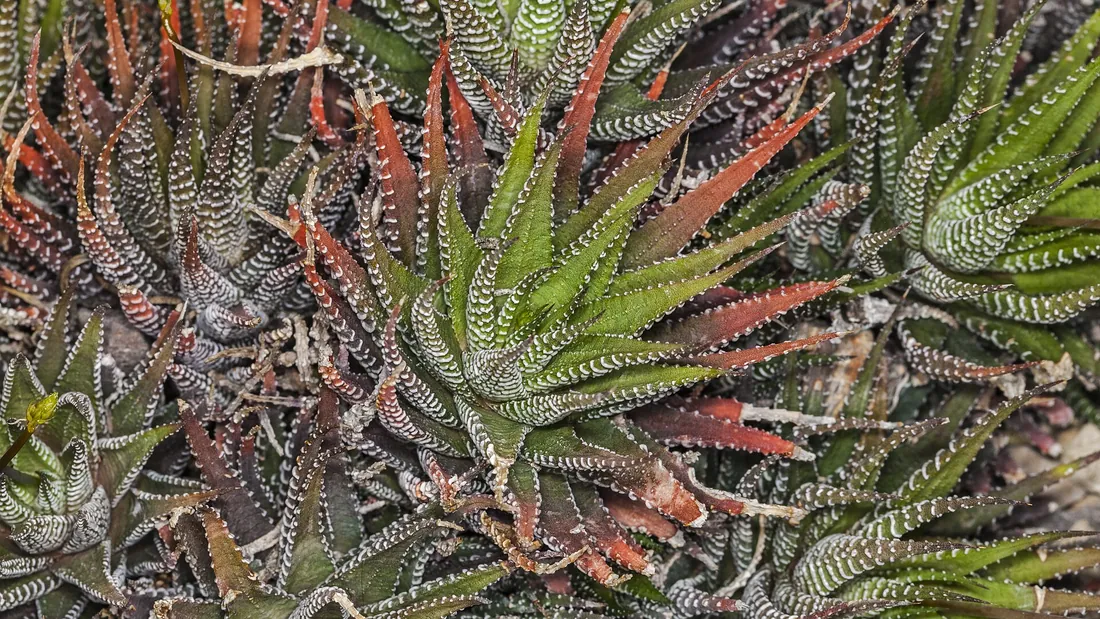

The haworthia is a small rosette succulent from South Africa, most often the species fasciata or attenuata, recognisable by its dark green leaves striped with small raised white bands. It is a perfect houseplant to start with: it needs little water, little space, and is content with good light without requiring scorching full sun, unlike the echeveria. It is kept indoors all year, as it dreads frost. A bright corner, sparing watering and a free-draining soil are enough to see it thrive for years.
Light and exposure
The haworthia likes bright light but not scorching sun. That is what sets it apart from other windowsill succulents: in the wild, it often grows sheltered by rocks, in light shade. An east- or west-facing sill, or a bright spot set back a little from a south window, suits it very well.
It even tolerates partial shade, which makes it one of the few succulents acceptable away from a full south window. In direct, prolonged sun, especially behind glass in summer, its leaves redden, brown or become spotted. If it turns a dull red, that is a sign of too much sun: pull it back a little. Conversely, a haworthia that stretches and pales is short of light.
Watering
Like all succulents, the haworthia is grown with restraint. Water only when the substrate is dry all the way through, then give water freely and let the excess drain away. In the growing season, spring and summer, that means watering roughly every ten to fifteen days; in winter, space it out a lot, once a month or less.
Pour the water at the base, on the soil, without flooding the centre of the rosette where standing moisture invites rot. The classic sign of overwatering is leaves turning soft, translucent and yellowish. A haworthia forgotten for a few weeks always recovers; an overwatered haworthia rots and dies. When in doubt, wait.
Soil and repotting
The haworthia wants a free-draining soil that does not hold water. A potting mix for cacti and succulents works, and is even better if you add coarse sand, perlite or pozzolana for a third of the volume. The aim is the same as for its cousins: that water runs through fast and the roots never sit in moisture.
The pot must have a hole at the bottom. A container that is not too large is preferable, because a big volume of soil stays moist too long around a small plant. Terracotta, being porous, helps the substrate dry between waterings and limits the risk of root rot.
Temperature and humidity
The haworthia is happy in the normal temperatures of a home, between 18 and 24 degrees for much of the year. It appreciates a slightly cooler spell in winter, around 10 to 15 degrees, in a bright, little-heated room, which helps it mark its rest without suffering.
It does not tolerate frost. The haworthia is frost-tender and has no business outdoors during a temperate winter. Unlike the echeveria that can go out in the warm season, the haworthia is grown more simply indoors all year: it does not need full sun, so it does not need a summer outing to stay handsome. Keep it sheltered, indoors, from 1 January to 31 December.
Pruning and upkeep
The haworthia is not pruned. It is a slow, compact plant that does not run like the large succulents, so care is limited to cleaning up. Gently remove the leaves at the base as they dry and brown, which is natural with age, to keep the rosette tidy and avoid mould.
If a flower stalk appears, a long slender stem bearing small discreet flowers, you can cut it at the base once it has finished flowering, as it is barely decorative and tires the plant for nothing. Otherwise, there is nothing to cut: the haworthia is content to be left alone.
Pests and diseases
The real risk, here again, is not a disease but too much water. A haworthia that softens, whose leaves turn transparent and yellow at the base, is suffering from overly generous watering and a soil that does not dry. It must then be taken out of the pot, the roots and rotten parts removed, left to dry and repotted in fresh, free-draining substrate.
On the pest side, watch for mealybugs, small white cottony clusters lodged between the leaves and at the collar, to be removed with a cotton bud dipped in alcohol. Root mealybugs can also settle in a substrate that has stayed too moist. A plant set in decent light and watered sparingly generally stays free of any problem.
Propagation
The haworthia propagates mainly through its offsets, called pups, those small rosettes born at the base of the mother plant. Just unpot the plant, detach a well-formed offset with a few roots if possible, let the cut dry for a day or two, then replant it in a small pot of free-draining substrate. It is the most reliable and quickest method.
Leaf cuttings are possible but less consistent than with the echeveria: detach a whole leaf at the base, let it callus, lay it on barely damp soil and arm yourself with patience, as rooting is slow and does not always succeed. For a beginner, separating the offsets remains the surest way to enlarge a collection.
Climate and hardiness
Where and in which climate it thrives
The haworthia is the no-fuss succulent: it lives indoors all year and asks for no schedule of going out or coming in. As it does without full sun, there is no point in moving it outdoors in the warm season; leave it in its place, on a bright but not full-south sill, where it drifts through the seasons quietly. That is what makes it an ideal plant for a beginner, a small flat or an office corner set back from the window.
The grey months are its only real constraint, and it handles them well. Cut watering sharply through the dark season, when the light drops and the plant goes to rest: soaked soil in a heated room is the one sure way to lose it. If you have a bright, cool room, it will spend a better winter there than in the overheated living room. When the fine days return and the light comes back, gradually resume watering and, if needed, repot or separate the offsets gathered at the base.
Growing haworthia?
Green Hub keeps a dated history of your own plant: its photos, its progress, its repottings. An AI answers about yours specifically, not a generic sheet, for free.
Identify my plantMonth-by-month care calendar
| January | Winter rest indoors. Very rare watering, once in the month at most. Set the plant in the brightest spot available to make up for the short days. |
|---|---|
| February | Still at rest. Keep watering drop by drop. Turn the pot now and then so the rosette stays even towards the light. |
| March | The light climbs again, growth restarts gently. Resume light watering when the soil is thoroughly dry. Good time to repot and separate the offsets if the pot is crowded. |
| April | Active growth. Water a little more regularly, always at the base and without soaking. Check that the light stays bright but without scorching sun behind the glass. |
| May | Full indoor season. A good time to propagate by separating the pups, which take quickly with the returning warmth. Watch that the spring sun does not burn the leaves. |
| June | Steady growth. Water freely but spaced out, letting it dry completely in between. If a flower stalk rises, leave it or cut it to your taste. |
| July | High summer. Beware of direct sun behind hot glass, which can scorch the haworthia: move it a little from the window if the leaves redden. |
| August | A fine time to take cuttings and separate the offsets. Keep watering sparing and watch for mealybugs between the leaves. |
| September | The days shorten, growth slows. Start spacing out watering. Clean up the dry leaves at the base. |
| October | Gradual entry into rest. Cut water back clearly. The plant stays indoors, it never had to go out anyway. |
| November | Winter rest settled in. Rare watering. A bright, cool room beats an overheated, dark living room for getting through winter. |
| December | Full rest. Almost no water, maximum light. Leave the plant alone while waiting for the long days to return. |
Green Hub tips
- Unlike the echeveria, the haworthia does not like scorching full sun: bright light or even partial shade is enough for it.
- It is the ideal succulent to start with and for small spaces: slow, compact, it forgives missed waterings.
- It stays indoors all year: frost-tender, it does not need a summer outing to stay handsome.
- To propagate it, detach the small rosettes born at the base and replant them after a day of drying.
Related species
Aloe vera
Aloe vera
Aloe vera (Aloe vera) is a succulent from the Arabian Peninsula, grown since antiquity for the soothing gel of its…
Aglaonema
Aglaonema commutatum
The aglaonema (Aglaonema commutatum) is a robust, easy houseplant, prized for its foliage variegated with green,…
Alocasia
Alocasia
The alocasia, nicknamed elephant ear, charms with its large, dramatically veined leaves. It is a demanding tropical…
Anthurium
Anthurium andraeanum
The anthurium (Anthurium andraeanum) is a tropical houseplant known for its smooth, waxy red spathe, which people often…
Areca palm
Dypsis lutescens
The areca (Dypsis lutescens) is a tropical palm from Madagascar, frost-tender, grown indoors wherever winter freezes.…
Boston fern
Nephrolepis exaltata
The Boston fern (Nephrolepis exaltata) is a hanging indoor fern, born in the humid undergrowth of the tropics. Here,…
The guides that mention it
Updated on
How this sheet is written
Written for Green Hub with the help of language models, then reviewed. It offers gardening guidance, not professional advice: if you are unsure whether a plant is toxic to a child or an animal, ask a vet, a doctor or your national poison centre.