Boston fern
Nephrolepis exaltata
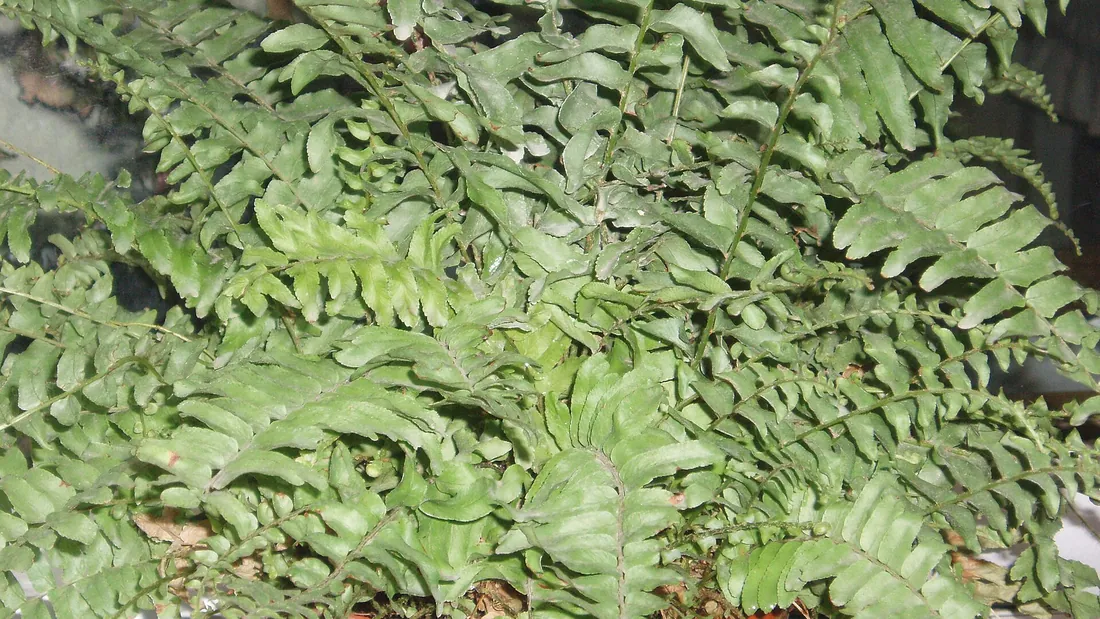

The Boston fern (Nephrolepis exaltata) is a hanging indoor fern, born in the humid undergrowth of the tropics. Here, everything comes down to air humidity: it wants a moist atmosphere and soft light, never direct sun. Its deadly enemy is the dry air of central heating in winter. As soon as the air dries out, the fronds turn brown, dry up and shed their leaflets in a shower.
Light and exposure
The Boston fern likes bright but indirect light. Place it near a sheer-curtained window that only gets the low morning or evening sun, or a metre or two from a very sunny bay window. In light that is too weak, the fronds grow spindly and pale; in direct sun, they scorch and become speckled with brown within a few hours.
A bright bathroom is the ideal spot: the filtered light and the steam from showers recreate its undergrowth atmosphere. A bright kitchen also does the job. Turn the pot a quarter turn now and then so the clump stays even and does not lean toward the glass.
Watering
The substrate must stay constantly fresh, never waterlogged and never completely dry. It is a tight balance: drying out, even briefly, scorches fronds that will not grow back, while too much water eventually rots the roots. Feel the surface, water as soon as the top starts to dry, and let the water drain away without ever leaving the pot sitting in its saucer.
Water at room temperature, preferably soft if your water is very hard, suits it better. In winter, watering continues but you keep a close eye on it: the heating dries the soil faster than you would think, while the plant is growing at a slow pace.
Soil and repotting
Give it a light potting mix, rich in organic matter and well draining. A mix for indoor plants with a little coco fibre or peat and a handful of perlite added retains moisture while letting the roots breathe. The bottom of the pot must always be able to drain the water away.
Repot in spring, roughly every two years or as soon as the roots start circling at the bottom. Move from one pot to the next without a jump in size: a fern that is a bit cramped fares better than a fern drowned in a large volume of soil that stays wet too long. This is also the right moment to divide the clump.
Temperature and humidity
The Boston fern is happy between 16 and 24 degrees, with no sudden swings. It dreads cold draughts as much as the immediate vicinity of a scorching radiator, and does not like to drop below 10 degrees. A normal living room suits it all year round.
The real critical point is air humidity during the heating season. Heating drives the humidity level well below what it can tolerate, and that is when it turns brown and thins out. Mist the foliage several times a week, set the pot on a tray of clay pebbles kept moist, or group your plants together to create a microclimate. Simply moving it away from radiators already changes everything.
Pruning and upkeep
The Boston fern is not really pruned. You simply cut off the dry, yellowed or damaged fronds at the base, as they appear, with clean scissors. This regular cleaning keeps the clump dense and airy and limits pockets of rot.
Routine care comes down to three gestures: dust it off now and then under a lukewarm shower, remove the fallen leaflets at the base, and feed with a half-strength fertiliser once a month from spring to the end of summer. Stop feeding in winter, when growth halts.
Pests and diseases
Indoors, the Boston fern suffers more from poorly regulated conditions than from real diseases. Browning frond tips and a massive drop of leaflets almost always betray air that is too dry or irregular watering, not a pathogen. A permanently waterlogged substrate, on the other hand, leads to root rot, made worse by a damp winter and late repotting.
As for pests, watch for mealybugs, small white cottony clusters nestled at the base of the fronds, and spider mites, which thrive precisely when the air is too dry and leave fine webs and dull foliage. Thrips can also appear. A lukewarm shower and a more humid atmosphere discourage a good number of these unwelcome guests.
Propagation
The simplest and most reliable method is dividing the clump. At the spring repotting, take out the root ball and separate it into two or three pieces, each with roots and a few fronds. Repot straight away in fresh compost, water, and keep out of direct light while it takes hold.
Nephrolepis exaltata also produces stolons, thin runners that set off from the clump. Pin the tip of a stolon into a small pot of moist compost placed beside the mother plant: it roots there, and you cut the cord once the young plant is well established. Sowing from spores exists but remains slow and reserved for enthusiasts.
Climate and hardiness
Where and in which climate it thrives
The Boston fern is grown indoors only, all year round. It is far too tender to spend the winter outside, even in zone 8a, and even in the warm season, a stint in the garden exposes it to direct sun and the cool nights it hates. You can move it onto a shaded, sheltered terrace in the very heart of summer, but it stays happier indoors.
The real challenge is the cold season’s double blow: heating that dries the air, and daylight that fades sharply. This combination is exactly what makes it turn brown and lose its leaflets. The remedy comes in three points: give it the brightest spot possible, preferably a bright bathroom or kitchen, humidify the air around it by misting or with a tray of moist pebbles, and follow the watering closely to keep the substrate fresh without drowning it.
A major advantage for a home with children or pets: the Boston fern is not toxic. It can be placed without worry within reach of a cat, a dog or a child, which is not the case for many hanging houseplants.
Growing boston fern?
Green Hub keeps a dated history of your own plant: its photos, its progress, its repottings. An AI answers about yours specifically, not a generic sheet, for free.
Identify my plantMonth-by-month care calendar
| January | The trickiest month. Move the fern away from radiators, mist several times a week and keep it in the brightest spot of the home. |
|---|---|
| February | The air stays dry and the light weak. Keep up the misting and the tray of moist pebbles. Water just enough to keep the substrate fresh. |
| March | Light returns and growth slowly picks up. Resume a diluted fertiliser every four weeks and remove the dry winter fronds. |
| April | A good time to repot or divide the clump if the pot is packed with roots. Use a light, well-draining compost. |
| May | Full recovery. Feed every fortnight at half strength. The plant copes better with missed watering thanks to the milder air. |
| June | Active growth. Watch the substrate drying out, which speeds up with the heat. A lukewarm shower dusts the foliage. |
| July | You can move it onto a shaded, sheltered terrace, never in direct sun. Water more often, as evaporation rises. |
| August | Peak heat. Keep the substrate fresh and the air humid. Inspect the underside of the fronds for spider mites and mealybugs. |
| September | Bring the plant in if it was outside, before the cool nights. Gradually cut back the fertiliser as autumn approaches. |
| October | Growth slows. Stop feeding. Find it its winter spot now, away from heat sources and near the light. |
| November | The heating comes back on and the air dries out. This is the moment to bring back misting and the tray of moist pebbles. |
| December | Minimal care. Reduced watering but never complete drying out, humidity kept up, and a watch on the frond tips that turn brown. |
Green Hub tips
- The dry air of central heating is its worst enemy: a bright bathroom or a tray of moist clay pebbles makes all the difference in winter.
- Never let it dry out completely. A single drying out scorches whole fronds that will not grow back, unlike other plants.
- Never direct sun: behind an uncurtained window, the fronds turn brown and dry out within a few hours.
- Non-toxic, it can be placed without risk within reach of cats, dogs and children, a rare asset among indoor hanging plants.
Related species
Aglaonema
Aglaonema commutatum
The aglaonema (Aglaonema commutatum) is a robust, easy houseplant, prized for its foliage variegated with green,…
Alocasia
Alocasia
The alocasia, nicknamed elephant ear, charms with its large, dramatically veined leaves. It is a demanding tropical…
Aloe vera
Aloe vera
Aloe vera (Aloe vera) is a succulent from the Arabian Peninsula, grown since antiquity for the soothing gel of its…
Anthurium
Anthurium andraeanum
The anthurium (Anthurium andraeanum) is a tropical houseplant known for its smooth, waxy red spathe, which people often…
Areca palm
Dypsis lutescens
The areca (Dypsis lutescens) is a tropical palm from Madagascar, frost-tender, grown indoors wherever winter freezes.…
Calathea (peacock plant)
Goeppertia (anciennement Calathea)
The calathea (genus Goeppertia, long classified under Calathea), or peacock plant, brings together tropical understorey…
The guides that mention it
Indestructible Houseplants: Tolerating Drought Is Not Tolerating Shade
Tolerating drought and tolerating shade are two different adaptations, and almost every list mixes them up. What these…
Watering Plants Properly: Deciding Rather Than Following a Schedule
Beginners water too often and too little at the same time. How to read the soil instead of the calendar, tell thirst…
Toxic Plants for Cats and Dogs: Recognising the Danger Rather Than Memorising a List
A list of toxic plants is easily forgotten and always incomplete. What actually protects a cat or dog is recognising…
Updated on
How this sheet is written
Written for Green Hub with the help of language models, then reviewed. It offers gardening guidance, not professional advice: if you are unsure whether a plant is toxic to a child or an animal, ask a vet, a doctor or your national poison centre.