Photinia
Photinia x fraseri
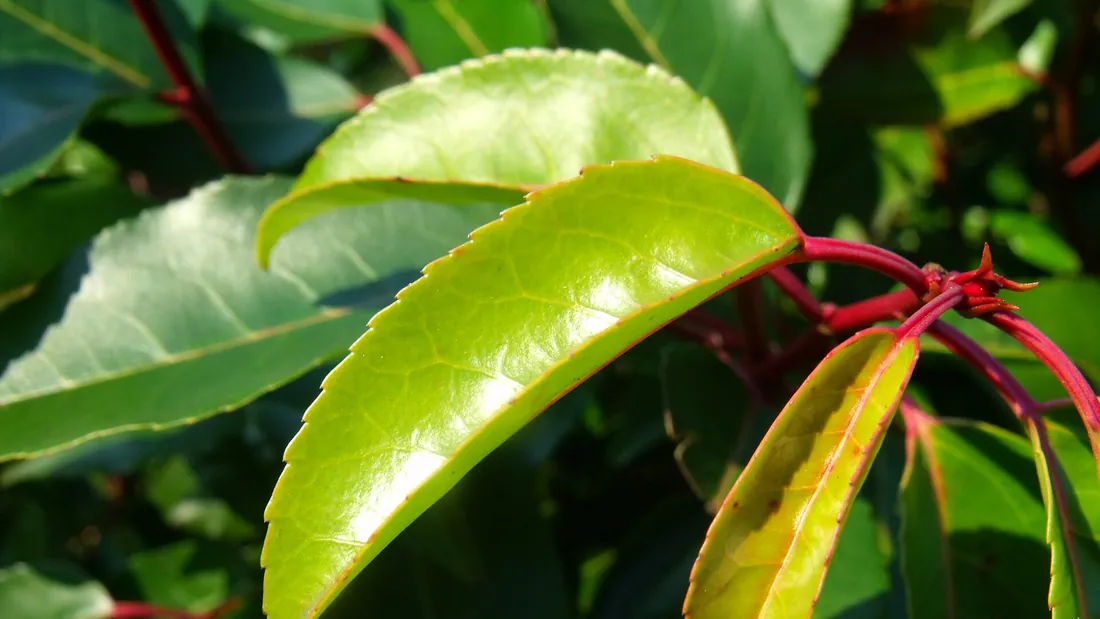

Photinia (Photinia x fraseri) is an evergreen shrub in the rose family that has become one of the most widely planted hedging plants in temperate gardens over the past twenty years or so. Its reputation rests on one striking detail: the young shoots emerge a brilliant scarlet red, standing out sharply against the dark green of the mature leaves. It makes a reliable, hardy evergreen hedge down to around minus 15 degrees, but that soft new red growth stays vulnerable to late spring frosts, something plenty of gardeners find out the hard way.
Light and exposure
Photinia likes full sun to partial shade. It’s in full sun that the young shoots develop their most intense red; in shade the plant grows just as well, but the new leaves stay duller, more brick than scarlet.
It copes well with wind and salt spray, which makes it a solid choice for a screening hedge along a terrace or a road. Still, avoid spots that stay permanently damp and enclosed: stagnant air around the foliage encourages leaf disease.
Watering
Once established, photinia gets by on rainfall alone and barely needs watering, except during a prolonged summer drought. The first year after planting is the critical period: water generously once or twice a week while the roots spread out.
In a pot or a freshly planted young hedge, keep an eye out especially during hot, dry summers, which are becoming more common in temperate climates. Watering at the base rather than over the foliage also helps keep entomosporium leaf spot in check, since it takes hold more readily on leaves that stay wet.
Soil and repotting
Photinia isn’t fussy about soil type as long as it drains well. It grows just as happily in heavy clay soils as in lighter ground, but it hates sitting in water over winter, which rots the roots.
A slightly acid to neutral soil suits it best. On very chalky ground, chlorosis can show up: the young leaves turn yellow between veins that stay green, a sign that iron is becoming hard for the plant to take up.
Temperature and humidity
Photinia is hardy in a temperate climate and copes without trouble with an ordinary winter, down to around minus 15 to minus 18 degrees once well established, which is USDA zone 7. Young plants in their first or second year are worth mulching at the base to get them through their first winters comfortably.
The real risk isn’t winter but spring: a late frost arriving after bud break can scorch the fresh red shoots, which brown and shrivel within hours. That’s exactly why it pays not to prune too early: an early prune triggers new growth that then walks straight into the last frosts.
Pruning and upkeep
Photinia is pruned two to three times a year: first when growth restarts, once the late frosts are out of the way, then in early summer, then in late summer, so the hedge keeps flushing with fresh red shoots. Every prune sets off a new wave of scarlet young leaves: that’s precisely the effect you’re after.
For a hedge, keep a planting distance of 80 to 100 centimetres between plants so it closes up without choking or rotting at the core. Avoid pruning late in the season, as the cold approaches: the resulting growth wouldn’t have time to harden off before winter.
Pests and diseases
The most common disease on photinia is entomosporium leaf spot, caused by the fungus Entomosporium mespili. It shows up as small reddish purple spots on the leaves that spread, sometimes develop a hole in the middle, and eventually cause the affected foliage to drop. It’s strongly encouraged by moisture sitting on the leaves and by rainy summers.
To keep it under control, rake up and dispose of fallen leaves rather than leaving them at the base of the hedge, give the planting room to breathe by respecting planting distances, and always water at the base without wetting the foliage. Like other members of the rose family, photinia can also be hit by fire blight (Erwinia amylovora), and suffers from iron chlorosis on overly chalky soil.
Propagation
Photinia is easily propagated from semi-ripe cuttings, taken in late summer from this year’s growth that has firmed up a little at the base but is still supple at the tip. Take cuttings 10 to 15 centimetres long, strip the lower leaves and set them in a mix of potting compost and sand.
Rooting under a plastic bag or in a mini propagator speeds things up noticeably, usually taking six to eight weeks. It’s the simplest way to duplicate an existing hedge for free, or to replace a plant that has died within an established row.
Climate and hardiness
Where and in which climate it thrives
Photinia is hardy down to around minus 15 to minus 18 degrees once well established, which places it in USDA zone 7 and above. It keeps its foliage all year as long as the winter stays within that range; a sharper cold defoliates it without necessarily killing it, but recovery costs a whole season of red shoots.
It is at ease in temperate oceanic and mild Mediterranean climates: a moderate winter, a damp spring, a summer without extremes. In a continental climate with a hard winter, it loses its point as an evergreen and needs a spot sheltered from the prevailing cold winds. Under prolonged dry heat it holds on but slows down, and a freshly planted hedge asks for water. In a humid subtropical climate it grows strongly, but entomosporium leaf spot becomes the main constraint: what decides things is how long the leaves stay wet, not the temperature.
What changes the procedure depending on the climate: the real risk is not winter, it is a late frost on the young red shoots. Where late frosts are common, you hold the first prune back until that risk is clearly gone; where they do not happen, you prune as soon as growth restarts. The rhythm itself does not change: two to three prunes spread from the start of growth to the end of summer, the last one early enough for the new growth to harden off before the cold. And everywhere, the sunniest spot in the garden gives the most intense red.
Growing photinia?
Green Hub keeps a dated history of your own plant: its photos, its progress, its repottings. An AI answers about yours specifically, not a generic sheet, for free.
Identify my plantMonth-by-month care calendar
| January | Dormant season. A good time to plant bare-root or balled stock, as long as the ground isn’t frozen. |
|---|---|
| February | Last window to plant before the ground freezes hard, ahead of the spring flush. |
| March | Photinia starts growing again. Hold off on the first prune, late frosts aren’t ruled out yet. |
| April | First prune of the season once frosts are truly behind you, it sets off an immediate wave of fresh red shoots. |
| May | Watch for late frosts that can scorch the fresh young shoots, and for entomosporium leaf spot, encouraged by spring damp. |
| June | Second prune of the season. Also a good time to take the first semi-ripe cuttings. |
| July | Keep taking semi-ripe cuttings. Water during dry spells, especially recently planted shrubs. |
| August | Third and last prune of the season, so the new growth has time to harden off before autumn. |
| September | End of the cutting season. Planting becomes possible again from late in the month. |
| October | A good planting window, the soil is still warm and the rains are back. |
| November | Keep planting balled or container-grown stock. Mulch the base of young plants before winter. |
| December | Rest period. Rake up fallen leaves marked with entomosporium spot to cut down on spores overwintering at the base of the hedge. |
Green Hub tips
- Prune photinia two to three times a year, from the start of growth through to late summer: that’s what keeps bringing on the young red shoots that make it so appealing.
- Never bring the spring prune forward too early. A late frost can scorch fresh young shoots within hours of them appearing.
- Rake up and bin the spotted leaves that fall at the base of the hedge: it’s the single most effective move against entomosporium leaf spot, photinia’s number one disease.
- For a truly intense red, plant photinia in full sun: in shade, the young shoots stay duller, almost brick coloured.
Related species
Apple tree
Malus domestica
The apple tree (Malus domestica) is the king of fruit trees in temperate climates, the one that has filled family…
Cherry laurel
Prunus laurocerasus
Cherry laurel (Prunus laurocerasus) is the most widely planted evergreen hedging shrub in temperate gardens, and it is…
Cherry tree
Prunus avium
The cherry tree (Prunus avium) is a vigorous, hardy fruit tree, perfectly at ease in a temperate climate, from USDA…
Peach
Prunus persica
The peach tree (Prunus persica) is a fruit tree that loves far more warmth and sun than a cool temperate climate…
Pear tree
Pyrus communis
The pear tree (Pyrus communis) is the apple tree’s cousin, a fruit tree for the family orchard that gives melting fruit…
Plum tree
Prunus domestica
The plum tree (Prunus domestica) is the classic family fruit tree, the one you find at the back of the garden or along…
The guides that mention it
Which Hedge to Plant, and How to Get It Right
Evergreen, deciduous or marcescent, annual growth, hardiness, soil, shade and sea spray: the real criteria for…
Pruning Flowering Shrubs and Roses: Deducing Instead of Memorising
New wood or old wood: this single question gives you the pruning time for any shrub at all, including ones whose name…
Updated on
How this sheet is written
Written for Green Hub with the help of language models, then reviewed. It offers gardening guidance, not professional advice: if you are unsure whether a plant is toxic to a child or an animal, ask a vet, a doctor or your national poison centre.