Which Hedge to Plant, and How to Get It Right
Choose a hedge in this order: first what it needs to do, then what the ground allows, and only at the end the species. Everything else follows: bare-root planting during dormancy, soil that is neither frozen nor waterlogged, honest spacing rather than tight, and pruning into a tapered, pyramid-shaped profile so the base never thins out.
Choosing a hedge means settling three questions in order. What does it need to do: screen year round, form a crisp clipped line, feed wildlife, cut the wind? What does the ground allow: chalky or clay soil, shade, sea spray, how much cold? Which species ticks those boxes? For a permanent screen, yew (hardy below -20 °C) and cherry laurel (-15 to -10 °C) are the safe bets, the first slow but forgiving of mistakes, the second fast and unforgiving if left to run. For an economical clipped hedge, beech and hornbeam hold onto their russet foliage all winter, with hornbeam tolerating the heavy soils that beech refuses. Plant bare root during dormancy, allow three plants per metre, prune wider at the base than at the top, and never while birds are nesting.
Evergreen, Deciduous or Marcescent: What a Hedge Does in Winter
The first question isn’t about the species, it’s about what the hedge does once growth stops for the season. Three behaviours exist, and they aren’t equivalent.
An evergreen keeps its foliage all year: yew, holly, cherry laurel, photinia, thuja, Leyland cypress, box. Only this group guarantees a permanently opaque screen, but it’s also the one that takes the most wind, and any dieback shows for all twelve months. A deciduous hedge sheds its leaves for the whole dormant season: it lets the eye through, but also the light, which is sometimes exactly what you want on a boundary exposed to low winter sun.
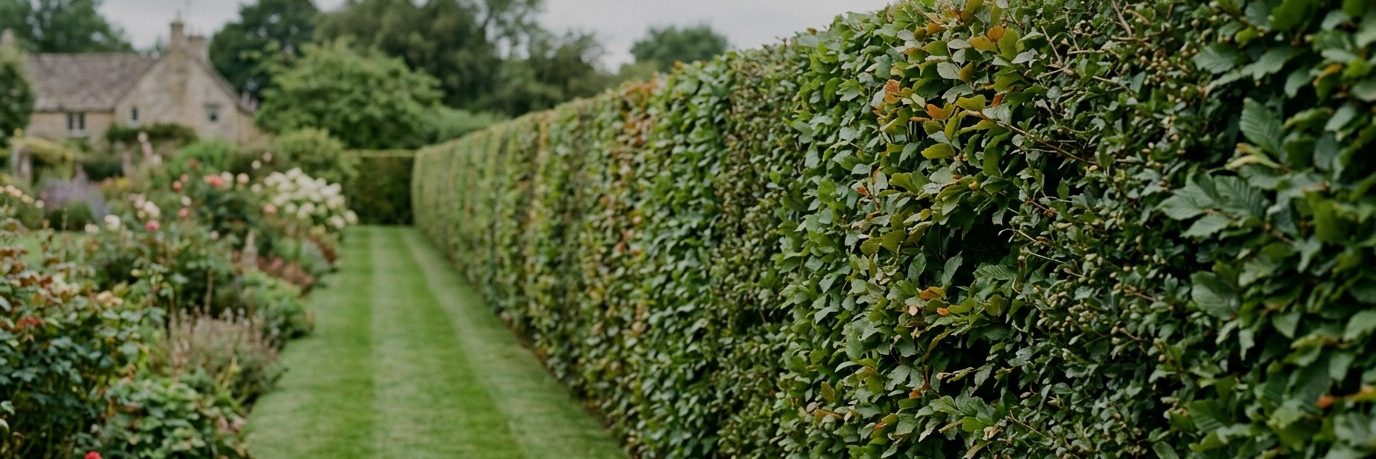
Between the two sits the marcescent habit, the compromise few people know about. Beech and hornbeam dry their leaves out when growth stops but don’t drop them: they stay attached, russet-coloured, until the new spring growth pushes them off. A clipped beech hedge therefore gives an opaque screen for nearly the whole bad season without being an evergreen, an effect more pronounced in beech than in hornbeam. Marcescence, though, depends on pruning: it’s the young shoots that hold onto the dry foliage, and a beech left unclipped sheds it like any other tree.
That leaves the semi-evergreen habit: California privet (Ligustrum ovalifolium) keeps its foliage through mild winters and drops it as soon as the cold sets in. Don’t rely on it for a permanent screen in a climate with hard winters.
Start From the Job, Never From the Catalogue
A failed hedge is almost always one chosen for how it looks at the garden centre rather than for the job it needs to do. Five uses come up again and again, each with its own trade-offs.
The fast privacy screen, for masking a view within two or three seasons: cherry laurel (40 to 60 cm a year), western red cedar (45 to 60 cm), Leyland cypress (90 cm and more). The trade-off cuts both ways: whatever grows fast doesn’t stop once it reaches the height you wanted, and none of the three regrows from bare wood when it’s time to cut it back.
The formal clipped hedge, for a crisp line and a controlled width: beech, hornbeam, yew, holly, privet and box all take shears well for decades. Yew and box give the densest surfaces; beech and hornbeam are the cheapest, sold bare root by the hundred.
The informal country hedge, several species mixed in a natural habit, cut back every two or three years: hazel, elder, viburnum, dogwood, honeysuckle. This is the arrangement that shelters the most wildlife and asks the least of you, but it needs room: 1.5 to 2 m of ground footprint.
The low border, under 60 cm, decorative and structuring: historically box, nowadays more often Japanese holly or yew kept low.
The windbreak, finally, where opacity is exactly what you don’t want. A solid screen forces wind up and over and creates turbulence just behind it, whereas a hedge that lets 40 to 50% of the airflow through cuts wind speed over ten to twenty times its own height.
Read Your Ground Before Choosing a Species
A species isn’t chosen in the abstract, it’s chosen against the constraints of the site. Four of those constraints rule out candidates more reliably than any sales pitch.
Cold comes first, and it’s measured in degrees, not in countries. Yew and hornbeam hold below -20 °C; beech, holly, box, western red cedar and Leyland cypress between -20 and -15 °C; cherry laurel and photinia between -15 and -10 °C; privet is the first to give up, between -10 and -5 °C. In USDA zones, where each band gives the average annual minimum, zone 5 drops to -29 °C, zone 6 to -23 °C, zone 7 to -18 °C, zone 8 to -12 °C. Compare those figures to the coldest it actually gets where you live: it’s the coldest night of the decade that kills a hedge, not the average winter.
Soil comes next. Chalky, free-draining ground suits yew, beech, hornbeam, holly, privet and box, all of which grow on chalk. It rules out Japanese holly (Ilex crenata), which prefers acid soil, between pH 4.5 and 6.5, and yellows from iron lockout as soon as the pH rises. Heavy, waterlogged winter soil, on the other hand, tips the balance toward hornbeam: the two look almost identical once clipped, but beech hates wet roots where hornbeam thrives.
Shade, always underestimated: yew is the only one that takes deep shade without thinning out, holly and hornbeam tolerate part shade, while photinia, thuja and Leyland cypress turn sparse without sun.
Wind and salt, finally: near the coast, sea spray scorches the foliage of most classic evergreens.
| Site constraint | Species that cope | Species to avoid |
|---|---|---|
| Chalky, alkaline, free-draining soil | Yew, beech, hornbeam, holly, privet, box, wayfaring tree | Japanese holly, which yellows from iron lockout |
| Heavy, clay soil, waterlogged in winter | Hornbeam, holly, dogwood, guelder rose, willow | Beech, yew, box, prone to root suffocation |
| Deep shade, north-facing wall base | Yew, holly, hornbeam, cherry laurel | Photinia, thuja, Leyland cypress |
| Coastal, salt-laden sea spray | Elaeagnus x ebbingei, Griselinia littoralis, tamarisk, sea buckthorn | Beech and box, scorched by the drying wind |
| Strong wind without salt, windbreak role | Hornbeam, yew, hazel, an open informal hedge | Any solid screen, which creates turbulence |
| Low clipped border, under 60 cm | Japanese holly, yew kept low, box-leaved honeysuckle | Box, wherever box tree moth is established |
Comparing the Most Widely Planted Species
The table below brings together the numbers that actually decide the outcome: annual growth, height if left unpruned, minimum temperature tolerated, and the one distinguishing trait.
The height column is worth reading twice: almost all of these plants are trees kept artificially short. Beech, hornbeam, yew and holly all exceed twelve metres if you stop pruning, and Leyland cypress passes thirty metres. A hedge isn’t a low-growing plant, it’s a tree under permanent restraint, and that restraint never stops.
Second reading: growth rates are maintenance commitments, not virtues. Over twenty years, the slow grower often costs less than the fast one.
| Species | Foliage | Growth per year | Height unpruned | Minimum tolerated | What sets it apart |
|---|---|---|---|---|---|
| Yew (Taxus baccata) | Evergreen | 20 to 40 cm | over 12 m | below -20 °C | Regrows from old wood, the only conifer that does; takes deep shade; toxic in every part |
| Holly (Ilex aquifolium) | Evergreen | 10 to 15 cm | over 12 m | -20 to -15 °C | Berries on pollinated female plants; tolerates part shade and chalk |
| Cherry laurel (Prunus laurocerasus) | Evergreen | 40 to 60 cm | 4 to 8 m | -15 to -10 °C | Fastest way to a dense screen; leaves and seeds contain cyanogenic compounds |
| Photinia x fraseri 'Red Robin' | Evergreen | about 30 cm | 4 to 8 m | -15 to -10 °C | Red young growth; needs sun and two to three trims a season |
| Western red cedar (Thuja plicata) | Evergreen | 45 to 60 cm | over 12 m | -20 to -15 °C | Holds dormant buds on old wood longer than the others |
| Leyland cypress | Evergreen | 90 cm and more | over 30 m | -20 to -15 °C | The fastest grower; doesn’t regrow from bare wood; prone to Seiridium canker |
| Box (Buxus sempervirens) | Evergreen | slow | 4 to 8 m | -20 to -15 °C | Unmatched density for edging; vulnerable to box tree moth and box blight |
| Japanese holly (Ilex crenata) | Evergreen | slow | 4 to 8 m | -20 to -15 °C | Box substitute, immune to box blight; needs acid soil, pH 4.5 to 6.5 |
| Beech (Fagus sylvatica) | Marcescent | 30 to 60 cm | over 12 m | -20 to -15 °C | Russet foliage all winter if clipped; refuses waterlogged soil |
| Hornbeam (Carpinus betulus) | Marcescent | 30 to 60 cm | over 12 m | below -20 °C | Beech look-alike that tolerates heavy clay, damp and part shade |
| Privet (Ligustrum ovalifolium) | Semi-evergreen | 40 to 60 cm | 4 to 8 m | -10 to -5 °C | Grows anywhere, tolerates urban pollution; berries not edible |
How Many Plants per Metre, and How Many Rows
Spacing is where a decision made too quickly ends up costing the most: once the plants are in the ground, it can’t be corrected.
The benchmark for an ordinary garden hedge, up to two metres tall, is three plants per metre, roughly 33 cm between plants, in a single row. That’s the compromise that closes up the line in three or four seasons without putting the plants in direct competition. To get there faster from young bare-root stock, go up to five per metre, about 20 cm apart, but in a staggered double row so each plant keeps its own share of soil.
For a hedge meant to grow past four metres, use two plants per metre on each of two rows, four in total, with 50 cm between plants. For vigorous conifers, the nursery rule is simple: two plants per metre while the hedge stays under two metres tall, then a spacing equal to a quarter of the final height you’re aiming for. A six-metre screen is therefore planted at 1.5 m intervals: absurdly sparse in year one, obvious by year ten.
Between rows, allow 30 to 45 cm. The principle: slightly tight spacing closes up a hedge faster than wide spacing, but spacing that’s genuinely too tight closes up nothing, it just creates root competition and a base that thins out.
| Hedge type | Plants per metre | Spacing | Arrangement |
|---|---|---|---|
| Ordinary garden hedge, up to 2 m | 3 | about 33 cm | Single row |
| Fast screen from young bare-root stock | 5 | about 20 cm | Staggered double row, rows 30 to 45 cm apart |
| Hedge meant to exceed 4 m | 4 total | 50 cm on each row | Staggered double row |
| Vigorous conifer, Leyland or thuja | 2 up to 2 m tall | beyond that, a quarter of the target height | Single row |
| Mixed informal country hedge | 2 to 3 | 35 to 50 cm | Staggered double row, 1.5 to 2 m footprint |
Bare-Root Planting, During Dormancy
The right planting window isn’t a month on the calendar, it’s a state of the plant and a state of the soil: the shrub dormant, leaves down for a deciduous species, growth stopped for an evergreen, and soil that’s neither frozen nor waterlogged. In the northern hemisphere it opens at leaf fall and closes at bud burst; in the southern hemisphere it’s shifted by six months. The marker is the same everywhere: you plant when the plant is asleep and the soil still crumbles under the spade.
It’s during this window, and only during it, that bare-root plants are available. Sold without a root ball, they cost a fraction of a container-grown plant: over twenty metres of hedge, the difference runs into hundreds of euros. In exchange, their roots can’t tolerate drying out, not even for an hour in the wind. If you can’t plant within two days, heel them in, roots in a trench covered with watered soil; they’ll keep for a few weeks that way, never past the point growth resumes. Before planting, soak the roots for an hour in a bucket of water.
Dig a continuous trench rather than a row of individual holes: that’s the difference between roots that spread out sideways and roots that circle inside a compacted hole. Loosen the soil to two spade depths, remove stones and weed rhizomes, work in compost if the soil is poor, but avoid nitrogen fertiliser, which pushes foliage growth ahead of root growth.
Plant at the root collar, firm the soil without compacting it hard, water generously even in cold weather, then mulch. The real test comes at the first dry season: that’s what decides whether the hedge takes, not the cold.
The Case of Box: Box Tree Moth, Box Blight and Replacements
Box remains unmatched for low shapes and tightly clipped volumes, but it faces two enemies that change the calculation.
The box tree moth (Cydalima perspectalis) is a moth whose caterpillars devour the foliage and then the bark. In temperate Europe it completes two to three generations a year, up to four in warmer regions, with a full cycle of 40 to 60 days around 25 °C: waves of attack follow one another without giving the plant time to recover. It overwinters as young caterpillars tucked into a silk cocoon between two leaves, often at the base of the shoots, and tolerates extreme cold. A dense hedge can be stripped to bare stems in a matter of days: monitoring has to be repeated every generation, not once a year.
Box blight (Calonectria pseudonaviculata) causes browning and defoliation in patches. It takes hold in humid weather between 18 and 25 °C, stops above 30 °C, and spreads through splashing, including from watering. Its resistant structures survive up to six years in plant debris: replanting box in the same spot after an outbreak is rarely a good idea.
The replacements deliver the same visual effect. Yew takes tight clipping better than any other conifer and lives for centuries. Japanese holly (Ilex crenata) closely mimics the habit and small leaf of box and escapes box blight, but demands fairly acid soil and yellows on chalk. Box-leaved honeysuckle (Lonicera nitida) gives the same effect much faster, in exchange for two or three trims a year.
If you keep your box, watch the inner foliage, where the caterpillars start, and water at the base rather than over the leaves to avoid spreading spores.
Pruning: Frequency, Shape, and What Never Grows Back
A formal hedge needs one to two prunings a year: a single pass at the end of the growing season is enough to hold a decent line, two passes give a cleaner, denser surface. Informal hedges are happy with a cutback every two or three years.
Shape matters more than frequency. Prune into a tapered pyramid, base wider than top, what English gardeners call the batter. The reason is mechanical: a hedge with vertical sides, or worse, wider at the top than the bottom, shades out its own base. Each year the bottom thins a little more, until you end up with a hedge on stilts that no amount of pruning can fix. The same tapered profile gives a sloped top that doesn’t hold snow, which otherwise spreads and snaps the topmost branches when it piles up on a flat surface.
Then comes the rule that’s most costly to ignore: on almost every conifer, brown, bare wood doesn’t regrow. Cut into the green and the hedge sprouts back; cut into the brown and the scar stays brown for good. That’s true of Leyland cypress, true cypress, and most false cypress. Western red cedar (Thuja plicata) holds onto dormant buds a little longer, which gives some margin, not a guarantee. Yew is the exception: the only hedging conifer that regrows from old wood, it can be renovated in three stages a year apart, the top, then one side, then the other. Broadleaf species, beech, hornbeam, holly, privet, cherry laurel, can also be cut back hard without drama.
One point isn’t negotiable: don’t prune during nesting season, which runs roughly, in both hemispheres, from early spring to late summer.
Distances, Neighbours and Safety
A hedge sits on a boundary, and as such it falls under local rules that no guide can settle on your behalf. What’s certain is that such rules exist almost everywhere and vary enormously: some set a minimum setback, often around a metre for a hedge meant to exceed two metres; others cap the height allowed on the boundary, frequently around two metres, with lower limits facing a street or near a junction; others tie the distance to the final height. Check your local planning rules before buying the plants: moving a hedge of thirty plants two years later isn’t a quick fix, it’s a full project.
Certain species are also regulated: rosaceous plants susceptible to fire blight, hawthorn, pyracantha and cotoneaster in particular, are subject to planting or movement restrictions in some regions, and those rules change over time. Check locally rather than relying on a ready-made list.
Finally, safety. Several of the best hedging species are toxic if ingested, which mainly changes how you handle the prunings. Every part of yew is toxic, including the seed inside the red berry, and it stays toxic once the clippings have dried: yew prunings have killed horses and cattle. Cherry laurel leaves and seeds contain cyanogenic compounds, and holly and privet berries aren’t edible. None of this rules these species out; it just means never leaving a pile of prunings within reach of grazing animals, and teaching children that no berry from an ornamental hedge is safe to taste.
Common pitfalls to avoid
MistakePlanting the whole line with a single species, thuja or cherry laurel being the usual culprits.
Why :A single-species hedge is a monoculture: the day the pest specific to that species arrives, it sweeps through the entire line unopposed. Box proved this with the box tree moth and box blight, Leyland cypress with Seiridium canker. And a dead evergreen leaves a permanent gap, since nothing fills in sideways to close it.
Do this instead :Mix at least three species, even in a hedge meant to look uniform: two evergreens from different botanical families plus one deciduous species is enough to break the chain of spread. On an already single-species hedge, replace each dead plant with a different species.
MistakeCramming plants in at five or six per metre in a single row to make the hedge close up faster.
Why :This is the density many nurseries push, because it sells more plants. In a single row, it puts the plants in direct competition for water and light: they shoot up in height, thin out at the bottom, and the weakest ones die within three or four years, leaving exactly the gaps you were trying to avoid.
Do this instead :Stick to three plants per metre in a single row. If you really want five plants per metre, switch to a staggered double row, with rows 30 to 45 cm apart.
MistakePruning the hedge with vertical sides, or slightly wider at the top than at the bottom.
Why :It’s the natural motion, since you prune standing upright in front of the hedge. But the top then shades its own base: the lower branches thin out a little more each year, then die. The result is a hedge on stilts, opaque up top and see-through at eye level.
Do this instead :Prune into a tapered pyramid, with the base noticeably wider than the top, stretching a sloped string line as a guide the first few times. The same profile stops snow from piling up on a flat top and spreading the topmost branches apart.
MistakeCutting back a conifer that has grown too wide by cutting into the old brown wood.
Why :On Leyland cypress, true cypress and most false cypress, bare wood no longer carries dormant buds. A cut made into the brown stays brown forever: the hedge doesn’t repair itself, it keeps a permanent scar along its whole length.
Do this instead :On these species, never cut beyond the green zone, and get the width under control in the first few years. If the hedge is already overgrown, the only honest fix is replacement. Yew is the exception and can be renovated in three stages a year apart.
MistakeGetting the hedge trimmer out in spring because the hedge looks shaggy.
Why :That’s exactly when birds are building nests, brooding and feeding chicks deep inside dense hedges. A pass with the trimmer destroys the brood, and in several countries knowingly destroying an occupied nest is a criminal offence.
Do this instead :Schedule major pruning outside the nesting season, from early spring to late summer in both hemispheres. If a cut is unavoidable, inspect the hedge branch by branch before you start and skip any section sheltering a nest.
The care sheets to read next
Every plant mentioned has its full sheet: watering, light, soil, pests and a month-by-month calendar.
Yew
Taxus baccata
Yew (Taxus baccata) is a conifer native to Europe, able to live for several centuries and to regrow from old wood…
Hornbeam
Carpinus betulus
The hornbeam (Carpinus betulus) is a native tree of temperate Europe, so common in hedges and woods that people often…
Beech
Fagus sylvatica
Beech (Fagus sylvatica) is the most common broadleaf tree in the temperate forests of Europe, just as happy standing…
Holly
Ilex aquifolium
Holly (Ilex aquifolium) is an evergreen shrub with glossy, spiny leaves and bright red berries that light up in the…
Cherry laurel
Prunus laurocerasus
Cherry laurel (Prunus laurocerasus) is the most widely planted evergreen hedging shrub in temperate gardens, and it is…
Photinia
Photinia x fraseri
Photinia (Photinia x fraseri) is an evergreen shrub in the rose family that has become one of the most widely planted…
Thuja
Thuja occidentalis
Thuja (Thuja occidentalis) is the conifer behind most of the evergreen hedges in temperate gardens, the one that has…
Leyland Cypress
Cupressus x leylandii
Leyland cypress (Cupressus x leylandii) is the fastest growing conifer hedge you can plant, capable of putting on up to…
Box
Buxus sempervirens
Box (Buxus sempervirens) is an evergreen shrub that has been clipped into balls, cones and low borders in formal…
Privet
Ligustrum ovalifolium
Privet (Ligustrum ovalifolium), often sold as California privet, is a shrub native to Japan that has become one of the…
Hazel
Corylus avellana
The hazel (Corylus avellana) is a shrub native to Europe and western Asia, found for as long as anyone can remember in…
Elder
Sambucus nigra
Elder (Sambucus nigra) is a large shrub native to temperate Europe that grows wild in hedgerows, along footpaths and on…
Viburnum
Viburnum
Viburnum is not one plant but a whole family of more than a hundred and fifty shrubs, broad enough to cover almost…
Honeysuckle
Lonicera
Honeysuckle (Lonicera) is a familiar plant in hedgerows and gardens, known for its very fragrant tubular flowers whose…
Frequently asked questions
Which hedge grows fastest, and is that the right criterion?
Leyland cypress, at 90 cm or more a year, ahead of western red cedar and cherry laurel, around 40 to 60 cm. But speed is a commitment, not a gift: whatever gains 90 cm a year will take that much cutting back every year, and Leyland passes thirty metres if you let it run. Worse, it doesn’t regrow from bare wood: a hedge left to grow two seasons too long can’t be cut back anymore, it has to be replaced.
Bare root or container-grown plants?
Bare-root plants cost a fraction of container-grown ones and are the obvious choice for a long hedge, but they’re only available during dormancy and can’t tolerate drying out. Container-grown plants can be planted almost year round, establish more reliably outside the planting season, and let you start with bigger stock, at the cost of a higher budget and closer attention to watering.
Does beech really keep its leaves in winter?
Partly, and on one condition. Beech is marcescent: its leaves brown when growth stops but stay attached, dry, until the new spring growth, which gives a russet curtain and a decent screen for most of the bad season. The condition is pruning: it’s the young shoots that hold onto the dry foliage, and a beech left unclipped sheds it like any other tree. Hornbeam does the same, though less markedly.
Is it still worth planting box, and what should replace it?
Box is still an option, but it demands year-round monitoring: the box tree moth completes two to three generations a season in a temperate climate, and box blight defoliates in patches during humid weather between 18 and 25 °C. Three replacements fill the same role: yew, denser still; Japanese holly, a box look-alike that needs fairly acid soil; box-leaved honeysuckle, faster growing, in exchange for two or three trims a year.
Can a hedge that has gone bare at the bottom be fixed?
It depends on the species. On a broadleaf, beech, hornbeam, holly, privet, cherry laurel, yes: cut back hard, let light back into the base by reshaping into a tapered pyramid, and the hedge fills back in over two or three seasons. On yew too, in three stages a year apart. On a Leyland cypress, no: the brown wood no longer carries dormant buds.
How far from the property line should a hedge be planted?
There’s no universal answer: this distance is set locally and varies widely from one country, and even one municipality, to the next. The most common pattern sets a minimum setback, often around a metre for a hedge meant to exceed two metres, and often caps the height allowed on the boundary, frequently around two metres. Check with your local authority before buying the plants, and leave room to prune both sides without encroaching on your neighbour’s property.
Green Hub looks after your plants
Photograph a plant: Green Hub identifies it and writes its care sheet, with no account. Sign in afterwards to keep its dated photos and history over time.
Identify a plantUpdated on
How this sheet is written
Written for Green Hub with the help of language models, then reviewed. It offers gardening guidance, not professional advice: if you are unsure whether a plant is toxic to a child or an animal, ask a vet, a doctor or your national poison centre.