Pear tree
Pyrus communis
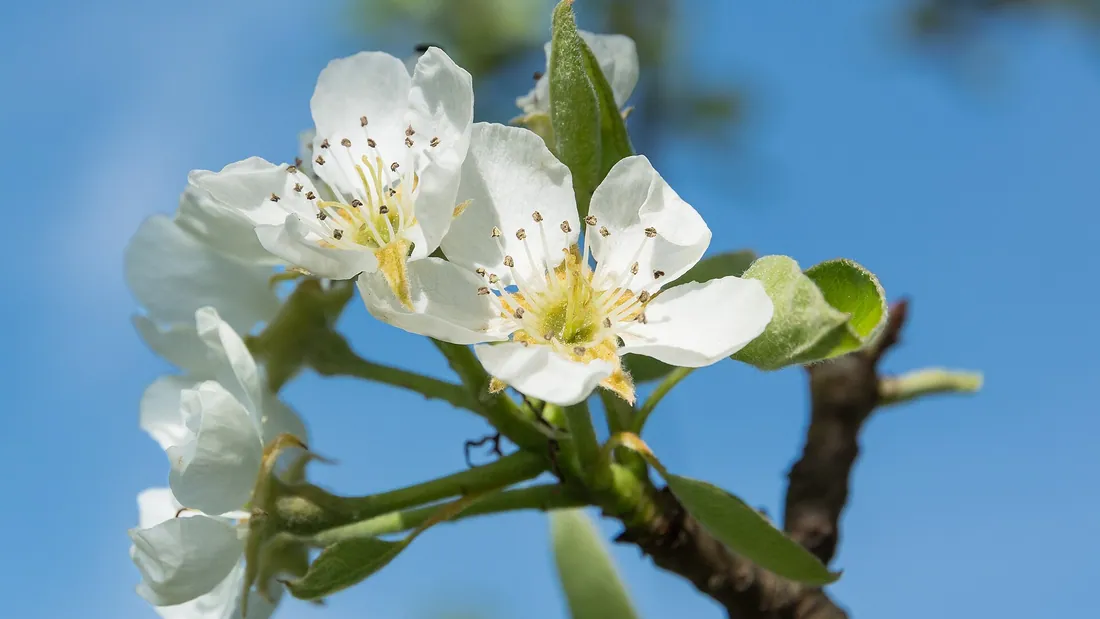

The pear tree (Pyrus communis) is the apple tree’s cousin, a fruit tree for the family orchard that gives melting fruit when the season smiles on it. It shares much with the apple tree, but flowers a little earlier, which exposes it more to the late spring frosts: some years, a single night of frost on the flowers is enough to ruin the harvest. Like the apple tree, it needs a compatible pollinator nearby to fruit well. Where frost lingers into flowering time, training it as an espalier against a sunny wall gives it the warmth and shelter that ripen fine pears.
Light and exposure
The pear tree demands full sun, even more than the apple tree, to ripen its fruit and give it sugar. Reserve the warmest, brightest spot in the garden for it, avoiding shade and cold hollows where the air stagnates.
Where springs stay cool, growing it trained against a well-exposed wall is a real ally. The wall stores the heat of the day and gives it back at night, which somewhat protects the early flowering from frost and pushes the fruit towards ripeness. A pear espaliered on the sunniest face of the house gives, where the summer is short, distinctly better pears than an isolated tree out in the open wind.
Watering
Once well established in open ground, the pear tree usually makes do with the rain that falls. But it is more sensitive than the apple tree to summer drought, especially on quince rootstock whose roots stay shallow: a spell of dryness while the fruit is swelling gives small and sometimes gritty pears.
So water young trees and trained forms generously during dry summers, aiming at the base and spacing the applications to encourage the roots to go down. A mulch keeps the soil cool and cuts down the watering chore. Along a wall, the soil dries faster than out in the open country, keep that in mind.
Soil and repotting
The pear tree likes a deep, cool, well-drained soil, rather more fertile and less chalky than the one that suits the apple tree. Soils that are too chalky make it yellow through iron deficiency. Deep loams suit it perfectly, provided water does not sit in winter.
At planting, dig a wide hole, loosen it and work in mature compost, without ever burying the graft point, which stays above the soil. On heavy, wet ground, plant on a slight mound to keep the roots away from standing water and prevent root suffocation.
Temperature and humidity
The pear tree is hardy to around -25 °C on dormant wood and comes through the winters of USDA zones 4 to 8 without trouble. Like the apple tree, it needs a good spell of winter cold, several hundred hours below 7 °C, to flower properly when mild weather returns; under too warm a winter, flowering scatters and the crop with it.
Its Achilles heel is its early flowering. The pear tree flowers about a week before the apple tree, on the first mild days after winter, at a time when late frosts are still frequent. A night at -2 °C on the open flowers scorches the organs and can bring down the year’s harvest, which explains why some years are generous and others almost nil. That is where a sheltered exposure and training against a wall come into their own.
Pruning and upkeep
Formative pruning, in winter and out of frost, builds the framework in the first years. The pear tree lends itself particularly well to trained forms, espalier or cordon, which you lead patiently along a wall or a wire. You keep an airy structure that lets the light in.
Maintenance winter pruning removes dead wood and cluttering branches, and renews the fruiting wood, the famous spurs and crowned twigs that carry the fruit buds. A summer prune calms over-vigorous trees, curbs the watershoots and exposes the fruit to the sun for better ripeness. The pear tree tends to raise its branches vertically: bending the shoots to the horizontal encourages them to fruit rather than run to wood.
Pests and diseases
Pear scab, like apple scab, stains leaves and fruit in wet weather and rainy springs: choose varieties that are little susceptible and rake up the fallen leaves. But the most serious enemy remains fire blight, caused by the bacterium Erwinia amylovora. It scorches shoots, flowers and young growth, which curl over and blacken as if singed by fire. There is no curative remedy: at the first symptoms, cut well below the affected zone, disinfect the tool between each cut and burn the waste.
Watch out too for pear rust, which marks the top of the leaves with bright orange spots over the summer. Its cycle passes obligatorily through junipers, often ornamental ones planted in the neighbourhood: moving or removing those junipers breaks the cycle and remains the most effective defence. Finally, keep an eye on aphids and the pear sucker, which weaken the tree and soil the foliage with honeydew.
Propagation
Like the apple tree, the pear tree does not come true from pip: propagating a variety goes through grafting. It is most often grafted onto quince, which gives a moderately sized tree that comes into bearing quickly and suits trained forms, or onto pear seedling for a vigorous, long-lived tree. Some varieties graft poorly directly onto quince and need an interstem.
Grafting is done by budding at the end of summer, or by cleft and whip-and-tongue in spring. It is a fine gesture for perpetuating an old local variety. For the simplest route, buy a maiden already grafted from a nursery, choosing at one go the variety, the rootstock and therefore the vigour of the tree.
Climate and hardiness
Where and in which climate it thrives
The pear is a fruit tree of temperate climates: in winter dormancy its wood takes frosts of around -25 °C without damage, which places it broadly between USDA zones 4 and 8 depending on the variety. It also needs a real winter, several hundred hours below 7 °C, to break the dormancy of its fruit buds: under a winter that is too mild, subtropical or hot Mediterranean, flowering straggles and turns erratic, and only low-chill varieties are worth planting there.
Its weak point is not the cold of winter, but the cold of the restart. The pear flowers about a week before the apple, and an open flower is destroyed at -2 °C. Wherever frost returns after bud break, in continental climates, in valley bottoms or at altitude, it is the position that makes the crop: avoid the hollows where cold air settles, prefer a slope or the shelter of a wall that gives back at night the heat of the day. Training as an espalier against a wall facing south or west, north or east in the southern hemisphere, is the classic answer, and it also buys ripeness for late varieties where the summer is short.
In a mild, damp oceanic climate the pear does well, but scab thrives on rainy springs and fire blight on stormy warm spells. Under dry heat, water while the fruit is swelling, especially on quince rootstock, which is shallower and less hardy than pear seedling and best avoided where the soil freezes deep.
Growing pear tree?
Green Hub keeps a dated history of your own plant: its photos, its progress, its repottings. An AI answers about yours specifically, not a generic sheet, for free.
Identify my plantMonth-by-month care calendar
| January | Peak season for bare-root planting, out of frost. Formative and maintenance pruning, ideal on trained forms, in dry weather. |
|---|---|
| February | End of the best window for planting and winter pruning. Lead and tie in the shoots of the espaliers. Check stakes and ties. |
| March | Sap rise approaching. Finish pruning before bud break. Mulch the base of young trees and clean under established specimens. |
| April | Early flowering, the most exposed to late frosts. Watch the forecast cold nights and protect the flowers of young trees if possible. |
| May | Fruit set after flowering. Watch for fire blight on the young growth and scab if the weather is humid. Keep an eye on aphids and pear sucker. |
| June | Normal physiological drop of the young fruit. Thin by hand if the tree is overloaded. Watch for the appearance of pear rust. |
| July | Summer pruning on trained forms and vigorous trees, bending down the upright shoots. Water young trees in case of drought. |
| August | First summer pears to pick and eat quickly, they keep poorly. Continue watering young specimens if the summer is dry. |
| September | Full harvest. Pick the autumn pears still firm, before full ripeness, to let them finish in the fruit store. Gather the fallen fruit. |
| October | Harvest of the late and keeping varieties, to bring into a cool, dark fruit store for a gradual ripening. Rake up the scabby leaves. |
| November | Leaf fall and rest. A good time to plant bare-root. Clean under the trees to break the disease cycle. |
| December | Vegetative rest. Plan the planting and the choice of a compatible pollinator. Winter pruning can begin in mild, frost-free weather. |
Green Hub tips
- The pear tree flowers before the apple tree: reserve the most sheltered spot in the garden for it to limit the damage from late frosts.
- Train it as an espalier against the sunniest wall: the heat of the wall protects the flowering and clearly improves the ripeness of the fruit where the summer is short.
- Plan a compatible pollinator flowering at the same time, without which many varieties give little fruit.
- Cut and burn without delay any shoot that blackens and curls into a crook: that is fire blight, serious and without remedy, disinfect the tool between each cut.
- Pick the autumn and winter pears still firm and let them finish ripening in the fruit store, in a cool, dark room: picked too late, they turn sleepy from the inside.
Related species
Apple tree
Malus domestica
The apple tree (Malus domestica) is the king of fruit trees in temperate climates, the one that has filled family…
Cherry laurel
Prunus laurocerasus
Cherry laurel (Prunus laurocerasus) is the most widely planted evergreen hedging shrub in temperate gardens, and it is…
Cherry tree
Prunus avium
The cherry tree (Prunus avium) is a vigorous, hardy fruit tree, perfectly at ease in a temperate climate, from USDA…
Peach
Prunus persica
The peach tree (Prunus persica) is a fruit tree that loves far more warmth and sun than a cool temperate climate…
Photinia
Photinia x fraseri
Photinia (Photinia x fraseri) is an evergreen shrub in the rose family that has become one of the most widely planted…
Plum tree
Prunus domestica
The plum tree (Prunus domestica) is the classic family fruit tree, the one you find at the back of the garden or along…
The guides that mention it
Small fruits and fruit trees: where to begin
Raspberry, redcurrant, blackcurrant, blueberry, apple, pear: what to start an orchard with and how to avoid picking the…
Garden Mulching: Every Mulch Has an Effect and a Drawback
Mulching is presented everywhere as a benefit with no downside. There is one for every material: what nitrogen drawdown…
Garden Diseases: Recognising What Is Attacking Your Plants, and Acting Before the Spot Appears
A white bloom that wipes off on a fingertip, an angular lesion stopped dead by a vein, a fruit browned from the bottom…
Pruning Fruit Trees: Deducing Instead of Memorising
An apple tree and a cherry tree are pruned neither at the same time nor for the same reason, and the peach is like…
How to Attract Birds to Your Garden, Season After Season
Winter feeding, well-positioned nest boxes, clean water and berry hedges: the complete method, season by season, for…
Updated on
How this sheet is written
Written for Green Hub with the help of language models, then reviewed. It offers gardening guidance, not professional advice: if you are unsure whether a plant is toxic to a child or an animal, ask a vet, a doctor or your national poison centre.