Apple tree
Malus domestica
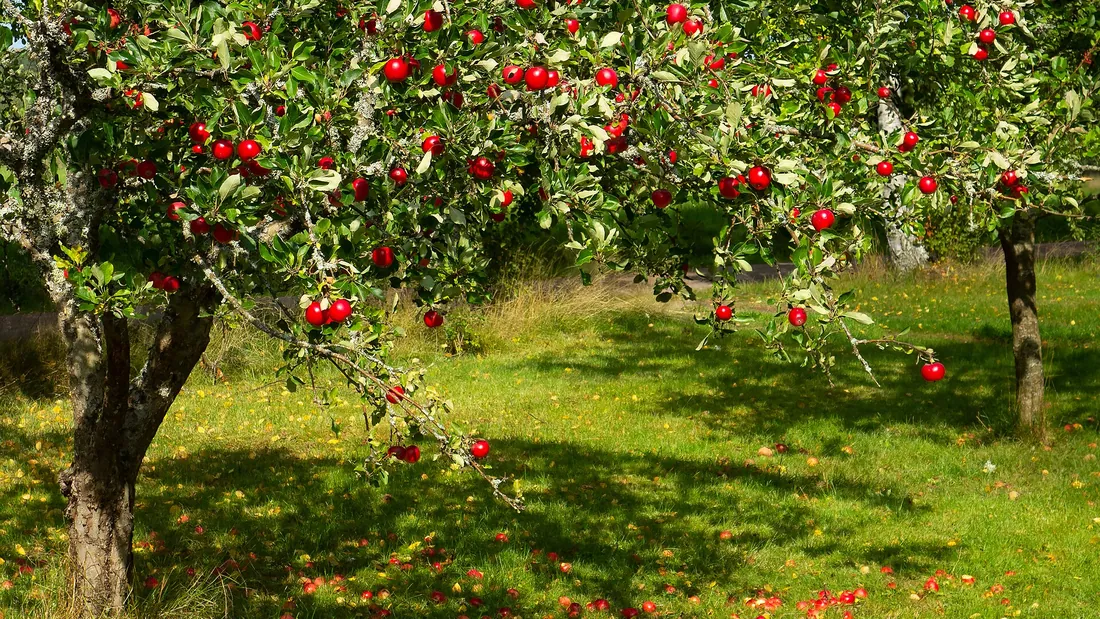

The apple tree (Malus domestica) is the king of fruit trees in temperate climates, the one that has filled family orchards for generations. It enjoys mild summers and cool winters, which give it exactly the cold its buds need to flower in spring. Two things decide success: the rootstock, which sets the final size of the tree, and the presence of a second compatible variety nearby, since most apple trees only fruit well with cross-pollination. Under a damp sky, the real battle is fought against scab, which stains leaves and fruit as soon as the spring turns rainy.
Light and exposure
The apple tree wants sun to ripen its fruit and concentrate the sugar. Give it an open, sunny spot with at least six hours of direct light a day. In a shady garden the tree still grows, but the harvest stays meagre and the fruit tastes bland.
An airy position where the air circulates well is worth its weight in gold under a damp climate: the foliage dries faster after rain and scab settles in less easily. Avoid valley bottoms where cold air pools and where spring frosts linger longer during flowering.
Watering
An apple tree well rooted in open ground manages on its own most years, since ordinary rainfall covers its needs. During the first two or three years after planting, however, water generously in case of summer drought so the root system establishes itself deeply.
Keep a special eye on young trees and espaliered forms on dwarfing rootstock, whose roots stay shallow and quickly suffer from dryness. A mulch at the base keeps the soil cool and saves you from watering all the time. In a hot, dry summer, a lack of water while the fruit is swelling means smaller apples.
Soil and repotting
The apple tree accepts most soils, but prefers a deep, cool, well-drained earth, neither too chalky nor permanently waterlogged. Heavy clay soils suit it fine, as long as water does not sit around the roots in winter.
At planting, dig a wide hole, loosen the bottom and work in mature compost without burying the graft point, which must stay well above the soil. Ground that is too soggy encourages root rot and root suffocation: on wet land, plant on a small mound to raise the collar.
Temperature and humidity
The apple tree is perfectly hardy in temperate climates: in dormancy, ordinary varieties take -25 to -30 °C and the hardiest down to -35 °C, that is USDA zones 3 to 8 depending on the cultivar. It actually needs a certain number of chill hours each winter, 800 to 1200 hours below 7 °C for most varieties, to break the dormancy of its buds and flower properly; under too mild a winter, only low-chill varieties give anything.
The sensitive point is flowering. The apple tree flowers fairly late, about a week after the pear, which partly protects it from the last frosts. But a night at -2 °C during full bloom scorches the flowers and ruins the year’s harvest. In cold hollows, a late frost at that moment makes all the difference between a fine year and a blank season.
Pruning and upkeep
Formative pruning is done in the first years, in winter and out of frost, to build a balanced, airy framework. You open the centre of the tree to the light and keep well-spaced branches. On a standard orchard tree you let it spread; on an espalier or goblet form you guide each branch.
Maintenance pruning, also in winter, removes dead wood, crossing branches and surplus watershoots, while renewing the fruiting spurs. Summer pruning is possible: you pinch or shorten the year’s growth, which calms vigour, lets sun onto the fruit and encourages fruit buds for next year. There is no point pruning an over-vigorous tree hard, it simply responds by growing back stronger.
Pests and diseases
The number one enemy under a damp climate is scab, a fungus that covers the leaves with olive-brown spots and marks the fruit with black corky scabs. It explodes during rainy springs, when the foliage stays wet for a long time. The best defence is to choose resistant varieties from the start, often old local varieties suited to the orchards of your own region, and to rake up and remove the fallen leaves in autumn, where the fungus overwinters.
Codling moth, the famous apple worm, tunnels through the fruit: pheromone traps and trap bands around the trunk help to keep it in check. Watch out too for aphids, which curl up the young shoots in spring, and powdery mildew, that white felting on young leaves and shoots in mild weather. Cut and burn affected shoots, and encourage helpers like ladybirds rather than spraying at random.
Propagation
The apple tree does not come true from seed: a pip gives an unknown tree, rarely good to eat. To get a specific variety, you propagate it by grafting onto a chosen rootstock. It is the rootstock that decides the final size: a dwarfing rootstock gives a small tree for a little garden or an espalier, a seedling stock gives a vigorous standard for a full orchard.
Grafting is done by budding at the end of summer, or by cleft and whip-and-tongue in spring on a rootstock planted the previous winter. It is a technical but accessible gesture, very rewarding when you want to save an old local variety. For the gardener in a hurry, buying a grafted maiden from a nursery is the simplest route: you then choose the variety and the rootstock in one go.
Climate and hardiness
Where and in which climate it thrives
The apple is the temperate fruit tree par excellence. In dormancy the wood of ordinary varieties takes -25 to -30 °C, and the hardiest varieties go down to -35 °C: depending on the cultivar the range runs from USDA zone 3 to 8. The limiting factor is therefore not the cold but its absence. It needs 800 to 1200 hours below 7 °C over winter to break bud dormancy; where the winter is too mild, subtropical or hot Mediterranean, flowering scatters, the leaves come before the flowers and the crop collapses. Those regions fall back on low-chill varieties such as 'Anna', 'Dorsett Golden' or 'Ein Shemer', which are satisfied with 200 to 300 hours.
The apple flowers late, about a week after the pear, which partly shelters it from late frosts. Only partly: at full bloom, a night at -2 °C scorches the open flowers and costs the year’s harvest. In continental climates with an abrupt spring, and in valley bottoms where cold air pools, altitude and the lie of the ground then count for more than the variety.
In a mild, damp oceanic climate the problem is no longer frost but water: scab needs long hours of wet foliage to germinate, and rainy springs set it off. The answer is resistant varieties, an airy position and raking up the fallen leaves. Under dry heat, it is watering while the fruit is swelling that decides the size of the apples.
Growing apple tree?
Green Hub keeps a dated history of your own plant: its photos, its progress, its repottings. An AI answers about yours specifically, not a generic sheet, for free.
Identify my plantMonth-by-month care calendar
| January | Peak season for bare-root planting, out of frost. Formative and maintenance pruning of established trees, in dry, mild weather. |
|---|---|
| February | End of the ideal window for planting and winter pruning. Apply a clay wash to the trunks if you wish. Check and set the stakes. |
| March | Bud break approaching. Last moment to prune before the sap rises. Clean around the base of the trees and mulch young specimens. |
| April | Flowering begins. Watch for forecast late frosts and protect young trees in bloom on cold nights. Look out for the first aphids. |
| May | Full bloom then fruit set. The bees do their work of cross-pollination. Watch for scab if the weather is rainy and humid. |
| June | Physiological drop of young fruit, quite normal. Thin by hand if the tree is overloaded for finer fruit. Set the codling moth traps. |
| July | Summer pruning possible on espaliered forms and over-vigorous trees. Water young trees in case of drought. Watch for codling moth and powdery mildew. |
| August | First early apples to pick and eat quickly. End of summer pruning. Keep watering young specimens if the summer is dry. |
| September | Full harvest of the main-season varieties. Pick gently, the fruit should come away with a light twist. Gather the fallen fruit. |
| October | Harvest of the keeping apples, to bring into a cool cellar for winter. Rake up and remove the leaves affected by scab. |
| November | Leaf fall, the tree enters its rest. A good time to plant bare-root. Clean under the trees to break the disease cycle. |
| December | Vegetative rest. Plan your planting and the choice of mutually compatible varieties. Winter pruning can begin in mild, frost-free weather. |
Green Hub tips
- Always plant at least two compatible varieties that flower at the same time, or check that an apple tree already grows at a close neighbour’s: without cross-pollination, many varieties give little or no fruit.
- Choose the rootstock according to the space: dwarfing for a small garden or an espalier against a wall, seedling stock for a full-orchard standard that will live for decades.
- Under a damp climate, bet on old local varieties resistant to scab, far easier to grow than supermarket varieties.
- Rake up and remove the dead leaves in autumn: that is where scab overwinters, and a clean base breaks the cycle for the following year.
- Do not pick a keeping apple too early: it should come away easily with a light twist of the hand, otherwise it will shrivel in the cellar.
Related species
Cherry laurel
Prunus laurocerasus
Cherry laurel (Prunus laurocerasus) is the most widely planted evergreen hedging shrub in temperate gardens, and it is…
Cherry tree
Prunus avium
The cherry tree (Prunus avium) is a vigorous, hardy fruit tree, perfectly at ease in a temperate climate, from USDA…
Peach
Prunus persica
The peach tree (Prunus persica) is a fruit tree that loves far more warmth and sun than a cool temperate climate…
Pear tree
Pyrus communis
The pear tree (Pyrus communis) is the apple tree’s cousin, a fruit tree for the family orchard that gives melting fruit…
Photinia
Photinia x fraseri
Photinia (Photinia x fraseri) is an evergreen shrub in the rose family that has become one of the most widely planted…
Plum tree
Prunus domestica
The plum tree (Prunus domestica) is the classic family fruit tree, the one you find at the back of the garden or along…
The guides that mention it
Small fruits and fruit trees: where to begin
Raspberry, redcurrant, blackcurrant, blueberry, apple, pear: what to start an orchard with and how to avoid picking the…
Garden Mulching: Every Mulch Has an Effect and a Drawback
Mulching is presented everywhere as a benefit with no downside. There is one for every material: what nitrogen drawdown…
Garden Diseases: Recognising What Is Attacking Your Plants, and Acting Before the Spot Appears
A white bloom that wipes off on a fingertip, an angular lesion stopped dead by a vein, a fruit browned from the bottom…
Pruning Fruit Trees: Deducing Instead of Memorising
An apple tree and a cherry tree are pruned neither at the same time nor for the same reason, and the peach is like…
How to Attract Birds to Your Garden, Season After Season
Winter feeding, well-positioned nest boxes, clean water and berry hedges: the complete method, season by season, for…
Updated on
How this sheet is written
Written for Green Hub with the help of language models, then reviewed. It offers gardening guidance, not professional advice: if you are unsure whether a plant is toxic to a child or an animal, ask a vet, a doctor or your national poison centre.