Cherry tree
Prunus avium
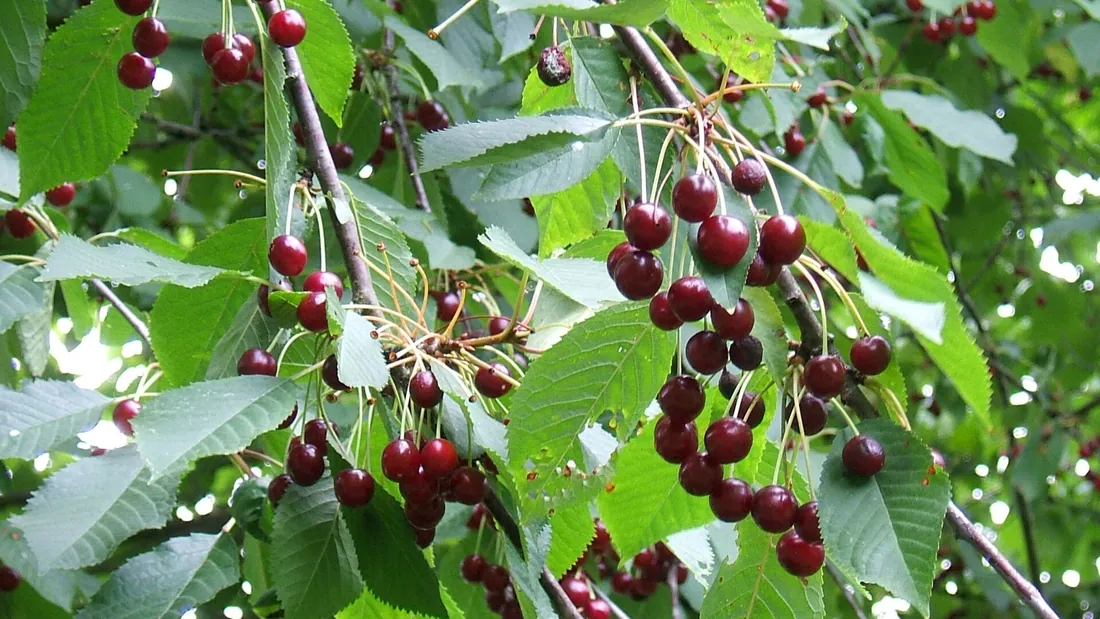

The cherry tree (Prunus avium) is a vigorous, hardy fruit tree, perfectly at ease in a temperate climate, from USDA zone 5 to zone 8. Its white flowering is early, which makes it vulnerable to the late frosts of the end of winter and the start of spring. The real secret of a healthy cherry tree fits in one sentence: you prune it in the green, just after the harvest in summer, never during the cold damp season. In a small garden, you choose a dwarfing rootstock of the Gisela type to keep the tree at human height and be able to cover it with a net against the birds.
Light and exposure
The cherry tree demands sun, as much as possible. Set it in an open, bright spot facing south or west, away from large trees that would shade it. The more light it gets, the sweeter and more coloured the fruit.
A point often forgotten counts as much as the sun: air circulation. A cherry tree planted in a damp, confined corner dries poorly after the rains and catches diseases more easily. Prefer an airy position, without exposing it to the cold winds that would damage the early flowering.
Watering
A well-established cherry tree, with a developed root system, manages on its own most of the time wherever the rains are regular. It is mainly the first three years that you must watch the watering, while it roots in: a good bucket of water a week in case of summer drought, at the base, without waterlogging.
One caution worth knowing: avoid sudden bursts of water just before the harvest. A heavy rain or a massive watering after a dry spell makes the cherries swell too fast and they split. A mulch at the base smooths out those swings by keeping the soil evenly cool.
Soil and repotting
The cherry tree likes deep, loose and above all well-drained soils. It hates standing water around the roots, which causes suffocation and gummosis. In heavy, clayey ground, plant on a small mound and improve the pit with compost and a little coarse sand to help the water run off.
It is happy in a neutral to slightly chalky soil, which is handy for the many clay-and-lime grounds. Just avoid decidedly acid soils that are waterlogged in winter, where it languishes and suffers at the collar.
Temperature and humidity
On the cold side, the cherry tree is tough: the wood holds through winter from USDA zone 5 to zone 8, down to about minus 25 degrees, and the tree even needs a good spell of cold, 700 to 900 hours below 7 degrees, to flower properly in spring. So it is not winter that worries it.
The danger comes from spring. The flowering is early, often before the last frosts have passed. A night at minus 2 degrees on open flowers, and the harvest is lost for the year. On a small dwarfed tree, you can throw a winter fleece over it on forecast critical nights; on a large specimen, you cross your fingers and choose from the start a spot that is not too early.
Pruning and upkeep
Here is the gesture that changes everything with the cherry tree: prune in the green, that is to say just after the harvest, in summer, when the tree is still in full sap. Never prune in winter. Wounds made during the cold, damp season heal poorly and open the door wide to canker, gummosis and silver leaf disease, three troubles that can condemn the tree.
Stay light. Remove dead wood, crossing branches and those heading inwards, air the centre to let the light through, and shorten what climbs too high to keep the tree accessible. On a dwarfing rootstock like Gisela, this summer pruning is enough to keep a compact shape, easy to protect with a net.
Pests and diseases
The first scourge of the cherry tree is the cherry fruit fly. The female lays in the ripening fruit, and you find a small white maggot inside. Good news: the early varieties, harvested early, largely escape the egg-laying that starts later in the season. Yellow sticky traps help to follow the flight and limit the laying.
Next come brown rot, that brown decay which mummifies the fruit and sometimes climbs onto the shoots in humid weather, and the black aphids that curl up the tips of the young shoots in spring. You cut and destroy the mummified fruit, you tolerate the aphids when the ladybirds do the work. And of course there are the birds, great lovers of cherries: on a dwarfed tree, a net laid as ripeness approaches settles the matter.
Propagation
The dessert cherry does not come true from seed: a stone will give a wild cherry with often mediocre fruit. Serious propagation goes through grafting onto a chosen rootstock, which determines both the variety of the fruit and the vigour of the tree.
For a small garden, everything is decided there: ask the nursery for a variety grafted onto a dwarfing rootstock of the Gisela type. The tree stays at human height, comes into bearing faster, and above all you can cover it with a net against the birds without scaffolding. Home grafting, by budding in summer or by cleft in spring, remains possible but takes a little practice.
Climate and hardiness
Where and in which climate it thrives
The cherry tree is solid against cold but demanding about its rhythm: the wood holds through winter from USDA zone 5 to zone 8, down to about minus 25 degrees, and the tree calls for 700 to 900 hours below 7 degrees to flower properly. Under too mild a winter, in a Mediterranean or subtropical climate, flowering turns erratic: you then need low chill varieties, of the 'Royal Lee' and 'Minnie Royal' type, which get by on 200 to 500 hours and have to be planted together to pollinate each other.
So it is not winter that decides the harvest, it is spring. The flowering is early and stays caught in the window of the late frosts: a single night at minus 2 degrees on open flowers sacrifices the year. On a large tree there is not much to be done; on a small dwarfed specimen, a fleece thrown over it on forecast nights saves the day. In a damp climate, pruning is the second non-negotiable point: you prune in the green after the harvest, never during the cold season, so as not to offer canker and silver leaf disease a fresh wound in wet weather.
Two starting choices make life enormously easier in a small garden. First the dwarfing rootstock of the Gisela type: the tree stays low, you prune and harvest it without a ladder, and above all you can throw an anti-bird net over it as soon as the cherries redden, failing which the blackbirds will not leave you a single one. Then the pollination: check at purchase, some varieties are self-fertile, many need a compatible cherry tree in the neighbourhood to set well. The harvest falls at the start of summer depending on the variety, the early ones having the advantage of dodging the cherry fruit fly.
Growing cherry tree?
Green Hub keeps a dated history of your own plant: its photos, its progress, its repottings. An AI answers about yours specifically, not a generic sheet, for free.
Identify my plantMonth-by-month care calendar
| January | Rest of the tree. Above all, do not prune. This is the right time to choose and order a variety grafted onto a dwarfing rootstock, and to check its pollination needs. |
|---|---|
| February | Planting possible out of frost, bare-root, in well-drained soil. Still no pruning. Stake and mulch the base of the young tree. |
| March | Bud break approaching. Watch for the first aphids on the tips of the shoots. A last cool mulch at the base before flowering. |
| April | Early flowering. Watch the forecasts for late frosts and cover the small trees with a fleece on critical nights. Do not prune. |
| May | Fruit set and swelling of the fruit. Frost risk still possible as long as the last frosts have not passed. Put up the yellow sticky traps to track the cherry fruit fly. |
| June | Start of harvest for the early varieties, those that best escape the fly. Lay the anti-bird net as soon as the cherries redden. |
| July | Full harvest of the main-season varieties. Just after picking, prune in the green: dead wood, crossing branches, airing of the centre. Remove the fruit rotted by brown rot. |
| August | End of the summer pruning if it is not finished. The tree heals quickly in warm weather. Water the young specimens in case of drought. |
| September | Clean up the fallen and mummified fruit under the tree to break the brown rot cycle. Take down and store the net. |
| October | Leaf fall. Rake them up if the tree has suffered from diseases, to limit the overwintering spores. A good time to plant a new specimen. |
| November | Planting still possible in unfrozen soil. Check the stake and the mulch of the young trees before winter. No pruning. |
| December | Complete rest. Observe the bare framework to plan the future summer pruning, but keep the secateurs sheathed until after the next harvest. |
Green Hub tips
- Always prune in the green, just after the harvest in summer. A pruning wound in the damp winter is the open door to canker and silver leaf disease.
- In a small garden, choose a dwarfing rootstock of the Gisela type: tree at human height, harvest without a ladder and anti-bird net easy to lay.
- Check at purchase whether the variety is self-fertile or whether it needs a neighbouring pollinator, otherwise you will have flowers but few cherries.
- Favour an early variety: harvested early, it largely escapes the cherry fruit fly whose egg-laying starts later.
- The stones and the leaves contain cyanogenic compounds: the flesh is eaten without worry, but you never bite into the stones.
Related species
Apple tree
Malus domestica
The apple tree (Malus domestica) is the king of fruit trees in temperate climates, the one that has filled family…
Cherry laurel
Prunus laurocerasus
Cherry laurel (Prunus laurocerasus) is the most widely planted evergreen hedging shrub in temperate gardens, and it is…
Peach
Prunus persica
The peach tree (Prunus persica) is a fruit tree that loves far more warmth and sun than a cool temperate climate…
Pear tree
Pyrus communis
The pear tree (Pyrus communis) is the apple tree’s cousin, a fruit tree for the family orchard that gives melting fruit…
Photinia
Photinia x fraseri
Photinia (Photinia x fraseri) is an evergreen shrub in the rose family that has become one of the most widely planted…
Plum tree
Prunus domestica
The plum tree (Prunus domestica) is the classic family fruit tree, the one you find at the back of the garden or along…
The guides that mention it
Small fruits and fruit trees: where to begin
Raspberry, redcurrant, blackcurrant, blueberry, apple, pear: what to start an orchard with and how to avoid picking the…
Garden Mulching: Every Mulch Has an Effect and a Drawback
Mulching is presented everywhere as a benefit with no downside. There is one for every material: what nitrogen drawdown…
Garden Diseases: Recognising What Is Attacking Your Plants, and Acting Before the Spot Appears
A white bloom that wipes off on a fingertip, an angular lesion stopped dead by a vein, a fruit browned from the bottom…
Pruning Fruit Trees: Deducing Instead of Memorising
An apple tree and a cherry tree are pruned neither at the same time nor for the same reason, and the peach is like…
How to Attract Birds to Your Garden, Season After Season
Winter feeding, well-positioned nest boxes, clean water and berry hedges: the complete method, season by season, for…
Updated on
How this sheet is written
Written for Green Hub with the help of language models, then reviewed. It offers gardening guidance, not professional advice: if you are unsure whether a plant is toxic to a child or an animal, ask a vet, a doctor or your national poison centre.