Cherry laurel
Prunus laurocerasus
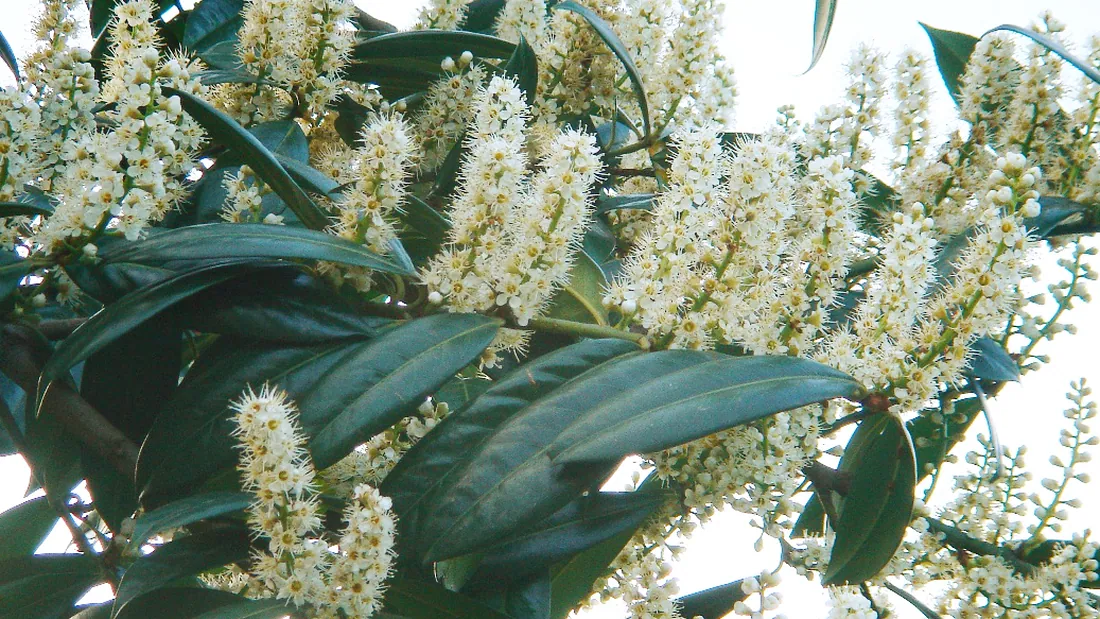

Cherry laurel (Prunus laurocerasus) is the most widely planted evergreen hedging shrub in temperate gardens, and it is easy to see why: fast-growing, capable of blocking a neighbour’s view within two or three seasons, and low-maintenance once established. Hardy down to -15, -18 °C, it grows away without complaint in a mild oceanic climate, with one real weakness: the occasional severe winter that can scorch its leaves, without actually killing the plant.
Light and exposure
Cherry laurel grows equally well in full sun and in deep shade, which makes it the most versatile hedging shrub around. It even tolerates the side of a house that never sees direct sun, or the foot of a large tree, where almost nothing else takes root. In full sun, the foliage simply stays denser and glossier.
That is exactly what makes it the safe choice for blocking a view or backing onto a shared wall that gets no direct light: nothing else grows that fast in those conditions. Just avoid permanently waterlogged soil, everything else suits it.
Watering
In the first year after planting, water regularly, especially in dry spells, while the roots settle in. A young plant short of water at the start often carries the setback for several seasons afterwards.
Once well rooted, cherry laurel becomes genuinely undemanding and is happy, most summers, with the ordinary rainfall of a temperate climate. Generous watering only becomes useful again during a drought lasting several weeks, recognisable by leaves hanging limp by the end of the day.
Soil and repotting
Cherry laurel is not fussy about soil and copes just as well with heavy clay as with ordinary garden ground, provided it is not permanently waterlogged. A little compost at planting simply helps it get away faster.
Its one real weak point is very chalky soil. Iron becomes less available to the plant, and the leaves turn yellow between the veins, a chlorosis problem seen on ground developed over limestone bedrock. An application of chelated iron or well-rotted compost corrects it.
Temperature and humidity
Cherry laurel handles a temperate winter without any trouble, with wood that shrugs off temperatures down to -15, -18 °C, USDA zone 7. It is far hardier than its southern-looking outline suggests.
The occasional severe winter, when the thermometer drops noticeably lower or an icy wind settles in for several days, can scorch the foliage: leaves turn brown, dry out and sometimes drop in large numbers. The plant almost never dies from it, it comes back from sound wood or even from the stump once growth restarts, looking a bit bare but very much alive.
Pruning and upkeep
Unlike most hedges, cherry laurel is best pruned with secateurs rather than a hedge trimmer. Its large leaves get sliced in half by a mechanical blade and turn brown along the cut within days, leaving a freshly trimmed hedge looking scorched for weeks. Secateurs, though slower, cut each stem cleanly between two leaves and avoid the problem entirely.
Prune in early summer, once the spring flush has finished, with a second light pass in late summer if the hedge has grown a lot. Never prune during a frost or just before one, freshly cut wood is more vulnerable then.
Pests and diseases
The most characteristic disease of cherry laurel is shot hole disease: brown spots appear on the leaves, then their centres dry out and drop away, leaving neat round holes clearly visible. It is encouraged by moisture sitting on the foliage and mainly affects hedges that are poorly ventilated or pruned at the wrong time.
Silver leaf disease, caused by a fungus that gives the leaves a silvery sheen before they wither, is rarer but hard to treat: cutting out and burning affected branches is the best response. Aphids and scale insects sometimes settle on young shoots without real harm, a good blast of water usually dislodges them. On chalky soil, it is more often yellow leaves with green veins that give away iron chlorosis.
Propagation
Taking cuttings is by far the simplest way to multiply a cherry laurel, and it is in fact how entire hedges were planted cheaply in the first place. Take semi-ripe shoots, neither too soft nor fully woody, at the end of summer, strip the lower leaves and plant them in a mix of compost and sand. Rooting takes several months but succeeds almost every time.
Growing from seed also happens naturally: blackbirds happily spread the stones after eating the black fruit, and it is not unusual to find young self-sown cherry laurels at the foot of a mother hedge. A cut stump also resprouts very readily from the base, which explains why this plant is so hard to get rid of once established.
Toxicity
Cherry laurel is toxic in every part, leaves and stones alike, which contain cyanogenic compounds that release hydrogen cyanide when chewed. Ingestion can cause digestive upset, and even more serious symptoms in children and pets. The black fruit flesh itself is less of a concern, but access to the stones should be prevented, and pruning debris should not be left where grazing animals can reach it.
Climate and hardiness
Where and in which climate it thrives
Cherry laurel is far hardier than its glossy, southern-looking foliage suggests: the wood takes -15 to -18 °C, which places it in USDA zone 7 and makes it growable throughout the milder zones as well. It is happiest in a mild, damp temperate oceanic climate: winters without prolonged freezing, rain spread through the year, summers without heatwaves. There, once established, it asks for neither watering nor protection. Under a continental climate with a dry, windy winter it suffers less from the cold itself than from desiccation: the icy wind empties the leaves while frozen ground stops the roots making up the loss, and the foliage browns. A thick mulch and a windbreak on the side of the prevailing cold winds are enough to limit the damage. Under a Mediterranean climate or dry heat it is the other way round: it copes, but summer watering and some afternoon shade save it from scorched leaves. After a severe winter the hedge can look dead, brown and bare as the cold lets go: do not dig it up, the wood almost always comes back once growth restarts, often from the base if the damage runs deep. Allow 80 to 100 centimetres between plants for a dense hedge, and keep the secateurs rather than an electric hedge trimmer, which shreds the large leaves and leaves them browning at the cut.
Growing cherry laurel?
Green Hub keeps a dated history of your own plant: its photos, its progress, its repottings. An AI answers about yours specifically, not a generic sheet, for free.
Identify my plantMonth-by-month care calendar
| January | Dormant season. A good time to plant bare-root or balled specimens if the ground is not frozen, and to note any frost damage without acting on it yet. |
|---|---|
| February | Still dormant. The last chance to prune before growth restarts if needed, and a good time to prepare planting spots. |
| March | Growth resumes. Container planting is possible, keep an eye on fresh young shoots, which are vulnerable to late frost. |
| April | Active growth gets going. Any leaves scorched over winter drop now, replaced by fresh foliage. A good month for planting. |
| May | Vigorous growth. This is when the hedge puts on the most height, a first light trim if needed. |
| June | The main prune of the year, done with secateurs, once the spring flush has finished. |
| July | Watch for shot hole disease in damp weather, water any plants put in this year if it turns dry. |
| August | Take semi-ripe cuttings to multiply the hedge, keep an eye out for scale insects. |
| September | A second light trim if the hedge has grown a lot over summer, also a good month for planting. |
| October | Ideal planting month, the soil is still warm and the rains are back, roots settle in before winter. |
| November | Last planting window before the frosts, mulch around young plants. |
| December | Rest period. Watch how the hedge handles the first real cold snap, hold off pruning if frost is forecast. |
Green Hub tips
- Never prune cherry laurel with an electric hedge trimmer if you want to avoid browning at the cut edges: secateurs take longer but leave a clean finish.
- If a severe winter scorches the leaves, do not dig it up too fast: it almost always comes back from the wood or the stump the following spring.
- Allow 80 to 100 centimetres between plants for a hedge that closes up quickly without crowding itself.
- Every part of the plant, leaves and stones alike, is toxic: keep children and pets away from fallen fruit.
Related species
Apple tree
Malus domestica
The apple tree (Malus domestica) is the king of fruit trees in temperate climates, the one that has filled family…
Cherry tree
Prunus avium
The cherry tree (Prunus avium) is a vigorous, hardy fruit tree, perfectly at ease in a temperate climate, from USDA…
Peach
Prunus persica
The peach tree (Prunus persica) is a fruit tree that loves far more warmth and sun than a cool temperate climate…
Pear tree
Pyrus communis
The pear tree (Pyrus communis) is the apple tree’s cousin, a fruit tree for the family orchard that gives melting fruit…
Photinia
Photinia x fraseri
Photinia (Photinia x fraseri) is an evergreen shrub in the rose family that has become one of the most widely planted…
Plum tree
Prunus domestica
The plum tree (Prunus domestica) is the classic family fruit tree, the one you find at the back of the garden or along…
The guides that mention it
Which Hedge to Plant, and How to Get It Right
Evergreen, deciduous or marcescent, annual growth, hardiness, soil, shade and sea spray: the real criteria for…
Watering Plants Properly: Deciding Rather Than Following a Schedule
Beginners water too often and too little at the same time. How to read the soil instead of the calendar, tell thirst…
Toxic Plants for Cats and Dogs: Recognising the Danger Rather Than Memorising a List
A list of toxic plants is easily forgotten and always incomplete. What actually protects a cat or dog is recognising…
Pruning Flowering Shrubs and Roses: Deducing Instead of Memorising
New wood or old wood: this single question gives you the pruning time for any shrub at all, including ones whose name…
What to Plant in a Shade Garden, Under Trees and Against Sunless Walls
Under a large tree or against a wall the sun never reaches, shade doesn’t rule out a planting bed: it calls for a…
Updated on
How this sheet is written
Written for Green Hub with the help of language models, then reviewed. It offers gardening guidance, not professional advice: if you are unsure whether a plant is toxic to a child or an animal, ask a vet, a doctor or your national poison centre.