Plum tree
Prunus domestica
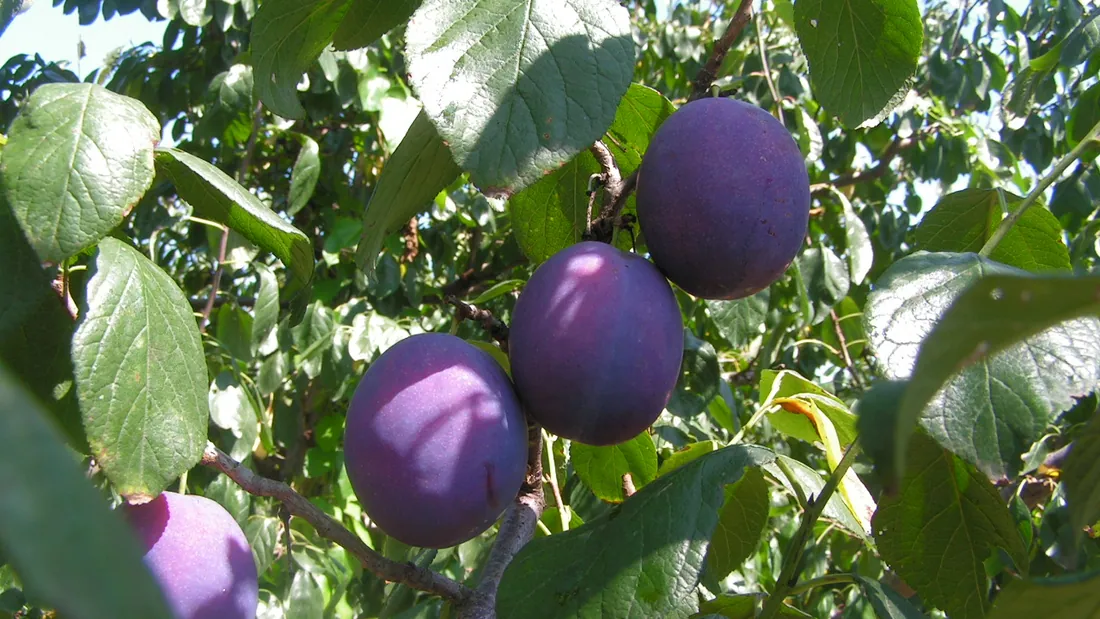

The plum tree (Prunus domestica) is the classic family fruit tree, the one you find at the back of the garden or along the edge of a meadow, planted generations ago. It comes in quetsche plums, mirabelles and greengages, each with its own use: quetsches for tarts and eau-de-vie, mirabelles for jam, greengages to eat straight off the tree. It is a tough, generous tree that mostly asks for patience, plus a bit of watchfulness around flowering time.
Light and exposure
The plum tree needs full sun to flower well and produce sweet fruit. A shaded spot gives a stunted tree, a thin harvest and far more disease, simply because the foliage never gets enough air and light to dry out.
Also pick a spot sheltered from cold winds, and above all not a dip in the ground. Cold air is heavier and pools there on clear spring nights, scorching the blossom that opens at the first mild spell. A gentle slope or slightly raised ground beats a low, enclosed corner of the garden.
Watering
For the first three years after planting, water the young tree regularly to help it root deeply, especially through dry summers. Once established, an adult plum tree largely fends for itself thanks to its deep roots.
The critical moment is while the fruit is swelling, in the weeks that follow fruit set. A dry spell followed by a sudden soaking, whether from watering or heavy rain, splits fruit that is already well formed. Steady, moderate watering beats a last-minute catch-up every time.
Soil and repotting
The plum tree is not fussy and adapts to most soils, though it prefers ground that is deep, moist and well drained, ideally neutral to slightly chalky. Work in some well-rotted compost at planting to give it a good start.
The one real enemy is standing water. Heavy, poorly drained soil suffocates the roots and opens the door to gummosis, the resin ooze typical of a Prunus in distress. On clay soil, plant on a small mound to raise the graft union above the wet.
Temperature and humidity
Cold itself is rarely a problem for the plum tree: it is a hardy tree that shrugs off well below -20 °C once dormant, and down to about -30 °C depending on the variety, that is USDA zones 4 to 9. In exchange it needs a marked winter, 700 to 1000 hours below 7 °C, to break the dormancy of its buds. The real risk lies in spring, not winter.
Flowering comes early, before the apple, at the first mild days after winter, right when late frosts are still common. A single night at -2 or -3 °C is enough to scorch open blossom and wipe out much of that year’s crop, without the tree itself taking any lasting harm.
Pruning and upkeep
One rule is absolute with the plum tree, as with all stone fruit: prune in summer, never in winter. The right time is after harvest, at the end of summer, while sap is still moving and wounds heal quickly. A cut made in winter, deep in dormancy, stays open for months and becomes an easy entry point for brown rot, canker and silver leaf disease.
The plum tree needs little pruning and dislikes heavy cuts. Limit yourself to opening up the centre of the tree, removing dead or diseased wood as soon as you spot it, whatever the season for that particular job, and shortening overly vigorous branches a little. A balanced framework is built over the first few years, not in a single session.
Pests and diseases
Brown rot is the plum tree’s number one problem, encouraged by damp springs and summers. It rots the blossom and then the fruit, which shrivels into mummies that stay hanging on the branches. Pick off and destroy these mummified fruit without fail, they carry the spores that restart the infection the following year.
Plum rust marks the underside of the leaves with orange pustules in late summer, shot hole disease peppers leaves with small holes as if shot with lead pellets, and black aphids curl the young shoots in spring. More seriously, sharka is a regulated viral disease that marks fruit and leaves with ring-shaped blotches: any suspect tree must be reported, there is no cure, and removal is often the only option.
Propagation
The plum tree cannot be reliably propagated from seed if you want to keep the original variety: a planted stone grows into an unpredictable rootstock, close to wild blackthorn, with fruit of little interest. The normal route is grafting onto a suitable rootstock, such as myrobalan plum, done by budding in summer or by cleft grafting at the end of winter.
In the garden, the most useful habit is watching for suckers: the rootstock often throws up shoots at the base of the trunk or further out in the lawn. These are not free baby plum trees but growth from the rootstock, and should be pulled out as soon as they appear so they do not drain the grafted tree.
Climate and hardiness
Where and in which climate it thrives
The European plum is a fruit tree of temperate climates and thoroughly hardy: once dormant, its wood takes well below -20 °C without damage, and down to about -30 °C depending on the variety, which places it between USDA zones 4 and 9. In exchange it needs a marked winter, of the order of 700 to 1000 hours below 7 °C, to break the dormancy of its buds: under a winter that is too mild, subtropical or hot Mediterranean, flowering turns erratic and the crop with it.
The real risk is therefore not winter but the restart. The plum flowers early, before the apple, and a night at -2 or -3 °C is enough to scorch the open blossom without the tree itself suffering. Wherever frost returns after flowering, in continental climates as in valley bottoms or at altitude, the choice of position weighs more than anything else: avoid the dips where cold air settles on clear nights, prefer a slope or a slightly raised spot. Check the self-fertility of the variety too: Mirabelle de Nancy, Quetsche d’Alsace and Reine-Claude d’Oullins crop on their own, while many others call for a pollinator nearby.
In a mild, damp oceanic climate, brown rot takes over: damp at flowering, then while the fruit is swelling, rots first the blossom and then the plums. Under dry heat, everything hinges on steady watering while the fruit swells, since heavy rain or a sudden soaking after a drought splits them.
Growing plum tree?
Green Hub keeps a dated history of your own plant: its photos, its progress, its repottings. An AI answers about yours specifically, not a generic sheet, for free.
Identify my plantMonth-by-month care calendar
| January | The tree rests completely. This is the best time to plant a bare-root plum tree, as long as the ground is not frozen. Do not prune. |
|---|---|
| February | Last chance for bare-root planting. Check stakes and ties on young trees. Still no pruning. |
| March | Buds swell. Last chance to plant a container-grown tree before growth restarts. |
| April | Flowering begins, often spectacular. Watch the frost forecast and keep a fleece cover on hand to protect young trees if a cold night is coming. |
| May | Fruit set. Some young fruit drops naturally, which is normal. Water if the month is dry, especially for trees planted less than three years ago. |
| June | Fruit is swelling. On a very heavy crop, thin it out a little for bigger fruit and to avoid broken branches. |
| July | Early varieties start to ripen. Watch for aphids on young shoots, and start picking up the first windfalls. |
| August | This is the heart of the harvest for most varieties, greengages and early quetsches leading the way. Pick up fruit affected by brown rot quickly so it does not spread. |
| September | Late quetsche plums are harvested. As soon as picking is finished on a given tree, it is the right time to start summer pruning. |
| October | Carry on with light pruning if needed. Pick up mummified fruit and diseased fallen leaves to limit brown rot next year. |
| November | A good time to plant a bare-root plum tree, once the leaves have dropped. Clean up around the base of the trees before winter. |
| December | Winter rest. A good moment to order new varieties and check that young trees are well protected from frost. |
Green Hub tips
- Never prune the plum tree in winter: do it in summer, right after harvest, or the wounds stay open and let in gummosis and canker.
- Check a variety’s self-fertility before buying. Mirabelle de Nancy or Reine-Claude d’Oullins crop on their own, others need a pollinator planted nearby.
- Pick up and destroy fruit mummified by brown rot, never leave it on the tree or in the compost: it restarts the infection the following year.
- Avoid planting in a dip in the ground. Cold air pools there on clear spring nights and scorches the plum tree’s early blossom, ruining the harvest without harming the tree itself.
Related species
Apple tree
Malus domestica
The apple tree (Malus domestica) is the king of fruit trees in temperate climates, the one that has filled family…
Cherry laurel
Prunus laurocerasus
Cherry laurel (Prunus laurocerasus) is the most widely planted evergreen hedging shrub in temperate gardens, and it is…
Cherry tree
Prunus avium
The cherry tree (Prunus avium) is a vigorous, hardy fruit tree, perfectly at ease in a temperate climate, from USDA…
Peach
Prunus persica
The peach tree (Prunus persica) is a fruit tree that loves far more warmth and sun than a cool temperate climate…
Pear tree
Pyrus communis
The pear tree (Pyrus communis) is the apple tree’s cousin, a fruit tree for the family orchard that gives melting fruit…
Photinia
Photinia x fraseri
Photinia (Photinia x fraseri) is an evergreen shrub in the rose family that has become one of the most widely planted…
The guides that mention it
Small fruits and fruit trees: where to begin
Raspberry, redcurrant, blackcurrant, blueberry, apple, pear: what to start an orchard with and how to avoid picking the…
Garden Mulching: Every Mulch Has an Effect and a Drawback
Mulching is presented everywhere as a benefit with no downside. There is one for every material: what nitrogen drawdown…
Garden Diseases: Recognising What Is Attacking Your Plants, and Acting Before the Spot Appears
A white bloom that wipes off on a fingertip, an angular lesion stopped dead by a vein, a fruit browned from the bottom…
Pruning Fruit Trees: Deducing Instead of Memorising
An apple tree and a cherry tree are pruned neither at the same time nor for the same reason, and the peach is like…
How to Attract Birds to Your Garden, Season After Season
Winter feeding, well-positioned nest boxes, clean water and berry hedges: the complete method, season by season, for…
Updated on
How this sheet is written
Written for Green Hub with the help of language models, then reviewed. It offers gardening guidance, not professional advice: if you are unsure whether a plant is toxic to a child or an animal, ask a vet, a doctor or your national poison centre.