Inch plant
Tradescantia zebrina
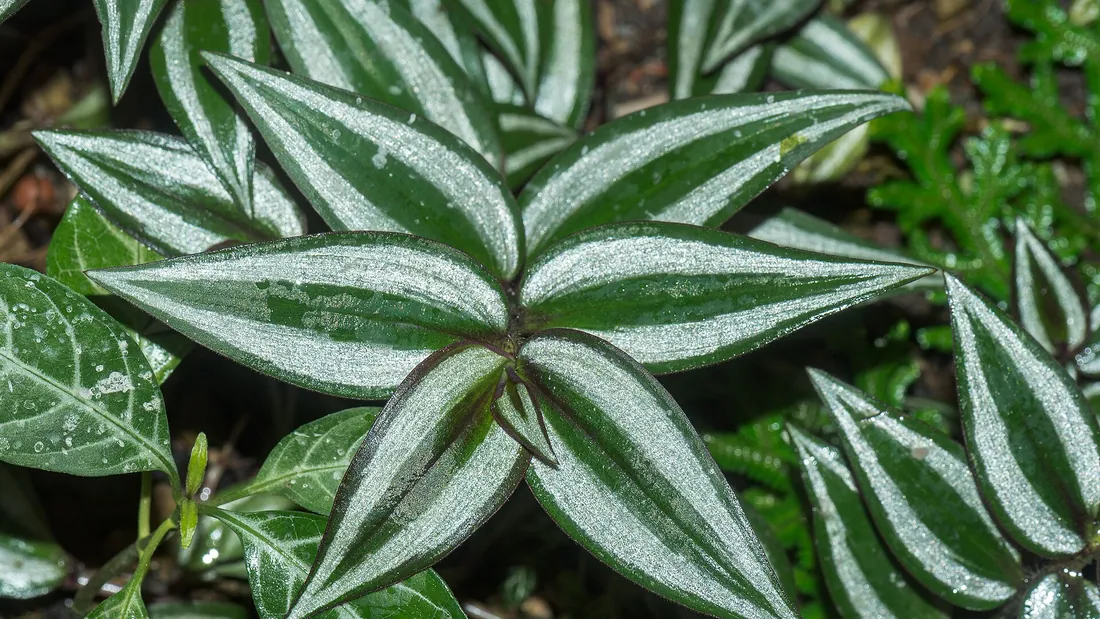

The inch plant (Tradescantia zebrina) is a trailing plant with foliage streaked in purple and silver, one of the most forgiving houseplants you can grow. It grows fast, roots from cuttings with your eyes closed, and puts up with plenty of neglect. Where winter freezes it is strictly a houseplant: it does not survive the cold season outdoors, but it happily enjoys the balcony or terrace during the warm season. Its only real demand is light, without which its pretty colours fade to a dull green.
Light and exposure
Give the inch plant bright light, ideally a little direct sun in the morning or late in the day. This is where all its charm is at stake: its leaves keep their purple and silver banding only in good light. In shade the plant keeps growing but stretches, its stems space out and the foliage pales until it turns almost green.
An east or west windowsill suits it very well. Behind a south-facing pane, a light screen during the hottest summer hours keeps the leaves from scorching. If you hang it, turn the pot a quarter turn now and then so it stays full on every side.
Watering
Water when the first few centimetres of compost have dried out, then empty the saucer. The inch plant likes to stay slightly moist in spring and summer, without ever being waterlogged. Its stems are a little fleshy and take the odd missed watering in stride: better to let it dry out a bit than to drown it.
In winter growth slows and its needs drop sharply. Space out the watering clearly then, letting the substrate dry more between two. Excess water in the cold season rots the base of the stems and softens the foliage, and that is the most common trouble on this otherwise sturdy plant.
Soil and repotting
An ordinary houseplant compost does the job, lightened with a handful of perlite or coarse sand so the water drains quickly. The inch plant is not fussy about the nature of the soil, it mostly wants it not to stay soaked.
Choose a pot with a drainage hole, wider than it is deep since the roots stay shallow. Repotting every one or two years in spring is enough, but since the plant renews itself so quickly through cuttings, many people simply start over with young cuttings in fresh compost rather than repotting an old, bare plant.
Temperature and humidity
The inch plant is happy in ordinary house temperatures, between 16 and 26 degrees. It enjoys summer warmth and easily tolerates a heated interior, as long as you do not press it against a radiator that dries the air.
Below 10 degrees it suffers, and the slightest frost kills it. It is a houseplant in a temperate climate: outdoors only in the warm season, and brought back in well before the first cold nights. Also avoid cold draughts in front of a poorly insulated door or window in winter.
Pruning and upkeep
Pinch the tips of the stems regularly, just above a leaf. The plant responds by branching, which fills it out instead of letting it run off into long bare stems. This is the key move to keep a full, trailing plant.
Over time the old stems go bare at the base, which is normal for this species. Cut them back without hesitation: they shoot again from below, and the cut pieces make just as many cuttings. A good spring cutback rejuvenates a tired plant in a few weeks.
Pests and diseases
The inch plant is rarely troubled by disease. The main danger remains stem rot linked to excess water, especially in winter: soft, translucent stems at the base, leaves that come away. The fix is simple, let it dry more and cut back into the healthy part to re-root.
As for pests, watch for spider mites when the air gets too dry near the heating, as well as mealybugs tucked into the leaf axils. A regular check and a lukewarm shower on the foliage are usually enough. Note finally that the sap can irritate sensitive skin: rinse your hands after pruning or taking cuttings, and wear gloves if your skin reacts easily.
Propagation
This is the plant to give someone starting out with cuttings, so easy is it. Cut a ten-centimetre stem below a node, remove the lower leaves and plunge it into a glass of water. Roots appear in just a few days, and you can pot it up as soon as they reach two or three centimetres.
Cuttings work just as well straight into moist compost, several sprigs in the same pot for an instant bushy effect. Spring and summer give the fastest roots, but with a little warmth the inch plant roots practically all year round. Make the most of it to renew an old plant or to give some away around you.
Climate and hardiness
Where and in which climate it thrives
In a temperate climate, the inch plant is grown as a full-fledged houseplant. Tradescantia zebrina is not hardy wherever it freezes: it tolerates neither frost nor cold nights, so leaving it outside in winter or planting it permanently in the ground is out of the question.
The right routine is to put it out on the balcony or terrace once the last frosts have passed, until early autumn. Outdoors, in clear light, it takes on its finest colours and grows before your eyes. Keep an eye on watering then, because a pot in full sun dries fast. Bring it back in as soon as the nights drop below 10 degrees again, and set it in a well-lit spot for winter. Under weak winter light, place it as close as possible to a window to keep it from stretching and paling. This is also the time to ease off on watering. A cutback in spring, as the light returns, restarts it for the whole season.
Growing inch plant?
Green Hub keeps a dated history of your own plant: its photos, its progress, its repottings. An AI answers about yours specifically, not a generic sheet, for free.
Identify my plantMonth-by-month care calendar
| January | Winter rest indoors. Water little, let it dry well between two. Keep it as close as possible to a bright window to limit stretching. |
|---|---|
| February | Still quiet. Watch for spider mites near the heating and give the foliage a lukewarm shower if the air is too dry. |
| March | Light returns. Cut back the bare stems to fill out and repot if the plant is cramped. Resume slightly more regular watering. |
| April | Full growth restarting. Take cuttings from the cut pieces in water or compost. Pinch the tips for a bushy plant. |
| May | Harden the plant off in shade for a few days, then put it out on the balcony after mid-May, once all risk of frost has passed. |
| June | Outdoors in bright light, it takes on its finest colours. Water regularly, the substrate dries fast in a pot in the sun. |
| July | Fast growth. Pinch to keep the shape, empty the saucers after rain. Take cuttings, they root in a few days. |
| August | In peak form. Keep up the close watering in strong heat and turn the hanging pot for even foliage on every side. |
| September | Bring the plant back in as soon as the nights cool below 10 degrees. Set it in a well-lit spot for winter. |
| October | Adjusting to indoor life. Reduce watering as growth slows and keep it away from cold draughts. |
| November | Entering rest. Water sparingly, no feeding. Clean the dusty foliage to catch what little light is available. |
| December | Full rest. Little water, no fertiliser. Take a few backup cuttings if needed on a bright sill to prepare for spring. |
Green Hub tips
- The more you pinch the stems, the bushier the plant becomes. A plant that stretches and goes bare simply calls for more frequent pinching.
- The colours are a light thermometer: nicely purple and silver foliage, it is in the right spot; foliage turning green and stems stretching, move it closer to the window.
- For a quick cutting, a glass of water and a stem are enough: the roots come out in a few days. Ideal to share or to multiply to fill a pot.
- Rinse your hands after pruning: the sap can sting sensitive skin. Light gloves settle the matter if your skin reacts fast.
- Never leave it outside in winter. A single night of frost is enough to lose it, whereas indoors it gets through the cold season without trouble.
Related species
Aglaonema
Aglaonema commutatum
The aglaonema (Aglaonema commutatum) is a robust, easy houseplant, prized for its foliage variegated with green,…
Alocasia
Alocasia
The alocasia, nicknamed elephant ear, charms with its large, dramatically veined leaves. It is a demanding tropical…
Aloe vera
Aloe vera
Aloe vera (Aloe vera) is a succulent from the Arabian Peninsula, grown since antiquity for the soothing gel of its…
Anthurium
Anthurium andraeanum
The anthurium (Anthurium andraeanum) is a tropical houseplant known for its smooth, waxy red spathe, which people often…
Areca palm
Dypsis lutescens
The areca (Dypsis lutescens) is a tropical palm from Madagascar, frost-tender, grown indoors wherever winter freezes.…
Boston fern
Nephrolepis exaltata
The Boston fern (Nephrolepis exaltata) is a hanging indoor fern, born in the humid undergrowth of the tropics. Here,…
The guides that mention it
Updated on
How this sheet is written
Written for Green Hub with the help of language models, then reviewed. It offers gardening guidance, not professional advice: if you are unsure whether a plant is toxic to a child or an animal, ask a vet, a doctor or your national poison centre.