Florist’s cyclamen
Cyclamen persicum
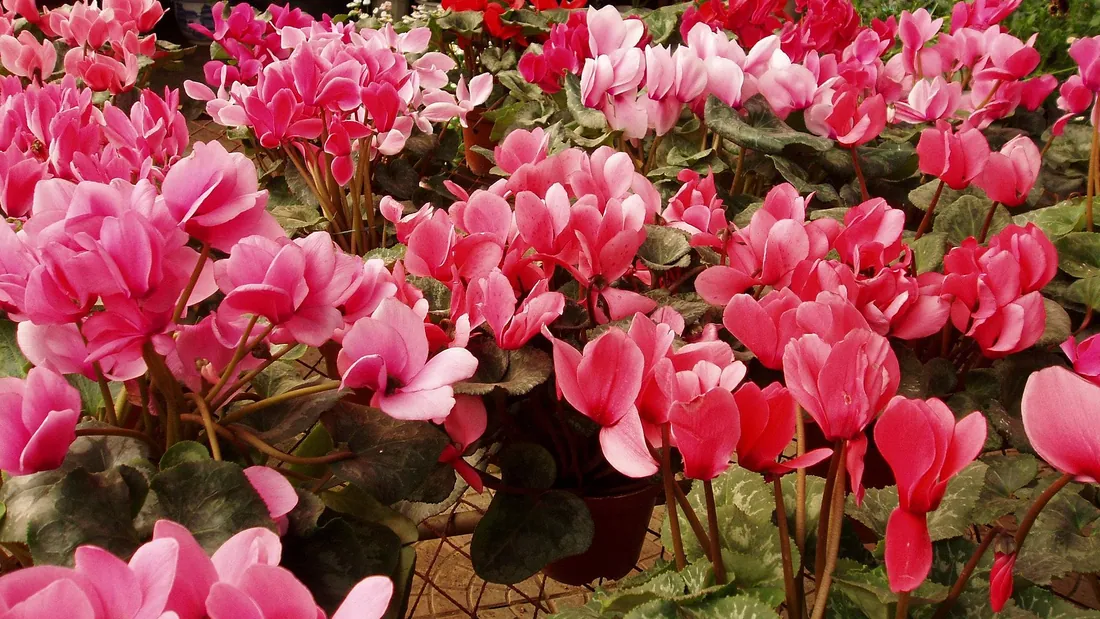

The florist’s cyclamen (Cyclamen persicum) is a houseplant that does the opposite of the others: it flowers in autumn and winter, when everything else rests, then goes dormant in summer. Its flowers, with their swept-back petals ranging from white to deep red, last for weeks above marbled foliage. Success comes down to two words: coolness and watering from below. It hates the heat of a radiator and rots if water touches its heart. Treated well, it flowers again year after year. Take care not to confuse it with the Neapolitan cyclamen, which is hardy in the garden.
Light and exposure
Cyclamen wants bright light but no scorching sun. An east- or north-facing window, or a spot set back a little from a south exposure, gives it the brightness it loves without cooking its foliage. In full bloom, good light helps the buds open and brings out the colours.
Avoid dark rooms, where it grows leggy and flowers poorly. The ideal spot is bright and above all cool: a lightly heated bedroom, a hallway, a windowsill away from any heat source. Light matters, but coolness matters even more.
Watering
Watering is the point that decides everything. Always water from below: set the pot in a saucer or a basin of water for about fifteen minutes, let the compost drink, then tip out the excess. Never wet the heart of the plant or the top of the tuber, water that sits there rots the crown and that is the most common cause of death.
Keep the compost fresh but never soaked during flowering. As summer begins, when the leaves yellow and the plant goes dormant, cut watering back sharply until it is almost fully suspended. The tuber then rests dry, and you gently resume watering at the end of summer when new leaves appear.
Soil and repotting
A light, rich and above all very well-drained compost suits it. A mix for flowering plants with a little sand or perlite added stops water from sitting around the tuber. Drainage here is a matter of survival, not comfort.
When planting or repotting, let the top of the tuber stick out slightly above the compost, half exposed. Buried too deep, it holds moisture on its crown and rots. A good drainage hole at the bottom of the pot is essential.
Temperature and humidity
This is a plant that loves the cool, against the grain of our overheated homes. It thrives between 15 and 18 degrees by day, and enjoys even cooler nights, down to 10 degrees. Under these conditions, flowering lasts for weeks.
Heat is its enemy. Placed near a radiator or in a room at 22 degrees, it yellows, its flowers fade quickly and it goes dormant early. Do not mistake it for a tropical plant: the milder and cooler its surroundings, the better it does. That is exactly what makes it a little temperamental in a well-heated house.
Pruning and upkeep
Cyclamen is not pruned. Care consists of removing spent flowers and yellowed leaves as they appear. Do not cut them with scissors: grip the stem at the base, close to the tuber, and pull sharply with a slight twist to detach it cleanly.
This gesture matters, because a cut stem left in place decays and can rot the crown. Regularly removing old foliage keeps the plant healthy, airs the heart and encourages new buds to form.
Pests and diseases
Tuber rot is problem number one, almost always caused by watering from above or by an excess of water. A softening heart, an unpleasant smell, foliage that collapses all at once are the signs. Prevention lies in watering from below and good drainage, there is little remedy once the crown is affected.
In a room that is too warm and stuffy, also watch for grey mould, botrytis, which covers leaves and flowers with a grey felt. Ventilate, remove affected parts, lower the temperature. Aphids and cyclamen mites can deform young foliage, more rarely.
Propagation
The florist’s cyclamen is propagated by seed, not by division: cutting the tuber gives nothing but rot. Collect the seeds from the capsules that form after flowering, when the stalks coil into a spiral, then sow in autumn in fresh compost, in darkness and in the cool, around 15 degrees.
Germination is slow and irregular, it takes several weeks, and you should count on a year or more before the first flowers. It is an exercise in patience, but it lets you raise plenty of plants. For most gardeners, coaxing an existing plant to flower again year after year remains the most rewarding path.
Toxicity
Cyclamen is toxic. It is the tuber that concentrates the danger: it is rich in saponins, in particular cyclamin, irritant substances. Eaten, it causes drooling, vomiting, diarrhoea and digestive upset, and at high doses cardiac trouble. The risk mainly concerns dogs and cats that dig up or chew the tuber, more rarely children drawn to the plant.
The leaves and flowers are far less loaded, but it is best to keep the plant out of reach of animals that nibble. Handling the foliage poses no danger, washing your hands is enough. If the tuber is eaten, contact your vet or the poison control centre.
Climate and hardiness
Where and in which climate it thrives
The florist’s cyclamen is grown as a cold-season houseplant, and a cool climate suits it rather well. The trap is the heating: through the heating season, a house often runs at 21 or 22 degrees, a temperature that makes it fade in a few days. Look for the coolest room you have, a spare bedroom, a hallway, a frost-free veranda, a windowsill away from the radiator. A cyclamen that lasts three months rather than three weeks is almost always a matter of coolness.
Water it from below, without ever wetting the heart, and let it sleep in summer, leaves yellowed and pot kept dry in a sheltered corner. It starts again at the end of summer. A word to avoid the most common confusion: Cyclamen persicum is not hardy and does not overwinter outdoors where it freezes. It is Cyclamen hederifolium, the Neapolitan cyclamen, a different species, that is perfectly hardy in zone 8a and flowers at the foot of trees in autumn, year after year, without protection. If you want cyclamen in the garden, that is the one to plant, not the florist’s kind.
Growing florist’s cyclamen?
Green Hub keeps a dated history of your own plant: its photos, its progress, its repottings. An AI answers about yours specifically, not a generic sheet, for free.
Identify my plantMonth-by-month care calendar
| January | Full bloom. Keep the plant cool, away from radiators, in bright light. Water from below and remove spent flowers and yellow leaves by pulling on the stem. |
|---|---|
| February | Flowering continues if the room stays cool. Keep watering by soaking and add a little flowering-plant feed every two to three weeks. |
| March | Last flowers of the season. Keep cleaning off the old foliage. Gradually space out watering as flowering fades. |
| April | The foliage sometimes starts to yellow: this is the start of the rest period, not a disease. Reduce water and stop feeding. |
| May | Entering dormancy. Let the leaves yellow and dry without pulling them off by force. Place the pot in a cool, shaded corner, watering very rarely. |
| June | The tuber rests, kept dry. Almost no watering, just enough to avoid complete drying out. Keep the pot in shade and cool. |
| July | Full summer dormancy. The tuber sleeps, without leaves. Leave it at rest, sheltered from sun and rain, without drowning it. |
| August | End of dormancy. Watch for small leaves appearing at the centre of the tuber. As soon as they show, gently resume watering from below. |
| September | Growth resumes. Repot if needed into fresh, well-drained compost, tuber half exposed. Resume regular watering by soaking. |
| October | The foliage develops and the first buds rise. Set the plant somewhere cool and bright. A small feed is possible. |
| November | Flowering begins. Keep it away from the heating that starts up in the house. Water from below, heart always kept dry. |
| December | Generous flowering in the middle of winter. Coolness, light and regular soaking. Remove spent flowers and leaves to relaunch the buds. |
Green Hub tips
- Always water from below, by soaking the pot, and never over the heart. Water that sits on the tuber rots it, the number one cause of death.
- Flee the heat. Away from radiators, between 15 and 18 degrees, a cyclamen flowers for weeks; at 22 degrees it fades in a few days.
- Leaves yellowing in summer? That is normal, the plant is going dormant. Reduce water, let it rest dry, it starts again at the end of summer.
- Do not confuse it with Cyclamen hederifolium, which is hardy in the garden. The florist’s cyclamen does not survive winter outdoors.
- The tuber is toxic to dogs and cats. Keep the plant out of their reach and do not let any animal dig in the pot.
Related species
Aglaonema
Aglaonema commutatum
The aglaonema (Aglaonema commutatum) is a robust, easy houseplant, prized for its foliage variegated with green,…
Alocasia
Alocasia
The alocasia, nicknamed elephant ear, charms with its large, dramatically veined leaves. It is a demanding tropical…
Aloe vera
Aloe vera
Aloe vera (Aloe vera) is a succulent from the Arabian Peninsula, grown since antiquity for the soothing gel of its…
Anthurium
Anthurium andraeanum
The anthurium (Anthurium andraeanum) is a tropical houseplant known for its smooth, waxy red spathe, which people often…
Areca palm
Dypsis lutescens
The areca (Dypsis lutescens) is a tropical palm from Madagascar, frost-tender, grown indoors wherever winter freezes.…
Boston fern
Nephrolepis exaltata
The Boston fern (Nephrolepis exaltata) is a hanging indoor fern, born in the humid undergrowth of the tropics. Here,…
The guides that mention it
Toxic Plants for Cats and Dogs: Recognising the Danger Rather Than Memorising a List
A list of toxic plants is easily forgotten and always incomplete. What actually protects a cat or dog is recognising…
What to Plant in a Shade Garden, Under Trees and Against Sunless Walls
Under a large tree or against a wall the sun never reaches, shade doesn’t rule out a planting bed: it calls for a…
Updated on
How this sheet is written
Written for Green Hub with the help of language models, then reviewed. It offers gardening guidance, not professional advice: if you are unsure whether a plant is toxic to a child or an animal, ask a vet, a doctor or your national poison centre.