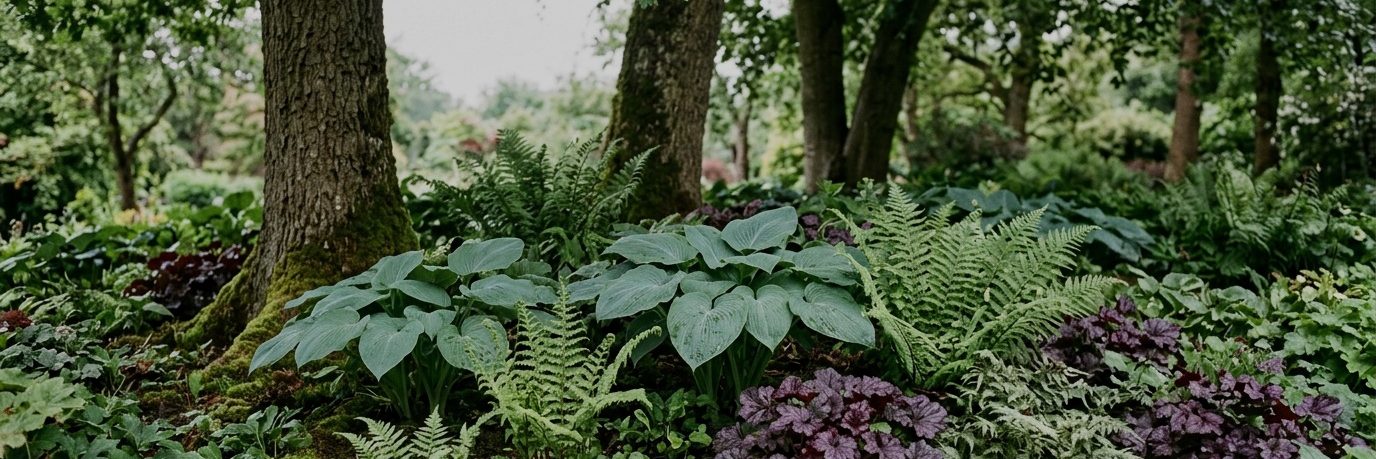
What to Plant in a Shade Garden, Under Trees and Against Sunless Walls
A shade garden thrives on its own palette rather than on the leftovers of full sun: partial shade, dense shade under a tree canopy and dry shade at the foot of a large specimen each call for different species, shrubs as much as perennials. The real obstacle under a large tree is, in fact, less a lack of light than root competition for water and nutrients, in soil that is often poor and dry even under a damp climate. By telling these situations apart and preparing the soil properly, you can build shade beds that stay attractive all year round: holly and yew for the winter framework, hosta and cyclamen for the seasonal carpet.
Partial Shade, Dense Shade, Dry Shade: Three Very Different Situations
Three different situations hide behind the word shade, and they don’t call for the same plants. Partial shade gets three to six hours of direct sun, often in the morning, under light foliage such as a birch, or against a wall that only catches the morning sun. Dense shade falls below three hours of direct light, under a thick canopy of beech or hornbeam, or at the foot of a wall direct sun never reaches: the light stays diffuse there all day long. Dry shade combines a lack of light with a lack of water, under a large tree with a dense root system, oak, beech or maple, whose shallow roots intercept rainfall before it reaches the soil at depth.
The best way to diagnose your plot remains observing it at several points in the day, keeping in mind that things change with the seasons: under deciduous cover, the light of late winter and early spring, before the leaves emerge, benefits woodland plants that make the most of it to flower early. This pattern holds just as true in a lowland garden as on a colder plateau, deep in the countryside or on the edge of a city: what matters is the density of the canopy, not the region.
Under a Large Tree: Poor, Dry Soil Contested by Roots
The soil under a large tree is rarely fertile, even in open ground and even on good garden land. The shallow roots of an oak, a beech or a maple capture most of the water and nutrients in the top thirty centimetres, exactly where you would want to plant a perennial or a shrub. The canopy intercepts a good share of the rain before it reaches the ground, except close to the trunk, where water runs down along the bark. The result: soil that is often dry in summer, even in a climate that receives 900 mm of rain a year, and poor in organic matter if the base of the tree is mowed rather than mulched.
The trick is to work with the tree rather than against it. Plant in autumn, when rainfall is regular and the plant can settle its roots before the tree’s own roots become active again in spring. Avoid deep digging, which damages the large roots: it’s better to open small pockets between them with a border spade and work in mature compost or leaf mould. A five to seven centimetre mulch retains moisture and enriches the soil season after season. For the first two summers, generous but spaced-out watering helps the planting take root.
Evergreen Shrubs That Hold the Winter Framework
Under deciduous cover, winter strips everything bare, leaves down, the bed exposed, unless a few evergreens hold the framework together. Yew remains the most tolerant of dense shade and dry soil: as a specimen, a clipped hedge or a low mass planting, it grows slowly but never falters, even at the foot of a large tree, its only requirement being soil that doesn’t sit waterlogged in winter. Holly copes with deep shade almost as well; planted in a group with at least one male to pollinate the females, it carries its red berries from autumn into winter, valuable to blackbirds. Cherry laurel grows faster and quickly covers a wall or a property boundary in dry shade, but its vigour calls for pruning every year, in early summer, after the new growth.
Boxwood, lower and finer in texture, structures the front of a shade bed as a clipped edging; it remains vulnerable to box tree moth and leaf spot disease, two problems that affect it as much in sun as in shade. Privet, semi-evergreen, loses part of its foliage in hard winters but tolerates shade and hard pruning without flinching, a good choice for a low hedge between a shade bed and a path.
Hazel, Hornbeam, Elder, Viburnum: Shrubs and Small Trees for the Woodland Edge
Four native or naturalised species extend the evergreen framework with lighter, deciduous foliage and real value for wildlife. Hazel tolerates partial shade well at the edge of a canopy, flowers as early as late winter with its yellow catkins, before the leaves even appear, and coppices without any trouble if you want to keep it in check. Hornbeam differs from beech in its better tolerance of shade and heavier soil; clipped as a hedge, it keeps its brown leaves all winter, useful for visually closing off a shade bed during the cold season.
Elder grows quickly at a shaded edge, carrying its white flower umbels in early summer and then its black berries in late summer, sought after by blackbirds; hard pruning every two or three years, after fruiting, stops it from taking over the whole space. Viburnum rounds out the palette: guelder rose tolerates damp partial shade with its balls of white flowers and red berries lasting into winter, while laurustinus, nearly evergreen, does well in drier shade. Planted together in a mixed hedge, these four shrubs form the transition between the sunlit edge and the shaded heart of the bed.
Perennials, Ground Cover and Hydrangea: Composing the Carpet and Blocks of Colour
Beneath the shrub framework, the carpet plays out in three acts. Hosta dominates cool, moist shade with its broad foliage, from spring to the first frosts, as long as the soil stays moist and you keep an eye out for the slugs that riddle it with holes in spring. Lily of the valley colonises the same soil in a dense mat, under a shrub or along a shaded path, and flowers in late spring without asking for any upkeep. Cyclamen, for its part, pulls off the opposite feat: Naples cyclamen, planted at the foot of a large tree, tolerates drought and root competition better than almost any other perennial, and flowers in early autumn, when the rest of the bed is already resting.
Hydrangea finds its place wherever the shade stays cool without being dry, at the edge of the bed rather than right against the trunk, with soil that never runs short of water in summer. Begonia, in a pot or as a small splash of colour in partial shade, brings an easy touch of summer colour, to be brought indoors or grown as an annual depending on the variety. Composed in layers, evergreens at the back, edge shrubs taking over from there, perennials as the carpet, a shade bed stays alive all year round: holly berries in winter, lily of the valley in spring, hosta foliage in summer, cyclamen in autumn.
The care sheets to read next
Every plant mentioned has its full sheet: watering, light, soil, pests and a month-by-month calendar.
Hosta
Hosta
The hosta (Hosta spp.) is a perennial native to the damp woodlands of East Asia, from Japan through China to Korea. It…
Holly
Ilex aquifolium
Holly (Ilex aquifolium) is an evergreen shrub with glossy, spiny leaves and bright red berries that light up in the…
Yew
Taxus baccata
Yew (Taxus baccata) is a conifer native to Europe, able to live for several centuries and to regrow from old wood…
Box
Buxus sempervirens
Box (Buxus sempervirens) is an evergreen shrub that has been clipped into balls, cones and low borders in formal…
Cherry laurel
Prunus laurocerasus
Cherry laurel (Prunus laurocerasus) is the most widely planted evergreen hedging shrub in temperate gardens, and it is…
Hydrangea
Hydrangea macrophylla
The hydrangea (Hydrangea macrophylla) is the flowering shrub for cool, partly shaded gardens, and one of the very few…
Lily of the valley
Convallaria majalis
Lily of the valley (Convallaria majalis) is the small perennial with white, fragrant bell flowers traditionally given…
Florist’s cyclamen
Cyclamen persicum
The florist’s cyclamen (Cyclamen persicum) is a houseplant that does the opposite of the others: it flowers in autumn…
Viburnum
Viburnum
Viburnum is not one plant but a whole family of more than a hundred and fifty shrubs, broad enough to cover almost…
Elder
Sambucus nigra
Elder (Sambucus nigra) is a large shrub native to temperate Europe that grows wild in hedgerows, along footpaths and on…
Hazel
Corylus avellana
The hazel (Corylus avellana) is a shrub native to Europe and western Asia, found for as long as anyone can remember in…
Hornbeam
Carpinus betulus
The hornbeam (Carpinus betulus) is a native tree of temperate Europe, so common in hedges and woods that people often…
Privet
Ligustrum ovalifolium
Privet (Ligustrum ovalifolium), often sold as California privet, is a shrub native to Japan that has become one of the…
Begonia
Begonia
Begonia is the star summer flower of window boxes, hanging baskets and shady borders. Hundreds of hybrids exist, but…
Frequently asked questions
Which plants tolerate dry shade under a large tree best?
Yew and cherry laurel do best among the shrubs, able to grow at the foot of an oak or a beech without declining. Among perennials, Naples cyclamen is the undisputed champion of dry shade: planted right at the base of the trunk, it tolerates root competition better than hosta, which needs soil that stays moist to develop well.
What’s the difference between partial shade and dense shade when choosing plants?
Partial shade gets three to six hours of direct sun a day, often in the morning, under light foliage or against a wall that only catches the morning sun. Dense shade falls below three hours, under a thick canopy of beech or hornbeam, or at the foot of a wall direct sun never reaches. Hydrangea is happy with the former, while hosta or holly tolerate the latter without any trouble.
When should you plant shrubs or perennials under an already established tree?
Autumn remains the best season: more regular rainfall gives roots time to settle before the tree’s own roots become demanding again in spring. Avoid deep digging near the trunk, open small pockets between the large roots instead, and water generously through the first two summers while the planting establishes its roots.
Which perennial flowers in shade in autumn, when few plants are in bloom?
Naples cyclamen is the benchmark: planted at the foot of a large tree, it flowers in early autumn and then develops decorative marbled foliage through to spring. The berries of viburnum and elder, carried in late summer, also extend the season of colour before winter, when holly takes over with its own.
Green Hub looks after your plants
Photograph a plant: Green Hub identifies it and writes its care sheet, with no account. Sign in afterwards to keep its dated photos and history over time.
Identify a plantUpdated on
How this sheet is written
Written for Green Hub with the help of language models, then reviewed. It offers gardening guidance, not professional advice: if you are unsure whether a plant is toxic to a child or an animal, ask a vet, a doctor or your national poison centre.