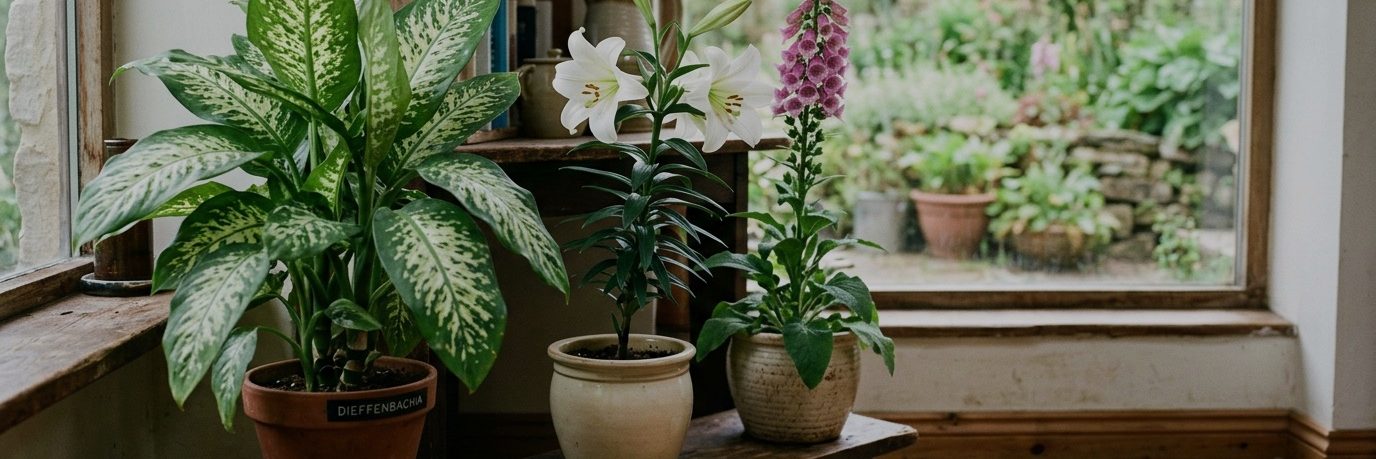
Toxic Plants for Cats and Dogs: Recognising the Danger Rather Than Memorising a List
A list of toxic plants does not protect anyone for long: it is easily forgotten, it is always incomplete, and it says nothing about how serious a given ingestion actually is. What makes a cat or dog owner able to decide is recognising the major toxin families at work, knowing that a cat does not react to the same toxin the way a dog does, and knowing the one action that matters in the first few minutes. In cats, one danger dominates all the others: true lilies and daylilies cause acute kidney failure from minimal exposure, including pollen or vase water, with no equivalent in dogs.
The useful question when a cat or dog has chewed on a plant is not whether it is toxic in general, but which mechanism is at work and how fast it acts. The calcium oxalate crystals in aroids such as dieffenbachia, philodendron, monstera, pothos or peace lily burn the mouth but rarely kill. Cardiac glycosides in lily of the valley and kalanchoe, alkaloids in yew, or cyanogenic compounds in cherry laurel and elder, by contrast, target a vital organ and leave little margin for error. In cats specifically, true lilies (Lilium) and daylilies (Hemerocallis) cause acute kidney failure from minimal exposure, including pollen or vase water, a danger with no equivalent in dogs. Garlic and onion, for their part, destroy red blood cells in both species through a completely different mechanism, with signs that only appear several days after ingestion. In every case, the rule for action stays the same: as soon as an ingestion is confirmed or even only suspected, contact your vet or your country’s animal poison control centre without delay, without waiting for symptoms to appear, and without ever making the animal vomit yourself, an act that is dangerous and contraindicated for several of these toxins.
Four toxin families, and the question that replaces the list
A list of toxic plants gives the reassuring impression of a manageable subject, but it is forgotten as soon as it is closed, it stays structurally incomplete since new varieties enter the market every year, and above all it flattens dangers that have nothing in common with each other. On a raw list, a dieffenbachia that burns the mouth for an hour sits right next to a yew, a handful of whose needles can stop a dog’s heart within a few dozen minutes. Someone who has memorised twenty plant names has not, in reality, learned to recognise either an emergency or its absence.
What actually makes someone able to judge is knowing the small number of chemical mechanisms that recur from one plant to another. Calcium oxalate crystals irritate mechanically whatever tissue they touch, without being absorbed into the body. Cardiac glycosides and certain alkaloids target the heart muscle directly. Other alkaloids, concentrated in bulbs that a dog digs up or a cat knocks over while playing, act on the nervous system and the gut. Saponins irritate the digestive tract along a gradient that depends mostly on the quantity swallowed. Cyanogenic compounds stay harmless as long as the leaf is intact and only release their poison once it is chewed. One last family, with no chemical link to the others, deserves a category of its own: the sulphur compounds in garlic and onion, which destroy red blood cells through a mechanism that has nothing digestive or neurological about it.
Recognising the family a plant belongs to then becomes possible even without knowing its name: a milky sap and thick leaves suggest a ficus and its local irritation, a bulb hidden beneath strap-like leaves suggests the amaryllis family and its alkaloids, and flowers in bell shapes or hanging clusters deserve the same caution reserved for cardiac glycosides. The sections that follow detail each family with the plants actually found in homes and gardens, before a reference table brings the whole set together plant by plant.
Calcium oxalate crystals: the burn that rarely kills, and its opposite that really does
Dieffenbachia, philodendron, monstera, pothos and peace lily all belong to the arum family, and share the same defence mechanism: their tissues contain insoluble calcium oxalate crystals shaped like microscopic needles, called raphides. A chewed leaf releases them instantly into the mouth, where they lodge in the mucous membranes. The pain is immediate, drooling is heavy, and the animal paws at its mouth or shakes its head. In the vast majority of cases, the animal spits the leaf out and stops on its own, which limits the dose actually swallowed: according to data from the ASPCA Animal Poison Control, these exposures are not considered life threatening, even though rare swelling of the throat can occasionally interfere with breathing or swallowing.
Ficus plants follow a related but distinct logic: the rubber plant (Ficus elastica), the fiddle-leaf fig (Ficus lyrata) and the common fig (Ficus carica) all secrete a milky sap containing a proteolytic enzyme and a photosensitising compound. This sap irritates the mouth and gut if a leaf is chewed, and irritates the skin on simple contact, which is why gloves are worth wearing to prune these plants. The mechanism is documented at the level of the whole genus rather than plant by plant: any plant genuinely related to ficus deserves the same caution, including a fruiting fig grown for its fruit rather than its foliage.
The word oxalate, however, hides two dangers of a completely different nature, and the mix up is a costly one. The raphides in aroids are insoluble: they act purely by mechanical contact, exactly where they lodge, without entering the bloodstream. The leaves of rhubarb, by contrast, contain soluble calcium oxalates, which dissolve in the digestive tract, pass into the bloodstream, bind there to the available calcium, and can either cause blood calcium levels to drop or crystallise inside the kidney tubules. This is a systemic mechanism, capable of genuine kidney damage, with no relation at all to the local, rarely serious burn caused by a dieffenbachia. Two plants that share the word oxalate in their description can therefore belong to two entirely opposite categories of severity.
The heart as target: cardiac glycosides and cardiotoxic alkaloids
Lily of the valley contains, in every part of the plant, cardiac glycosides such as convallatoxin, which act directly on heart rhythm. Ingesting leaves, flowers or rhizomes can cause nausea and vomiting, then cardiac arrhythmias that can go as far as cardiac arrest, in cats as in dogs. One detail matters as much as the plant itself: the water in a vase where lily of the valley stems have been standing becomes toxic too, and must never be left within reach.
Kalanchoe, a very common potted flowering plant sold year round, acts through a related chemistry, bufadienolides, another family of cardiac glycosides that blocks the sodium potassium pump in heart muscle cells. The first signs are digestive, vomiting and drooling, before arrhythmias appear in cases of substantial ingestion, in cats as in dogs.
Yew changes chemistry without changing target: its alkaloids, the taxines, present in the needles, the bark and above all the seeds contained inside the berries, act on cardiac ion channels rather than on the sodium potassium pump, but the clinical result looks much the same, a sudden cardiac arrest, sometimes without the slightest warning sign. Only the soft red covering around the seed, the aril, is free of danger; the seed itself stays toxic if it is bitten into. A yew hedge remains one of the most dangerous plants a cat or dog can come across in the garden.
Three plants from this same family deserve to be named separately, because they are far more widespread than lily of the valley, and a guide that leaves them out misses most of the real cardiac risk. Oleander contains oleandrin, a cardiac glycoside active in every part of the plant, including dried material, including the water that cut branches have stood in: it is one of the most toxic ornamental plants there is for a companion animal, and it lines entire avenues throughout every mild climate. Foxglove, which gave its name to digoxin, works through the same chemistry throughout the whole plant. Azalea and rhododendron go through a different molecule, grayanotoxin, but arrive at the same place: vomiting and weakness first, then arrhythmias. These are among the most widely planted shrubs in the world, and that very ordinariness is precisely what makes them dangerous.
These different chemistries, cardiac glycosides in lily of the valley, oleander and foxglove, bufadienolides in kalanchoe, grayanotoxins in azalea, taxine alkaloids in yew, all converge on the same target. That is what makes the category toxic to the heart more useful to remember than the exact name of each molecule: it tells you immediately that no waiting period is reasonable.
The cat’s absolute emergency: true lilies and acute kidney failure
In this entire field, one fact outweighs all the others: in cats, true lilies (the genus Lilium, which includes the Asiatic lily, the Oriental lily and the Easter lily) and daylilies (the genus Hemerocallis) cause acute kidney failure. The precise toxin still has not been identified with certainty, but its effect is documented unambiguously by the ASPCA Animal Poison Control: every part of the plant is implicated, including pollen that settles on the coat and water that cut flowers have stood in. Minimal exposure is enough, sometimes a single bite of petal or a few grains of pollen licked off a paw.
The first signs, lethargy and vomiting, can appear in as little as two hours, but the real kidney damage plays out over twenty four to seventy two hours. Treatment has to start very quickly, within eighteen hours according to the ASPCA, to offer a serious chance of recovery; there is no antidote, only supportive care started as early as possible. That is exactly why, for this particular family of plants, a vet should be contacted as soon as exposure is confirmed, without waiting for the slightest sign.
A dog exposed to the same plants, in the vast majority of cases, only gets a passing digestive upset, with no kidney damage: this is a mechanism specific to cats, with no documented equivalent in dogs. This asymmetry alone justifies treating the exact same bouquet differently depending on which animal shares the house.
The word lily, however, tells you almost nothing about a plant’s actual toxicity, and it misleads in both directions at once.
| Common name | Botanical genus | Actual toxicity | Species most at risk |
|---|---|---|---|
| True lily (Asiatic lily, Oriental lily, Easter lily) | Lilium | Acute kidney failure from minimal exposure, including pollen or vase water | Cats, almost exclusively |
| Daylily | Hemerocallis | The same acute kidney risk as true lilies, despite a name that sounds harmless | Cats, almost exclusively |
| Peace lily | Spathiphyllum | Calcium oxalate crystals: mouth burns, drooling, rarely more | Cats and dogs, low severity |
| Lily of the valley | Convallaria | Cardiac glycosides: harms the heart, no link to the kidneys | Cats and dogs |
| Peruvian lily | Alstroemeria | Not a true lily and no kidney risk at all; the ASPCA lists it as non-toxic, other poison control centres report mild digestive upset | Cats and dogs, low or no severity depending on the source |
The peace lily is not a true lily: its calcium oxalate crystals, already described above, cause nothing worse than a burnt mouth. Lily of the valley is genuinely dangerous, but through the cardiac route already covered, not the kidneys. The Peruvian lily is not a true lily either and poses no kidney risk at all; veterinary sources disagree here, with the ASPCA listing it as non-toxic while other poison control centres report mild digestive upset. The daylily, unlike these three examples, sounds like just another ordinary border perennial, with nothing in its name to suggest danger: yet it shares, in cats, exactly the same kidney risk as true lilies, and deserves exactly the same emergency response.
Bulbs mistaken for vegetables
A bulb gets dug up, unearthed, batted around like a toy, and that behaviour puts a digging dog at just as much risk as a cat that tips over a pot: three common plants show how the very same action can hide very different chemistries.
Clivia and daffodil belong to the amaryllis family and concentrate lycorine and related alkaloids, mostly in their bulb. At low doses, ingestion causes drooling, vomiting and diarrhoea; a large quantity of bulb can trigger convulsions, a drop in blood pressure and arrhythmias. The daffodil bulb, in particular, can be mistaken for an onion at a glance, a mix up that comes up regularly even among people who store their planting bulbs next to their vegetables.
Tulips belong to an entirely different botanical family and an entirely different chemistry: their toxins, the tulipalins, are allergenic lactones rather than alkaloids, also concentrated in the bulb. They cause drooling, vomiting and digestive upset, with more pronounced signs when a large quantity is swallowed. In people who handle large numbers of bulbs at planting time, they also cause a characteristic contact dermatitis.
In the moment, it barely matters whether the bulb being chewed is a clivia, a daffodil or a tulip: the behaviour that creates the exposure, digging up and biting into a round object, matters more than precise botanical identification, and calls for exactly the same reflex to pick up the phone.
Saponins: a gradient of severity depending on dose
Saponins are defence molecules that many plants manufacture against their natural predators. Unlike the cardiac toxins already covered, their danger is not binary: it increases with the quantity swallowed, which makes the context of the ingestion, a leaf nibbled out of curiosity versus an entire pot knocked over and devoured, just as important as the identity of the plant.
Sansevieria and dracaena illustrate the mild to moderate end of this gradient: vomiting, drooling and diarrhoea if leaves are eaten. Dracaena stands out in cats through vomiting sometimes tinged with blood and dilated pupils, a sign distinctive enough to help point to the diagnosis.
Aloe vera deserves a note on handling: the translucent gel at the centre of the leaf is harmless, but the yellow latex found just beneath the rind concentrates saponins and anthraquinones, with a marked laxative effect and digestive upset if an animal ingests it.
Holly and yucca sit even lower on this same gradient, with digestive upset most often limited to vomiting and brief diarrhoea for small quantities of berries or foliage.
Cyclamen rounds off this overview by illustrating the gradient within a single plant: its leaves and flowers carry only a low concentration of cyclamine, while its underground tuber concentrates most of it. A cat that nibbles a leaf in passing does not run the same risk as a dog that digs up and chews the tuber, where cardiac disturbances and convulsions become possible at high doses.
Plant cyanide and garlic-induced anaemia: what the vegetable patch hides
One last family of toxins stays invisible for as long as the leaf is intact. Cherry laurel, hydrangea and raw elder contain cyanogenic compounds: an enzyme and a cyanide-carrying sugar stay separated in different compartments of the plant cell, and only meet once chewing, crushing or wilting breaks down that separation, releasing hydrogen cyanide.
In cats and dogs, this chemistry does less damage than is often assumed: both species break down plant matter far less efficiently than grazing livestock, in which severe cyanide poisonings are the best documented. In the vast majority of real world ingestions in cats and dogs, the signs stay digestive, drooling, vomiting, abdominal discomfort, generally appearing between fifteen minutes and a few hours after chewing. Elder illustrates this logic well: its green parts and raw berries are the concern, while cooking destroys the cyanogenic compound, which makes those same berries harmless once turned into jam or syrup.
Tomato adds yet another, different toxin, solanine, present in the leaves, stems and green fruit, but absent at any worrying dose from the ripe fruit. It causes excessive drooling, lethargy and digestive upset, in cats as in dogs.
Garlic and onion deserve a full explanation of their own, because their mechanism has nothing to do with anything covered so far. Their sulphur compounds directly oxidise red blood cells, whether raw, cooked, dried or powdered, causing haemolytic anaemia in both species. Cats are more sensitive to it than dogs, and garlic, at a comparable quantity, is several times more toxic than onion. The main trap lies in the delay: red blood cells start breaking down quickly, but the anaemia itself only becomes visible several days after ingestion, so an animal that seems perfectly normal that same evening is no reassurance at all.
Rhubarb closes out this tour of the vegetable patch by echoing the distinction drawn earlier: its leaves contain soluble oxalates, absorbed by the body, capable of dropping blood calcium and reaching the kidneys, a severity that its closeness to the edible stalks makes easy to forget. Wisteria, whose seeds and pods concentrate lectins and a glycoside, wisterin, causes vomiting sometimes tinged with blood and diarrhoea if pods that have fallen to the ground are eaten. Privet, finally, with its black berries and leaves, causes digestive upset and incoordination in an animal that eats it in quantity.
The table that follows brings together, plant by plant, the species most at risk, the most dangerous part and the effect observed, for every plant mentioned so far.
| Plant | Species most affected | Most toxic part | Effect observed |
|---|---|---|---|
| Dieffenbachia | Cats and dogs | Leaves and stems | Immediate mouth burns, drooling, difficulty swallowing |
| Philodendron | Cats and dogs | Leaves | Mouth irritation, drooling, vomiting |
| Monstera | Cats and dogs | Leaves | Irritation of the mouth and throat |
| Pothos | Cats and dogs | Leaves and stems | Mouth irritation, heavy drooling |
| Spathiphyllum | Cats and dogs | Leaves | Mouth burns, drooling, rarely throat swelling |
| Sansevieria | Cats and dogs | Leaves | Vomiting, drooling, diarrhoea |
| Rubber plant (Ficus elastica) | Cats and dogs | Milky sap | Mouth and digestive irritation, skin irritation on contact |
| Fiddle-leaf fig (Ficus lyrata) | Cats and dogs | Milky sap | Mouth and digestive irritation, skin irritation on contact |
| Common fig (Ficus carica) | Cats and dogs | Milky sap | Same irritant mechanism as other ficus |
| Lily of the valley | Cats and dogs | The whole plant, and vase water | Cardiac arrhythmias, vomiting, risk of cardiac arrest |
| Yew | Cats and dogs | Needles and seeds, the whole plant except the flesh of the aril | Cardiac arrest, sometimes with no warning sign |
| Oleander | Cats and dogs | All parts, even dried, and water they have stood in | Oleandrin: cardiac arrhythmias that can go as far as cardiac arrest |
| Foxglove | Cats and dogs | The whole plant | Cardiac glycosides: vomiting, weakness, arrhythmias, possible cardiac arrest |
| Azalea and rhododendron | Cats and dogs | Mainly the leaves, but the whole plant | Grayanotoxins: vomiting and weakness first, then cardiac arrhythmias |
| Sago palm (Cycas) | Mainly dogs, cats too | All parts, especially the seeds | Cycasin: vomiting, jaundice, clotting disorders, liver damage, possible death |
| Autumn crocus | Cats and dogs | Mainly the bulb, but the whole plant | Colchicine: vomiting sometimes bloody, diarrhoea, shock, multiple organ damage |
| Castor bean | Cats and dogs | Mainly the seeds | Ricin: mouth irritation, vomiting, diarrhoea, kidney damage, convulsions, possible death |
| Monkshood | Cats and dogs | The whole plant, including the root | Aconitine: digestive upset, muscle weakness, arrhythmias, no specific antidote |
| Kalanchoe | Cats and dogs | The whole plant | Vomiting, drooling, cardiac arrhythmias with large quantities |
| Clivia | Cats and dogs | Bulb and fleshy roots | Vomiting, drooling, convulsions if a large quantity of bulb is eaten |
| Daffodil | Cats and dogs | Bulb | Vomiting, drooling, convulsions if the bulb is eaten |
| Tulip | Cats and dogs | Bulb | Drooling, vomiting, more severe effects with large quantities |
| Dracaena | Cats and dogs, dilated pupils typical in cats | Leaves | Vomiting sometimes tinged with blood, drooling, lethargy |
| Cyclamen | Cats and dogs | Tuber | Drooling, vomiting, cardiac disturbances if the tuber is eaten |
| Aloe vera | Cats and dogs | Yellow latex beneath the rind | Vomiting, diarrhoea, laxative effect |
| Holly | Cats and dogs | Berries | Vomiting, diarrhoea |
| Yucca | Cats and dogs | Leaves | Mild digestive upset |
| Cherry laurel | Cats and dogs | Leaves and seed kernels | Digestive upset, rarely more serious |
| Hydrangea | Cats and dogs | All parts | Digestive upset |
| Elder | Cats and dogs | Raw berries, leaves, bark | Digestive upset |
| Garlic | Cats (more sensitive) and dogs | All parts, including cooked or powdered | Destruction of red blood cells, delayed anaemia |
| Onion | Cats (more sensitive) and dogs | All parts, raw or cooked | Destruction of red blood cells, delayed anaemia |
| Tomato | Cats and dogs | Leaves, stems, green fruit | Digestive upset, weakness |
| Rhubarb | Cats and dogs | Leaves | Drop in blood calcium, possible kidney damage |
| Wisteria | Cats and dogs | Seeds and pods | Vomiting sometimes tinged with blood, diarrhoea, lethargy |
| Privet | Cats and dogs | Berries and leaves | Digestive upset, incoordination |
Cat versus dog: a real difference, not a cliché
It is tempting to treat toxic to animals as a single, uniform risk, but cats and dogs respond differently to several of the molecules already described, for precise, documented physiological reasons, not out of mere blanket caution.
A cat’s liver clears certain families of substances less effectively: it lacks part of the glucuronidation enzyme pathway that other species commonly use to neutralise compounds before excreting them. The consequence can be measured directly: paracetamol, to cite just one well documented example, stays active in a cat’s blood for nearly five times as long as in a dog’s. This same metabolic fragility partly explains why certain plant toxins, tolerated by a dog at a low dose, remain dangerous for a cat at the same dose relative to body weight.
The lily remains the clearest illustration of this asymmetry, a kidney toxin that strikes only the cat for an identical exposure. Garlic and onion give a more nuanced version: both species are affected by the destruction of red blood cells, but the cat is more sensitive to it at a comparable quantity.
Behaviour adds its own difference, independent of chemistry. A dog more readily swallows large quantities without discrimination, which increases the raw dose received. A cat is more selective bite by bite, but makes up for it through curiosity, access to height by jumping or climbing, and above all through grooming, which turns pollen or sap deposited on the coat into a delayed exposure that no amount of watching the food bowl can anticipate.
Recognising the emergency, acting in the first few minutes, and setting up a safe space
An isolated, purely oral sign, drooling, pawing at the mouth, a slight retch, most often points to the kind of local irritation already covered, oxalate crystals or ficus sap, and is rarely a life threatening emergency on its own. By contrast, vomiting and diarrhoea that persist, an abnormal heart rhythm, tremors, convulsions, jaundice, or simply the fact that a cat has been near a lily or a daylily, all justify treating the situation as a life threatening emergency regardless of how the animal currently looks, because several of the toxins described above, renal, cardiac, delayed haemolytic, do most of their damage before any sign becomes visible.
| Sign observed | What it signals | What to do |
|---|---|---|
| Drooling and pawing at the mouth, with no other sign | Local mouth irritation, often mild | Contact the vet to confirm, monitor how it develops |
| Vomiting and diarrhoea that persist | Digestive toxin, severity varies with the plant and the quantity | Contact the vet or the animal poison control centre without waiting for it to worsen |
| Abnormal heart rhythm, weakness, collapse | Cardiac toxin, life threatening emergency | Contact the vet as an absolute emergency, transport the animal immediately |
| Lethargy, or no sign at all, in a cat recently in contact with a lily or a daylily | Kidney failure already developing, even if invisible | Contact the vet immediately, without waiting for a symptom |
| Dark urine, weakness, pale gums, several days after eating garlic or onion | Delayed haemolytic anaemia | Contact the vet as soon as the ingestion is known, not only once these signs appear |
Two actions should be ruled out whatever the plant involved. The first is waiting to see whether symptoms appear before calling: for the most serious toxins, the useful window for action is measured in hours and closes well before a wait and see approach has noticed anything unusual. The second is making the animal vomit yourself: this is actively dangerous for an irritant substance, which then passes a second time through a mouth and oesophagus already under attack, carries a real risk of inhalation in an animal that is already unwell, and in any case serves no purpose at all once the toxin has been absorbed. A phone call costs nothing and lets a professional decide within seconds whether inducing vomiting is even appropriate for the substance involved.
The sequence that works stays simple: move the animal away from the rest of the plant, keep a fragment if possible or note its name, the time, and the approximate quantity involved, then contact your vet or your country’s animal poison control centre without delay, including outside opening hours through an emergency service. This approach applies just as much before a symptom appears as after.
For the handful of plants classed as an absolute emergency, true lilies, daylilies, lily of the valley, yew, placing them up high does not amount to real protection given how a cat jumps and grooms itself: the only reliable strategy in a home with a cat is not to bring them in at all; for a dog, a genuinely inaccessible area of the garden remains a workable option. For the rest of the plants covered here, ordinary vigilance is enough, and for anyone looking for indoor species with no risk at all, several are verified as non-toxic by reference veterinary sources: calathea, maranta, spider plant, peperomia, Chinese money plant and Boston fern. Non-toxic does not mean harmless in any quantity: an animal that gorges on a large amount of any foliage, even harmless foliage, can get a passing bout of digestive discomfort, unrelated to poisoning.
Common pitfalls to avoid
MistakeBelieving that a cat instinctively avoids toxic plants.
Why :A cat has no innate ability to detect the chemical danger in a leaf: it explores through taste and texture, especially when young, and an unpleasant flavour limits the quantity swallowed but does not prevent that first bite. For several toxins in this guide, such as lily pollen or yew needles, that first bite alone is already enough.
Do this instead :Treat the presence of a high risk plant within a cat’s reach as no barrier at all, whatever the animal’s usual behaviour, and think in terms of moving or removing the plant rather than trusting the animal’s judgement.
MistakeAssuming that a bouquet or plant placed up high keeps a cat safe.
Why :A cat jumps and climbs effortlessly to most surfaces in a room, which already defeats the height argument. Worse, for the most serious danger in this guide, a simple brush of the muzzle against the stamens is enough to deposit pollen on the coat, which the animal then swallows all by itself while grooming, long after the bouquet has been put back seemingly out of reach.
Do this instead :For plants in the most serious category, true lilies, daylilies, lily of the valley, yew, the only reliable solution in a home with a cat is not to bring them in at all, rather than looking for a spot high enough.
MistakeWaiting for symptoms to appear before calling a vet.
Why :Several of the most serious toxins in this guide act silently before any visible sign: the kidneys of a cat exposed to a lily may already be deteriorating while the animal still seems normal, and the useful window for effective treatment is measured in hours. Waiting to see if something happens means letting go of exactly the time that would have allowed action.
Do this instead :Contact the vet or the animal poison control centre as soon as an ingestion is confirmed or even only likely, describing the plant and the quantity involved, without waiting for a first sign before picking up the phone.
MistakeTreating every plant called a lily as the same risk.
Why :The common name misleads in both directions. The peace lily is not a true lily and its danger stays limited to a burnt mouth. The daylily, by contrast, sounds like just another ordinary border perennial, yet shares exactly the same acute kidney risk as true lilies in cats. Reacting to the name rather than the botanical genus can lead just as easily to panicking over nothing as to underestimating a genuine emergency.
Do this instead :Identify the actual botanical genus before judging severity, relying on a verified match rather than the common name on the label, and treat any Lilium or Hemerocallis as an absolute emergency in cats, whatever name it was sold under.
MistakeMaking the animal vomit yourself in the belief that it limits the poisoning.
Why :Inducing vomiting is contraindicated for several of the toxins described here: an irritant substance passes twice through a mouth and oesophagus already under attack, and an animal that is already unwell risks inhaling what it brings up. Once the toxin has been absorbed, making the animal vomit achieves nothing anyway. No owner can judge alone which of these situations they are in.
Do this instead :Never induce vomiting without explicit instruction from a vet or an animal poison control centre: the first useful action is always the phone call, which lets a professional decide within seconds whether vomiting is even desirable for the substance involved.
The care sheets to read next
Every plant mentioned has its full sheet: watering, light, soil, pests and a month-by-month calendar.
Dieffenbachia
Dieffenbachia seguine
Dieffenbachia (Dieffenbachia seguine) is a houseplant with large foliage variegated in cream and green, native to the…
Heartleaf philodendron
Philodendron hederaceum
The heartleaf philodendron (Philodendron hederaceum), also known as the sweetheart plant, is a vine from the tropical…
Swiss cheese plant
Monstera deliciosa
The Monstera deliciosa, or Swiss cheese plant, is a tropical liana from Central America that has become the star of…
Pothos
Epipremnum aureum
The pothos (Epipremnum aureum), also called devil’s ivy, is a tropical vine from the Solomon Islands that has become…
Peace lily
Spathiphyllum
The peace lily (Spathiphyllum) is a tropical understorey plant from Central America, prized for its glossy green…
Clivia
Clivia miniata
The clivia (Clivia miniata) is a sturdy, generous houseplant from the undergrowth of South Africa. Its broad strap-like…
Kalanchoe
Kalanchoe blossfeldiana
The kalanchoe (Kalanchoe blossfeldiana) is a flowering succulent from Madagascar, with fleshy leaves and small clusters…
Florist’s cyclamen
Cyclamen persicum
The florist’s cyclamen (Cyclamen persicum) is a houseplant that does the opposite of the others: it flowers in autumn…
Madagascar dragon tree
Dracaena marginata
The Madagascar dragon tree (Dracaena marginata) is a houseplant with a slender trunk and a tuft of strap-like leaves…
Aloe vera
Aloe vera
Aloe vera (Aloe vera) is a succulent from the Arabian Peninsula, grown since antiquity for the soothing gel of its…
Rubber plant
Ficus elastica
The rubber plant (Ficus elastica) is a tree of the humid forests of Southeast Asia, grown in temperate climates as a…
Fiddle-leaf fig
Ficus lyrata
Ficus lyrata, or fiddle-leaf fig, is an African understorey tree recognisable by its large, glossy, violin shaped…
Snake plant
Dracaena trifasciata
The snake plant (Dracaena trifasciata), long classed under the name Sansevieria trifasciata and nicknamed…
Lily of the valley
Convallaria majalis
Lily of the valley (Convallaria majalis) is the small perennial with white, fragrant bell flowers traditionally given…
Yew
Taxus baccata
Yew (Taxus baccata) is a conifer native to Europe, able to live for several centuries and to regrow from old wood…
Cherry laurel
Prunus laurocerasus
Cherry laurel (Prunus laurocerasus) is the most widely planted evergreen hedging shrub in temperate gardens, and it is…
Hydrangea
Hydrangea macrophylla
The hydrangea (Hydrangea macrophylla) is the flowering shrub for cool, partly shaded gardens, and one of the very few…
Calathea (peacock plant)
Goeppertia (anciennement Calathea)
The calathea (genus Goeppertia, long classified under Calathea), or peacock plant, brings together tropical understorey…
Prayer Plant
Maranta leuconeura
The prayer plant (Maranta leuconeura) is a houseplant with striking foliage, veined in red or marbled in light and dark…
Spider plant
Chlorophytum comosum
The spider plant (Chlorophytum comosum), also called ribbon plant, is a South African perennial that has become the…
Peperomia
Peperomia
The peperomia (genus Peperomia) brings together a large family of small houseplants with thick, fleshy foliage, such as…
Chinese money plant
Pilea peperomioides
The Pilea (Pilea peperomioides) is an easy houseplant, recognisable by its round, fleshy leaves that look like little…
Boston fern
Nephrolepis exaltata
The Boston fern (Nephrolepis exaltata) is a hanging indoor fern, born in the humid undergrowth of the tropics. Here,…
Yucca
Yucca elephantipes
The indoor yucca (Yucca elephantipes) is a shrub from Central America with a thick swollen trunk, without the prickly…
Daffodil
Narcissus
The daffodil (Narcissus) is the first big signal of spring in the garden. Long before the tulips, its yellow trumpets…
Tulip
Tulipa
The tulip (Tulipa) is a spring-flowering bulb, come from the mountains of Central Asia and become the emblem of Dutch…
Holly
Ilex aquifolium
Holly (Ilex aquifolium) is an evergreen shrub with glossy, spiny leaves and bright red berries that light up in the…
Privet
Ligustrum ovalifolium
Privet (Ligustrum ovalifolium), often sold as California privet, is a shrub native to Japan that has become one of the…
Wisteria
Wisteria sinensis
Wisteria (Wisteria sinensis) is a woody climber from China, capable of covering an entire house front within a few…
Rhubarb
Rheum rhabarbarum
Rhubarb (Rheum rhabarbarum) is a robust, long-lived perennial that thrives anywhere the winter is a real one. A…
Tomato
Solanum lycopersicum
The tomato (Solanum lycopersicum) is the queen of the vegetable garden, but it is a plant of sun and warmth that plays…
Garlic
Allium sativum
Garlic (Allium sativum) is one of the easiest vegetables in a kitchen garden, provided you grasp two things. You don’t…
Onion
Allium cepa
The onion (Allium cepa) is a hardy, no-fuss bulb vegetable, one of the easiest crops to succeed with in a vegetable…
Elder
Sambucus nigra
Elder (Sambucus nigra) is a large shrub native to temperate Europe that grows wild in hedgerows, along footpaths and on…
Fig tree
Ficus carica
The fig tree (Ficus carica) is a Mediterranean tree, yet it really can be grown up to USDA zone 7 provided you shelter…
Frequently asked questions
Why is the lily so dangerous for a cat, when it is almost harmless for a dog?
True lilies (Lilium) and daylilies (Hemerocallis) contain a toxin that still has not been identified with certainty, and that specifically attacks a cat’s kidneys: every part of the plant is implicated, including pollen deposited on the coat and water that cut stems have stood in. Minimal exposure, sometimes a single bite of petal, can be enough to trigger acute kidney failure within two or three days, with treatment that has to start very quickly to have a real chance of success. A dog exposed to the same plants most often develops nothing more than a simple digestive upset, with no kidney damage: this is a mechanism specific to the feline species, with no known equivalent in dogs.
Does a cat naturally avoid toxic houseplants?
No, and this is a dangerous piece of received wisdom. A cat explores out of curiosity, through taste and through play, with no innate ability to spot a dangerous plant before nibbling it, and young cats are especially prone to this kind of exploration. An unpleasant flavour can limit the quantity swallowed once a plant has been started on, but it does not prevent that first bite, which is already enough for certain powerful toxins. It is better to rely on plant placement and plant choice than on the animal’s judgement.
What should I do in the very first few minutes if my cat or dog has just chewed a suspect plant?
Move the animal away from the rest of the plant, keep a piece of it if possible or note its name, the time, and the approximate quantity involved, then contact your vet or your country’s animal poison control centre without delay, even outside opening hours through an emergency service. Never induce vomiting yourself: this action is dangerous for several toxins and should only ever be decided by a professional. Do not wait for a symptom to appear before calling, either, since some of the most serious toxins act before any visible sign.
Are lily of the valley and yew as dangerous as the lily for a cat?
They are very dangerous, but through a different mechanism and for both species at once, unlike the lily, which specifically targets a cat’s kidneys. Lily of the valley contains cardiac glycosides that directly disrupt heart rhythm, including through its vase water. Yew contains taxine alkaloids that can cause cardiac arrest within a few dozen minutes, sometimes with no warning sign at all, in cats as in dogs. These are two absolute emergencies, but they affect the heart rather than the kidneys, and they do not spare dogs the way the lily does.
Do a cat and a dog really risk the same thing from the same plant?
Not always, and the difference is physiological, not just a matter of size. A cat’s liver clears certain families of substances less efficiently, for lack of a well developed enzyme pathway, which lowers its safety margin for several plant toxins. The clearest example remains the lily, deadly to a cat’s kidneys and almost harmless to a dog. Garlic and onion, by contrast, damage the red blood cells of both species, but the cat is more sensitive to it at an equal quantity. There is also a behavioural difference: a dog more readily swallows large quantities, while a cat, more selective bite by bite, exposes itself differently by climbing, sniffing flowers up close, and grooming itself afterwards.
Which houseplants can I safely keep with cats or dogs?
Several common decorative plants are verified as non-toxic by reference veterinary sources: calathea, maranta, spider plant (Chlorophytum), peperomia, Chinese money plant (Pilea peperomioides) and Boston fern. They make a good replacement for a pothos or a dieffenbachia on an accessible shelf. Non-toxic, however, does not mean harmless in any quantity: an animal that gorges on a lot of foliage, even harmless foliage, can get a passing bout of digestive discomfort, unrelated to poisoning.
Green Hub looks after your plants
Photograph a plant: Green Hub identifies it and writes its care sheet, with no account. Sign in afterwards to keep its dated photos and history over time.
Identify a plantUpdated on
How this sheet is written
Written for Green Hub with the help of language models, then reviewed. It offers gardening guidance, not professional advice: if you are unsure whether a plant is toxic to a child or an animal, ask a vet, a doctor or your national poison centre.