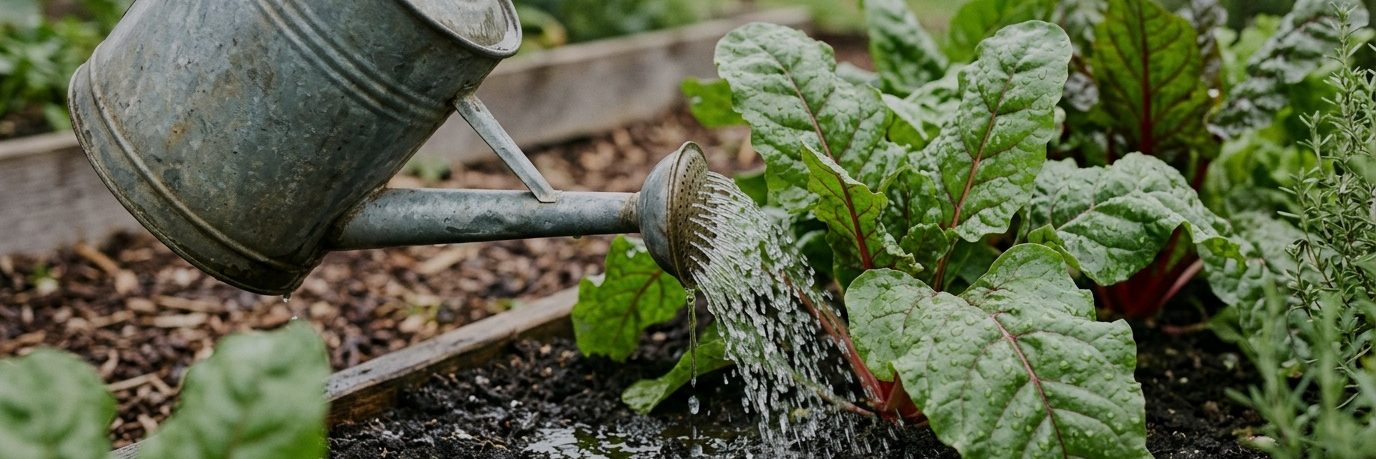
Watering Plants Properly: Deciding Rather Than Following a Schedule
Watering well is not about finding the right frequency, it is about learning to decide: a useful watering soaks the entire root zone, then the soil is left to drain before the next one. The most common mistake always runs the same way, small doses too close together that wet only the top few centimetres and build a shallow root system. Too much and too little water even produce the same limp leaves: only the state of the soil at depth settles it.
To water well, forget frequency and think in volume and depth instead. A successful watering reaches down to the bottom of the roots, then you wait for the top layer to dry: that is what pushes roots downward and makes the plant self-reliant. A small daily top-up, by contrast, wets only two or three centimetres of soil, concentrates roots at the surface and keeps the bottom of the pot saturated, where oxygen vanishes within hours. Since a suffocating plant wilts exactly like a thirsty one, never decide from the look of the foliage: push a finger 3 to 5 cm into a pot, weigh the pot, or dig a 20 cm hole in open ground. The dose is then set by the soil texture, the container and the plant’s growth stage, never by the calendar.
Watering More Often Does Not Mean Watering Better
The beginner’s reflex is always the same: a little water almost every day. Soil physics says the opposite. Water does not spread evenly through the ground, it moves down as a wetting front from the surface: above the front the soil is wet, below it the soil stays exactly as dry as before. One litre per square metre equals one millimetre of water depth, and 25 mm applied in one go reaches down about 30 cm in sandy soil, 18 cm in loam and only 10 to 12 cm in clay. A two-litre watering can spread over one square metre therefore wets one to two and a half centimetres of soil. The roots below never see that water.
Repeated for weeks, this habit creates the very problem it thinks it solves. Roots grow wherever water and air coexist: if the only moist zone is the surface, the whole root system settles there. Trials on turf are unambiguous, deep, spaced-out watering gives deeper rooting and better resilience in dry spells than daily watering. The plant becomes dependent on you: three hot days without you and it collapses.
The rule that replaces frequency fits in one sentence: soak the entire root zone, then wait for the top few centimetres to dry. Only two exceptions, seedlings and cuttings whose roots live entirely in the surface layer, and small containers in hot weather, where the growing medium alone is the whole root zone and goes from saturated to dry within a day.
What Water Actually Does in the Soil
After a thorough watering, gravity drains the largest pores within twenty-four to forty-eight hours; what stays held by capillarity is field capacity, the tank at its fullest. Once the roots have pulled out everything they can, you reach the permanent wilting point. The gap between the two, the available water capacity, is the only number that matters. A sandy soil is not thirstier than any other, its tank is simply smaller: 60 to 100 mm of usable water per metre of soil, against 150 to 200 mm for a loam or a clay. Same demand, half the reservoir, so closer and more modest applications: this is the one case where frequency is the right answer.
Infiltration speed is the other half of the story. Clay absorbs slowly: poured too fast, water runs off or pools on the surface. Two passes of about fifteen minutes solve the problem, the first breaks the resistance, the second soaks in. Sandy soil does the opposite, everything runs straight through, and whatever passes below the roots is lost.
| Soil | Available water per metre of soil | Depth wetted by 25 mm of water | What it requires | Common mistake |
|---|---|---|---|---|
| Sandy | 60 to 100 mm | About 30 cm | Moderate, closely spaced doses | A heavy application that runs below the roots |
| Loamy | 150 to 200 mm | About 18 cm | Large, well-spaced applications | Assuming you are safe without ever checking |
| Clay | 150 to 200 mm, partly inaccessible | 10 to 12 cm | Two passes about fifteen minutes apart | Pouring fast: water runs off or pools |
| Potting mix in a pot | Closed volume, no reserve around it | The whole root ball in one watering | Water until it runs out, then empty the saucer | A glassful that only wets the top |
Evapotranspiration gives the real calendar, valid in every climate and in both hemispheres. It runs around 1 mm a day in the cold season in a temperate climate, climbs to 4 to 6 mm a day at the height of the growing season, and reaches 5 to 8 mm in hot, dry, windy weather. A planted bed therefore loses 4 to 6 litres per square metre per day at peak season, and almost nothing once growth slows down.
A Drowning Plant Looks Exactly Like a Thirsty One
Roots breathe, and that is the whole story. Oxygen diffuses roughly ten thousand times more slowly in water than in air. As soon as the soil pores fill with water, gas exchange stops, and the remaining dissolved oxygen is used up within hours by the roots and by soil micro-organisms. Deprived of oxygen, a root stops actively absorbing water. The result is counter-intuitive: the plant wilts with its feet in water, and the foliage cannot tell the two situations apart.
Infection follows. The root-rot pathogens Pythium and Phytophthora produce mobile spores that swim through water films: it is waterlogging that carries them to roots already weakened. The roots turn brown and soft, their outer layer slides off between your fingers leaving a central thread behind, the collar darkens and turns slimy, a smell of stagnant water rises from the pot, and yellowing starts with the lowest leaves. Thirst produces the opposite: roots that are firm but dry and brittle, a root ball that shrinks away from the pot wall, leaf edges that are dry and crumbly.
In a confirmed case of overwatering, the worst move is to add more water. Unpot the plant, cut away everything soft back to clean tissue, repot into fresh, barely moist growing medium, without fertiliser, somewhere bright but not scorching. The asymmetry between the two accidents is worth remembering: a thirsty plant recovers within hours of a good watering, a drowned plant takes weeks and often does not make it. That is the whole argument for erring on the side of dry with water-storing plants such as aloe vera, snake plant, ZZ plant, echeveria and Christmas cactus. Even a pothos, a peperomia or a pilea dies more often from drowning than from drought.
Four Tests That Replace the Calendar
The finger test remains the first reflex: push your index finger 3 to 5 cm into a pot, water if it is dry, wait if it is not. Its limit is that it only tells you about the top layer, the one that dries first and lies the most. The skewer test fills that gap: push a wooden skewer down to the bottom of the pot, leave it thirty seconds, then pull it out. Dark and coated with clinging growing medium, the pot is moist at depth; clean and dry, the root ball is dry all the way down.
Pot weight is the most reliable indicator, and the least used. Water is heavy, a litre weighs a kilogram, and a five-litre pot that has used up half its reserve has lost several hundred grams, which you can feel immediately. Weigh the pot once right after it has drained, then again when the plant is genuinely asking for water: the comparison becomes instant from then on, even through a cachepot.
In open ground, only a trowel gives a real answer: dig a hole 20 to 25 cm deep next to the plant and look. The surface can be dusty while the root zone is still at field capacity, and the opposite is just as true after a 5 mm shower that only wetted the mulch. As for two-pronged metal moisture probes, they measure conductivity, not water: fertiliser salts make them read wet, fresh potting mix makes them read dry, and the electrodes corrode over time. Use them only to compare readings on the same pot, never as an absolute value.
Reading the Leaves Without Being Fooled
Leaf signals come late and stay ambiguous, which makes them poor triggers for action. The most misleading case is midday wilting. A courgette, a hydrangea, a tomato can droop under the strongest sun while the soil is perfectly moist, because transpiration briefly outpaces what the roots can absorb: the plant folds its leaves to reduce its exposed surface, a protection, not a distress signal. The real verdict comes early in the morning. Still limp at daybreak, the plant has a genuine problem; standing upright again, a two o’clock watering would only have added an excess.
Colour needs the same caution. Soft yellowing that spreads up from the lowest leaves, with the growing medium still moist, points to overwatering. Dry, crumbling, crispy edges point to underwatering, or to a build-up of salts. A leaf blade that yellows while the veins stay clearly green has nothing to do with thirst: it is iron chlorosis, with iron locked up by an alkaline soil or hard water, a classic case in blueberry and hydrangea watered with hard water.
Finally, context outweighs the leaf itself. A ficus that drops its leaves after repotting is reacting to the disturbance, and watering it more only finishes it off. A lettuce or a strawberry plant, rooted in the top fifteen centimetres, will falter well before a tomato settled twice as deep, in the same soil at the same moment. The leaf tells you something is happening, the growing medium tells you what.
Pot or Open Ground: Two Different Physics, Two Different Habits
In open ground, the soil acts as a buffer. Water infiltrates, capillarity redistributes it sideways, and roots go looking for it. On a tree or a large shrub, most of the root system, on the order of 90 percent, sits within the top 60 cm, but it spreads out over two to three times the width of the canopy. Watering at the foot of the trunk of an established cherry laurel or olive tree therefore waters almost nothing: you need to pour under the canopy’s edge and beyond.
A pot is a closed volume, with no capillary continuity with the ground, and two consequences of that go underestimated. First, the bottom of any container holds a saturated zone whose thickness depends on the growing medium used, not on the height of the pot: with the same medium, a wide, shallow bowl therefore stays proportionally far wetter than a tall pot. Second, the material sets the pace: unglazed terracotta dries out much faster than plastic or glazed ceramic. Drainage holes are not negotiable, and the saucer should be emptied ten minutes after watering.
The third trap is specific to pots. Peat or coco-based growing medium that has dried out to the core turns hydrophobic and shrinks away from the pot wall: the water then takes the free gap between the root ball and the wall and runs straight out of the bottom within seconds without wetting anything. The watering can is empty, the pot stays light, and the plant declines even though you would swear you watered it. The only fix is bottom-watering: stand the pot in a few centimetres of lukewarm water for twenty to thirty minutes, until the bubbles stop rising, then let it drain.
| Situation | What to check | Sign it is the right moment | Dose and rhythm | Trap specific to this case |
|---|---|---|---|---|
| Seedlings and cuttings | The top centimetre | The surface starts turning pale | Little, often, as a fine mist | A jet strong enough to dislodge the seeds |
| Indoor pot, cold season | Pot weight | Noticeably lighter than right after draining | Thoroughly, then wait ten to twenty days | Keeping up the summer rhythm |
| Outdoor pot, hot season | Finger at 3 cm, then weight | Dry at 3 cm and pot feels light | Until it runs out, sometimes every day | A full saucer left sitting in the sun |
| Plant put in that year | The root ball, not the soil around it | Root ball dry at 10 cm | Generous and spaced out, over the root ball and beyond | Little and often: the root ball stays dry |
| Established bed in open ground | The soil at 20 cm, with a trowel | Dry at 20 cm after weeks without rain | One heavy application, then one to two weeks | Watering at the foot of the trunk |
| Vegetable garden in production | The soil at 15 cm under the mulch | Dry beneath the mulch | Regular rather than heavy, at the base | Alternating drought and heavy watering |
| Drought-tolerant herbs and succulents | The growing medium at the core | Completely dry at the core | Thoroughly, then let it dry out completely | Treating thyme and lavender like basil |
The Plant’s Growth Stage Sets the Dose
In a seedling or a cutting, the root is one to two centimetres long and lives in the layer the sun dries first: here, and only here, little and often is the right move, as a very fine mist or watered from below. Counter-intuitively at this stage, stored rainwater is the wrong choice: a water butt can harbour Pythium and Phytophthora, the pathogens behind damping-off, and mains water is safer for young seedlings.
A plant put in the ground that year still lives off the root ball it arrived with. Lack of water during the first two seasons is the main cause of failed establishment in trees and shrubs, and an already sizeable specimen can take two to three seasons to become self-sufficient. Good practice is generous and spaced out: pour over the root ball and a little beyond it to draw the roots outward, keep a shallow watering basin, and leave a circle about 1.2 m wide free of competition. An established shrub, by contrast, asks for nothing outside of a prolonged drought.
In food production, consistency is what matters, not the total volume. Blossom end rot in tomato and pepper, those blackened patches at the base of the fruit, is not a lack of calcium in the soil but a failure of calcium transport caused by uneven watering. The same mechanism explains splitting: a heavy watering after a dry spell swells the flesh faster than the skin can stretch, and both tomato and carrot crack open. Finally, in the cold season and under low light, a houseplant stops growing: keeping up the summer rhythm is the leading cause of death for indoor monstera deliciosa and peace lily.
The Water Itself: Hardness, Sodium, Temperature
Hardness is measured in calcium carbonate: under 60 mg per litre the water is soft, from 60 to 120 moderately hard, from 120 to 180 hard, above 180 very hard. Units differ by country: one French degree of hardness equals 10 mg per litre, one German degree equals 17.8 mg per litre. But the parameter that actually acts on the growing medium is not hardness, it is alkalinity, in other words the bicarbonate content. Above roughly 60 mg per litre, every watering behaves like a small dose of lime: the pH of the growing medium rises, iron and manganese become unavailable, and the foliage yellows between veins that stay green.
Acid-loving plants pay the price first, blueberry and hydrangea in the garden, calathea, orchid and Boston fern indoors. Rainwater solves the problem: it holds almost no calcium and is naturally a little acidic, around pH 5.5 to 6. Two absolute rules on the tap-water side. Never water with the output of a household water softener, which trades calcium for sodium: the sodium builds up in the growing medium, burns root tips and degrades soil structure, which is why it pays to tap a garden line upstream of the softener. And keep chlorine in perspective: the few tenths of a milligram per litre found in drinking water do not harm garden plants, and evaporate within a day from an open watering can. Chloramine, increasingly used in its place, does not evaporate: that calls for an activated-carbon filter, or rainwater instead.
That leaves temperature: water noticeably colder than the growing medium slows absorption and can sometimes mark the foliage of tropical plants, which is why it helps to fill the watering can the evening before.
| Parameter | Typical range | Who notices it | What to do |
|---|---|---|---|
| Hardness, as calcium carbonate | Soft under 60 mg/L, hard from 120 to 180, very hard beyond that | White deposits on growing medium and foliage | Rainwater for acid-loving plants |
| Alkalinity, the bicarbonates | Above 60 mg/L, acts like a dose of lime | Blueberry, hydrangea, calathea, orchid | Rainwater, refreshed acidic growing medium |
| Sodium in softened water | Calcium is replaced with sodium | Scorched leaf edges, degraded soil | Never softened water: tap a line upstream |
| Chloramine | Stable, unlike chlorine: does not evaporate | Highly sensitive plants | Activated carbon, or rainwater |
| Water temperature | Colder than the growing medium, it slows absorption | Indoor tropicals | Fill the watering can the evening before |
| Stored rainwater | pH around 5.5 to 6, no lime | Seedlings, vulnerable to damping-off | Yes for acid-lovers, mains water for seedlings |
The Technique: When, How, and What to Water With
Morning is the best compromise, for three reasons: evaporation is at its lowest, the foliage dries during the day, and the plant heads into the hot hours with a full reserve. Evening comes second in very hot weather, but it leaves the foliage wet all night, exactly what mildew, powdery mildew and botrytis are waiting for: water at the base only if you go with evening.
As for the idea that a water droplet acts as a lens and burns leaves in the sun, the question has been measured and modelled: on a smooth leaf, the droplet spreads out and its optical focal point falls below the leaf blade, so no burn is possible. The effect only becomes real on hairy leaves, where the hairs hold the droplet in a sphere above the surface. The real reason to avoid the middle of the day is not optical but practical: you lose a lot to evaporation, and the first burst from a hose left in the sun comes out scalding. A plant genuinely in distress at two in the afternoon should be watered at two in the afternoon.
On equipment, a fine-rose watering can suits seedlings, a watering can without a rose, poured at the base, suits everything else. A drip line commonly delivers 2 litres per hour per emitter, which makes the dose easy to calculate; a soaker hose is laid every 30 to 45 cm in dense plantings. A sprinkler, by contrast, loses a lot to the air and wets the foliage. Finally, 5 to 7 cm of mulch laid over soil that is already moist strongly cuts evaporation from bare soil, by 40 to 90 percent depending on the material, provided the collar is kept clear. Mint and hosta, which are happy with permanently cool soil, benefit the most; thyme, rosemary and lavender can do without it.
Common pitfalls to avoid
MistakeGiving a small glass of water every day, just to be safe.
Why :Two litres spread over a square metre wet only one to two and a half centimetres of soil, even less in clay soil: below that layer, the ground stays as dry as before. Roots settle wherever the water arrives, at the surface, and the plant cannot go three hot days without you anymore.
Do this instead :Water thoroughly, until the whole root zone is wet, then wait for the top few centimetres to dry. Check once with a trowel how far down the water actually reached: that is the only real calibration for your watering can.
MistakeAdding more water to a wilting plant without ever touching the growing medium first.
Why :Root suffocation produces the same wilting as thirst: deprived of oxygen, the roots stop absorbing and the foliage droops even though the root ball is soaked. One more watering finishes the plant off.
Do this instead :Touch before you pour. Waterlogged growing medium, a dark collar, a smell of stagnant water, soft roots: unpot, cut back to clean tissue, repot into fresh, barely moist growing medium and wait for it to start growing again.
MistakeWatering a bone-dry pot and assuming the job is done because water runs out of the bottom.
Why :Peat or coco fibre that has dried out to the core turns hydrophobic and shrinks. Water takes the free gap between the root ball and the pot wall and runs straight out within seconds without wetting anything. The pot stays light and the plant declines even though you would swear you watered it.
Do this instead :Bottom-water it: stand the pot in a few centimetres of lukewarm water for twenty to thirty minutes, until the bubbles stop rising, then let it drain. And do not let the root ball reach that state again.
MistakeRelying on a layer of clay pebbles to make up for a sealed cachepot or a container with no drainage holes.
Why :A drainage layer does not create an exit: excess water still accumulates at the bottom and rises back into the growing medium, right where the roots are. Every container already has a saturated zone at its base whose thickness depends on the growing medium, not on the height of the pot, and a cachepot full of water only makes that zone thicker.
Do this instead :Drill drainage holes, or grow in an inner pot that you lift out to water. Water until it runs freely out of the bottom, then empty the saucer or the cachepot within ten minutes.
MistakeKeeping up the summer watering rhythm once demand collapses.
Why :Evapotranspiration drops from 4 to 6 mm a day at peak growth to about 1 mm in the cold season, and a houseplant under low light stops growing altogether. Same amount of water given, consumption divided by five or ten: the growing medium stays saturated for weeks, and rot sets in.
Do this instead :Switch back to check-first mode: weigh the pot or push in a skewer before every watering, and accept spacing it out to ten, fifteen or twenty days. Go back to a steady rhythm once growth resumes.
The care sheets to read next
Every plant mentioned has its full sheet: watering, light, soil, pests and a month-by-month calendar.
Tomato
Solanum lycopersicum
The tomato (Solanum lycopersicum) is the queen of the vegetable garden, but it is a plant of sun and warmth that plays…
Carrot
Daucus carota
The carrot (Daucus carota) is a staple root vegetable in the vegetable garden, keeping all winter and sown directly in…
Zucchini
Cucurbita pepo
The zucchini (Cucurbita pepo) is the easy summer vegetable par excellence, one plant yields more than a family can eat.…
Lettuce
Lactuca sativa
Lettuce (Lactuca sativa) is the most widely grown salad in the vegetable garden, easy and quick, harvested six to ten…
Strawberry
Fragaria x ananassa
The strawberry (Fragaria x ananassa) is a hardy perennial that fits very well into any vegetable garden. Hardy to…
Basil
Ocimum basilicum
Basil (Ocimum basilicum) is an annual, cold-sensitive herb that comes from the warm regions of Asia. It is a summer…
Mint
Mentha
Mint (Mentha) covers several species and hybrids, from spearmint to peppermint, all perennial and fragrant. It is a…
Lavender
Lavandula angustifolia
True lavender (Lavandula angustifolia) is a hardy Mediterranean plant that scents the air and draws bees all summer…
Rosemary
Salvia rosmarinus
Rosemary (Salvia rosmarinus, long known as Rosmarinus officinalis) is an evergreen Mediterranean shrub with needle-like…
Thyme
Thymus vulgaris
Thyme (Thymus vulgaris) is a small Mediterranean subshrub with woody stems and a powerful fragrance, hardy to about…
Olive tree
Olea europaea
The olive tree (Olea europaea) is a Mediterranean tree whose hardiness stops at around minus 8 to minus 10 degrees, in…
Cherry laurel
Prunus laurocerasus
Cherry laurel (Prunus laurocerasus) is the most widely planted evergreen hedging shrub in temperate gardens, and it is…
Hydrangea
Hydrangea macrophylla
The hydrangea (Hydrangea macrophylla) is the flowering shrub for cool, partly shaded gardens, and one of the very few…
Blueberry
Vaccinium corymbosum
The cultivated blueberry (Vaccinium corymbosum) is the large shrubby cousin of the wild bilberry, also called the…
Hosta
Hosta
The hosta (Hosta spp.) is a perennial native to the damp woodlands of East Asia, from Japan through China to Korea. It…
Swiss cheese plant
Monstera deliciosa
The Monstera deliciosa, or Swiss cheese plant, is a tropical liana from Central America that has become the star of…
Peace lily
Spathiphyllum
The peace lily (Spathiphyllum) is a tropical understorey plant from Central America, prized for its glossy green…
Calathea (peacock plant)
Goeppertia (anciennement Calathea)
The calathea (genus Goeppertia, long classified under Calathea), or peacock plant, brings together tropical understorey…
Orchid
Phalaenopsis
The moth orchid (Phalaenopsis) is the queen of houseplants, and for good reason: it flowers for months on end and copes…
Boston fern
Nephrolepis exaltata
The Boston fern (Nephrolepis exaltata) is a hanging indoor fern, born in the humid undergrowth of the tropics. Here,…
Pothos
Epipremnum aureum
The pothos (Epipremnum aureum), also called devil’s ivy, is a tropical vine from the Solomon Islands that has become…
Peperomia
Peperomia
The peperomia (genus Peperomia) brings together a large family of small houseplants with thick, fleshy foliage, such as…
Chinese money plant
Pilea peperomioides
The Pilea (Pilea peperomioides) is an easy houseplant, recognisable by its round, fleshy leaves that look like little…
Aloe vera
Aloe vera
Aloe vera (Aloe vera) is a succulent from the Arabian Peninsula, grown since antiquity for the soothing gel of its…
Snake plant
Dracaena trifasciata
The snake plant (Dracaena trifasciata), long classed under the name Sansevieria trifasciata and nicknamed…
ZZ plant
Zamioculcas zamiifolia
The ZZ plant (Zamioculcas zamiifolia) is a perennial from East Africa with upright stems lined with glossy, deep-green…
Echeveria
Echeveria
The echeveria is a rosette-forming succulent, born on the rocky plateaus of Mexico, that stores water in its thick,…
Christmas cactus
Schlumbergera
The Christmas cactus (Schlumbergera) is a spineless cactus, but not a desert cactus: it comes from the mountain forests…
Frequently asked questions
How often should you water your plants?
There is no single right frequency, and that is the trap. The same plant can need water every day in a small pot during hot weather and only once a month indoors once the light drops. What stays fixed is not the rhythm but the rule: water thoroughly when the root zone is dry, then wait. Check with a finger 3 to 5 cm deep in a pot, by the weight of the pot, or with a trowel in open ground.
How can I tell if I am watering too much or too little?
Not from the leaves: limp and yellowing, they say the same thing in both cases. Look at the growing medium and the roots instead. Waterlogged soil, a dark collar, a smell of stagnant water, brown and soft roots whose outer layer slides off: too much. Shrunken soil, dry at 20 cm, roots that are firm but brittle, crispy leaf edges: too little. One test settles it: a thirsty plant perks back up within hours, a drowned plant takes weeks.
How much water should you give at each watering?
Enough to wet the full depth of the roots, which depends on the soil. Twenty-five millimetres, or 25 litres per square metre, reach down about 30 cm in sandy soil, 18 cm in loam and only 10 to 12 cm in clay. In a pot, the marker is visual: water until it runs freely out of the drainage holes, then empty the saucer. Dig once right after watering to see exactly how far down the water reached.
Should you water in the morning or the evening, and does the sun burn wet leaves?
Morning is the best compromise: little evaporation, foliage that dries during the day, and so fewer fungal diseases. Evening cuts evaporation in very hot weather but leaves the foliage wet all night; water at the base if you go with evening. As for droplets acting as a lens, measurement has settled the question: on a smooth leaf, the focal point falls below the leaf blade, so no burn is possible. Only hairy leaves, which hold the droplet in a sphere, are ever affected.
Rainwater or tap water?
For most of the garden, tap water works perfectly well. Rainwater becomes useful when the mains water is hard, above 120 mg per litre of calcium carbonate, and especially rich in bicarbonates: every watering then acts like a dose of lime, which acid-loving plants cannot tolerate. Save it for blueberry, hydrangea, calathea and orchid. Never use water from a softener, which replaces calcium with sodium, and stick to mains water for seedlings.
How do you manage two or three weeks away from home?
In open ground, one deep watering before you leave and 5 to 7 cm of mulch over already-moist soil are enough for established plants: it is that year’s new plantings and the vegetable garden in production that suffer. In pots, group everything in light shade and out of the wind, since a single pot left in the sun dries out several times faster. Bottom-water the large containers, stand the small ones on a bed of damp sand, and test a drip system several days before you leave.
Green Hub looks after your plants
Photograph a plant: Green Hub identifies it and writes its care sheet, with no account. Sign in afterwards to keep its dated photos and history over time.
Identify a plantUpdated on
How this sheet is written
Written for Green Hub with the help of language models, then reviewed. It offers gardening guidance, not professional advice: if you are unsure whether a plant is toxic to a child or an animal, ask a vet, a doctor or your national poison centre.