Savory
Satureja hortensis
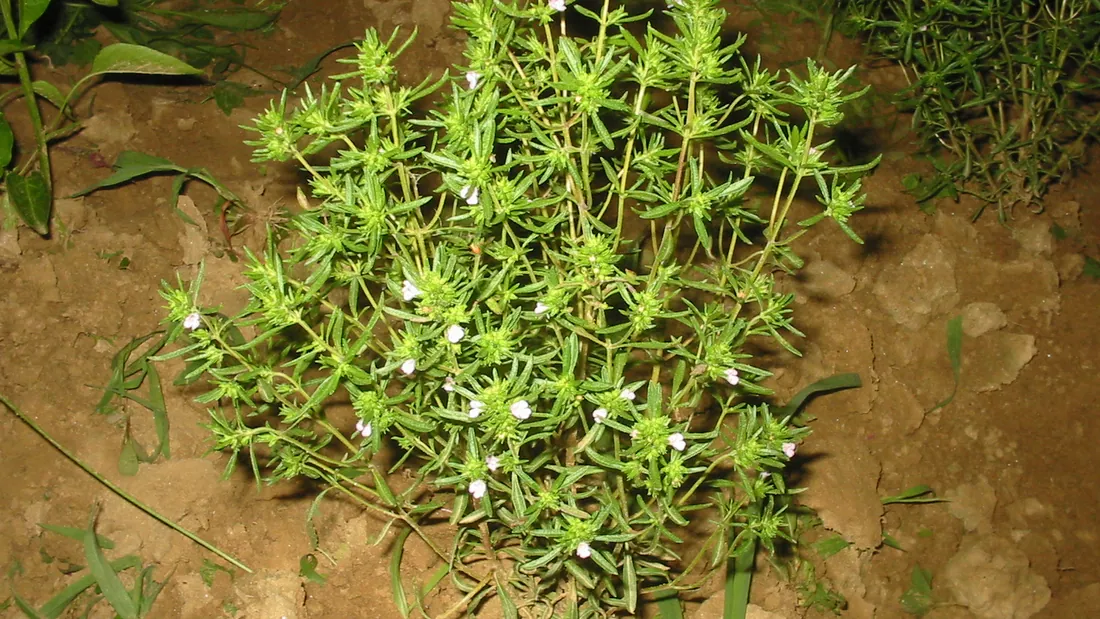

Savory is a Mediterranean herb with a peppery taste, a cousin of thyme and rosemary. Take care not to confuse two plants that share the same name: summer savory (Satureja hortensis) is an annual, resown every spring, while winter savory (Satureja montana) is a woody perennial, hardier, that lasts several years. Both ask for the same thing: full sun, poor and perfectly draining soil, and above all very little water. In a temperate climate, the perennial can spend the winter outdoors as long as its roots never sit in damp.
Light and exposure
Savory is a child of the south: it wants full sun, no compromise. Give it the warmest, brightest spot in the garden, a bank, a border with nothing casting shade over it, the foot of a wall that reflects heat. Six to eight hours of direct sun a day is what concentrates its essential oils and gives it that peppery scent so prized in cooking.
In shade or partial shade it grows weak, stretches upward and loses almost all its aroma. Under an often grey sky, do not skimp on light: a savory placed too much in the shade is a bland savory. In a pot, set it on the sunniest terrace and turn the container from time to time for even growth.
Watering
This is a plant of dry ground, and its greatest enemy is too much water. Once established, savory needs very little: it far prefers a slight thirst to constantly damp soil. Let the earth dry out between waterings and water only during prolonged drought, when the foliage is just beginning to show it.
At emergence and during the first weeks, keep the soil slightly moist while the young plants root. After that, space watering out sharply. In a pot, excess is even quicker to prove fatal: water only when the substrate is dry several centimetres down, and always empty the saucer. A plant that yellows and rots at the base has almost always had too much water, never too little.
Soil and repotting
Forget rich, heavy soil: savory is at its best in poor, stony, dry ground. An over-fed substrate makes it grow soft, watery leaves with a weakened scent. What matters above all is drainage: water must run off, never stagnate.
If your soil is heavy or clayey, as it is in most deep loams and valley bottoms, lighten it generously with coarse sand, gravel or fine grit, and plant preferably on a mound or in a rockery. In a pot, a mix of potting soil and sand, over a good layer of clay pebbles or gravel at the bottom, recreates its original conditions perfectly. No fertiliser: it does not want any.
Temperature and humidity
Savory loves heat and copes very well with summer drought. It is over cold that the two species clearly diverge. Summer savory, an annual, completes its cycle in one season and dies at the end of the growing season anyway: frost simply marks its natural end, and you resow it when mild weather returns.
Winter savory is perennial and far hardier: it takes the frosts of a temperate winter in its stride and comes back every spring. Its weak point is not cold but stagnant winter damp: waterlogged, cold soil rots its roots far more surely than the thermometer does. In stony, draining soil, or in a raised pot so water drains away, it comes through a rainy winter without flinching. Several nurseries rate it down to around minus fifteen degrees, USDA zone 7.
Pruning and upkeep
For annual savory, pruning merges with harvesting: pinch the tips of the stems regularly to force it to branch and stay bushy rather than bolting to flower too fast. Each picking triggers new tender shoots.
Perennial savory needs a maintenance cut coming out of winter: cut the clumps back by a good third in early spring, once the hard frosts have passed, to remove dead wood and force dense regrowth from the base. Without this yearly cut, the plant thins out from the centre and becomes woody and sparse over the years. Never cut too low into the old wood, it recovers poorly.
Pests and diseases
In draining soil and full sun, savory is a robust plant, little prone to disease. Almost all its troubles come from water: in soil that is too damp, root and collar rot lie in wait, especially in winter for the perennial. The cure is not a treatment but drainage, sorted out from planting.
In a hot, dry summer, aphids can sometimes settle on the young shoots, without real seriousness. Foliage that greys or takes on a light down almost always betrays excess moisture or a lack of air: give it air, space the plants, and let it dry. Curiously, savory is itself reputed to keep aphids away from neighbouring crops, which makes it a good companion in the vegetable garden.
Propagation
Annual savory is propagated by sowing, quite simply. Sow in place from mid-May, once the soil has warmed and the frosts have passed, or under cover in pots from April. The seeds are fine: sow on the surface or barely covered, as they need light to germinate. Emergence takes two to three weeks, then thin the plants out.
Winter savory is sown the same way but is also propagated by stem cuttings in summer, or by clump division in spring, which is quicker for getting ready-formed plants. Take a well-rooted piece from the edge of the clump and replant it straight away in draining soil.
Climate and hardiness
Where and in which climate it thrives
Everything comes down to drainage and to the choice of species. Summer savory, the annual, is the simplest: hardiness does not concern it, you sow it once the last frosts are past, harvest all summer, and the return of the cold marks the natural end of its cycle. There is no point trying to keep it, it does not come back, you resow the following year from fresh or home-saved seed.
Winter savory, the perennial, is worth looking after, because it gives a lasting herb from one year to the next. Its hardiness is remarkable for a Mediterranean plant: several nurseries rate it down to around minus fifteen degrees, USDA zone 7. So it is almost never the cold that kills it, it is water. In a Mediterranean or semi-arid climate, mild winter and dry summer, it looks after itself. Under an oceanic climate with mild but rainy winters, water stagnates for months in heavy clay soils, and that is where it rots at the collar. Under a continental climate with a dry winter, the cold is sharper but the soil stays dry under the frost, and it comes through unharmed. In a humid subtropical climate the heat is no problem, the summer rain and the air moisture are.
The move that changes everything: plant it in stony soil, on a mound or in a raised rockery, or grow it in a pot so the moisture truly drains away instead of rising back by capillary action. Placed like this, it comes through the cold season without protection, unlike rosemary or lavender, which are more tender and often need a fleece or a move under cover. For the annual, sowing in place waits until the soil has really warmed: germination slows sharply below 15 degrees, and waiting two or three weeks longer gains time rather than losing it. In the vegetable garden, put it near broad beans and beans, its traditional place: it keeps blackfly away from them and flavours their cooking very well once harvested together.
Growing savory?
Green Hub keeps a dated history of your own plant: its photos, its progress, its repottings. An AI answers about yours specifically, not a generic sheet, for free.
Identify my plantMonth-by-month care calendar
| January | Nothing to do outside. The perennial sleeps, protected by well-drained soil more than by a fleece. This is the time to order seeds of annual savory. |
|---|---|
| February | Winter rest. Check that the perennial plants in pots are not sitting in saucer water after the rains. Prepare sand and gravel to lighten future planting spots. |
| March | Cut back the clumps of perennial savory by a third to remove dead wood and trigger dense regrowth. Too early to sow the annual without warmth. |
| April | Sow annual savory under cover, in pots, warm and in the light. Divide old perennial clumps and replant the pieces in draining soil. |
| May | Once the last frosts have passed, sow annual savory in place in full sun and plant out the pots. Dry, poor soil, above all no fertiliser. |
| June | Full growth. Pinch the stem tips to make it branch. First harvests of young shoots. Water very little, only in case of real drought. |
| July | Generous harvest before and during flowering, when the scent is at its most intense. Take cuttings from the perennial if you want new plants. Let the soil dry between waterings. |
| August | Harvest continues. Cut bunches to dry head-down in an airy room for winter. Watch a few aphids on the young shoots without worry. |
| September | Last fine pickings. Harvest the perennial again before it slows. Let a few annual plants go to seed if you want to save them. |
| October | Annual savory finishes its cycle and yellows, pull the spent plants. Save the seeds from the dry stems. Make sure the perennial is well drained before winter. |
| November | Clean up the annual’s spots. Do not prune the perennial now, the old foliage protects it. Earth up the plants slightly in heavy soil to keep water away from the collar. |
| December | Rest. The perennial overwinters if drainage is perfect. Plan the season, note the spots that worked and keep seeds from the best annual plants. |
Green Hub tips
- Keep the fundamental difference in mind: Satureja hortensis is annual and resows every year, Satureja montana is perennial and hardy. Choose according to whether you want one summer’s crop or a herb that lasts.
- The real risk for the perennial is not frost but stagnant damp in the cold season. Plant it in stony soil or in a raised pot and it comes through winter without protection.
- Poor soil, no fertiliser, little water: it is by depriving it that you flavour it. A savory that is over-fed and over-watered grows bland leaves.
- Set it near broad beans and beans in the vegetable garden. It is their traditional companion, it keeps aphids away from them and then flavours their cooking.
- Harvest before and during flowering, when the essential oils are most concentrated, for the maximum peppery taste.
Related species
Basil
Ocimum basilicum
Basil (Ocimum basilicum) is an annual, cold-sensitive herb that comes from the warm regions of Asia. It is a summer…
Lavender
Lavandula angustifolia
True lavender (Lavandula angustifolia) is a hardy Mediterranean plant that scents the air and draws bees all summer…
Lemon balm
Melissa officinalis
Lemon balm (Melissa officinalis) is a hardy perennial with crinkled foliage that gives off a lemon scent the moment you…
Marjoram
Origanum majorana
Marjoram is the gentle cousin of oregano: same family, but a finer, sweeter and less pungent scent, much prized in…
Mint
Mentha
Mint (Mentha) covers several species and hybrids, from spearmint to peppermint, all perennial and fragrant. It is a…
Oregano
Origanum vulgare
Oregano (Origanum vulgare) is a tough, perennial herb built for sun and dry soils. Here is the good news: it is fully…
The guides that mention it
Easy herbs to grow
Thyme, rosemary, basil, parsley, mint: which ones make it through the winter outdoors, which ones self-seed, and how to…
Sowing Seeds Successfully: Why It Fails, and What Fixes It
A seed that never comes up was not unlucky. Germination temperatures by species, correct depth, seeds that need light,…
Updated on
How this sheet is written
Written for Green Hub with the help of language models, then reviewed. It offers gardening guidance, not professional advice: if you are unsure whether a plant is toxic to a child or an animal, ask a vet, a doctor or your national poison centre.