Basil
Ocimum basilicum
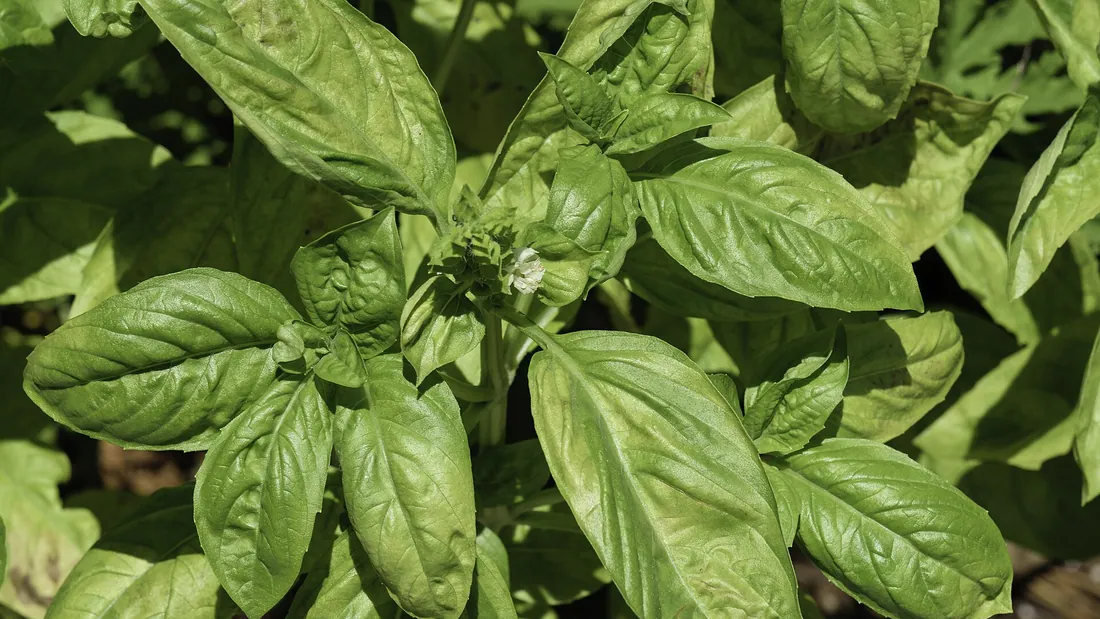

Basil (Ocimum basilicum) is an annual, cold-sensitive herb that comes from the warm regions of Asia. It is a summer plant that will not forgive the cold: it already suffers below 12 degrees, blackens below 10 degrees, and never survives a frost. You sow it under cover six to eight weeks before your last frosts, and only move it outside once the nights hold above 10 degrees, all risk of frost gone.
Light and exposure
Basil wants warmth and sun. Give it the warmest, brightest spot you have: a very bright windowsill, a veranda, a small greenhouse or a sheltered corner of the terrace. It needs at least six hours of sun a day to develop its aromas.
Growing it in a pot has a real advantage: you can follow the sun and bring the plant in for the evening as soon as the nights turn cool. In open ground, save the warmest wall of the garden for it, the one that catches the midday sun and gives its heat back in the evening.
Watering
Basil needs a soil that stays fresh and moist, without ever being waterlogged. Water regularly, ideally in the morning, at the base of the plant and not on the foliage. Watering in the evening leaves the leaves damp all night and opens the door to disease, a real risk under a humid summer.
In a pot, the compost dries out quickly in high summer and can need water every day in hot weather. A basil that wilts at midday but perks up again in the evening is simply short of water at the hottest moment.
Soil and repotting
A rich, light, well-drained potting mix suits it perfectly, whether in a pot or in open ground. Add a little mature compost at planting to support rapid growth.
Basil hates having its feet in water. In a pot, a drainage hole and a layer of clay pebbles at the bottom prevent stagnation, which is particularly useful when the rains set in at the end of summer.
Temperature and humidity
This is the critical point of the whole crop. Basil grows well between 18 and 28 degrees and already suffers below 12 degrees: the leaves blacken and growth stops. It tolerates no frost at all.
Do not trust an early mild spell at the end of winter. Late frosts often come back several weeks after the first fine days: wait until your region’s average last-frost date is well past before moving anything into open ground, and keep a protective fleece within reach for the cool nights early in the season.
Pruning and upkeep
Pinch out the tops of the stems regularly, just above a pair of leaves. The plant then branches and becomes bushy instead of running up tall. The more you harvest by pinching, the more basil produces.
Remove the flower buds as soon as they appear. Once basil flowers, it puts its energy into seeds, the leaves become smaller and more bitter, and the plant declines. Cutting off the flowers clearly extends the harvest.
Pests and diseases
Basil downy mildew, caused by Peronospora belbahrii, is the most common disease in a humid climate. You recognise it by a yellowing on the upper side of the leaves and a greyish-purple felting on the underside. It spreads quickly in mild, damp weather, typical of a soft, rainy end of summer.
To limit it, give the plants plenty of air, space them out, water at the base in the morning and never on the foliage. Collar rot, encouraged by soil that is too wet, and the slug that loves young plants round out the list of troubles to watch for.
Propagation
Sowing is the simplest route. Sow indoors, in the warmth between 18 and 22 degrees, from March onwards, on the surface because the seeds need light to germinate. Emergence takes one to two weeks.
Basil also roots very easily from cuttings: cut a stem ten centimetres long, remove the lower leaves and place it in a glass of water. Roots appear in one to two weeks, and you can then pot it up. A handy trick for multiplying a shop-bought plant.
Climate and hardiness
Where and in which climate it thrives
Basil is a tropical perennial that frost turns into an annual: it only stays outdoors all year round in a frost-free climate, USDA zone 10 and above. Everywhere else it is grown for a single warm season. It grows well between 18 and 28 °C, already suffers below 12 °C, and a single spell at 4 or 5 °C, even without frost, is enough to blacken the foliage.
In a temperate climate, oceanic or continental, everything hangs on timing: sow under cover six to eight weeks before your last frosts, harden the plants off, then move them out only once the nights hold above 10 °C. An early mild spell proves nothing: it is the late frosts that decide. Growing in a pot remains the best insurance, since it lets you bring the plants in at every cold snap.
The nature of the risk changes with the air. Under a mild, damp summer with cool nights and dew, downy mildew (Peronospora belbahrii) dominates: it sporulates at night as soon as relative humidity stays above 85 per cent for several hours, between 15 and 25 °C, hence watering at the base in the morning and resistant varieties such as 'Prospera'. In a Mediterranean climate, a dry subtropical one or a heated flat, the problem is reversed: dry heat sends the plant to flower within days, and red spider mite thrives between 20 and 30 °C as soon as the air falls below 50 per cent humidity. Light shade in the middle of the day and more frequent watering serve better there than full sun.
Growing basil?
Green Hub keeps a dated history of your own plant: its photos, its progress, its repottings. An AI answers about yours specifically, not a generic sheet, for free.
Identify my plantMonth-by-month care calendar
| January | Nothing to do in the garden. This is the time to order seeds and choose varieties, from classic green to purple basil. |
|---|---|
| February | Patience. Too early to sow without enough light and warmth. Prepare pots and compost. |
| March | First sowings indoors, in the warmth between 18 and 22 degrees, on the surface near a bright window. |
| April | Carry on sowing. Prick out the young plants into individual pots. Keep them under cover, it still frosts. |
| May | Harden off the plants by putting them out for a few hours in fine weather. Plant in open ground only once the last frosts have passed. |
| June | Full growth. Pinch out the tops of the stems to branch them. First real harvest. Water at the base in the morning. |
| July | Generous harvest. Remove the flower buds. In a pot, water every day in hot weather. |
| August | The harvest is in full swing. Watch for downy mildew in humid weather: give the plants air and remove affected leaves. |
| September | Last harvests in the garden. Bring a pot onto a windowsill to prolong it. Make pesto and flavoured oils. |
| October | The season ends outdoors. Only pots brought into the light hold on a little longer. |
| November | End of cycle. Basil is an annual, it does not come back. Clean pots and spots. |
| December | Rest. Note what worked well for next season and keep the seeds from the most vigorous plants. |
Green Hub tips
- Never move basil outside before your region’s last-frost date has passed. An early mild spell is a trap, late frosts come back after it.
- Always water at the base and in the morning. Wet leaves in the evening, under a humid summer, invite downy mildew.
- Cut off the flowers as soon as they show. Once it has gone to seed, basil turns bitter and stops producing.
- To multiply a fine bunch from the market for free, put a stem in water: it roots in two weeks.
Related species
Lavender
Lavandula angustifolia
True lavender (Lavandula angustifolia) is a hardy Mediterranean plant that scents the air and draws bees all summer…
Lemon balm
Melissa officinalis
Lemon balm (Melissa officinalis) is a hardy perennial with crinkled foliage that gives off a lemon scent the moment you…
Marjoram
Origanum majorana
Marjoram is the gentle cousin of oregano: same family, but a finer, sweeter and less pungent scent, much prized in…
Mint
Mentha
Mint (Mentha) covers several species and hybrids, from spearmint to peppermint, all perennial and fragrant. It is a…
Oregano
Origanum vulgare
Oregano (Origanum vulgare) is a tough, perennial herb built for sun and dry soils. Here is the good news: it is fully…
Rosemary
Salvia rosmarinus
Rosemary (Salvia rosmarinus, long known as Rosmarinus officinalis) is an evergreen Mediterranean shrub with needle-like…
The guides that mention it
Easy herbs to grow
Thyme, rosemary, basil, parsley, mint: which ones make it through the winter outdoors, which ones self-seed, and how to…
Watering Plants Properly: Deciding Rather Than Following a Schedule
Beginners water too often and too little at the same time. How to read the soil instead of the calendar, tell thirst…
Garden Diseases: Recognising What Is Attacking Your Plants, and Acting Before the Spot Appears
A white bloom that wipes off on a fingertip, an angular lesion stopped dead by a vein, a fruit browned from the bottom…
Gardening on a Balcony or Terrace: Vegetables and Flowers in Pots
Weight, wind, exposure: what really changes when you garden up high instead of in open ground, and how to choose your…
Gardening Under a Greenhouse or Cold Frame: Growing All Year Round
A greenhouse or even a simple cold frame changes everything: sowings brought forward by several weeks, harvests…
Companion Planting in the Vegetable Garden: Which Plants Belong Together
Tomatoes and basil get along beautifully, while potatoes and tomatoes make each other sick: companion planting explains…
Which Garden Flowers Are Edible, and How to Cook With Them
From flower bed to plate: the flowers that are genuinely edible, the harvesting method that preserves their flavour,…
How to Compost in an Apartment with Worm Composting
Tiered bin, red worms and worm tea: how to compost your kitchen scraps without a garden or odor, even in a city…
Updated on
How this sheet is written
Written for Green Hub with the help of language models, then reviewed. It offers gardening guidance, not professional advice: if you are unsure whether a plant is toxic to a child or an animal, ask a vet, a doctor or your national poison centre.