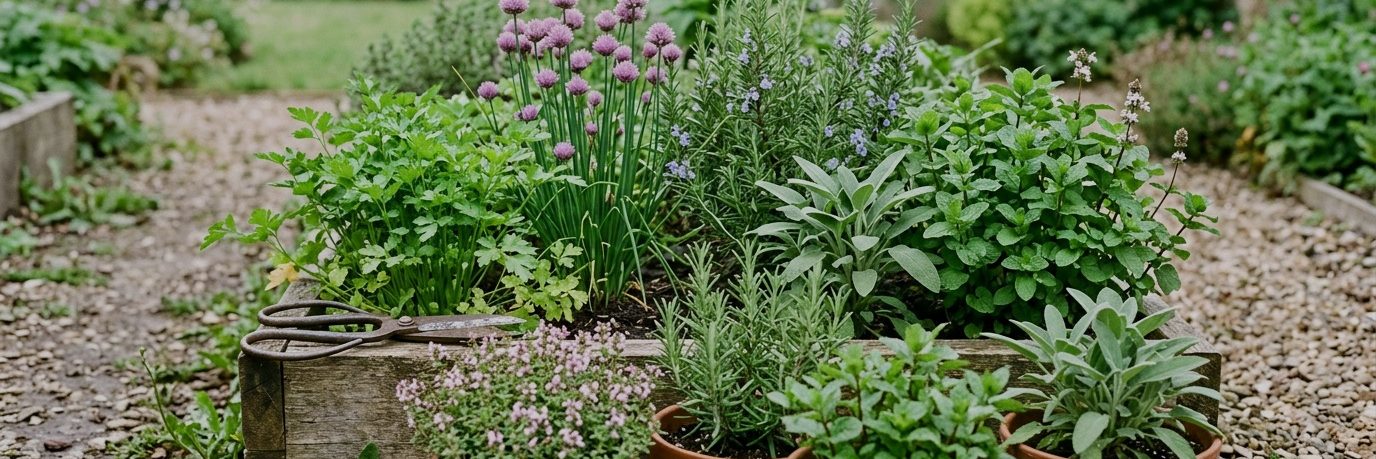
Easy herbs to grow
The easiest herbs fall into two groups: the perennials that survive winter (thyme, rosemary, sage, mint, oregano, chives, tarragon, bay laurel) and the annuals to resow every spring (frost-tender basil, parsley, coriander, dill, chervil). Most of them thrive in a pot on a sunny balcony. A temperate oceanic climate, with its damp winters and frosts lasting well into spring, only troubles the most tender ones, starting with basil. Once you know which ones come indoors, which ones self-seed and which ones stay outside, a bed of herbs becomes one of the least demanding crops in the garden.
The perennials that survive the winter
These are the herbs you plant once and that come back every year without any effort on your part. Thyme, rosemary, sage and bay laurel are evergreen: they keep their leaves all winter and you can pick from them even under the snow. Oregano and chives die back at the surface with the first frosts, then shoot up again from the base in spring. Mint does the same, only more vigorously. All of them cope easily with the winters of a temperate climate, provided their feet stay dry: it is standing moisture, far more than the cold, that rots them under a mild, rainy winter.
Two subtleties are worth knowing. Bay laurel is hardy once established, but a young first-year plant can suffer from a hard frost: a winter fleece or a sheltered spot against a wall for the first season is enough to see it through. Lemon balm, on the other hand, is perfectly hardy and even a little too generous: it self-seeds everywhere on its own, something to keep an eye on if you don’t want it colonising the bed.
The annuals to resow every spring
The other family does not survive winter and starts over each year, which is no chore at all: they are often the quickest to get going. Basil is the textbook case, so frost-tender that it blackens at the first cold snap, so it is grown as an annual and sown under cover before being put out once all risk of frost has passed, that is after your region’s average last frost date. Coriander, dill, chervil, savory and marjoram are sown directly in place in spring and crop within a few weeks. Chervil and coriander even prefer a little coolness and bolt quickly in the heat, so you sow them in succession.
Parsley is a case apart: biennial, it makes its leaves the first year and goes to seed the second, after which it needs resowing. In practice you therefore treat it as an annual to renew. Its germination is slow, two to three weeks, which wrongly puts people off: you just have to be patient and keep the seedbed moist. French tarragon, often filed with this group, in fact belongs to neither: it is not sown at all and is propagated solely by cuttings or by dividing the clump.
In a pot on a balcony
The great majority of these herbs are happy in a pot, and a well-exposed balcony makes an excellent extra vegetable garden. Three things really matter. Drainage first: a hole in the bottom of the pot, a layer of clay pebbles or gravel, and a compost that does not hold water, because in a rainy climate the rain drowns more herbs than drought ever does. Sun next: thyme, rosemary, sage and oregano want the sunniest spot and take it scorching, while parsley, chives, chervil and mint will accept partial shade. Watering last: let the surface dry out between two rounds rather than keeping the soil permanently soaked.
One herb deserves a pot to itself: mint. In open ground, its running roots invade everything and smother its neighbours in a single season. Kept in its own container, it stays well-behaved and generous. On a balcony, you can safely group the Mediterranean ones (thyme, rosemary, sage, oregano) in the same large planter, since they share the same craving for sun and dryness, and set mint and lemon balm apart on the side.
Harvesting so the plant grows back
Harvesting well is not about picking at random: it is about pruning in a way that spurs the plant on. On basil, you never pick leaf by leaf from the bottom; you pinch out the top, meaning you nip the stem just above a pair of leaves, and the plant branches into two new shoots. Repeated regularly, this gesture turns a spindly basil into a small bushy shrub. The same pinching principle applies to marjoram, savory and oregano: you cut the tips, the plant fills out.
The other rule is to harvest before flowering. As soon as a herb flowers and goes to seed, it channels its energy into reproduction and its leaves turn bitter or tough: this is clear on basil, coriander and chervil. So you pinch off the flower buds to prolong the leaf harvest. With chives and parsley, on the contrary, you pick from the outside, taking the oldest stems at the base to let the heart keep producing. Harvesting often is the best fertiliser: the more you cut, the more it grows.
Storing your herbs
In summer, a herb always produces more than you can use, and two simple methods extend the harvest until the following spring. Drying suits woody herbs rich in essential oil: thyme, rosemary, sage, oregano, bay laurel, savory and marjoram dry very well, in small bunches hung upside down in a dry, airy spot, away from direct sun. Once dry, you crumble the leaves into a sealed jar, where they keep their aroma for several months.
Freezing is better for tender, water-filled herbs, which lose everything when dried: basil, parsley, chives, coriander, dill, chervil, tarragon and mint. The handiest way is to chop them, pack them into an ice-cube tray and cover with a little water or olive oil before freezing: you get portions ready to drop into a pan. Basil also lends itself very well to pesto, which freezes and concentrates the whole scent of a summer on the balcony.
The care sheets to read next
Every plant mentioned has its full sheet: watering, light, soil, pests and a month-by-month calendar.
Basil
Ocimum basilicum
Basil (Ocimum basilicum) is an annual, cold-sensitive herb that comes from the warm regions of Asia. It is a summer…
Parsley
Petroselinum crispum
Parsley (Petroselinum crispum) is the most used herb in the kitchen, flat or curled depending on taste. It is a…
Chives
Allium schoenoprasum
Chives (Allium schoenoprasum) are a small perennial of the onion family, with fine hollow stems tasting mildly of…
Mint
Mentha
Mint (Mentha) covers several species and hybrids, from spearmint to peppermint, all perennial and fragrant. It is a…
Thyme
Thymus vulgaris
Thyme (Thymus vulgaris) is a small Mediterranean subshrub with woody stems and a powerful fragrance, hardy to about…
Rosemary
Salvia rosmarinus
Rosemary (Salvia rosmarinus, long known as Rosmarinus officinalis) is an evergreen Mediterranean shrub with needle-like…
Sage
Salvia officinalis
Common sage (Salvia officinalis) is a small aromatic shrub with evergreen grey-green foliage, originating from the dry…
Oregano
Origanum vulgare
Oregano (Origanum vulgare) is a tough, perennial herb built for sun and dry soils. Here is the good news: it is fully…
Coriander
Coriandrum sativum
Coriander (Coriandrum sativum) is an annual herb grown for both its fresh leaves, with their pronounced flavour, and…
Dill
Anethum graveolens
Dill (Anethum graveolens) is an annual herb with a lacy outline, a cousin of the carrot and fennel. It is a warm-season…
Tarragon
Artemisia dracunculus
Tarragon (Artemisia dracunculus) is an aromatic perennial with an aniseed scent, a cornerstone of French cooking. The…
Bay laurel
Laurus nobilis
Bay laurel (Laurus nobilis) is the only true culinary bay, the one whose leaf you drop into sauces and stocks. Take…
Lemon balm
Melissa officinalis
Lemon balm (Melissa officinalis) is a hardy perennial with crinkled foliage that gives off a lemon scent the moment you…
Chervil
Anthriscus cerefolium
Chervil (Anthriscus cerefolium) is a fine annual herb with finely cut foliage and a delicate, slightly aniseed flavour.…
Marjoram
Origanum majorana
Marjoram is the gentle cousin of oregano: same family, but a finer, sweeter and less pungent scent, much prized in…
Savory
Satureja hortensis
Savory is a Mediterranean herb with a peppery taste, a cousin of thyme and rosemary. Take care not to confuse two…
Lemon verbena
Aloysia citriodora
Lemon verbena (Aloysia citriodora) is a shrub whose leaves give off a clean, intense lemon scent, the one in an evening…
Frequently asked questions
Which herbs survive winter outdoors?
Thyme, rosemary, sage, oregano, chives, mint, tarragon and bay laurel are perennial and hardy through a temperate winter. The evergreen ones (thyme, rosemary, sage, bay) can be picked even in the depths of winter. The real danger is not the cold but standing moisture, so make sure they have good drainage.
Can you grow basil all year round?
Not outdoors: basil is frost-tender and blackens at the first cold snap, so it is grown as an annual from spring to autumn. You sow it warm indoors and only put it out once the frosts are over, after your region’s average last frost date. In winter, only a pot on a bright windowsill lets you keep some, with a modest result.
Which herb should you choose as a beginner?
Chives and mint are the most forgiving: perennial, they come back on their own every year and forgive almost anything. Thyme and rosemary follow, indestructible once settled in the sun. Just keep mint in its own pot, or it will take over everything.
Why should mint be kept in a separate pot?
Mint puts out running roots that race under the soil and resurface everywhere, smothering neighbouring plants in a single season. In open ground it quickly becomes unmanageable. A pot to itself contains it while still letting it produce abundantly; lemon balm poses the same problem by self-seeding.
Green Hub looks after your plants
Photograph a plant: Green Hub identifies it and writes its care sheet, with no account. Sign in afterwards to keep its dated photos and history over time.
Identify a plantUpdated on
How this sheet is written
Written for Green Hub with the help of language models, then reviewed. It offers gardening guidance, not professional advice: if you are unsure whether a plant is toxic to a child or an animal, ask a vet, a doctor or your national poison centre.