Althea
Hibiscus syriacus
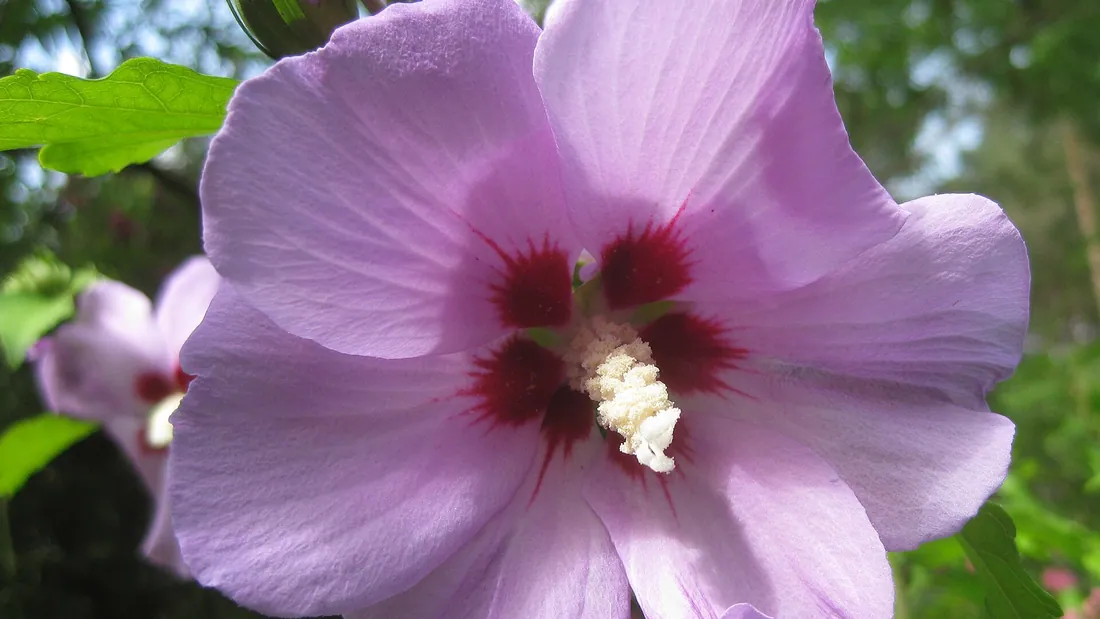

Althea (Hibiscus syriacus) is a hardy deciduous garden shrub that flowers when every other one has finished, from midsummer right up to the first frosts, not to be confused with the indoor hibiscus with tropical flowers that people grow in pots all year round. This one stays outdoors summer and winter and comes through cold of minus twenty degrees with no protection once established. It has one disconcerting habit: it leafs out weeks after the rest of the garden, which makes it look dead in spring.
Light and exposure
Althea wants as much sun as possible. A spot that catches the midday and afternoon sun, sheltered from cold, drying winds, gives the most generous flowering. In part shade it still grows and flowers, but less abundantly and with a shape that tends to stretch towards the light.
In a climate with cool, windy summers, a place against a sunny wall or in a sheltered corner of the garden makes a real difference to how many flowers you get: the wall stores the day’s heat and gives it back after sunset, and it is that summer heat that drives the flowering. Avoid low spots where cold air pools at the end of winter, since that only delays a leafing out that is already late.
Watering
Once well rooted, after two or three years in the ground, althea copes well with dry spells and needs no special watering. Young plants, on the other hand, need regular watering in the first and second year, while the roots settle in deep.
The point to watch is flowering. A summer that is too dry, with no watering at all, often makes the flower buds drop before they even open. A generous watering once a week during prolonged dry spells, right through the flowering season, keeps the display going.
Soil and repotting
Althea is not fussy and is happy in ordinary garden soil, as long as it drains well. A little compost at planting helps young plants get off to a good start, but no further feeding is really needed after that.
The real weak point is too much water in winter. In heavy clay soil that stays waterlogged for weeks, the roots eventually rot. In poor, chalky soil, chlorosis can appear, with leaves turning yellow between veins that stay green, a dose of compost or iron usually fixes it.
Temperature and humidity
Althea is thoroughly hardy in the open ground, from USDA zone 5 to zone 9: it copes without damage with cold down to minus fifteen to minus twenty degrees once well established. It is a shrub built for cold winters, unlike its indoor cousin, which cannot take any frost at all. For the first two winters, while the roots are still shallow, a good mulch at the base settles the question.
What surprises people most is how slow it is to start. Even after a mild winter, it keeps its branches bare for weeks after every other shrub in the garden. That is not a sign of poor health, it is simply its nature, and it is exactly what puts it out of reach of late frosts, so you have to resist the urge to dig it out too soon.
Pruning and upkeep
Althea flowers on the current year’s wood, meaning on the shoots that grow during spring and summer. Pruning in late winter, before the leaves come out, encourages vigorous regrowth and more, larger flowers in the growing season.
Cut back last year’s shoots by a third to half their length, just above a bud. This pruning is not compulsory, an unpruned althea still flowers, but it genuinely changes how generous the summer flowering is.
Pests and diseases
Althea is a generally healthy shrub that rarely causes real problems. Black aphids are the most common issue, settling in colonies on young shoots and flower buds in spring and early summer. A firm jet of water or some soft soap usually gets rid of them.
On poor, chalky soil, watch for chlorosis, yellow leaves with green veins. And if flower buds drop without opening in high summer, that is not a disease but a sign of too little water, corrected by watering more generously during dry spells.
Propagation
Taking cuttings is the most reliable way to get an althea identical to the parent plant. Take semi-ripe cuttings in the middle of summer, from this year’s shoots that have already firmed up a little at the base, and root them in a light mix, in the shade.
Growing from seed is possible but really for the curious, since flowering only starts after several years and the flowers you get do not always match the parent plant, as garden varieties are often hybrids. Layering, bending a low branch down into the soil until it roots, also works well.
Climate and hardiness
Where and in which climate it thrives
Althea is hardy from USDA zone 5 to zone 9: once it has been in the ground for two or three years, it takes cold down to minus fifteen or minus twenty degrees with no protection at all, and its one-year-old wood comes through unharmed. A young plant is more fragile than a mature one, and a mulch at the base is enough to keep it safe for its first two winters.
Its very late leafing out, several weeks after every other shrub in the garden, is its real quirk and its best insurance: it never gets caught by a late frost. Many gardeners dig it out by mistake, thinking it is dead when faced with those still bare branches, when really you just need to be patient.
What genuinely changes from one climate to another is the flowering, not the survival. It needs summer heat to flower: in a cool, windy oceanic climate the display starts late and stays more modest, which is why you plant it in the warmest, most sheltered spot in the garden, at the foot of a wall that catches the midday sun and away from the prevailing cold winds. Under a hot dry summer it flowers far more generously but drops its buds as soon as it runs short of water. Where winters are mild and sodden, it is standing water that kills it, not cold: plant on free-draining soil or on a slight mound. And in regions with long hot summers it self-seeds so freely that it is treated as invasive in some areas.
Growing althea?
Green Hub keeps a dated history of your own plant: its photos, its progress, its repottings. An AI answers about yours specifically, not a generic sheet, for free.
Identify my plantMonth-by-month care calendar
| January | Complete rest. The shrub is bare and shows no sign of life, which is entirely normal in the depths of winter. Use this time to plan a sunny spot if you are thinking of planting a new one. |
|---|---|
| February | The last few weeks before leafing out. This is a good time to prune last year’s shoots, before the sap rises again, to encourage a more generous flowering this summer. |
| March | Still no leaves, no need to worry. Althea remains one of the last shrubs to come out of dormancy, well after the others. |
| April | The branches are often still bare while the rest of the garden turns green. This is the shrub’s most characteristic trait, patience is the order of the day. |
| May | Leafing out finally arrives, the first leaves appear. Once it gets going, growth quickly makes up for lost time. |
| June | The foliage fills out fully. Water young plants put in recently if the weather turns dry, established plants manage on their own. |
| July | The first flowers open, marking the start of a long flowering season. Watch for aphids, which like to settle on the still closed buds. |
| August | Flowering is in full swing. During a heatwave or prolonged dry spell, a weekly watering stops the buds dropping before they open. |
| September | Althea keeps flowering generously, while most other shrubs in the garden have already finished their season. |
| October | The last flowers still open in fine weather. Althea remains one of the latest shrubs in the garden to flower. |
| November | The leaves turn yellow and drop, the shrub starts to go bare. Mulch around young plants before the first hard frosts. |
| December | Complete winter rest. The bare shrub copes with the cold with no trouble, keep in mind the pruning to do in February. |
Green Hub tips
- Never worry about seeing althea still bare when the whole garden has already greened up, it is the last shrub to leaf out, it always gets there in the end.
- Prune in late winter, before it leafs out, althea flowers on the current year’s wood and regular pruning gives more and bigger flowers.
- Water generously during dry summers, especially at the height of flowering, otherwise the buds drop before they even open.
- Plant it in full sun and sheltered from the wind to make the most of its late flowering, which runs from midsummer to the first frosts, when the rest of the garden is already done.
Related species
Beech
Fagus sylvatica
Beech (Fagus sylvatica) is the most common broadleaf tree in the temperate forests of Europe, just as happy standing…
Begonia
Begonia
Begonia is the star summer flower of window boxes, hanging baskets and shady borders. Hundreds of hybrids exist, but…
Box
Buxus sempervirens
Box (Buxus sempervirens) is an evergreen shrub that has been clipped into balls, cones and low borders in formal…
Butterfly bush
Buddleja davidii
Buddleia (Buddleja davidii), better known as the butterfly bush, is a nearly indestructible shrub that has taken over…
Cherry laurel
Prunus laurocerasus
Cherry laurel (Prunus laurocerasus) is the most widely planted evergreen hedging shrub in temperate gardens, and it is…
Clematis
Clematis
Clematis is the queen of flowering climbers, able to cover a wall, a trellis or an old apple tree with hundreds of…
The guides that mention it
Pruning Flowering Shrubs and Roses: Deducing Instead of Memorising
New wood or old wood: this single question gives you the pruning time for any shrub at all, including ones whose name…
Which flowering shrub to choose for a garden in bloom all year round
Viburnum in winter, lilac in spring, buddleia in summer, rose of Sharon in autumn: the method for stringing together…
Updated on
How this sheet is written
Written for Green Hub with the help of language models, then reviewed. It offers gardening guidance, not professional advice: if you are unsure whether a plant is toxic to a child or an animal, ask a vet, a doctor or your national poison centre.