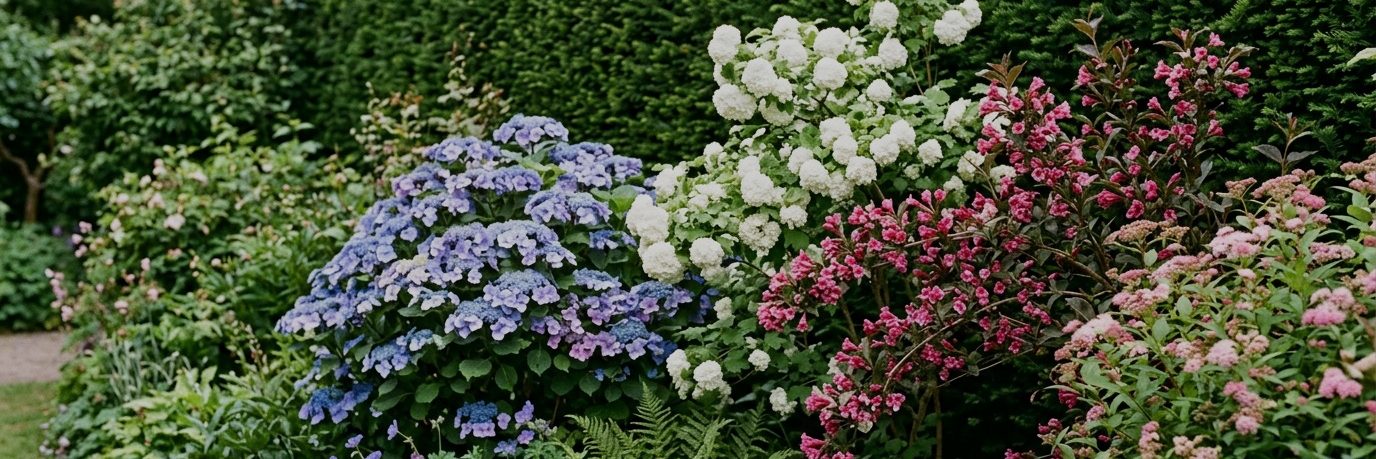
Which flowering shrub to choose for a garden in bloom all year round
Choosing flowering shrubs for a garden in bloom all year round means spreading the flowering out across the four seasons rather than betting everything on the spring peak, when lilac and weigela flood the garden for three weeks and then leave a gap until summer. The method is to pick one or two shrubs per period, winter, spring, summer and late season, based on exposure, mature height and soil type. In a climate with mild, damp winters, species such as viburnum or winter honeysuckle flower as early as midwinter, which makes for an almost continuous bloom rather than a pile-up of crushes from the same few weeks.
The method: spreading the flowering across the four seasons
The classic trap of a garden in bloom is giving in to the spring crush at the garden centre, the season when the shelves overflow with forsythia and lilac in flower. The method that avoids this imbalance is to split the year into four periods, winter, spring, summer and late season, then pick one or two shrubs per period rather than stacking up five that all flower in May. A simple table listing the flowering months of each candidate quickly reveals the gaps in the calendar still to fill.
Three criteria then settle the choice. Exposure first, most flowering shrubs want sun or bright partial shade, with a few species such as viburnum or hydrangea being the only ones to accept denser shade. Mature height next, too often ignored at the time of purchase, a lilac can reach four to five metres while a rose of Sharon stays compact at around two to three metres, better to check the label than to dig up an overgrown shrub later. Soil last, most species are content with ordinary ground, but some, such as hydrangea, have precise requirements. The pruning technique depends on which wood carries the flowers and deserves a guide of its own.
Winter: the shrubs that flower while the garden sleeps
Viburnum, and Viburnum tinus in particular, remains the mainstay of winter flowering in a temperate maritime garden. Its pale pink buds open into small white clusters from the start of winter and keep going, in waves, until mid-spring, carried by evergreen foliage that structures the garden even in the depths of winter. It tolerates partial shade, grows well as a standalone specimen or in an informal hedge, and its blue-black berries feed the birds at the end of winter. It is the shrub to place first in a continuous-flowering plan, since few species cover the whole cold season so broadly.
Winter honeysuckle plays a different card, small cream flowers, almost invisible on the bare wood, but with a scent that carries several metres on a still day. Unremarkable the rest of the year, it is better planted near a path or a window still opened in winter, rather than as a centrepiece visible from the living room. Forsythia closes out this period in style from the very end of winter, its bare branches covering themselves in a brilliant yellow before the leaves even appear, the clearest signal that winter is loosening its grip on the garden.
Spring: managing abundance without everything looking alike
Spring never runs short of candidates, the risk is rather planting everything at the same height and in the same shade of purple. Lilac opens the season in April and May with a scent that carries far, but its tall silhouette, four to five metres except for dwarf varieties, destines it for the back of a border, and it prefers well-drained, rather chalky soil. To break up this mass, weigela, with pink bells on arching stems in May and June, and spring-flowering spirea, covered in tiny white flowers on a cascading habit, bring a contrast of shape and colour.
Wisteria adds a dimension that shrubs cannot give, a vertical flowering, in fragrant mauve clusters in May, spectacular on a pergola or a solid wall, but it demands a sturdy support, never a gutter or a light cladding, since its vigour becomes impressive with age. It is a long-term investment, best chosen as a grafted specimen to flower from the first few years. Snowball viburnum takes over from its tinus cousin in May and June, globe-shaped flower heads turning from green to pure white, a different silhouette that closes out the spring period.
Summer: holding the colour from June to the first cool spells
Summer carries the longest flowering if the choices are right. Buddleia, in mauve, pink or white spikes from July to September, draws butterflies and bees in large numbers and grows tall, two to three metres in a season, which reserves it for the back of a border. Hydrangea completes the palette depending on the species chosen, the macrophylla, with its big blue or pink globes depending on soil acidity, peaks in July and August, while the paniculata, in conical white panicles turning pink, extends the flowering into October and copes better with full sun, a duo that covers the whole of summer on its own.
For roses, the decisive choice is made at purchase, a repeat-flowering rose blooms again in waves from June to the first frosts if the spent flowers are removed, while a non-repeat-flowering variety, often an old rose with a strong scent, offers only a single, generous flowering in June. On the same pillar, pairing a repeat-flowering climbing rose with a summer clematis extends the effect over time, the clematis often flowering again after the rose’s first wave, on a shared support sturdy enough for both.
Late season: extending the flowering until the frosts
Rose of Sharon, or garden hibiscus, closes the march of the great summer flowerings with its large corolla-shaped flowers, white, pink, mauve or blue-tinged depending on the variety, carried from late August through to the first frosts of October on a compact shrub that rarely exceeds three metres. It is one of the few shrubs that starts late and keeps going long, useful for stopping the garden fading out as early as September. Paniculata hydrangea goes even further, its panicles turn from white to pink then to copper-brown and stay decorative on the plant all winter, a relay that almost joins up with the winter viburnum’s flowering.
The repeat-flowering rose, if well chosen in spring, also closes the loop by flowering again intermittently until the first cold snaps. To put together this calendar, it is better to visit the garden centre at several different times rather than just once in spring, when the stock pushes seasonal flowering and leaves winter and autumn under-represented. Noting the flowering month on the label, and checking that it matches a period still empty in the plan, remains the simplest habit for rounding out a garden in bloom.
The care sheets to read next
Every plant mentioned has its full sheet: watering, light, soil, pests and a month-by-month calendar.
Forsythia
Forsythia x intermedia
Forsythia (Forsythia x intermedia) is the first shrub of the year to flower: its golden yellow blooms burst out on bare…
Lilac
Syringa vulgaris
Common lilac (Syringa vulgaris) is a deciduous shrub found in almost every old country garden. Its late spring scent is…
Hydrangea
Hydrangea macrophylla
The hydrangea (Hydrangea macrophylla) is the flowering shrub for cool, partly shaded gardens, and one of the very few…
Butterfly bush
Buddleja davidii
Buddleia (Buddleja davidii), better known as the butterfly bush, is a nearly indestructible shrub that has taken over…
Spirea
Spiraea
Spirea (Spiraea) is one of the easiest and most rewarding flowering shrubs you can plant. It shows up in almost every…
Weigela
Weigela florida
Weigela (Weigela florida) is a deciduous shrub from East Asia that has become an unkillable classic of temperate…
Viburnum
Viburnum
Viburnum is not one plant but a whole family of more than a hundred and fifty shrubs, broad enough to cover almost…
Honeysuckle
Lonicera
Honeysuckle (Lonicera) is a familiar plant in hedgerows and gardens, known for its very fragrant tubular flowers whose…
Clematis
Clematis
Clematis is the queen of flowering climbers, able to cover a wall, a trellis or an old apple tree with hundreds of…
Wisteria
Wisteria sinensis
Wisteria (Wisteria sinensis) is a woody climber from China, capable of covering an entire house front within a few…
Althea
Hibiscus syriacus
Althea (Hibiscus syriacus) is a hardy deciduous garden shrub that flowers when every other one has finished, from…
Rose
Rosa
The rose (Rosa) is a hardy flowering shrub that overwinters outdoors without trouble, down to about -20 °C for most…
Frequently asked questions
How do you avoid flowering gaps between two waves of shrubs?
The safest approach is to choose species whose periods overlap slightly rather than lining them up end to end, Viburnum tinus fading in late April just as lilac is starting, or paniculata hydrangea taking over from buddleia at the end of summer. Drawing up a table with the flowering months of each shrub before buying immediately reveals the periods still empty in the calendar.
Which flowering shrub should you choose for shade or partial shade?
Viburnum and hydrangea are among the few flowering shrubs that accept fairly dense shade without stopping their flowering, even if the bloom stays a little less generous than in full sun. Winter honeysuckle also tolerates light partial shade. Most other species, lilac, buddleia, rose of Sharon or wisteria, need at least half a day of direct sun to flower properly.
Does hydrangea need acidic soil to stay blue?
Only the macrophylla hydrangea changes colour depending on the soil pH, blue in acidic soil, pink in chalky or neutral soil, for lack of available aluminium for the roots. In chalky soils, common in many regions, the flower naturally turns pink unless a specific soil additive is used. Paniculata hydrangea, on the other hand, stays white then pink regardless of the soil, with no reaction to pH.
How much distance should you allow before planting a flowering shrub?
The simplest rule is to add together the mature spread of the two neighbouring plants and divide by two to get the planting distance, going by the height and width given on the label rather than the size of the potted specimen. A lilac or a wisteria needs several metres of clearance from a house wall or a gutter, while a rose of Sharon or a spirea is happy with one to one and a half metres.
Green Hub looks after your plants
Photograph a plant: Green Hub identifies it and writes its care sheet, with no account. Sign in afterwards to keep its dated photos and history over time.
Identify a plantUpdated on
How this sheet is written
Written for Green Hub with the help of language models, then reviewed. It offers gardening guidance, not professional advice: if you are unsure whether a plant is toxic to a child or an animal, ask a vet, a doctor or your national poison centre.