Artichoke
Cynara scolymus
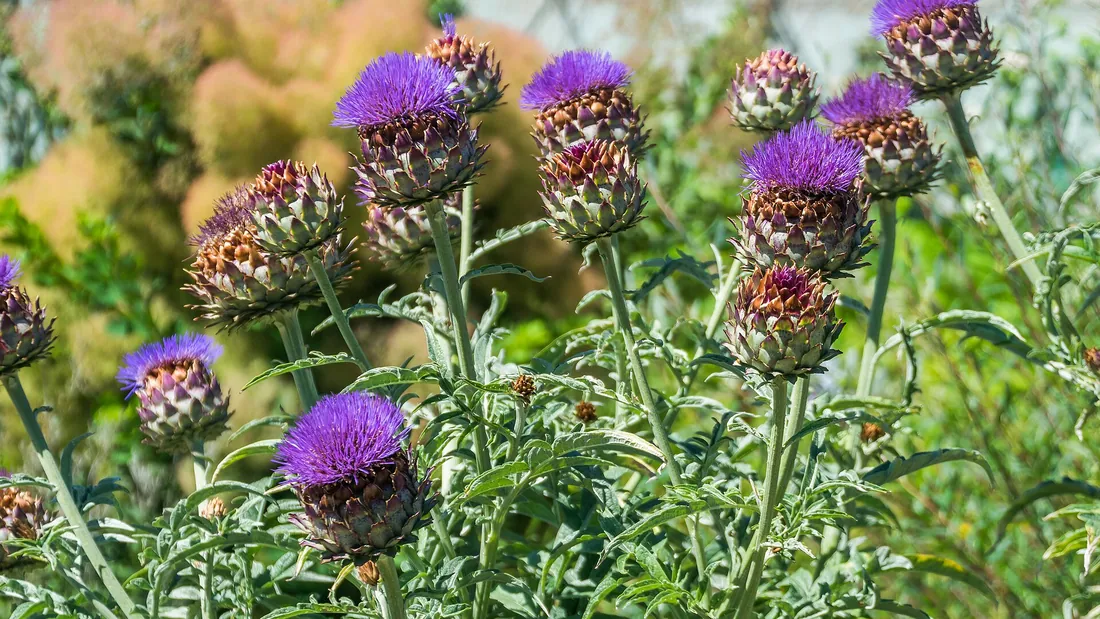

The artichoke (Cynara scolymus) is a large perennial with silvery, deeply cut foliage, as striking in an ornamental garden as it is productive in a vegetable patch. You do not eat the plant itself but its flower head, that big bud which would open into a blue violet flower if left in place: it is picked while still closed, well before the scales start to spread. Under a mild, rainy winter it is a temperamental perennial: it minds the cold itself less than the standing damp, which rots the crown far more reliably than a dry frost does.
Light and exposure
The artichoke wants sun, plenty of it, and warmth to swell its heads properly. Give it the most open, sunniest spot in the garden, sheltered from prevailing winds, which easily flatten its large leaves and snap the flowering stems once they carry weight.
It is a bulky plant, a mature clump easily spreads a metre in every direction. Do not tuck it against a shady wall or squeeze it between other crops: it needs air to keep disease at bay and room to spread its foliage without competition.
Watering
During active growth, especially while the heads are forming, the artichoke is thirsty. Skimping on water at that stage gives small, tough heads that swell poorly. Water generously in dry spells, at the base, without wetting the heart of the foliage.
Too much water is, however, its worst enemy, especially in winter. Soil that stays waterlogged through the rains of the cold season rots the crown far more reliably than cold does. Good drainage matters just as much as watering itself.
Soil and repotting
The artichoke is a heavy feeder that wants deep, rich, well worked soil. Add well rotted compost or manure at planting time, and repeat the feed every spring to support its vigorous growth.
Drainage matters just as much as richness. On heavy clay soil, common in temperate gardens, loosen it deeply and do not hesitate to plant on a slight mound to carry winter water away from the crown.
Temperature and humidity
Depending on the variety, the artichoke tolerates frost down to minus five or minus seven degrees on perfectly drained soil. Where the winter is damp the problem is almost never cold on its own: it is the combination of cold and standing damp that rots the crown.
A dry frost usually passes without damage on a protected plant. A mild but waterlogged winter, increasingly common in mild oceanic regions, is actually more dangerous for the plant than a sharp cold snap.
Pruning and upkeep
The artichoke is not really pruned, it is thinned out. Each plant sends up several offshoots at its base: keep only three or four strong ones per plant and remove the rest, otherwise the plant exhausts itself feeding too many stems for small heads.
Harvest the heads with about ten centimetres of stem attached. Once the harvest is over for the season, gradually cut back the fading foliage, which also makes winter protection easier afterwards.
Pests and diseases
Black bean aphid is the most common pest: it colonises the heart of the young shoots and the underside of the leaves, especially in spring. A firm jet of water or soft soap is usually enough if you act early, before the colony explodes.
Slugs happily attack young plants and tender offshoots in spring. Powdery mildew can appear on the foliage in a hot, dry summer, but it is really crown rot, caused by too much winter moisture, that truly threatens the plant wherever the cold season is wet.
Propagation
Propagation by offsets is the method to favour: in spring, use a spade to detach a side shoot that has already rooted at the base of the mother plant, keeping a piece of the crown attached, and replant it straight into its final spot. It is quick and the new plant keeps exactly the qualities of the variety.
Sowing from seed is possible but gives uneven results, the artichoke rarely coming true from seed. It is worth trying mainly if you want to test new varieties or raise plants in bulk, knowing that some of the seedlings will disappoint.
Toxicity
The cooked flower head is harmless, including for cats and dogs: the artichoke is not among the toxic plants listed by the ASPCA. Simply avoid letting your animals chew large quantities of raw, leathery leaves, which can cause digestive upset.
Climate and hardiness
Where and in which climate it thrives
How hardy an artichoke is depends first on the variety: 'Gros Vert de Laon' is reckoned to hold down to about -5 °C with its crown well protected, 'Camus de Bretagne' stays semi-hardy, and 'Violet de Provence', finer in flavour, is clearly the most tender of the three. The plant is grown as a perennial from USDA zone 7 to 11, and replanted yearly as an annual anywhere colder. The figure alone is misleading, though: under a mild, rainy oceanic climate it is almost never frost that kills the artichoke, it is the combination of cold and standing water, which rots the crown. A mild but sodden winter is more dangerous to it than a sharp, dry cold snap. Under a continental climate with a cold, dry winter, the crown comes through better than you would expect once it is mounded up and mulched dry, snow even acting as insulation; there you plant in spring, once the hard frosts are past and the soil has warmed. Under a Mediterranean or mild subtropical climate the artichoke is on home ground, so much so that it is often run on a reversed cycle: planted as the cool season begins, it crops through the mild winter, and it is the dry summer heat rather than the cold that sends it dormant. Wherever the winter is wet the procedure never changes: cut back the foliage at the end of the growing season, mound up the crown, cover with a thick, dry mulch, dead leaves or straw, or a winter fleece, and above all plant on a mound 20 to 30 centimetres high in heavy soil. A short summer with cool nights delays head formation by several weeks and cuts the quantity picked, without taking anything from the flavour. And whatever the climate, a plant wears out: renew it every three to four years from offsets.
Growing artichoke?
Green Hub keeps a dated history of your own plant: its photos, its progress, its repottings. An AI answers about yours specifically, not a generic sheet, for free.
Identify my plantMonth-by-month care calendar
| January | Nothing to do to the plant itself, the winter mulch should stay firmly in place. This is the time to order offsets or potted plants if you want to expand the planting in spring. |
|---|---|
| February | Winter protection still needs to hold, do not uncover the plants too early even on a few mild days. Use the time to prepare the spot for new plantings to come. |
| March | Prepare the soil deeply where you plan to plant: dig it over and add a generous helping of well rotted compost or manure. Still hold off fully uncovering plants already established. |
| April | This is planting month, once the hard frosts are over. Set out offsets or young plants, spacing them widely, a metre in every direction, in well drained, enriched soil. |
| May | Active growth. Water if spring turns dry and watch for black bean aphid on the young shoots, it settles in fast once the weather warms. |
| June | Plants established for a year or more form their first flower buds. Water generously in dry spells so the heads swell well. |
| July | First heads are harvested, cut while still tightly closed with about ten centimetres of stem. Keep up steady watering if the heat sets in. |
| August | Harvest continues, sometimes with a second flush of heads on the side shoots. Keep watching for black bean aphid, active right through late summer. |
| September | Last harvests of the season. This is also a good time to take a few rooted offsets for new plantings next spring. |
| October | After the first frosts, start cutting back the fading foliage. Cut down on watering, the plant is heading into dormancy. |
| November | Full winter protection: mound soil up around the crown, then cover with a thick, dry mulch, dead leaves or straw, or a fleece. |
| December | Complete rest. Check now and then that the mulch has not blown away or become waterlogged, it is what protects the crown until spring. |
Green Hub tips
- Where the winter is damp it is not cold that kills the artichoke but standing wet. Cut back the foliage, mound the crown and cover with a dry mulch before the hard frosts arrive.
- Harvest the heads while still tightly closed, before the scales start to spread: past that point the heart turns fibrous and far less pleasant to eat.
- To keep the qualities of your variety, propagate by offsets in spring rather than from seed, which gives uneven results.
- An artichoke plant wears out over time: plan to renew it every three to four years rather than counting on one clump lasting forever.
Related species
Coneflower
Echinacea purpurea
Coneflower (Echinacea purpurea) is a tall, sturdy perennial from the prairies of North America, recognisable by its…
Dahlia
Dahlia
The dahlia (Dahlia) is a tuberous plant that offers one of the longest and most spectacular displays of the summer…
Lettuce
Lactuca sativa
Lettuce (Lactuca sativa) is the most widely grown salad in the vegetable garden, easy and quick, harvested six to ten…
Oxeye Daisy
Leucanthemum vulgare
The oxeye daisy (Leucanthemum vulgare) is that white flower with a yellow centre that pops up on its own in our…
Tarragon
Artemisia dracunculus
Tarragon (Artemisia dracunculus) is an aromatic perennial with an aniseed scent, a cornerstone of French cooking. The…
Witloof chicory
Cichorium intybus var. foliosum
Witloof (Cichorium intybus var. foliosum), the forced chicory better known as endive or chicon, is grown in two stages:…
The guides that mention it
Making Compost: Steering the Thermal Biology of the Heap
A compost heap is not a pile of waste you stir, it is a thermal process you steer. The real carbon/nitrogen ratio of…
Garden Mulching: Every Mulch Has an Effect and a Drawback
Mulching is presented everywhere as a benefit with no downside. There is one for every material: what nitrogen drawdown…
Updated on
How this sheet is written
Written for Green Hub with the help of language models, then reviewed. It offers gardening guidance, not professional advice: if you are unsure whether a plant is toxic to a child or an animal, ask a vet, a doctor or your national poison centre.