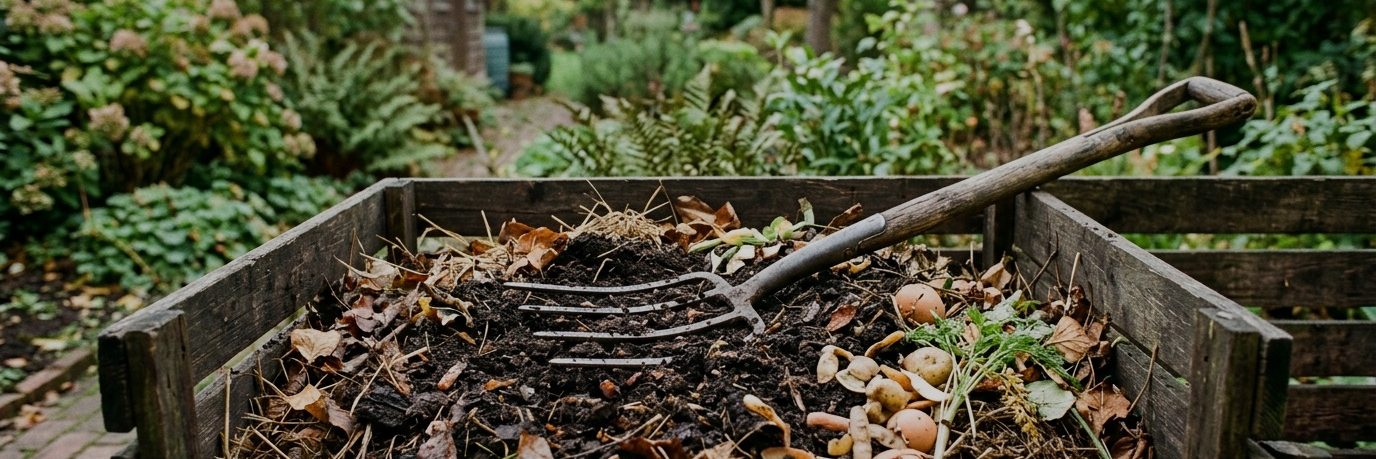
Making Compost: Steering the Thermal Biology of the Heap
A compost heap is not a pile that rots, it is a microbial population you feed: it burns carbon for energy, takes up nitrogen to build its proteins, and dissipates the rest as heat, which is what drives the temperature of the heap up. The whole business comes down to four variables, the carbon/nitrogen ratio, moisture, oxygen and volume, and every classic failure is simply one of them outside its range. Once you understand what heats up and why, the heap that stinks, the one that stays cold and the one that reseeds weeds stop being mysteries.
Making compost means steering an aerobic fermentation across four variables. The carbon/nitrogen ratio of the mix should sit around 30 to 1: below that, surplus nitrogen escapes as ammonia and the heap reeks; above it, the bacteria run short of nitrogen and nothing gets going. Moisture holds between 50 and 60 percent, the feel of a wrung-out sponge: below 30 percent activity stops, beyond 65 percent water blocks the pores and the heap tips into anaerobic putrefaction. Oxygen, for its part, depends on the porosity of the mix far more than on the fork. And volume governs everything else: below roughly one cubic metre, the heat produced escapes through the surface faster than it is made, and the heap will never rise far above ambient temperature. A heap that heats up goes through four phases, mesophilic up to around 40 °C, thermophilic with a useful plateau of 50 to 65 °C, cooling, then curing. Only the thermophilic phase destroys weed seeds and a good share of disease agents, and only where the heat actually reaches, which is why the regulatory standards think in terms of a pairing of temperature and duration rather than a peak temperature. A cold heap produces the same material, in six months to two years, but it leaves intact the seeds and the resistant structures that went into it.
A Compost Heap Does Not Rot, It Breathes
What happens inside a heap is nothing like passive decay. Bacteria, fungi and actinobacteria consume the material the way any living thing does: they oxidise carbon to draw energy from it, and take up nitrogen to build their proteins and enzymes. Only part of the energy released goes into their growth, the rest leaves as heat. It is that waste heat, produced by billions of cells in a confined volume, that pushes a heap to temperatures nothing outside it supplied. A composter is a biological reactor, and its temperature is the dial that tells you whether the population is working.
The condition for all of this is oxygen. Composting micro-organisms are aerobic, and the working figure is that they need more than 10 percent oxygen in the air held in the pores to do the job properly. As soon as oxygen runs short, the material does not stop: another flora takes over, anaerobic, which ferments instead of oxidising. It produces organic acids, sulphur compounds and methane, gives off very little heat, and works far more slowly. That is exactly what we call rotting. Composting and putrefaction are not two degrees of the same phenomenon, they are two metabolisms competing for the same material, and oxygen availability is what decides between them.
One practical consequence follows immediately: the products sold as compost activators or accelerators are useless. The micro-organisms involved are already present in astronomical numbers on every piece of organic matter, on peelings as much as on fallen leaves, and a properly built heap has no need of any more. What starts a heap is its physical and chemical conditions, not its inoculum. If you really want to seed it, a shovelful of finished compost or garden soil does the same job and costs nothing.
The Carbon/Nitrogen Ratio: The Only Setting That Really Decides
The carbon/nitrogen ratio, or C/N, is the amount of carbon available for each unit of nitrogen in the mix. Aim for a ratio of about 30 to 1 by mass, with a working range of roughly 25 to 35. The mechanism is simple: microbes consume far more carbon than nitrogen, and that proportion is set by the microbes, not by the gardener. Below 25 to 1, nitrogen is in excess of what they can take up, and the surplus leaves into the air as ammonia: the heap stings the nose, and the nitrogen you thought you were bringing to the garden evaporates. Above 35 to 1, nitrogen becomes the limiting factor, the population plateaus, the temperature does not climb and breakdown drags on for months.
Sorting materials into greens and browns is a popular translation of that ratio, and it is a translation that betrays you exactly where it most needs to be right, because it rests on colour. Coffee grounds are the textbook case: brown, dry to the touch, they look like everything we file under carbon, when their C/N sits around 20 to 1, with about 2 percent nitrogen. They are a nitrogen input, to be treated like peelings. Nor are they acidic, by the way: the grounds, once the coffee has been brewed, come out between pH 6.5 and 6.8, close to neutral, the acidity having gone into the cup. Fresh grass clippings are the other badly judged material, in the opposite direction: they are taken for harmless filler when they sit between 9 and 25 to 1, around 17 on average, which makes them one of the most nitrogen-rich and most unbalancing materials in the garden.
| Material | C/N ratio | What it brings | What misleads |
|---|---|---|---|
| Fresh grass clippings | 9:1 to 25:1, around 17 on average | Nitrogen and a great deal of water | Passes for harmless filler: on its own it suffocates |
| Coffee grounds | About 20:1 | Nitrogen, on the order of 2 percent | Its brown colour gets it filed with the carbon materials |
| Vegetable kitchen waste | 14:1 to 20:1 | Nitrogen, water, immediately available sugars | Left on the surface, it invites fruit flies and rodents |
| Manure | 5:1 to 50:1 depending on the animal and the bedding | Nitrogen and microbial flora | Very strawy, horse manure above all, it swings over to the carbon side |
| Fallen leaves | 40:1 to 80:1 | Carbon and structure | Far more carbon-rich than their softness suggests |
| Straw | 50:1 to 150:1 | Carbon and lasting air channels | It does not pack down, and that is its main quality |
| Fresh branch chippings | About 50:1 to 150:1 | Slow carbon and lasting porosity | Green wood and thin shoots are far less carbon-rich than the trunk |
| Dry sawdust and shavings | 200:1 to 750:1, more for conifers | Very slow carbon | In excess, they freeze the heap for months |
| Ordinary paper | 130:1 to 200:1 | Carbon | Newsprint is far more carbon-rich, several hundred to one |
| Corrugated cardboard | About 560:1 | Concentrated carbon and structure | A modest volume already corrects a lot of nitrogen |
| The mix to aim for | Around 30:1 | The balance at which the heap heats up | Set by smell and thermometer, not by calculation |
In practice nobody weighs anything. You think in volumes, and the common marker of two to three volumes of carbon-rich material to one volume of nitrogen-rich material works, on one condition: that the carbon material is fallen leaves, straw or fresh branch chippings, which sit broadly between 40 and 150 to 1. With corrugated cardboard, at close to 560 to 1, that marker becomes wrong and leads to a heap frozen for months: a far smaller volume is enough to correct the same nitrogen excess. The heap then tells you itself where it stands, and it says so above all through smell and temperature.
Two inputs deserve a note of their own. Eggshells supply neither usable carbon nor usable nitrogen and do not break down on the timescale of a compost heap: they come out whole, and they have to be ground fine for their calcium to be of any use one day. Wood ash is a pH corrector, not a carbon material: beyond about 5 percent of the heap volume, it drives the pH up and speeds the loss of nitrogen as ammonia, which is exactly the opposite of the intended effect.
The Four Thermal Phases, and What Each One Destroys
A properly built heap follows a reproducible temperature curve, and each segment of that curve matches a different microbial population and a different job.
The mesophilic phase covers the first hours to the first days. Micro-organisms that live at ordinary temperatures attack whatever is immediately available, soluble sugars, starches, simple proteins. They produce heat, and that heat gradually eliminates them. It is also the phase where the pH falls, often to around 5 to 6, under the effect of the organic acids released: a young heap is acidic, and that is normal.
Beyond around 40 °C, a thermophilic flora takes over and the most spectacular phase begins. The useful plateau lies between 50 and 65 °C. This is where cellulose, hemicelluloses, fats and complex proteins are attacked, which is to say the bulk of plant structure. It is also the only phase that sanitises: from 55 °C held onward, a good share of human and plant pathogens is destroyed. Above about 65 °C, the process limits itself in a counter-intuitive way: the heat kills the micro-organisms producing it, the population collapses and breakdown slows. A very hot heap is not a high-performing heap, it is a heap sterilising itself of its own workers. During this phase the pH climbs sharply, up towards 7 to 8.5, and beyond 8 nitrogen starts escaping as ammonia.
Then comes cooling, once the easy substrates are exhausted. The temperature falls back, and mesophiles recolonise the heap from the outer edge, which never heated and served them as a refuge. Then curing, the long, silent phase almost everyone skips: several weeks to several months at ambient temperature, during which fungi attack the lignin, worms, woodlice and springtails mix and break up the material, the C/N falls, humic substances form and phytotoxicity disappears. This phase cannot be sped up with heat: it is time, and nothing else.
Hence the most useful tool in the whole setup, and the least common: a long-probe thermometer, pushed into the core of the heap. It turns an opaque pile into a readable process, and it tells you when to turn far better than any calendar.
Why a Small Bin Never Heats Up
Heat is produced throughout the volume of the heap and lost through its surface. Those two quantities do not scale at the same rate: halve the dimensions and the volume is divided by eight while the surface is divided only by four. A small heap therefore offers proportionally far more exchange surface for the same density of heat production, and it cools faster than it warms. This is not a matter of adjustment, it is a matter of geometry, and no mix, no activator, no turning makes up for it.
The practical threshold used everywhere is around one cubic metre, that is a heap one metre on each side, to reach and above all to hold thermophilic temperatures. Below that you may get a spike of warmth, never a plateau. You also need to understand where the reactor actually is: the outer 15 to 25 cm of the heap barely work at all, they act as thermal insulation and stay close to air temperature. A 300 litre bin filled to a third therefore does not have a small hot core, it has nothing but insulation. And a balcony composter of a few dozen litres is physically incapable of heating up, whatever care goes into the mix.
The opposite excess exists too. Commercial windrows are kept between 1 and 3 m high and 3 to 4 m wide: beyond that, the material compacts under its own weight, air no longer moves through the lower layers, and the base of the heap turns anaerobic while the core overheats.
The last factor is the feeding pattern, and it is the one that condemns the most home composters. A bin fed a handful a day never gathers enough fresh substrate at one moment to trigger a temperature rise: each addition is diluted into a mass already digested. The same annual quantity, stockpiled separately then built in one go, heats up. That is the whole principle behind the fast methods, including the one developed at the University of California, Berkeley: a heap of at least one cubic metre built in a single session, a C/N close to 30, wrung-out-sponge moisture, a first turn on the fourth day then a turn every two days, for compost in about eighteen days. Nothing magic about it, only the four variables held at the same time.
Moisture, Oxygen, and What Turning Actually Does
Water is the living medium of the micro-organisms, and it is also what deprives them of air. The optimum range lies between 50 and 60 percent moisture. Below 30 percent, bacterial activity stops: a dry heap is not dead, it is paused, and it will restart with the first rain. Beyond 65 percent, water fills the pores, oxygen no longer diffuses and the heap goes anaerobic, with the smells and the slowness that come with it, plus a loss of nutrients through leaching.
The squeeze test replaces any measurement. Take a handful of material from the core of the heap and squeeze hard. It should hold together in a ball and glisten slightly, releasing at most a drop or two. If water runs between your fingers, it is too wet. If the handful crumbles as soon as you open your hand, it is too dry. Correcting a heap that is too dry is not done by watering it from the top: the water carves preferential channels and comes out at the bottom without wetting the mass. You moisten layer by layer, while building or while turning.
Oxygen, for its part, is managed through structure, not with a fork. What keeps air channels open is coarse, rigid material: twigs, hollow stems, chippings, cardboard crumpled rather than laid flat. Particles that are too fine increase the surface offered to microbes, but they pack down and close off the air passage, and the gain is quickly cancelled out.
Which brings us to turning, whose point is almost always badly explained. The oxygen introduced by a pass with the fork is used up within hours: this is not aeration in any lasting sense of the word. Turning earns its keep through three other effects, and they are considerable. It restores the porosity lost to settling and breaks up compacted pockets. It exposes material still intact, which usually triggers a fresh temperature peak. And above all, it brings the outer shell that never heated into the hot core: that is the only way to run the whole mass through the sanitising phase, and it is why the American regulation requires a minimum number of turns on top of a temperature target, where its European counterpart prefers to extend the required duration. Turning is not stirring the top, it is moving the heap and putting inside what was outside.
One safety point the guides almost always leave out: turning a heap puts spores into the air. The thermophilic moulds that do the work, Aspergillus fumigatus foremost among them, and the actinobacteria responsible for that damp-earth smell disperse in a cloud as soon as you disturb dry, dusty material. In most people this causes nothing at all, but respiratory irritation and hypersensitivity pneumonitis have been documented after nothing more than a spell of gardening, and the risk becomes serious for someone with severe asthma or a weakened immune system. The move that settles almost all of it is to moisten the heap before turning rather than after, and to stand with your back to the wind. An FFP2 mask is justified for those whose health puts them at risk.
Climate shifts the moisture setting, in both directions. In a very wet maritime climate, a heap left uncovered soaks up water from above, packs down and leaches: cover it with a breathable tarpaulin or a thick layer of straw, without ever sealing it. In a dry climate, or one with continental summers, the problem is exactly the reverse, an open heap dries out until it stops: it needs watering at every turn and a shaded spot. No fixed rule holds from one climate to another, only the squeeze test settles it.
Hot Compost Against Cold Compost: What Survives
Both approaches produce compost. The difference is not in the quality of the material you end up with, it is in the fate of whatever problematic thing went in, and incidentally in the time it takes.
For weed seeds, everything depends on heat and moisture. The reference work on thermal seed mortality gives clear orders of magnitude: at 60 °C, the seeds of all six species tested were dead within three hours or less, and at 70 °C within forty minutes at most. Those figures come from laboratory trials on batches of seed brought to temperature in a thermostatic bath, not in a heap: they give the order of magnitude, not a guarantee in the field. Against that, a dry seed holds out far longer than a moist one, and the dry pockets of a heap serve as its refuge even in hot composting. In a cold heap, which never exceeds ambient temperature, no seed is destroyed: composting weeds that have gone to seed then amounts to sowing them along with the compost.
For disease agents, the commonly accepted threshold is 55 °C held. The regulatory standards give the measure of what held means, and they do not go about it the same way on either side of the Atlantic. The American standard, applied to sewage sludge as well as to organic certification, calls for 55 °C held for three days in a closed or aerated system, or 55 °C held for fifteen days in a windrow with at least five turns during that period. The European regulation imposes no number of turns but demands more duration, and offers a choice of four pairings: 70 °C for three days, 65 °C for five days, 60 °C for seven days, or 55 °C for fourteen days, with the material regularly mixed or ventilated. The figure to remember is therefore not the 55, which plenty of heaps reach for an afternoon, it is the pairing of temperature and duration and the fact of running the whole mass through it.
What survives anyway deserves naming, because that is where the bad decisions get made. The resistant structures of fungi and protists, sclerotia and resting spores, are of another order of toughness than ordinary spores. A six-month home composting trial completely eliminated tobacco mosaic virus but did not eliminate clubroot, whose resting spores came through the process; in the laboratory it takes about 96 hours at 54 °C, or 24 hours at 65 to 75 °C, before they can no longer be detected, conditions a garden heap rarely holds everywhere at once. The other resistant category is the eggs of parasites present in carnivore faeces.
| Criterion | Hot compost | Cold compost |
|---|---|---|
| What makes it possible | At least one cubic metre built in a single session, C/N close to 30, wrung-out-sponge moisture | Any volume, material added day by day |
| Temperature reached at the core | Useful plateau of 50 to 65 °C | Rarely more than air temperature |
| Time until usable compost | About a fortnight to a few months depending on the turning rhythm | Six months to two years |
| Weed seeds | Destroyed where the heat reaches: all killed in three hours or less at 60 °C | Kept intact, then resown along with the compost |
| Disease agents | Many destroyed from 55 °C genuinely held | No thermal destruction |
| What resists in both cases | Sclerotia, resting spores and parasite eggs, above all in the dry pockets and the outer shell | Everything, including fragments of perennial roots |
| Soil fauna | Absent during the hot phase, returns on cooling | Present throughout: worms, woodlice, springtails |
| Work required | Built in one session, then regular turns | Almost none |
One last consequence, often ignored, shows clearly what heat buys you. Under the American organic farming standards, a compost that meets those temperature and turning conditions can be used with no waiting period before harvest at all, while raw manure has to be incorporated at least 120 days before harvesting a crop whose edible part touches the soil, and 90 days in other cases. It is the clearest statement there is of what the thermophilic phase actually delivers.
Finally, caution is in order with raw kitchen waste, which can carry foodborne bacteria such as Salmonella and Escherichia coli. A heap that never heated offers no guarantee of destruction, and regrowth after cooling has been documented even in composts that did heat. One more organism is worth knowing about, because it comes not from the waste but from the compost itself: Legionella longbeachae lives naturally in potting mixes and composts, and it is the leading environmental cause of legionellosis in Australia and New Zealand. Contamination happens by breathing in the dust or by putting hands to mouth. In a counter-intuitive finding established by the New Zealand investigations, neither masks nor gloves showed any protective effect, whereas handwashing did. The sensible approach does not mean giving up on peelings: wash your hands after handling the heap, do not spread cold or young compost on the surface around lettuces and leafy vegetables close to harvest, and work it into the soil well before planting rather than laying it around crops already growing.
What Does Not Go In, and the Real Reason
The list of forbidden items circulates from site to site without anyone asking why again, and it mixes copied legends with real problems, each with its own cause.
Start with the legends. Citrus carries two accusations: its acidity, and the limonene in its peel, an antimicrobial. The acidity is neutralised during the process, which moves precisely from an acidic pH to a neutral or slightly alkaline one; limonene is genuinely active at high concentration, but one peel is a negligible fraction of the volume of a heap and the compound evaporates quickly once the skin is opened. The only well-founded objection is mechanical: the waxy cuticle slows breakdown in a cold heap, which cutting it up solves. Onion and garlic are nothing special either, the reservation comes from worm composting, where worms avoid strongly scented zones in a confined space. Bread breaks down perfectly well; the problem is not one of composting but of easy food left at snout height, so a question of burying it, not of banning it.
Then come the real problems, and they are not alike. Dog and cat faeces are a health issue, not a smell issue: they can contain parasite eggs, notably Toxocara and the oocysts of Toxoplasma gondii, known to be resistant and not reliably destroyed by the conditions of a garden heap. They have no place in compost destined for the vegetable garden. Meat, fish, dairy and fats pose two distinct and compounding problems: they attract rodents and flies, and their density in protein and lipids tips the zone locally into anaerobic putrefaction, with the fats also coating the particles and blocking the exchange of water and air.
Diseased plants call for finer reasoning than yes or no. What counts is not the disease but its survival structure. A leaf fungus with fragile spores is destroyed even in a lukewarm heap. A resistant structure is not: sclerotia and resting spores come through home composting, as the clubroot case shows, which means the roots of affected cabbage, cauliflower, broccoli or Brussels sprouts have to leave the circuit. Weeds that have gone to seed follow yet another logic: it is not the plant that is the problem, it is the seed, and it only dies to heat. The roots of creeping perennials, couch grass, bindweed, horsetail, follow a third logic: every fragment is capable of regrowing, and a cold heap stores them intact until you redistribute them around the garden. Gardeners deal with them beforehand: several weeks drowning in a closed bucket of water, or smothering in an opaque bag until they are unrecognisable, before they join the heap.
| Material | Verdict | The real reason |
|---|---|---|
| Citrus | No problem | The acidity is neutralised during the process and the limonene evaporates; only the waxy peel lingers in a cold heap, and cutting it up is enough |
| Onion and garlic | No problem | Nothing sets them apart from other peelings; the reservation comes from worm composting, where worms flee strongly scented zones in a confined space |
| Bread and starchy leftovers | Accepted, but buried | They break down very well; what causes the problem is easy food left at snout height |
| Eggshells | No problem and no effect | They do not break down on the timescale of a compost heap: they have to be ground fine for the calcium to be of any use one day |
| Meat, fish, dairy, fats | Best avoided in the garden | Two compounding causes: they attract rodents and flies, and their density in protein and lipids tips the zone into anaerobic putrefaction |
| Dog and cat faeces | Never in compost for the vegetable garden | They can contain parasite eggs, Toxocara and the oocysts of Toxoplasma gondii, which resist conditions a garden heap does not reliably reach |
| Plants carrying resistant structures | Only if the heap heats up throughout | Fragile spores are destroyed even at lukewarm temperatures; sclerotia and resting spores come through six months of home composting |
| Weeds gone to seed | Only in hot, turned compost | It is not the plant that is the problem but the seed, and the seed only dies to heat |
| Roots of couch grass, bindweed, horsetail | Only after pre-treatment | Every fragment is capable of regrowing; drowning in a closed bucket or smothering in an opaque bag kills them before the compost does |
| Wood ash | A handful, no more | Beyond about 5 percent of the volume, the pH climbs and nitrogen escapes as ammonia; coal and briquette ash, never |
| Glossy paper, thermal till receipts | No | For glossy paper, the mineral or plastic coating simply does not break down; for the thermal receipt, it is the bisphenol in the coating that has no business in vegetable garden soil |
| Bags and cutlery labelled compostable | Only if they carry a home composting label | The word compostable on its own refers to industrial conditions; only home composting labels, of the OK compost HOME, NF T51-800 or AS 5810 type, certify breakdown at ambient temperature |
Recognising Finished Compost, and the Cress Test
Two distinct ideas hide behind the word maturity, and confusing them costs crops. Stability means the end of intense microbial activity: the material no longer consumes oxygen in quantity and no longer gives off heat. Maturity means the absence of phytotoxicity, that is the product’s fitness to sit alongside living roots without hindering them. A compost can be stable without being mature.
The field signs are well known: an even dark brown colour, a crumbly structure that breaks apart between the fingers, a smell of woodland floor rather than of ammonia or sourness, original materials become unrecognisable apart from the resistant ones, shells, stones, twigs. The volume has usually shrunk by half or more. The forest-soil smell comes from the geosmin produced by actinobacteria, and it is a good signal: a sharp or sour smell says the opposite.
Two tests go further than a glance, and both can be done at home. The self-heating test consists of filling a well-insulated container, a vacuum flask or a lined bucket, with compost brought back to the right moisture, and following its temperature over a few days. The standardised protocol counts a compost as stabilised when it rises no more than 20 °C above ambient temperature. Watch out for a documented trap: compost that has been dried, refrigerated or frozen heats up artificially in the first days after rewetting, which leads to a wrong verdict of instability. Let it come back to equilibrium before testing.
The cress test is the second, and it is the one that detects phytotoxicity, which no visual inspection does. It is a bioassay described by Zucconi and colleagues in the early 1980s, since become the reference. You sow a set number of garden cress seeds, Lepidium sativum, on the compost or on its water extract, and the same number on an identical support moistened with clean water, which serves as the control. After a few days you count the germinations and measure the length of the rootlets in both series. The germination index is the product of the relative germination rate and the relative root elongation. Below 50 percent of the control, the compost is clearly toxic. It is considered mature from 80 to 90 percent. Cress is used because it germinates fast and reacts strongly, which makes the verdict readable within a few days.
Using a compost that is too young does two different kinds of damage. The first is the ammonium nitrogen still present, phytotoxic at high concentration, which burns root tips and the edges of young foliage. The second is more insidious: if the residual C/N stays high, soil microbes carry on the digestion in place and draw on the soil’s mineral nitrogen to do it, the very nitrogen the crops were expecting. The plants yellow and stall, and the gardener concludes there is not enough compost. The risk of immobilisation rises as soon as the C/N goes above 20 to 30 to 1.
A mature compost, finally, is a slow-release soil improver, not a fertiliser: only something like 10 to 25 percent of its nitrogen becomes available in the first year, then a few percent a year in the years that follow. It is worked into the top few centimetres of the soil or laid down as a mulch. Hungry crops make the best use of it, tomato, courgette, pumpkin, cucumber, aubergine, pepper, artichoke, rhubarb, leek, celery, chard, spinach and the brassicas. Root vegetables such as carrot, radish and beetroot are better sown on a bed improved the previous season. Bean and broad bean fix their own nitrogen and ask for none. Herbs from dry climates, thyme, rosemary, lavender, sage, dislike soil that is too rich and too moist. And since mature compost usually comes out neutral to slightly alkaline, it is not the amendment to reserve for acid-lovers such as blueberry or hydrangea. In the orchard and among the soft fruit, raspberry, redcurrant, blackcurrant, strawberry, grapevine and rose take readily to a surface mulch of mature compost.
The Failures, and What They Say About the Heap
Every classic failure is one of the four variables outside its range, and identifying which one avoids the corrections that make things worse.
It stinks, first case: a sharp, aggressive smell of ammonia. That is an excess of nitrogen, a C/N too low, often together with a pH above 8. The smell is literally the escape of the nitrogen you wanted to keep. Work in carbon-rich, structural material straight away, torn cardboard, fallen leaves, chippings, and hold off on grass clippings and peelings for a while. Above all do not lime it: lime would push the pH up and speed the loss.
It stinks, second case: a smell of rotten egg, of pond mud or of sewer. The cause is exactly the reverse, it is anaerobic conditions. The heap is too wet, too packed, or both. Rebuild it with coarse, dry material, breaking up the compacted layers. Gardeners report these two smells in the same way and they call for opposite corrections: it is the single most rewarding distinction in the whole diagnosis.
It does not heat up: five checks, in this order. Volume, below one cubic metre it is lost from the start. Moisture, below 30 percent everything stops. Nitrogen, a heap of leaves alone at 40 to 80 to 1 will stay cold for months. The feeding pattern, a handful a day never triggers anything while the same mass built in one go heats up. And finally the most ordinary possibility of all, a heap that heated three weeks ago is not broken, it is in its cooling phase, and that is the normal course of events. None of these five causes is fixed by a shop-bought activator.
It is soaked: water is coming in faster than it leaves, or the heap has no drainage. Rebuild it on a bed of coarse woody material that lets the water run through, cover it without sealing it, and work in absorbent carbon material, torn cardboard or dry leaves. In a very wet climate this is not an incident but a permanent constraint to handle from the design of the heap onward.
Rodents: they come looking for two things, concentrated food and dry, warm, undisturbed shelter. The two levers match. Never leave meat, fish, dairy, fats, bread or cooked leftovers on the surface, and systematically bury each fresh addition under a layer of brown material. And remove the shelter value: a heap turned regularly and kept properly moist does not make a good nest. A metal mesh with openings under a centimetre placed beneath the composter blocks access from below. The presence of rodents is also an indicator in itself, it usually signals a heap that is too dry and never disturbed.
Clouds of small flies: these are fruit flies and fungus gnats, which lay on sugary, moist material left out in the open. They are harmless but multiply very fast. The correction is purely mechanical: bury each fresh addition under a good layer of dry brown material, and to make that gesture a reflex, keep a stock of fallen leaves or torn cardboard next to the composter. A cider vinegar trap with a drop of washing-up liquid brings the adult population down while the cause is being fixed.
An ant nest set up in the bin: that is a signal of dryness. Ants colonise dry, stable material, not an active heap. Moisten it and turn it, and they leave of their own accord.
Common pitfalls to avoid
MistakeSorting materials by their colour: coffee grounds and everything brown on one side, everything green on the other.
Why :The brown/green sorting is a rough translation of the carbon/nitrogen ratio, and it gets things wrong precisely on the materials that are added most often. Coffee grounds are brown, dry to the touch, and yet their C/N sits around 20 to 1 with about 2 percent nitrogen: they are a nitrogen input. Fallen leaves, for their part, sit between 40 and 80 to 1, far more carbon-rich than their softness suggests. A bin where you pile up coffee grounds, peelings and clippings in the belief that a few leaves balance it out drops below 20 to 1, and the surplus nitrogen leaves as ammonia.
Do this instead :Think in C/N, never in colour. Coffee grounds, fresh clippings and peelings count as nitrogen; fallen leaves, straw and chippings as carbon; corrugated cardboard as a carbon concentrate at close to 560 to 1, of which a small volume is enough. The nose arbitrates: if it stings, carbon is missing.
MistakeEmptying the whole mower box into the composter in one go.
Why :Fresh clippings are essentially water and their C/N sits around 17 to 1, which makes them the most unbalancing material in the garden. Tipped in as a single block, they form a thick layer that settles into a virtually watertight mat: oxygen no longer diffuses, the anaerobic flora takes over, and you get a slimy pancake that smells of pond mud instead of heating up.
Do this instead :Mix, never layer. Alternate thin layers of clippings with crumpled cardboard, fallen leaves or chippings, or better still, mix the two with a fork before loading. Some of the clippings can also stay on the lawn as mulch, or be spread out to dry for a day or two before joining the heap.
MistakeStirring the surface of the heap and counting on that to aerate it.
Why :The oxygen introduced by a turn is used up within hours: that is not what does the work over time. Turning earns its keep mainly for something else, bringing the outer 15 to 25 cm back into the core, since they have never gone above ambient temperature and act as insulation. Stirring only the top leaves that outer shell where it is, with its seeds and its resistant structures intact. The American regulation requires a number of turns on top of a temperature for exactly this reason.
Do this instead :Turn by moving the heap from one spot to another, putting inside what was outside and underneath what was on top. And understand that what maintains oxygen between two turns is not the fork but the porosity: twigs, hollow stems, chippings, cardboard crumpled rather than laid flat.
MistakeThrowing diseased plants and weeds already gone to seed onto the compost, counting on the heat to settle the matter.
Why :The average home heap does not reach those conditions, and certainly not everywhere in the mass. Seeds only die to heat: at 60 °C it takes up to three hours to kill them all, but a heap that tops out at 30 °C does not harm them at all, and dry pockets serve as their refuge even in a hot heap. On the disease side, what counts is not the fungus but its survival structure: in a six-month home composting trial, tobacco mosaic virus was eliminated but the resting spores of clubroot were not.
Do this instead :Sort as you add, not afterwards. Weeds in seed and plants carrying resistant structures go on the compost only if the heap genuinely heats up and you turn it enough to run the whole mass through. Otherwise, out of the circuit. The roots of creeping perennials are drowned for several weeks in a closed bucket of water, or smothered in an opaque bag, before joining the heap.
MistakeUsing a compost because it looks finished, brown and crumbly, without letting it have its curing phase.
Why :Brown and crumbly says the hot phase is over, not that the material is stabilised or that it is mature. A young compost still releases ammonium nitrogen, phytotoxic at high concentration, which burns root tips and the edges of young foliage. And if its residual C/N stays high, soil microbes finish the digestion in place by drawing on the soil’s mineral nitrogen: the crops yellow and stall. The risk of immobilisation climbs as soon as the C/N goes above 20 to 30 to 1.
Do this instead :Check rather than guess. A stabilised compost no longer heats up after a turn and rises no more than 20 °C above ambient in a self-heating test in an insulated container. The cress germination test settles phytotoxicity within a few days. When in doubt, let it cure another month or two, or keep the young compost for a surface mulch well away from seedlings and young plants.
The care sheets to read next
Every plant mentioned has its full sheet: watering, light, soil, pests and a month-by-month calendar.
Tomato
Solanum lycopersicum
The tomato (Solanum lycopersicum) is the queen of the vegetable garden, but it is a plant of sun and warmth that plays…
Zucchini
Cucurbita pepo
The zucchini (Cucurbita pepo) is the easy summer vegetable par excellence, one plant yields more than a family can eat.…
Pumpkin
Cucurbita maxima
The pumpkin (Cucurbita maxima) is a large, sprawling, hungry and frost-tender squash that came from the Andes. It is a…
Cucumber
Cucumis sativus
The cucumber (Cucumis sativus) is an annual vegetable from the warm regions of the southern Himalayas, and it shows: it…
Eggplant
Solanum melongena
The eggplant (Solanum melongena) is the most cold-sensitive and the most heat-hungry of the garden nightshades, even…
Bell pepper
Capsicum annuum
The bell pepper (Capsicum annuum) is an annual fruiting vegetable and a genuinely cold-shy one, the sweet cousin of the…
Artichoke
Cynara scolymus
The artichoke (Cynara scolymus) is a large perennial with silvery, deeply cut foliage, as striking in an ornamental…
Rhubarb
Rheum rhabarbarum
Rhubarb (Rheum rhabarbarum) is a robust, long-lived perennial that thrives anywhere the winter is a real one. A…
Curly kale
Brassica oleracea var. sabellica
Curly kale (Brassica oleracea var. sabellica), also known simply as kale, is a leafy vegetable of uncommon hardiness.…
Cauliflower
Brassica oleracea var. botrytis
Cauliflower (Brassica oleracea var. botrytis) is a demanding vegetable that thrives in a cool, damp climate but never…
Brussels sprout
Brassica oleracea var. gemmifera
Brussels sprouts (Brassica oleracea var. gemmifera) are harvested from autumn into the heart of winter, and every frost…
Broccoli
Brassica oleracea var. italica
Broccoli (Brassica oleracea var. italica) is a cabbage whose central head we harvest, a cluster of flower buds still…
Leek
Allium porrum
The leek (Allium porrum) is the winter vegetable par excellence. Very hardy, it stands in the ground all winter and is…
Celery
Apium graveolens
Celery (Apium graveolens) covers two vegetables from the same species: stalk celery, grown for its crisp ribs, and…
Swiss chard
Beta vulgaris subsp. cicla
Swiss chard (Beta vulgaris subsp. cicla), also called leaf beet, is a generous, easy leafy vegetable, a close relative…
Spinach
Spinacia oleracea
Spinach (Spinacia oleracea) is a cool-season leaf vegetable, hardy and in a hurry to live. Coolness suits it very well:…
Lettuce
Lactuca sativa
Lettuce (Lactuca sativa) is the most widely grown salad in the vegetable garden, easy and quick, harvested six to ten…
Carrot
Daucus carota
The carrot (Daucus carota) is a staple root vegetable in the vegetable garden, keeping all winter and sown directly in…
Radish
Raphanus sativus
The radish (Raphanus sativus) is the fastest vegetable in the garden, ready to bite into in three to five weeks. It is…
Beetroot
Beta vulgaris
Beetroot (Beta vulgaris) is an easy root vegetable, one of the most forgiving in the kitchen garden. You sow it…
Bean
Phaseolus vulgaris
The green bean (Phaseolus vulgaris) is one of the easiest vegetables in the kitchen garden, provided you respect one…
Broad bean
Vicia faba
The broad bean (Vicia faba) is one of the very first vegetables of the year, a rustic, sturdy legume that goes into the…
Onion
Allium cepa
The onion (Allium cepa) is a hardy, no-fuss bulb vegetable, one of the easiest crops to succeed with in a vegetable…
Raspberry
Rubus idaeus
The raspberry (Rubus idaeus) is a small fruiting shrub, hardy down to -25 °C, that grows wild in the cool woodland of…
Redcurrant
Ribes rubrum
The redcurrant (Ribes rubrum) is a small bushy fruit shrub that produces those pretty clusters of translucent red…
Blackcurrant
Ribes nigrum
The blackcurrant (Ribes nigrum) is a small hardy fruit shrub that is genuinely happy in a cool climate, down to USDA…
Strawberry
Fragaria x ananassa
The strawberry (Fragaria x ananassa) is a hardy perennial that fits very well into any vegetable garden. Hardy to…
Grapevine
Vitis vinifera
The grapevine (Vitis vinifera) is a vigorous climber that produces table grapes, grown since antiquity around the…
Rose
Rosa
The rose (Rosa) is a hardy flowering shrub that overwinters outdoors without trouble, down to about -20 °C for most…
Hydrangea
Hydrangea macrophylla
The hydrangea (Hydrangea macrophylla) is the flowering shrub for cool, partly shaded gardens, and one of the very few…
Blueberry
Vaccinium corymbosum
The cultivated blueberry (Vaccinium corymbosum) is the large shrubby cousin of the wild bilberry, also called the…
Thyme
Thymus vulgaris
Thyme (Thymus vulgaris) is a small Mediterranean subshrub with woody stems and a powerful fragrance, hardy to about…
Rosemary
Salvia rosmarinus
Rosemary (Salvia rosmarinus, long known as Rosmarinus officinalis) is an evergreen Mediterranean shrub with needle-like…
Lavender
Lavandula angustifolia
True lavender (Lavandula angustifolia) is a hardy Mediterranean plant that scents the air and draws bees all summer…
Sage
Salvia officinalis
Common sage (Salvia officinalis) is a small aromatic shrub with evergreen grey-green foliage, originating from the dry…
Frequently asked questions
What carbon/nitrogen ratio should you aim for, and how do you get there without weighing anything?
The target is a mix around 30 to 1 by mass, with a working range of 25 to 35. Below that, surplus nitrogen leaves as ammonia and the heap stings the nose; above it, the bacteria run short of nitrogen and nothing gets going. Nobody weighs anything: you think in volumes, roughly two to three volumes of carbon-rich material to one volume of nitrogen-rich material. That shortcut only holds if the carbon material is fallen leaves, straw or fresh branch chippings, between 40 and 150 to 1. With dry sawdust or shavings, at several hundred to one, or corrugated cardboard close to 560 to 1, a far smaller volume is needed. The heap then tells you itself where it stands: a sharp smell means carbon is missing; nothing happening at all means nitrogen or water is missing.
Why is my compost not heating up?
Five causes, to check in this order. Volume first: below about one cubic metre, the heap loses heat through its surface faster than it produces it, and no adjustment makes up for that geometry. Water next: below 30 percent moisture, microbial activity stops. Nitrogen: a heap of leaves alone, at 40 to 80 to 1, stays cold for months. The feeding pattern: a bin fed a handful a day never gathers enough fresh material at one moment to get going, while the same mass built in a single session heats up. And finally the most ordinary cause of all, a heap that heated three weeks ago and has cooled is not broken, it has simply moved into its cooling phase. None of these five causes is fixed by a shop-bought activator.
My compost smells bad: what needs correcting?
It all depends on the smell, and the two corrections are opposite. A sharp ammonia smell signals an excess of nitrogen, a carbon/nitrogen ratio too low, often with a pH above 8: the nitrogen is literally escaping as gas, and the smell is that loss. Work in carbon-rich, structural material at once, and hold off on grass clippings and peelings. Above all do not lime it, that would push the pH up and speed the escape. A smell of rotten egg, of pond mud or of sewer says the opposite: the heap is too wet or too packed, oxygen no longer diffuses and the anaerobic flora has taken over. Rebuild it then with coarse, dry material, breaking up the compacted layers.
Do you have to turn your compost, and how often?
Turning is not essential to getting compost, it is what separates a fast, sanitised compost from a slow one. The oxygen it introduces is used up within hours: its real value lies in restoring the porosity lost to settling, exposing material still intact, and above all bringing the outer 15 to 25 cm into the hot core, since they never heated and act as insulation. That is why the American regulation requires a number of turns on top of a temperature target, while its European counterpart demands a longer duration instead. In practice, a heap run hot is turned from the fourth day onward then every two days, which gives compost in about eighteen days; an ordinary heap makes do with one turn a month; a cold heap is not turned at all, and then takes six months to two years.
Can you compost citrus, onion, bread and eggshells?
Yes to all four, contrary to what gets copied around. The acidity of citrus is neutralised during the process, which moves from an acidic pH to a neutral or slightly alkaline one, and its limonene evaporates once the skin is opened; their only real drawback is a waxy cuticle that lingers in a cold heap, which cutting them up solves. Onion and garlic are nothing special, the reservation comes from the worm bin, where worms avoid strongly scented zones. Bread breaks down perfectly well, but it concentrates easy food: bury it under a layer of brown material. Eggshells cause no problem and bring almost nothing either, since they do not break down on the timescale of a compost heap, unless ground fine.
How can you tell whether a compost is genuinely mature, and what is the risk of using it too soon?
Two ideas hide behind maturity. Stability is the end of intense microbial activity: a stable compost no longer heats up after a turn, and in a self-heating test in an insulated container it rises no more than 20 °C above ambient temperature. Maturity is the absence of phytotoxicity, and it is measured with a cress germination test: you sow garden cress on the compost or its water extract, and the same number of seeds on a control moistened with clean water, then compare the germination rate and the length of the rootlets after a few days. Below 50 percent of the control, the compost is clearly toxic; it is considered mature from 80 to 90 percent. Used too soon, it releases ammonium nitrogen that burns young roots, and its residual carbon makes soil microbes draw on the available mineral nitrogen: the crops yellow and stall.
Green Hub looks after your plants
Photograph a plant: Green Hub identifies it and writes its care sheet, with no account. Sign in afterwards to keep its dated photos and history over time.
Identify a plantUpdated on
How this sheet is written
Written for Green Hub with the help of language models, then reviewed. It offers gardening guidance, not professional advice: if you are unsure whether a plant is toxic to a child or an animal, ask a vet, a doctor or your national poison centre.