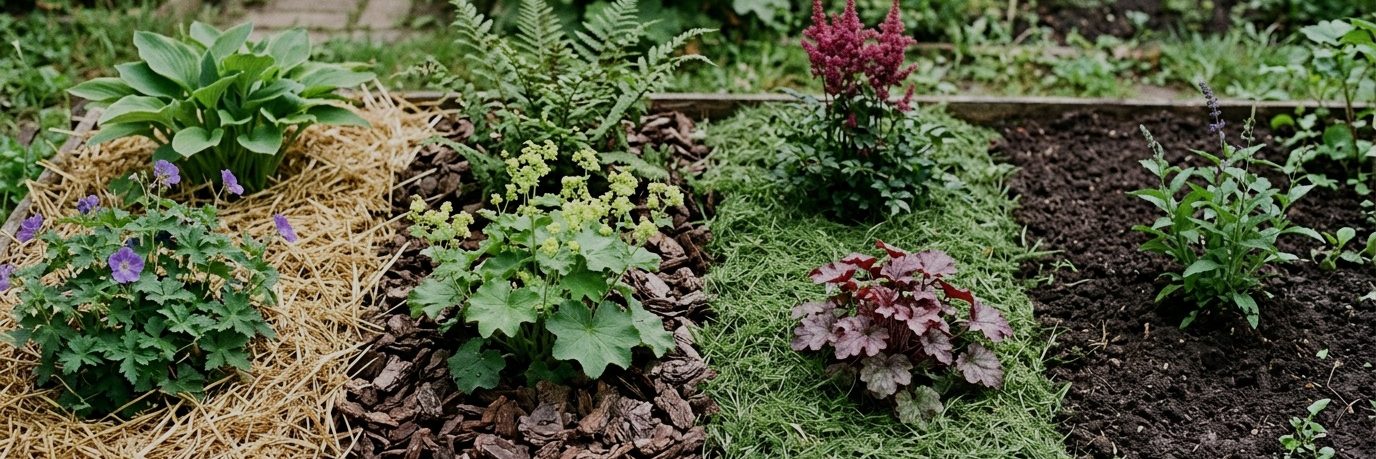
Garden Mulching: Every Mulch Has an Effect and a Drawback
Mulching is not an automatic benefit, it is a trade-off: every material has a measurable effect on light, water and soil temperature, and every one of them drags its own drawback along. Nitrogen drawdown stays skin-deep as long as the mulch sits on the surface, and turns serious the moment it is dug in. An organic mulch slows the warming of the soil in spring, which suits cool-season crops and penalises heat-loving ones. And there are situations, cold heavy soil, seed rows, young transplants, where the right mulch is no mulch at all.
A mulch does four measurable things: it cuts out light at ground level, it slows evaporation, it damps down temperature swings and, if it is organic, it feeds the soil as it breaks down. Each of those four effects has a flip side, and that is what most guides leave unsaid. Cutting out light stops small-seeded annuals but lets rhizomatous perennials straight through, since they restart on their own reserves. Damping down temperature means the soil warms more slowly in spring, which penalises tomato, pepper, cucumber and melon, all crops that start badly while the soil stays cold. Breaking down means consuming nitrogen: laid on the surface, the effect stays confined to the contact zone between mulch and soil, and roots never notice it; mixed into the soil, it reaches the entire worked volume and genuinely stalls fast crops for months. The right mulch is therefore the one that matches what you are trying to achieve, at the depth its own material calls for, laid on soil that is already warm and already moist, and kept clear of the collar.
What a Mulch Actually Does, and What Each Effect Costs
A mulch has no virtues, it has physical effects, and each one is paid for somewhere. The first is optical: the layer intercepts light before it reaches the soil. Many annual weed seeds, the small ones above all, germinate only after receiving a light signal; denied that signal, they stay dormant. The price of this screen is that it applies to your own sowings too, and a mulch laid over a row of carrots or lettuces blocks exactly what you were trying to bring up.
The second effect concerns water. By breaking the contact between the soil and dry air, the mulch slows evaporation: one trial on straw measured a reduction of about 35 percent compared with bare soil, and published figures vary a great deal with the material, the depth and the climate. The flip side is symmetrical and rarely stated: a mulch does not make water, it preserves whatever state it finds the soil in. Spread over dry ground, it seals the drought in, and rewetting will then take far more water than if the soil had been left bare.
The third effect is thermal. The material traps air, so it insulates: under an organic mulch, the daily temperature swing of the soil narrows markedly. Insulation does not choose a direction: it shields against summer heat peaks and it delays warming in spring.
The fourth effect exists only for organic mulches: as they break down, they sustain soil life and end up as humus. Mineral mulches contribute nothing on that front, ever, however long you leave them in place. It is this fourth effect that raises the nitrogen question, which is the next subject.
No material ticks all four boxes to the same degree. The choice is therefore made the other way round from what you usually read: you are not looking for the best mulch, you start from what you want to achieve, that season, in that spot.
| What you are after | The mulch that delivers it | Depth | What it costs in exchange |
|---|---|---|---|
| Holding on to water in the hot season | Straw, shredded leaves, coarse chippings | 8 to 15 cm for straw, 5 to 8 cm for shredded leaves, 10 cm for chippings | Soil slower to warm, and drought sealed in if laid on dry ground |
| Blocking flushes of annual weeds | Coarse arborist chippings, bark | 10 cm maintained for chippings, 5 to 8 cm for bark | Rhizomatous perennials come through anyway, and the layer has to be topped up |
| Feeding the soil over several years | Ramial chipped wood from young broadleaf branches | 5 to 7 cm, on the surface | Almost nothing visible the first season, and a real stall if it is dug in |
| A warm, drained base for dry-climate plants | Slate, gravel, volcanic rock | 5 to 8 cm | Nothing added to the soil, heat given back at night, a near-permanent choice |
| Keeping fruit off contact with the soil | Straw | A continuous layer under the fruit | Slug shelter exactly where they do the most damage |
| Recycling clippings on the spot | Wilted clippings, in successive layers | 1 to 2 cm per pass | Waterproof felt as soon as you thicken it, and persistent herbicide if the lawn was treated |
Nitrogen Drawdown: Skin-Deep on the Surface, Serious Once Dug In
This is the worst-explained subject in gardening, and the confusion comes from one missing word: where. The micro-organisms that digest organic matter need carbon as an energy source and nitrogen to build their own proteins, in a ratio of roughly 20 to 30 parts carbon to one part nitrogen. When the material you hand them exceeds that ratio, the nitrogen it contains is no longer enough: they take the shortfall from the surroundings, and that nitrogen is no longer available to roots. Below a ratio of 20, the opposite happens and decomposition releases nitrogen. Between 20 and 30, the two cancel out.
The question therefore becomes arithmetic. Grass clippings sit between 9 and 25: at that level they release nitrogen rather than immobilising it. Fallen leaves run around 40 to 80, cereal straw between 48 and 150, hardwood bark around 220, sawdust around 440 on average within a range of 200 to 750, and chippings made from trunk wood reach several hundred. Those last three are the only materials genuinely capable of massive immobilisation.
That leaves the decisive point. A very carbon-rich material laid on the surface touches the soil only along its underside. Nitrogen depletion happens in that contact zone, over a thickness of about a centimetre, and no further: roots, which explore far deeper, never see any of it. This is the consistent result of trials on arborist chippings left as a surface cover, where nitrogen in the soil beneath is not reduced and even rises over the years. An amusing detail: this deficiency confined to the interface is probably one of the reasons a thick mulch stops weed seeds from establishing, since they germinate precisely where there is nothing left to eat.
Dig the same material in and you change problems entirely. By incorporating it, you multiply the contact surface by several orders of magnitude and you spread the competition through the whole worked volume, which is to say through the root zone itself. There, nitrogen drawdown is real, it lasts for months, and it hits fast, hungry crops first. A garden demonstration followed over three years, in which 7 cm of chippings spread at leaf fall were dug in when growth resumed, saw lettuces struggle during the first months of the season, while maize, sunflower and tomato had caught up with the control before the end of summer. That source has to be taken for what it is: a demonstration published in a gardening magazine, a single plot divided into three beds, two with ramial chipped wood and one control, with no replication and no statistical treatment. It is a coherent field observation, it is not a scientific measurement.
The symptom looks like a classic deficiency: slowed growth, pale green to yellowing foliage starting from the bottom. What sets it apart is the context, it appears after an application of very carbon-rich material, and it is reversible: the nitrogen has not left the garden, it is stored in microbial biomass and returns to the soil when those micro-organisms die. The corrections that work come in this order: do not dig it in, add a little nitrogen-rich material underneath the carbon-rich mulch rather than on top of it, and do not mulch with fresh chippings a bed you intend to sow within the following weeks.
The Thermal Effect: The Mulch That Delays Your Spring
Here is the counter-argument almost every guide forgets. An organic mulch is an insulator, and an insulator laid on cold soil stops it warming up just as surely as it stops it overheating. Solar radiation is intercepted by the material instead of being absorbed by the ground, and the air trapped inside the layer does the rest.
The magnitudes look modest as a daily average and turn out decisive in practice. On winter wheat, during the late-winter warming phase, the mean temperature of the top ten centimetres was measured between 0.42 and 0.65 °C lower under straw than on bare soil, depending on the rate applied. Written like that it is hardly spectacular, but half a degree sustained over weeks shifts the date on which a soil crosses a threshold, and it is the threshold that counts. Practitioners describe a lag of several weeks in getting a bed going when it was mulched too early.
And heat-loving crops are governed by sharp thresholds. Tomato has a germination minimum of around 10 °C, and at that level it needs roughly forty-three days to emerge; at 15 °C it still takes about a fortnight, whereas its germination optimum sits far higher, around 29 °C. That optimum should not be confused with the planting marker, which is something else: soil between 18 and 21 °C is what is recommended when setting the plants out. For cucumber, common practice is to wait for soil above 21 °C, and melon asks for the same; that is a field recommendation, not a measured threshold. A tomato plant set under 8 cm of straw in ground stuck around 15 °C stays stunted and dark, and loses weeks it never makes up. Aubergine, pepper and pumpkin follow the same logic.
There is a second, less familiar effect at night that points the same way. Bare soil, firm and moist, stores the heat of the day and gives it back at night towards the vegetation, which lifts the temperature at ground level by a few degrees. Any cover reduces that transfer. The measurement exists for cover crops: a tall, dense cover can cost up to about 5 °C compared with bare soil on a night of radiation frost, against about 1 °C for a short cover. Those figures do not transfer to a mulch: nothing of the kind has been quantified for it, and the mechanism is not even identical, since a living cover transpires whereas a mulch does not. The direction of the effect, on the other hand, is not in doubt. Where late frosts are a risk, on a peach tree, a fig or a vine at bud break, bare soil is an ally you are deliberately choosing not to use.
That very same insulation becomes a massive asset once the constraint is reversed. In a trial run in a hot desert climate, bare soil and a mineral mulch exceeded 40 °C at 5 cm depth for nine to twelve hours a day, while the organic mulches never reached that level and stayed 13 to 22 °C cooler in the afternoon. At 30 cm, the gap still held at 8 to 10 °C. That is not a temperate climate, but the order of magnitude shows where the benefit lies: it is a summer benefit, it is spectacular, and the only way to buy it is to accept the slower spring.
The practical conclusion is easy to remember: mulch goes onto soil that is already warm and already moist, not before. When a bed has spent the bad season under cover, pull the mulch aside about two weeks before planting heat-loving crops, let the sun do its work, and put it back once the plants are in and growing away.
Depth and Particle Size: Every Material Has Its Own
The single figure repeated everywhere, one depth for every material alike, does more damage than anything else apart from mulch piled against a trunk: the right depth runs from one or two centimetres for clippings to fifteen for straw. The useful depth depends on two properties of the material: how fine it is, and how wet it is when you lay it.
A fine, damp material mats down into felt. Fresh grass clippings tipped on in a thick layer stick to themselves, ferment without oxygen, heat up, smell foul and turn into a membrane that rain runs off instead of soaking through. They are used in layers of one to two centimetres, wilted first, renewed as the mowings come. Whole leaves make the same waterproof felt as they plaster themselves flat against one another, the large leathery ones above all; run over with the mower, those same leaves hold perfectly at five to eight centimetres and break down three to four times faster.
A coarse material does the opposite: it lets air, water and part of the light through, so you need more of it. Straw is very open and settles enormously, which is why it goes on at eight to fifteen centimetres in order to end up as a useful layer. Arborist chippings should be frankly coarse, and are kept at ten centimetres to hold weeds back; since they settle as they break down, spread them generously at the outset and top the layer up as it thins.
Two safeguards sit on top of this material-by-material logic. On heavy soil, poorly drained or regularly waterlogged, a thick mulch sustains the suffocation instead of correcting it: drop to two or three centimetres of fine material, or do not mulch at all until the drainage is sorted out. And at the foot of a tree, common practice is to stay within about ten centimetres. The usual justification, adventitious roots forming from the trunk and eventually strangling it, is shakier than it looks: the reference systematic review finds no mulch depth that has been shown to make a tree decline, traces the belief back to unsourced trade-press articles, and offers another reading, that of a thin mulch spread over a mound of imported soil, which then reproduces the effects of planting too deep. Caution is still worth keeping, it costs nothing; it simply does not have the status of a measured rule that it is credited with.
| Material | Indicative C/N ratio | Depth when laid | What it is good for | Its drawback |
|---|---|---|---|---|
| Wilted grass clippings | 9 to 25 | 1 to 2 cm per pass | Fast nitrogen supply to a vegetable garden in production | Waterproof felt in a thick layer, persistent herbicides |
| Shredded fallen leaves | 40 to 80 | 5 to 8 cm | Borders, fruit trees, free at leaf fall | Water-repellent crust if the leaves are left whole |
| Cereal straw | 48 to 150 | 8 to 15 cm, settles a great deal | Vegetable garden, protecting fruit lying on the soil | Slug shelter, blows away while it is dry |
| Ramial chipped wood from young branches | 50 to 170 | 5 to 7 cm | Rebuilding the soil over two to three years | No visible effect the first season, disastrous once dug in |
| Hardwood bark | Around 220 | 5 to 8 cm | Ornamental borders, long-lasting cover | Very slow decomposition, nothing supplied quickly |
| Chippings from old wood, sawdust | Sawdust around 440, from 200 to 750; several hundred for trunk wood | 10 cm for coarse chippings, on the surface only; sawdust, being fine and prone to matting, is limited to 1 to 2 cm | Paths, the base of established shrubs | Massive nitrogen immobilisation as soon as it is incorporated |
| Slate, gravel, volcanic rock | Not applicable, inert material | 5 to 8 cm | Dry-climate plants, drainage at the collar | Nothing added to the soil, night warmth, tedious to remove |
Against Weeds: The Threshold Depth, and What Gets Through Anyway
Mulch does not kill weeds, it stops some of them from ever starting. The mechanism is light: a large share of annuals, small-seeded species in particular, need a light signal to emerge, a signal telling them they are at the surface and hold enough reserves to get there. The smaller the seed, the more it is inhibited by burial or shade. That is why a mulch works remarkably well against flushes of annuals, and against them alone.
Depth matters, but not in the way it is usually written up. A systematic review of the arboricultural literature records a weed-control benefit from five centimetres upwards; the figure of seven and a half centimetres sometimes quoted from it as a threshold is nothing of the sort, it is simply the lowest of the maximum depths tested by the studies surveyed. What the review does establish is that the benefit keeps increasing with thicker layers, which vindicates the field recommendation for arborist chippings: ten centimetres, maintained. Any thinner and you slow the flushes without holding them. And the effect wears out: an organic layer decomposes and thins, so it has to be topped up, otherwise the germination window reopens.
What gets through are the perennials with underground storage organs. They do not germinate, they resprout, and they have the reserves to fund the journey. A three-centimetre fragment of couch grass rhizome is enough to rebuild a whole plant; so is a five-centimetre piece of bindweed root, and its roots have been traced down to five metres. Horsetail and ground elder work the same way. A thick mulch reduces their vigour and makes pulling easier because the soil stays loose, but an infested plot will need going over regularly, every year, whatever you lay on top of it. Believing that a layer of chippings will settle an established stand of couch grass is the most expensive illusion in mulching.
One last point: the mulch can itself sow. Hay is the whole plant cut down, seed heads included, and one bale holds a considerable number of them; straw is what is left after threshing, so hollow stems, with at worst a few cereal regrowths that pull out easily. The shortcut of treating hay as straw costs two seasons of weeding. And the overall effect is not always the one you hope for: in the three-year ramial chipped wood demonstration already mentioned, the mulched beds produced more weeds than the control, without the protocol allowing any cause to be identified.
Ramial Chipped Wood: What It Is, What It Delivers, and Over What Timescale
Ramial chipped wood is not a synonym for wood chips. It is a defined material: chippings from living, freshly cut branches under seven centimetres in diameter, the ideal sitting around three to four. Diameter is not a cosmetic detail, it is the whole definition. Young branches concentrate most of the tree’s minerals and nutrients and their lignin is still only weakly polymerised, so soil fungi break into it easily. Their carbon to nitrogen ratio lies between 50 and 170 for branches under seven centimetres, against roughly 500 for trunk wood. That ratio is calculated on a mass basis: for the same mass of material, ramial chipped wood is therefore three to ten times richer in nitrogen than chippings made from logs, depending on where you land within the range.
Species composition matters too. The reference material is a mixture of broadleaves. The Quebec work behind the technique lists conifers among the species to avoid and goes no further than tolerating a share of around twenty percent in the mix; beyond that, you are outside the documented framework. Its authors themselves restrict the rule to temperate and cold climates. Chippings from a hedge of pure thuja or cherry laurel are not ramial chipped wood, they are chippings of conifers and evergreen shrubs, and the same effects should not be expected from them.
What to expect from it, next, is a question of timetable rather than of intensity. The three-year garden demonstration already cited, with its three beds and no replication, gives the curve: first season behind on the fast crops, long-season crops catching up before the end of the first summer, second year slightly behind in spring then level with the control from the start of summer, and third year clearly ahead, with one mulched and watered bed producing nearly three times as many tomatoes as the control. The next sentence in that source is rarely quoted and yet it changes the reading: the bed that was mulched but not watered came out level with the control. The factor of three therefore owes as much to irrigation as to the ramial chipped wood. The same observations describe soil that had become more friable, more heavily colonised by earthworms, and watering needs appreciably reduced.
So where does the disappointment come from? From three mistakes, always the same ones. People use it as an ordinary mulch, expecting a result within the season, when the outlay only pays back over two to three years. They dig it in to speed things up, which triggers exactly the nitrogen drawdown they were trying to avoid, the real one, the kind that stalls the crop. And they call any green-waste chippings ramial chipped wood, often chippings made from old branches and trunks, whose carbon to nitrogen ratio is ten times higher and which will do nothing comparable.
The sensible way to use it: spread a moderate layer at leaf fall, leave it on the surface, let the earthworms do the incorporating, and give the first season over to crops that are in no hurry, fruit trees and bushes, soft fruit, artichoke, asparagus, rhubarb, rather than to lettuces and spinach.
Slugs and the Collar: The Two Harms Mulching Really Does Cause
On slugs, what is documented has to be kept apart from what merely circulates. What is documented is the shelter effect. The literature on no-till arable cropping is clear and consistent: a surface cover of residues creates a cool, dark, damp and stable microclimate, which is precisely the optimal habitat for slugs, and damage there is notoriously higher than on cultivated soil. The grey field slug, Deroceras reticulatum, is the species responsible in the majority of cases, and its window of harm is the cool damp spring, exactly when your young plants are at their most vulnerable. A mulch does in the vegetable garden what residues do in the field.
What belongs to folklore is the idea that a given material repels them. In 2023 the Royal Horticultural Society tested five household barriers around 108 lettuces, spread across nine pots and nine raised beds, over six weeks: crushed eggshells, pine bark, copper tape, horticultural grit and wool pellets. No difference in damage between the protected lettuces and the ones left with nothing at all. A gastropod’s mucus is a protective film that carries it calmly across anything. The right conclusion to draw is this: it is not the material that counts, it is the shelter, and a ring of bark around a young plant is not a barrier, it is accommodation.
What genuinely changes something is duller and more effective: no mulch, or a very thin one, around young plants while they are still at the fragile stage, waiting until they are well ahead before laying the layer down, keeping a clear ring at the base, and picking slugs off by hand on mild damp nights, which are the nights they come out. Residues also shelter ground beetles, which are their predators, so the balance under an established mulch is not systematically unfavourable: it is the establishment phase of the crop that is the weak point.
The second harm is slower and far more final. Bark is not a root: it is built to alternate wet and dry, and it defends itself badly when it stays wet permanently. Mulch heaped up against a stem or a trunk maintains exactly that continuous moisture, softens the tissues and opens the door to collar rots. Phytophthora species, which cause collar and root rots in fruit trees, are aquatic organisms: they need prolonged saturation in order to develop. Even so, it has not been demonstrated that cone-shaped mulch, the famous volcano, increases the incidence of these rots: the two studies that looked for that relationship did not find it. The biology points that way, the correlation is missing, and field consensus is enough to settle the gesture, because pulling the mulch away from the trunk reduces the risk. On a grafted tree the rule is absolute: the graft union is never covered, neither with soil nor with mulch. When a specimen shows the symptoms, the first intervention is precisely to clear the base down to the top of the main roots and let it dry.
To that add a quieter form of damage, and a belief that needs putting back in its place. You read everywhere that beyond ten centimetres of depth the tree throws adventitious roots into the mulch, above its collar, and that these roots end up strangling the trunk; the reference systematic review establishes no mulch depth responsible for the decline of a tree and attributes the idea to unsourced trade-press articles. Better, then, to treat it as customary caution rather than as settled fact. The damage that is entirely real lies elsewhere: voles dig their runs in mulch piled against the bark, where they gnaw all winter with nothing showing from the outside; the tree breaks bud in spring, then dies all at once, ring-barked around its full circumference.
The clearance rule fits into a single image. A tree mulch is a flat disc, not a volcano: spread it widely, out to the edge of the canopy and beyond it if you can, and leave a bare ring of eight to fifteen centimetres around the trunk, only a few centimetres around a herbaceous stem such as a tomato or a courgette. On a young fruit tree in vole country, widen that bare zone at the base further still.
Mineral Mulches: Nothing for the Soil, a Great Deal for Heat
Crushed slate, gravel, volcanic rock: these are rocks, they do not break down, and that sentence should be taken literally. They add no organic matter, they do not feed soil life, they make no humus, and none of that will change in ten years. In exchange they never raise a nitrogen question, they do not settle, they do not need renewing. They go on in a layer of five to eight centimetres and the matter is closed, which is also the problem: a mineral mulch is a near-permanent choice, extremely tedious to remove, and one that slowly fouls with soil and debris until it becomes a seedbed that is hard to weed.
Their real effect is thermal, and it is substantial. Rock has far more thermal mass than an airy organic material: it stores the day’s radiation in its bulk and gives it back once the sun has gone. The most telling measurement comes from a trial comparing mulches in a hot desert climate: at 10 pm, the surfaces of the organic mulches were already 4 to 8 °C cooler than that of a granite mulch or of bare soil, and at 30 cm depth the mineral mulch and the bare soil were still 8 to 10 °C warmer. The same logic explains why gravel mulching is an old technique of cold, dry regions, where it serves precisely to warm the soil and to cut evaporation.
Who gains from it: everything that comes from dry climates and tolerates, or even demands, a warm, well-drained base. Lavender, rosemary, thyme, sage, olive and vine take to it very well, and the surface drainage a mineral mulch gives the collar is more use to them than the organic matter it fails to supply. Who loses by it: everything that asks for cool soil and steady moisture at root level, starting with the vegetable garden in full production, soft fruit and woodland perennials. A bed of moisture-loving plants over volcanic rock in full sun is living on a radiator.
Two stubborn beliefs deserve cutting off cleanly, and the second one applies to organic mulches as well. Slate does not make a soil acid: no study has tested a slate mulch from that angle, and there is no measurable effect on pH to expect from it. And conifer needles and pine bark do not acidify it either, contrary to what has been repeated for decades. Needles are indeed acidic as they fall, in a pH range of 3 to 4, but that acidity is neutralised during decomposition and the buffering capacity of a garden soil absorbs the rest. Measurements from university trials find no significant difference after several years of mulching with needles or bark, nor even after three years of conifer chippings incorporated into the soil. The direct consequence: neither slate nor pine bark will make a soil suitable for a blueberry or a blue hydrangea. That is decided at planting time, in the composition of the growing medium, and not with a mulch.
When Not to Mulch, and What to Never Mulch With
There are situations in which mulching is a mistake, and they are almost never listed. The first is cold, heavy soil coming out of winter. Poorly drained clay that stays sodden does not need covering, it needs to drain and to warm up; a thick mulch there sustains root suffocation and manufactures the exact conditions that root-rot organisms are looking for. On soils like that, mulch thinly, mulch late, and only once the ground has drained, or do not mulch at all and work on the drainage first.
The second is sowing. A mulch cuts out light and stands in the way: most seedlings do not push through it, and the cool damp soil it maintains slows germination while favouring damping-off. A row of carrots, lettuces, leeks or beans is sown on bare soil and mulched once the plants are up and well away, between the rows rather than over them. The same caution applies to young transplants for as long as they are within a slug’s reach.
The third is spring for heat-loving crops, set out above: you wait for the soil to warm, which sometimes means pulling a winter mulch aside two weeks before planting. The fourth is the late-frost situation on a specimen at bud break, where bare soil gives back a night warmth that a mulch intercepts. And the fifth is the collar of anything that has bark.
Climate moves the cursor without changing the rules. In a damp oceanic climate, with mild and very wet winters, it is excess water that kills rather than cold: there the mulch is first of all a risk to watch through the cold season, and a benefit in summer. In a dry or dry continental climate, the logic reverses and mulching becomes above all a weapon against evaporation, whose thermal cost in spring is willingly accepted. Both cases exist and neither of them is the default rule.
That leaves the question of materials, where doubt has to be settled by abstaining rather than by qualifying. Clippings from a lawn treated against broadleaf weeds are a genuine danger in a vegetable garden: herbicides of the aminopyralid, clopyralid and picloram family pass through the clippings, through manure and through composting without breaking down, and stay active from a few months to three or four years. Concentrations in the parts-per-billion range are enough to damage tomato, lettuce, bean, pea, spinach and potato, with twisted leaves, cupped and elongated, poor emergence and deformed fruit. Reclaimed wood from building sites or demolition is not to be shredded into mulch: on samples taken at construction-waste facilities, 18 out of 22 leached arsenic above the regulatory threshold set by the State of Florida, and less than 0.1 percent of wood treated with chromated copper arsenate is enough to push a mulch past that same State’s cleanliness threshold for residential soil. Both of those figures are American and do not apply everywhere, but the warning itself holds generally: the restriction of this treatment for residential uses came in on different dates from one country to another, the European Union and the United States not having moved at the same time, and this wood is still sold for certain uses in Australia and New Zealand. Depending on where you live and on the age of the construction, it can therefore perfectly well be sitting in a garden today. Finally, cocoa shells contain theobromine and caffeine, exactly as chocolate does. The ASPCA Animal Poison Control Center has followed a series of cases of ingestion by dogs, with vomiting, tremors, seizures and a racing heart rate, and the reference veterinary manual documents deaths of animals that had eaten this mulch. A fatal outcome remains rare, but it has happened. And what makes the risk concrete rather than theoretical is that this mulch smells of chocolate: it actively draws the dog in instead of keeping it away. In a garden a dog has the run of, you do not use it.
| Material | What has been established | What to do |
|---|---|---|
| Clippings from a treated lawn | Aminopyralid, clopyralid and picloram pass through clippings, manure and composting, stay active from a few months to three or four years, and do harm at doses in the parts-per-billion range | Do not use them in the vegetable garden without knowing the lawn’s treatment history |
| Reclaimed wood, pallets, building-site waste | Out of 22 samples from construction-waste facilities, 18 leached arsenic above the reference threshold set by the State of Florida, and less than 0.1 percent of wood treated with chromated copper arsenate is enough to push a mulch past that same State’s cleanliness threshold for residential soil; both markers are American, and this wood is still sold for certain uses in other countries | Never shred wood whose origin you do not know, least of all for the vegetable garden |
| Cocoa shells | Theobromine and caffeine, just as in chocolate, plus a chocolate smell that actively draws the dog in; cases of ingestion followed by the ASPCA Animal Poison Control Center, with vomiting, tremors, seizures and tachycardia, and animal deaths documented by the reference veterinary manual | Do not use them in a garden a dog has the run of |
| Conifer needles, pine bark | Soil acidification is not measurable: acidic as they fall, around pH 3 to 4, they are neutralised during decomposition and the soil buffers the rest | Safe to use, but useless for acidifying soil intended for a blueberry |
| Hay | The whole plant cut down, seed heads included, so loaded with seed, unlike straw, which has been threshed | Keep hay for areas where you accept the weeding, and straw for the vegetable garden |
Common pitfalls to avoid
MistakeDigging the mulch in when the bed is tidied up, or raking the chippings into the top few centimetres so they work faster.
Why :This is the one gesture that turns a non-problem into a real problem. Laid on the surface, a very carbon-rich material starves only its contact zone with the soil of nitrogen, over about a centimetre, out of reach of the roots. Incorporated, it spreads the same competition through the whole worked volume, which is to say right through the root zone: in a garden demonstration followed over three years, with no replication and no statistics, in which the ramial chipped wood was dug in when growth resumed, the lettuces struggled during the first months of the season.
Do this instead :Leave the mulch on the surface and let the earthworms do the incorporating at their own pace. If a very carbon-rich material absolutely has to go into the soil, compost it first, or apply it at the end of the season on a bed that will not be cropped for several months.
MistakeMulching the vegetable garden early in spring, before the soil has warmed, to get ahead of drought and weeds.
Why :A mulch is an insulator, and it does not choose a direction. On winter wheat, the mean temperature of the top ten centimetres is measured between 0.42 and 0.65 °C lower under straw during the warming phase, and that gap sustained over weeks shifts the date on which thresholds are crossed. Tomato does not germinate below 10 °C of soil, and even then it needs more than forty days to emerge; at 15 °C it still takes about a fortnight, while the field marker for cucumber and melon is to wait for soil above 21 °C. A plant set into ground that is going nowhere stays stunted and dark and loses time it never makes up.
Do this instead :Mulch onto soil that is already warm and already moist, never the other way round. On a bed kept covered through the cold season, pull the mulch aside about two weeks before planting heat-loving crops, let the sun do the work, and put it back once the plants are in and growing away.
MistakeHeaping the mulch into a cone against a tree trunk or the base of a stem, because that is the part you want to protect.
Why :Bark is built to alternate wet and dry; kept permanently wet, it softens. Phytophthora species, responsible for collar rots, are aquatic organisms that require prolonged saturation. It has not been demonstrated that volcano mulching increases the incidence of these rots, the two studies that looked for it having found nothing, but the field consensus is constant: pulling the mulch away from the trunk reduces the risk. The story of adventitious roots strangling the tree beyond ten centimetres is not established either, no mulch depth having ever been linked to the decline of a specimen. The certain damage lies elsewhere: voles dig their runs inside the cone and gnaw the bark all winter long, out of sight.
Do this instead :Spread it as a flat disc out to the edge of the canopy and beyond, leaving a bare ring of eight to fifteen centimetres around a trunk and of a few centimetres around a herbaceous stem. On a grafted specimen, never cover the graft union, neither with soil nor with mulch.
MistakeEmptying the mower box onto the bed as a single thick layer of fresh clippings.
Why :Clippings are a fine, damp material with a low carbon to nitrogen ratio, between 9 and 25: they deprive the soil of nothing, but they mat down on themselves. In a thick layer they ferment without oxygen, heat up, give off a smell of ammonia and form a waterproof membrane that rain runs off instead of soaking through. The soil underneath dries out while you believe you have protected it.
Do this instead :One to two centimetres per pass, wilted before spreading, renewed as the mowings come; or mixed with a coarse material that stops it sticking to itself. And no clippings from a lawn treated against broadleaf weeds: those herbicides stay active from a few months to three or four years.
MistakeLaying a ring of bark, eggshells, grit or wool around a young plant to keep slugs at bay.
Why :In 2023 the Royal Horticultural Society tested five of these barriers around 108 lettuces, in pots and in raised beds, over six weeks: no difference in damage compared with the lettuces left with nothing, since their mucus lets gastropods glide straight over. Worse, the gesture targets the wrong mechanism: the real relationship between mulch and slugs is not a barrier being crossed, it is a cool, dark, damp shelter offered at the very foot of the crop.
Do this instead :Act on the shelter and on the timing rather than on the material: no mulch, or a very thin one, around young plants while they are still at the fragile stage, a clear ring at the base, the layer laid down once the plants are well away, and hand-picking on mild damp nights, which are the nights they come out.
The care sheets to read next
Every plant mentioned has its full sheet: watering, light, soil, pests and a month-by-month calendar.
Tomato
Solanum lycopersicum
The tomato (Solanum lycopersicum) is the queen of the vegetable garden, but it is a plant of sun and warmth that plays…
Bell pepper
Capsicum annuum
The bell pepper (Capsicum annuum) is an annual fruiting vegetable and a genuinely cold-shy one, the sweet cousin of the…
Eggplant
Solanum melongena
The eggplant (Solanum melongena) is the most cold-sensitive and the most heat-hungry of the garden nightshades, even…
Cucumber
Cucumis sativus
The cucumber (Cucumis sativus) is an annual vegetable from the warm regions of the southern Himalayas, and it shows: it…
Zucchini
Cucurbita pepo
The zucchini (Cucurbita pepo) is the easy summer vegetable par excellence, one plant yields more than a family can eat.…
Pumpkin
Cucurbita maxima
The pumpkin (Cucurbita maxima) is a large, sprawling, hungry and frost-tender squash that came from the Andes. It is a…
Bean
Phaseolus vulgaris
The green bean (Phaseolus vulgaris) is one of the easiest vegetables in the kitchen garden, provided you respect one…
Lettuce
Lactuca sativa
Lettuce (Lactuca sativa) is the most widely grown salad in the vegetable garden, easy and quick, harvested six to ten…
Carrot
Daucus carota
The carrot (Daucus carota) is a staple root vegetable in the vegetable garden, keeping all winter and sown directly in…
Leek
Allium porrum
The leek (Allium porrum) is the winter vegetable par excellence. Very hardy, it stands in the ground all winter and is…
Potato
Solanum tuberosum
The potato (Solanum tuberosum) is one of the most rewarding crops in the vegetable garden: easy, productive and…
Swiss chard
Beta vulgaris subsp. cicla
Swiss chard (Beta vulgaris subsp. cicla), also called leaf beet, is a generous, easy leafy vegetable, a close relative…
Artichoke
Cynara scolymus
The artichoke (Cynara scolymus) is a large perennial with silvery, deeply cut foliage, as striking in an ornamental…
Asparagus
Asparagus officinalis
Asparagus (Asparagus officinalis) is an unusual perennial for a vegetable patch: once established, an asparagus bed…
Rhubarb
Rheum rhabarbarum
Rhubarb (Rheum rhabarbarum) is a robust, long-lived perennial that thrives anywhere the winter is a real one. A…
Strawberry
Fragaria x ananassa
The strawberry (Fragaria x ananassa) is a hardy perennial that fits very well into any vegetable garden. Hardy to…
Raspberry
Rubus idaeus
The raspberry (Rubus idaeus) is a small fruiting shrub, hardy down to -25 °C, that grows wild in the cool woodland of…
Blackcurrant
Ribes nigrum
The blackcurrant (Ribes nigrum) is a small hardy fruit shrub that is genuinely happy in a cool climate, down to USDA…
Redcurrant
Ribes rubrum
The redcurrant (Ribes rubrum) is a small bushy fruit shrub that produces those pretty clusters of translucent red…
Blueberry
Vaccinium corymbosum
The cultivated blueberry (Vaccinium corymbosum) is the large shrubby cousin of the wild bilberry, also called the…
Apple tree
Malus domestica
The apple tree (Malus domestica) is the king of fruit trees in temperate climates, the one that has filled family…
Pear tree
Pyrus communis
The pear tree (Pyrus communis) is the apple tree’s cousin, a fruit tree for the family orchard that gives melting fruit…
Cherry tree
Prunus avium
The cherry tree (Prunus avium) is a vigorous, hardy fruit tree, perfectly at ease in a temperate climate, from USDA…
Plum tree
Prunus domestica
The plum tree (Prunus domestica) is the classic family fruit tree, the one you find at the back of the garden or along…
Peach
Prunus persica
The peach tree (Prunus persica) is a fruit tree that loves far more warmth and sun than a cool temperate climate…
Fig tree
Ficus carica
The fig tree (Ficus carica) is a Mediterranean tree, yet it really can be grown up to USDA zone 7 provided you shelter…
Grapevine
Vitis vinifera
The grapevine (Vitis vinifera) is a vigorous climber that produces table grapes, grown since antiquity around the…
Olive tree
Olea europaea
The olive tree (Olea europaea) is a Mediterranean tree whose hardiness stops at around minus 8 to minus 10 degrees, in…
Hydrangea
Hydrangea macrophylla
The hydrangea (Hydrangea macrophylla) is the flowering shrub for cool, partly shaded gardens, and one of the very few…
Rose
Rosa
The rose (Rosa) is a hardy flowering shrub that overwinters outdoors without trouble, down to about -20 °C for most…
Lavender
Lavandula angustifolia
True lavender (Lavandula angustifolia) is a hardy Mediterranean plant that scents the air and draws bees all summer…
Rosemary
Salvia rosmarinus
Rosemary (Salvia rosmarinus, long known as Rosmarinus officinalis) is an evergreen Mediterranean shrub with needle-like…
Thyme
Thymus vulgaris
Thyme (Thymus vulgaris) is a small Mediterranean subshrub with woody stems and a powerful fragrance, hardy to about…
Sage
Salvia officinalis
Common sage (Salvia officinalis) is a small aromatic shrub with evergreen grey-green foliage, originating from the dry…
Box
Buxus sempervirens
Box (Buxus sempervirens) is an evergreen shrub that has been clipped into balls, cones and low borders in formal…
Frequently asked questions
How thick should a layer of mulch be?
There is no single depth, there is one per material, and the single figure repeated everywhere does real damage. Fresh clippings go on in layers of 1 to 2 cm, otherwise they mat down into waterproof felt. Shredded leaves hold at 5 to 8 cm; left whole they form a crust that water no longer crosses. Straw goes on at 8 to 15 cm because it settles enormously. Coarse chippings are kept at 10 cm to block weeds. Two safeguards: on heavy, frequently waterlogged soil, drop to 2 or 3 cm of fine material or do not mulch at all, and around a tree stay within about ten centimetres, keeping a bare ring clear at the base. That last limit is customary caution and not a demonstrated threshold: no mulch depth has ever been established as making a tree decline.
Does mulching really starve the soil of nitrogen?
It depends entirely on where the material is sitting. Laid on the surface, a very carbon-rich mulch touches the soil only along its underside: nitrogen is tied up in that contact zone, over about a centimetre, and the roots exploring deeper never see any of it. Incorporated into the soil, the same material spreads the competition through the whole worked volume, right in the root zone, and there the stall is real and lasts for months. The only materials genuinely capable of massive immobilisation are the most carbon-rich of all: bark, sawdust and chippings from old wood. Straw is not among them. Grass clippings, between 9 and 25, release nitrogen instead of taking it.
When should you mulch, and from what point is it too early?
A mulch goes onto soil that is already warm and already moist. Too early, it does exactly the opposite of what you want: it insulates cold soil and delays its warming, which is measurable and penalises tomato, pepper, aubergine, cucumber and melon, all crops that sulk while the soil stays cold. It also seals drought in if it is spread over dry ground. The useful marker is not a date but a state: soil drained, warmed, and plants already in. On a bed kept covered through the cold season, pull the mulch aside about two weeks before planting heat-loving crops, then put it back once the plants are well away.
Does mulching attract slugs?
It does not attract them, it houses them, and that distinction changes how you respond. The literature on crops grown without tillage is consistent: a cover of residues creates the cool, dark, damp and stable microclimate that slugs need, and damage there is higher. The idea that some material repels them, on the other hand, does not hold up: a Royal Horticultural Society trial run in 2023 on 108 lettuces over six weeks compared pine bark, eggshells, grit, copper tape and wool pellets with unprotected lettuces, and found not the slightest difference. The lever is therefore not the material but the timing: little or no mulch around young plants, a clear ring at the base, and the layer laid down once the plants have got well ahead.
Can you mulch with grass clippings, pine needles or cocoa shells?
Clippings yes, in layers of 1 to 2 cm and wilted first, on one condition: knowing the lawn’s history. Selective herbicides of the aminopyralid and clopyralid family pass through clippings, manure and composting without breaking down and stay active from a few months to three or four years, at minute doses that are still enough to deform tomatoes, beans and lettuces. Conifer needles and pine bark, yes as well: the acidification myth does not survive measurement, they are acidic as they fall but neutralised during decomposition, and they will therefore not make a soil suitable for a blueberry either. Cocoa shells are to be ruled out: they contain theobromine and caffeine just as chocolate does, and they smell of it, so they actively draw the dog in. The ASPCA Animal Poison Control Center has documented cases of poisoning, with vomiting, tremors, seizures and tachycardia, and the reference veterinary manual reports deaths of animals that had eaten them. It is rare, but it has happened: in a garden a dog has the run of, you do not use them.
Organic mulch or mineral mulch: which one should you choose?
They do not do the same job. An organic mulch breaks down, so it feeds the soil, it has to be topped up, and it keeps the root zone cooler: that is the choice for the vegetable garden, for soft fruit and for beds of moisture-loving plants. A mineral mulch never breaks down, so it adds nothing to the soil and never will, but it asks for no maintenance and it stores the heat of the day to give it back at night. That thermal mass suits anything from dry climates, lavender, rosemary, thyme, sage, olive, vine, and penalises everything that demands cool soil. Two things worth knowing: slate does not make a soil acid, no measurable effect on pH being expected from it, and a mineral mulch is a near-permanent choice, extremely tedious to remove once it has worked its way down into the soil.
Green Hub looks after your plants
Photograph a plant: Green Hub identifies it and writes its care sheet, with no account. Sign in afterwards to keep its dated photos and history over time.
Identify a plantUpdated on
How this sheet is written
Written for Green Hub with the help of language models, then reviewed. It offers gardening guidance, not professional advice: if you are unsure whether a plant is toxic to a child or an animal, ask a vet, a doctor or your national poison centre.