Rubber plant
Ficus elastica
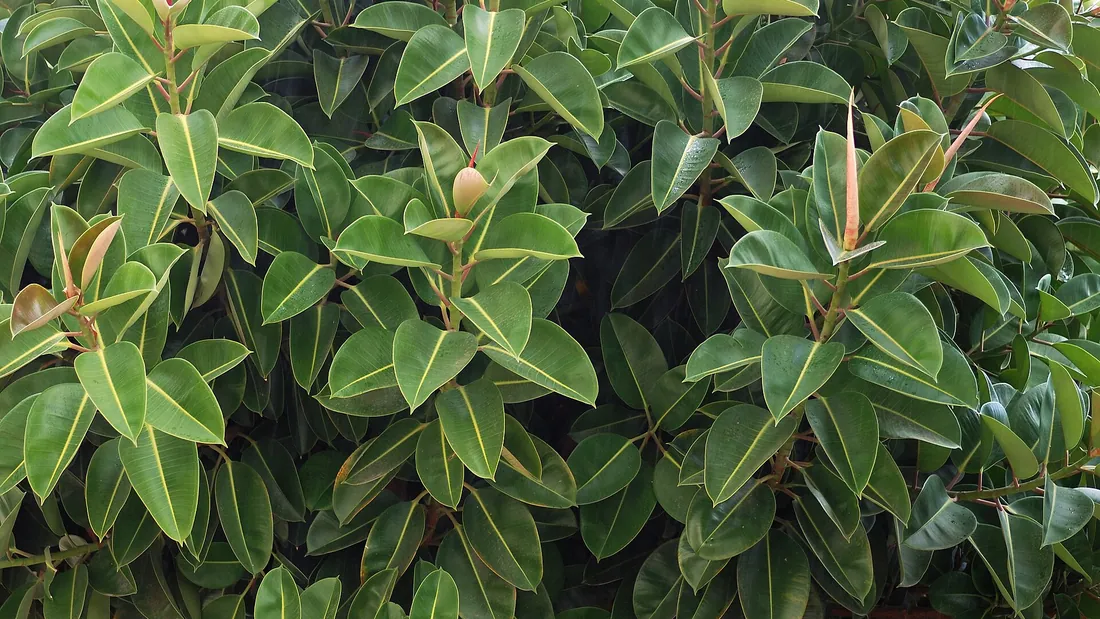

The rubber plant (Ficus elastica) is a tree of the humid forests of Southeast Asia, grown in temperate climates as a houseplant for its large, thick, glossy leaves. In the wild it exceeds thirty metres; indoors it forms a handsome shrub kept to the size you want by pruning. It lives indoors all year round, enjoys bright light and above all dreads excess water in the cold season. It is a sturdy plant, perfect for a first large green specimen.
Light and exposure
The rubber plant wants bright light, without scorching direct sun. A spot near an east or west facing window, or slightly back from a south facing window, suits it. The variegated varieties (Tineke, Ruby) need more light than the dark green type to keep their colours, but never full summer sun.
In insufficient light, the plant stretches, the space between the leaves lengthens and the base thins out. In weak winter light, when the days are at their shortest, move the pot closer to a bright window and turn it a quarter turn a week so it grows straight.
Watering
Let the top two to three centimetres of substrate dry out before watering again, roughly once a week in spring and summer, then every ten to fifteen days in winter. The rubber plant copes far better with a slight lapse than with excess water.
Always empty the saucer: roots left soaking rot, and that is the first cause of loss of the lower leaves. In winter, when the plant slows down because of the weak light, cut back the watering sharply. Leaves that yellow and fall in series almost always signal watering that is too generous, not a lack of water.
Soil and repotting
A quality potting soil for green plants, lightened with a handful of perlite or a little bark for drainage, works very well. The pot must have holes, that is non negotiable for this plant that is sensitive to standing water.
Repot in spring every two or three years, or when the roots spill out of the drainage holes, into a pot only slightly larger. A pot that is too big keeps the soil damp too long and rots the roots. On a large specimen that is hard to repot, simply replace the top few centimetres of soil each spring.
Temperature and humidity
The rubber plant is happy between 16 and 24 degrees. Below 12 degrees it suffers and may lose its leaves. It tolerates no frost. Keep it away from cold draughts from doors and single glazed windows, as well as from hot radiators that dry out its foliage.
The sensitive point is winter: the plant does not like cold snaps, but it also suffers from the air dried out by heating through the whole heating season. Regularly dusted foliage and a little humidity in the air help it get through the season. Above all, avoid leaving it in a cool, damp room and watering it as if it were summer.
Pruning and upkeep
Pruning is done in spring. Cut the top of the main stem above a leaf to stop the plant growing taller and force it to branch out. The plant then grows back in several branches below the cut. Wear gloves, because the milky sap flows abundantly and irritates the skin.
Regularly wipe the large leaves with a damp cloth: dust builds up on them quickly and blocks the light, already scarce in winter. Clean, shiny foliage captures the little available light better and stays healthy.
Pests and diseases
In winter, in dry air, watch out for scale insects (mealybugs and armoured scale) that settle along the veins and in the leaf axils, and for red spider mites (Tetranychus urticae) under the foliage. Remove scale insects with cotton wool soaked in diluted methylated spirit and raise the room humidity against the mites.
The drop of the lower leaves is the most common trouble: it comes from excess water, a cold snap or a sudden change of location. The rubber plant does not like being moved often. Find it a good spot and let it settle in.
Propagation
Tip cuttings are taken in spring or summer. Cut a section of stem with two or three leaves, let the sap dry for a few minutes, then plant the cutting in a light, moist mix and cover with a plastic bag to keep the humidity. Rooting takes several weeks of patience.
For a specimen bare at the base, air layering gives better results: notch the stem, wrap the wound in moist moss held by plastic film, and cut below the roots once they have grown well, often after one to two months.
Toxicity
The milky sap contains latex that irritates the skin and mucous membranes, and causes digestive upset if a leaf is chewed. Keep the plant away from cats, dogs and young children, and wear gloves to prune it.
Climate and hardiness
Where and in which climate it thrives
The rubber plant is an indoor plant all year round. It never goes out in the cold season: it tolerates no frost and a damp winter would be fatal to it.
At the height of the warm season, you can give it a holiday outdoors in the bright shade of a sheltered terrace, where the natural light does it a world of good. Bring it back in as soon as the nights drop below 12 degrees, and gradually reacclimatise it indoors to prevent it dropping its leaves from the shock. The two challenges of the cold season are the weak light, which slows the plant down, and the dry air of heating. Then, water little and keep the foliage clean: that is what gets it through the bad season without damage.
Growing rubber plant?
Green Hub keeps a dated history of your own plant: its photos, its progress, its repottings. An AI answers about yours specifically, not a generic sheet, for free.
Identify my plantMonth-by-month care calendar
| January | Rest. Water little, every 12 to 15 days, only when the soil has dried out. The brightest possible light, away from radiators and draughts. |
|---|---|
| February | Still resting. Dust the leaves with a damp cloth. Watch for scale insects and red spider mites in the dry air. |
| March | The light returns, growth picks up gently. Resume more regular watering. A good time to repot if needed. |
| April | Full recovery. Ideal for repotting and cuttings. Prune the top to encourage branching. First light feeding. |
| May | Active growth. Water about once a week. Feed every fortnight with a diluted green plant fertiliser. |
| June | You can put the plant out in bright shade on a sheltered terrace. Fine new leaves are the reward. |
| July | Full summer. Water as soon as the surface has dried. Dust the foliage and continue the light feeding. |
| August | Still a good growth period. Take cuttings from the pruned tips. Prepare for the return indoors at the end of the month. |
| September | Bring the plant back in as soon as the nights drop below 12 degrees, gently to avoid leaf drop. |
| October | Space out the watering markedly. Last light feeding. Clean the foliage before winter. |
| November | Going into rest. Move the pot closer to a bright window. Stop feeding and reduce the water. |
| December | Winter rest. Water very little. Beware of the dry air from the heating: mist or set the pot on damp clay pebbles. |
Green Hub tips
- Wear gloves to prune: the milky sap irritates the skin and stains clothes.
- The rubber plant hates being moved. Find it a good bright spot and let it settle in without constantly shifting it.
- Lower leaves yellowing and falling in winter: it is almost always excess water. Let the soil dry out more.
- Cut the top in spring to force the plant to branch out rather than grow into a single bare stem.
Related species
Fiddle-leaf fig
Ficus lyrata
Ficus lyrata, or fiddle-leaf fig, is an African understorey tree recognisable by its large, glossy, violin shaped…
Fig tree
Ficus carica
The fig tree (Ficus carica) is a Mediterranean tree, yet it really can be grown up to USDA zone 7 provided you shelter…
Aglaonema
Aglaonema commutatum
The aglaonema (Aglaonema commutatum) is a robust, easy houseplant, prized for its foliage variegated with green,…
Alocasia
Alocasia
The alocasia, nicknamed elephant ear, charms with its large, dramatically veined leaves. It is a demanding tropical…
Aloe vera
Aloe vera
Aloe vera (Aloe vera) is a succulent from the Arabian Peninsula, grown since antiquity for the soothing gel of its…
Anthurium
Anthurium andraeanum
The anthurium (Anthurium andraeanum) is a tropical houseplant known for its smooth, waxy red spathe, which people often…
The guides that mention it
Toxic Plants for Cats and Dogs: Recognising the Danger Rather Than Memorising a List
A list of toxic plants is easily forgotten and always incomplete. What actually protects a cat or dog is recognising…
How to Compost in an Apartment with Worm Composting
Tiered bin, red worms and worm tea: how to compost your kitchen scraps without a garden or odor, even in a city…
Updated on
How this sheet is written
Written for Green Hub with the help of language models, then reviewed. It offers gardening guidance, not professional advice: if you are unsure whether a plant is toxic to a child or an animal, ask a vet, a doctor or your national poison centre.