Forsythia
Forsythia x intermedia
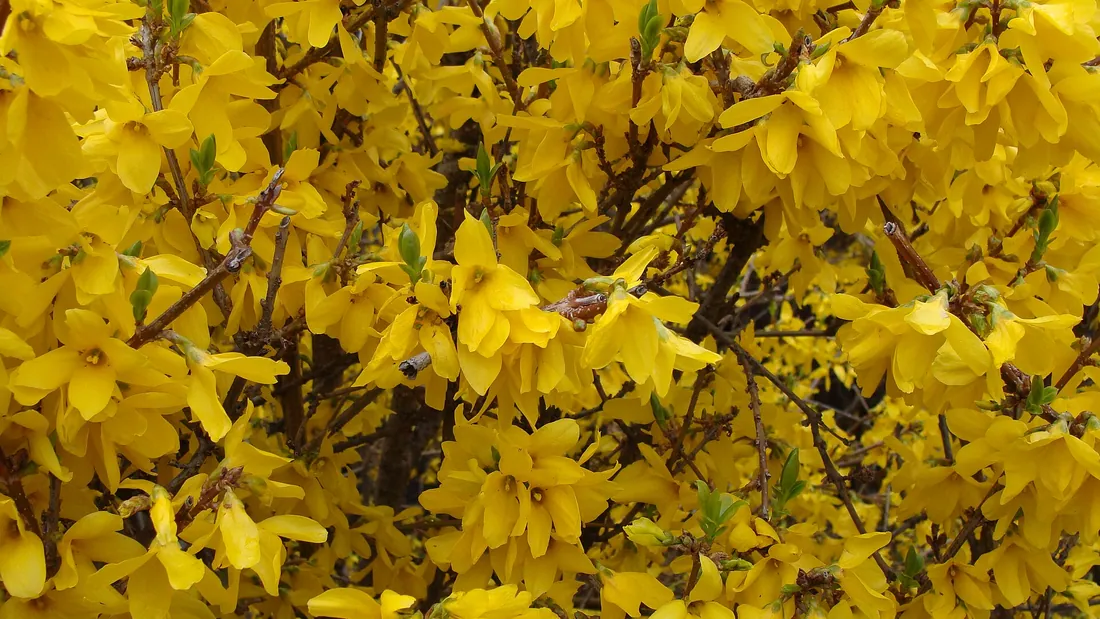

Forsythia (Forsythia x intermedia) is the first shrub of the year to flower: its golden yellow blooms burst out on bare wood at the end of winter, before the leaves even appear. Hardy down to minus twenty-five degrees, tough as nails and undemanding about soil, it is the shrub you plant once and never regret. There is a single rule to know, and it is absolute: prune only just after flowering, never before, or you remove every flower of the following year.
Light and exposure
Forsythia flowers best in full sun. The sunnier the spot, the denser and more golden the late winter display along the whole length of the branches. In shade or part shade it grows perfectly well but flowers noticeably less, with branches reaching for the light instead of covering themselves in flowers.
It copes equally well with a windy corner or a sheltered garden, which makes it valuable where other shrubs refuse to settle. It is the classic shrub for an informal hedge. One qualification in climates with scorching summers: light afternoon shade keeps the foliage from burning and costs almost nothing in flowering.
Watering
Once established, forsythia needs almost no watering at all. It is a tough shrub that draws moisture from deep in the soil and copes very well with summer drought, even through increasingly dry summers.
Only the first year after planting deserves some attention: water a young plant once or twice a week during dry spells while its roots settle in. After that, short of a truly severe and prolonged drought, it manages on its own. Few gardeners make the link: a severe midsummer drought thins out the following year’s display, because that is exactly when the flower buds are formed.
Soil and repotting
Forsythia is not fussy about soil type. It grows equally well in clay or chalky soil, in poor ground or richer ground, as long as it is not permanently waterlogged.
Ordinary garden soil suits it with no special amendment. A little compost at planting helps it get going, but it is not essential for such an undemanding shrub.
Temperature and humidity
Forsythia is completely hardy as far as its wood goes: it shrugs off frosts of minus twenty-five degrees without damage and needs no winter protection at all, from USDA zone 5 to zone 8.
Its weak point is not cold, it is the timing of its flowers. The flower buds freeze long before the wood, at around minus twenty degrees: after a very cold winter the shrub is alive, green and perfectly healthy, but completely devoid of flowers. Where winters regularly drop below that threshold, choose a cultivar selected for bud hardiness, such as 'Northern Gold' or 'Meadowlark'. And everywhere, a late frost falling on flowers that have already opened browns them and shortens the display by a few days: the shrub itself is never harmed, only the look of it suffers for a while.
Pruning and upkeep
This is the single most important thing to know about forsythia: it flowers on wood it produced the previous year. In practical terms, the buds for the next display form as early as this summer on this year’s shoots. Pruning in winter or very early spring, before flowering, means cutting off the flowers to come.
The rule is simple: prune only in the two or three weeks that follow the fall of the last flowers, never before. Shorten the branches that have just flowered and even out the shape. On an old shrub that has gone bare at the base or grown too big, cut back a third of the oldest stems right to the ground every two or three years: the shrub comes back stronger, with young wood and a renewed display of flowers.
Pests and diseases
Forsythia is a healthy shrub that causes very few problems. That is one of the reasons for its success in gardens and hedges just about everywhere.
You occasionally see dieback on weakened shoots, or forsythia gall, woody swellings that appear on the stems without necessarily threatening the plant. In both cases it is enough to cut out and remove the affected parts during the yearly pruning. No routine treatment is needed on a healthy shrub.
Propagation
Taking cuttings is the simplest and most reliable way to multiply a forsythia. In autumn, cut a length of this year’s growth, fifteen to twenty centimetres long, and plant it straight into open ground, somewhere sheltered from the wind. It roots almost automatically, no rooting hormone or greenhouse needed, a real gift for anyone wanting to fill out a hedge cheaply.
Forsythia also layers itself: low branches that touch the ground root naturally at the point of contact. Just look for these spontaneous layers at the foot of an old shrub, separate them from the parent plant once rooted, and replant them wherever you like.
Climate and hardiness
Where and in which climate it thrives
Forsythia is hardy from USDA zone 5 to zone 8, sometimes 9: the wood takes cold of minus twenty-five to minus twenty-nine degrees without damage. But the real limit lies elsewhere. The flower buds, formed the previous summer, freeze long before the wood does: below roughly minus twenty degrees they are destroyed and the shrub goes through spring entirely green, without a single flower, while being perfectly alive. This is the classic disappointment of cold continental winters, and there is an answer to it: cultivars selected for bud hardiness, 'Northern Gold', which still flowers after minus thirty-nine degrees, or 'Meadowlark', after minus thirty-four.
At the other end, a winter that is too mild denies it the cold it needs to break the dormancy of those same buds: under a hot Mediterranean or subtropical climate the display stays sparse and erratic, when it comes at all. Forsythia is a shrub for climates with clearly marked seasons.
In a mild, damp oceanic climate it is entirely at home and asks for no protection; the only hazard is a late frost browning flowers that have already opened, which never threatens the shrub itself. Under a hot dry summer it holds up well once established, but it flowers less if drought strikes the previous summer, at the exact moment the buds are forming. Where winters are mild and sodden, it is standing water that makes it decline, not cold: plant in free-draining soil or on a slight mound.
Growing forsythia?
Green Hub keeps a dated history of your own plant: its photos, its progress, its repottings. An AI answers about yours specifically, not a generic sheet, for free.
Identify my plantMonth-by-month care calendar
| January | Complete rest. The bare branches wait for spring, no particular task needed in the garden beyond watching the shape. |
|---|---|
| February | The buds start to swell. In a mild winter the very first flowers can even open by the end of the month in the most sheltered spots. |
| March | Forsythia’s big month. The branches cover themselves in golden yellow flowers before the leaves appear, often the first shrub in flower in the whole garden. |
| April | Flowering comes to an end. As soon as the last flowers drop, it is the ideal time to prune, never before. |
| May | Prune without delay if you have not already. The green leaves have taken over and the shrub is back to its summer look. |
| June | Active growth of young shoots. Keep an eye on the shape of a hedge and correct any branches heading off at odd angles. |
| July | Water only plants put in this year if there is a marked drought. An established forsythia manages on its own. |
| August | Next year’s flower buds are already forming on this year’s wood. Also a good time to take semi-ripe cuttings. |
| September | A good time to plant a new forsythia, the soil is still warm and the rain returns to help it root. |
| October | The ideal window for taking hardwood cuttings straight into open ground. Cut this year’s shoots and plant them in a sheltered spot. |
| November | The leaves fall. Still a good month to plant while the soil remains workable. |
| December | The shrub goes into complete rest. Use the time to study its shape and mark the old stems to cut back next year, without pruning now. |
Green Hub tips
- Never prune forsythia in winter or early spring: the following season’s flowers are already forming on last year’s wood, and pruning too early removes them all.
- The only real pruning window is right after flowering, in the two or three weeks that follow the fall of the flowers. Once that has passed, leave the shrub alone until the following year.
- An old, bare forsythia comes back stronger if you cut a third of its oldest stems right to the ground every two or three years.
- To multiply a forsythia for free, simply plant a length of this year’s growth straight into open ground in autumn, it roots on its own with no special care at all.
Related species
Lilac
Syringa vulgaris
Common lilac (Syringa vulgaris) is a deciduous shrub found in almost every old country garden. Its late spring scent is…
Olive tree
Olea europaea
The olive tree (Olea europaea) is a Mediterranean tree whose hardiness stops at around minus 8 to minus 10 degrees, in…
Privet
Ligustrum ovalifolium
Privet (Ligustrum ovalifolium), often sold as California privet, is a shrub native to Japan that has become one of the…
Althea
Hibiscus syriacus
Althea (Hibiscus syriacus) is a hardy deciduous garden shrub that flowers when every other one has finished, from…
Beech
Fagus sylvatica
Beech (Fagus sylvatica) is the most common broadleaf tree in the temperate forests of Europe, just as happy standing…
Begonia
Begonia
Begonia is the star summer flower of window boxes, hanging baskets and shady borders. Hundreds of hybrids exist, but…
The guides that mention it
Improving Clay Soil: Diagnosis, Amendments and Drainage
Ground that clings to your boots in winter and cracks open in summer: a clay soil is not condemned, it changes with the…
Pruning Flowering Shrubs and Roses: Deducing Instead of Memorising
New wood or old wood: this single question gives you the pruning time for any shrub at all, including ones whose name…
Dividing, Taking Cuttings, Sowing: Multiplying Your Plants for Free
Dividing a perennial, taking cuttings from a shrub, or sowing seed straight from the garden: the techniques that fill a…
Which flowering shrub to choose for a garden in bloom all year round
Viburnum in winter, lilac in spring, buddleia in summer, rose of Sharon in autumn: the method for stringing together…
Designing your garden by colour: the combinations that work
Warm harmonies, cool harmonies, monochrome schemes or bold contrasts: colour changes everything in a garden, from the…
Updated on
How this sheet is written
Written for Green Hub with the help of language models, then reviewed. It offers gardening guidance, not professional advice: if you are unsure whether a plant is toxic to a child or an animal, ask a vet, a doctor or your national poison centre.