Designing your garden by colour: the combinations that work
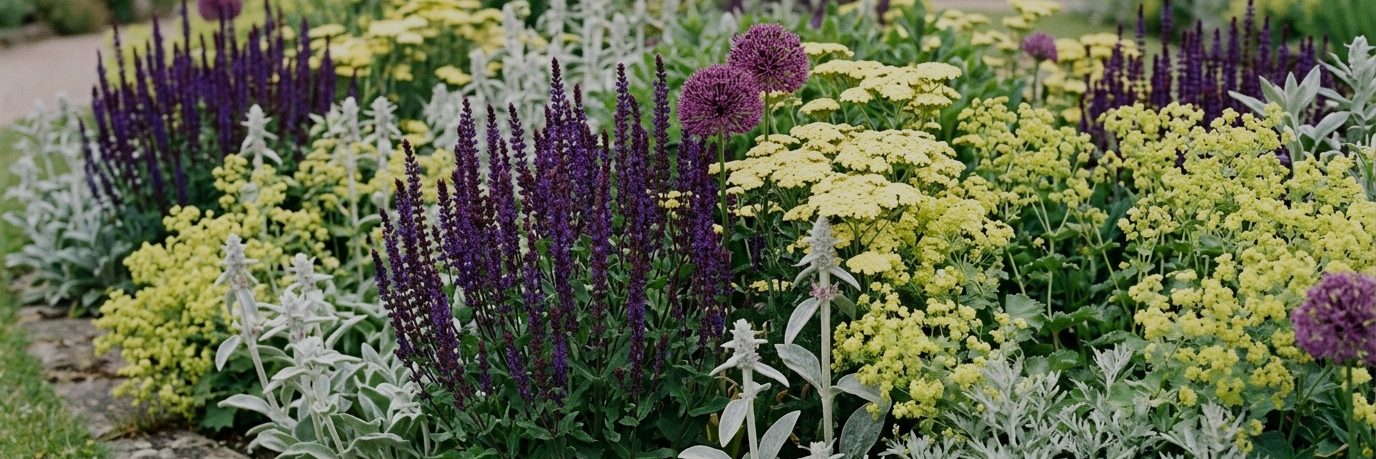
Designing a garden by colour means consciously choosing harmonies rather than piling up random garden-centre finds: warm harmonies in red, orange and yellow, cool harmonies in blue, purple and white, or a monochrome scheme that plays a single hue through several values. Under an often hazy light, colours read differently than under a full Mediterranean sun; pastels and whites gain a softer glow, while highly saturated tones can look muted under an overcast sky. Foliage, whether purple, silver or gold, rounds out the palette and holds its colour far longer than any bloom.
Warm harmonies: red, orange and yellow to energise a border
Red, orange and yellow make up the warm palette, the one that visually advances and closes down space, a useful effect for warming up a garden that feels too far away, or breaking the monotony of a long lawn. Forsythia opens the season as early as late winter, its branches covered in vivid yellow before the leaves even appear, followed by tulips and daffodils in orange or gold tones that give structure to spring borders. In summer, the dahlia takes over with a range of deep reds, coppery oranges and rich yellows barely matched by any other perennial, and some roses, from coral to blood red, carry that energy right through to the first frosts.
This palette needs a careful hand under an often hazy sky: an all-warm border can quickly look garish under a cloudy sky, whereas it would sing under bright sun. Breaking it up with clean green foliage, or adding a few pots of orange and yellow petunias to keep the display going into the first cold spells, keeps the composition legible without cooling it down completely. Saving the brightest tones for the foreground or the sunniest spots further strengthens the sense of depth you’re after.
Cool harmonies and the white garden: blue, purple and the art of the evening
Blue, purple and white make up the cool palette, the one that visually recedes and makes a small space feel larger, a valuable effect in city gardens. Lavender, with its grey-blue spikes and silvery foliage, is the mainstay of summer, paired with buddleia and its purple clusters, which also draw butterflies, or with lilac, whose scented clusters open the season in mid-spring in shades of purple or white. Hydrangea deserves a mention of its own: its colour depends directly on soil pH, true blue in acidic soil, pink in chalky or neutral soil, a detail many gardeners discover by surprise when they move from one soil type to another.
The white garden, or moon garden, pushes this logic to the extreme by relying on a single colour for a calming effect that comes fully into its own at dusk, when white keeps catching the light while other tones fade away. Oxeye daisies, white peonies, white roses and pale-centred daffodils form a reliable base; paired with grey or silver foliage, they build a scene that still reads clearly well after sunset, a real asset for anyone enjoying their terrace on a summer evening.
The monochrome scheme: playing a single hue for strong unity
A monochrome scheme plays the same colour across several values, from the palest to the deepest, rather than multiplying different hues. It’s the surest way to get a border that looks designed rather than accumulated, especially in a small garden where too many distinct colours quickly create a cluttered impression. A pink monochrome scheme, for instance, might pair the near-white pink of a pale peony, the true pink of a dahlia and the deeper magenta of a rose, all tied together by the same green foliage that avoids any visual break.
A blue-purple monochrome scheme works just as well: lavender, buddleia and blue hydrangea, rounded out by the pale mauve of an early-season crocus, make up a coherent palette from late winter through to the first frosts. The rule that makes the difference is to vary the value, light, mid, deep, and not just the shade, or the whole scheme falls flat. Adding a single contrasting touch, a pot of pure white or some silver foliage, also keeps the scheme from turning monotonous through sheer uniformity.
Complementary contrasts: making two opposite colours vibrate
On the colour wheel, complementary colours, sitting directly opposite each other, reinforce one another through contrast: purple and yellow, blue and orange, red and green. That’s the principle behind the near-foolproof pairing of purple lavender or buddleia planted in front of forsythia or yellow daffodils, a contrast that really snaps in spring, when borders are still thin on density. The blue of a hydrangea grown in acidic soil against the coppery orange of a dahlia produces the same effect in high season, a bolder pairing but a formidably effective one at the back of a border.
Coneflower, with its pink-magenta petals sometimes shading into purple around an orange centre, pairs naturally with the clean green of the surrounding foliage, a more subtle red-green contrast but every bit as legible from the house or the terrace. For contrast to work without tiring the eye, it’s best kept to a few precise focal points, the entrance to the garden, a seating corner, rather than spread across an entire border, where it ends up cancelling itself out for lack of any visual resting place.
Foliage, the palette that’s too often forgotten
Flowers rarely last more than a few weeks, whereas foliage holds its colour from spring right through to the first frosts, which makes it the real backbone of any colour scheme. Certain weigela varieties with near-black purple foliage, such as Wine and Roses, give structure to a border even outside flowering, while the silvery grey of lavender does the opposite, lighting up the darker corners of a cool monochrome scheme. The young shoots of many roses emerge in bronze or coppery tones before turning green, a warm note that comes for free and is too often overlooked when planning purely around the flowers still to come.
Beyond the plants mentioned here, the variegated, gold or purple foliage of hostas, heucheras and ornamental grasses usefully extends this logic in more mixed borders, especially in shade, where flowers become scarcer. Thinking about foliage colour at the time of purchase, and not just the flower on show at the garden centre, saves many a border from blazing for three weeks and then settling into a uniform green for the rest of the season.
The care sheets to read next
Every plant mentioned has its full sheet: watering, light, soil, pests and a month-by-month calendar.
Lavender
Lavandula angustifolia
True lavender (Lavandula angustifolia) is a hardy Mediterranean plant that scents the air and draws bees all summer…
Rose
Rosa
The rose (Rosa) is a hardy flowering shrub that overwinters outdoors without trouble, down to about -20 °C for most…
Hydrangea
Hydrangea macrophylla
The hydrangea (Hydrangea macrophylla) is the flowering shrub for cool, partly shaded gardens, and one of the very few…
Dahlia
Dahlia
The dahlia (Dahlia) is a tuberous plant that offers one of the longest and most spectacular displays of the summer…
Coneflower
Echinacea purpurea
Coneflower (Echinacea purpurea) is a tall, sturdy perennial from the prairies of North America, recognisable by its…
Oxeye Daisy
Leucanthemum vulgare
The oxeye daisy (Leucanthemum vulgare) is that white flower with a yellow centre that pops up on its own in our…
Peony
Paeonia
The peony (Paeonia) is a hardy perennial with remarkable longevity: once well settled, it can flower for several…
Tulip
Tulipa
The tulip (Tulipa) is a spring-flowering bulb, come from the mountains of Central Asia and become the emblem of Dutch…
Daffodil
Narcissus
The daffodil (Narcissus) is the first big signal of spring in the garden. Long before the tulips, its yellow trumpets…
Crocus
Crocus
Crocus is the very first splash of colour in the garden as winter loosens its grip. It is not unusual to see it push…
Butterfly bush
Buddleja davidii
Buddleia (Buddleja davidii), better known as the butterfly bush, is a nearly indestructible shrub that has taken over…
Weigela
Weigela florida
Weigela (Weigela florida) is a deciduous shrub from East Asia that has become an unkillable classic of temperate…
Forsythia
Forsythia x intermedia
Forsythia (Forsythia x intermedia) is the first shrub of the year to flower: its golden yellow blooms burst out on bare…
Lilac
Syringa vulgaris
Common lilac (Syringa vulgaris) is a deciduous shrub found in almost every old country garden. Its late spring scent is…
Petunia
Petunia
Petunia (genus Petunia), also sold under the name Surfinia for its trailing varieties, is the queen of summer window…
Frequently asked questions
Which colours should I combine in the garden for a harmonious result?
Two approaches work reliably: harmony, which stays within a family of related tones, warm ones like red and orange or cool ones like blue and purple, and the monochrome scheme, which plays a single colour across several values. Complementary contrast, purple against yellow or blue against orange, is more dramatic but should be kept to a few focal points so it doesn’t tire the eye.
How do you create a successful white garden, or moon garden?
Rely on white flowers, oxeye daisies, peonies, roses or pale-centred daffodils, paired with grey or silver foliage that extends the luminous effect. White keeps catching the light at dusk while other colours fade away, which makes this kind of border especially pleasant in the evening, near a terrace or a seating area used after sunset.
What is a monochrome scheme in the garden, and why does it work so well?
A monochrome scheme plays the same colour across several values, from the palest to the deepest, rather than piling up different hues. It’s the surest way to get a border that looks designed rather than accumulated, especially in a small garden, where too many distinct colours quickly create a visually cluttered impression.
Does foliage really matter for colour in the garden?
Yes, and it’s often the great forgotten element: a flower lasts a few weeks, while purple, silver or gold foliage holds its colour from spring right through to the first frosts. Certain weigela or rose varieties offer remarkable foliage colours, useful for keeping a border legible even outside flowering.
Green Hub looks after your plants
Photograph a plant: Green Hub identifies it and writes its care sheet, with no account. Sign in afterwards to keep its dated photos and history over time.
Identify a plantUpdated on
How this sheet is written
Written for Green Hub with the help of language models, then reviewed. It offers gardening guidance, not professional advice: if you are unsure whether a plant is toxic to a child or an animal, ask a vet, a doctor or your national poison centre.