Lilac
Syringa vulgaris
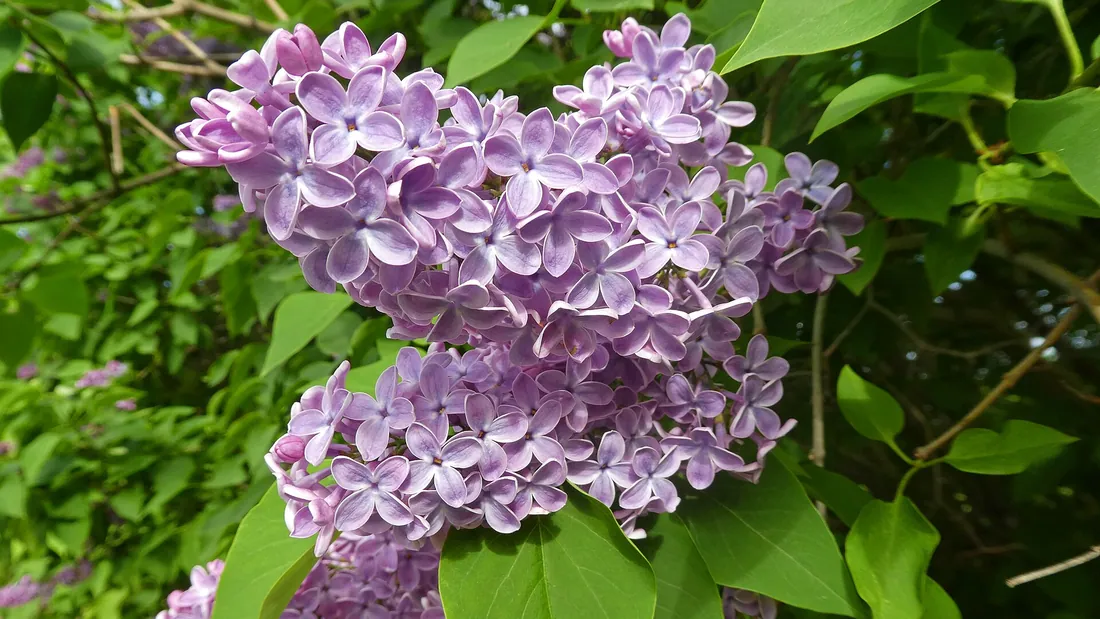

Common lilac (Syringa vulgaris) is a deciduous shrub found in almost every old country garden. Its late spring scent is unlike anything else, and its clusters of mauve flowers, sometimes white or pink depending on the variety, announce that the growing season has truly arrived. Once established it is a remarkably tough plant, built for sharp winters and free-draining soil, that mostly asks for patience and a good sunny spot.
Light and exposure
Lilac wants full sun, that is the number one condition for a good bloom. Give it at least six hours of direct sun a day. In shade or even part shade the shrub survives just fine but barely flowers, with thin, sparse clusters.
It is often planted on its own in the middle of a lawn, at the back of a border, or along a fence that catches the midday and late-day sun. It does not mind wind or open spots, a real advantage in open countryside.
Watering
A young lilac, planted less than two years ago, needs regular watering while it roots in, especially during dry summers. A generous but occasional watering works better than a daily trickle, it pushes the roots to grow deep.
Once established, it is a remarkably self sufficient plant. A mature lilac practically manages without watering, barring an exceptionally long drought. What it really cannot stand is too much water. Waterlogged soil in winter rots the roots far more reliably than a dry summer ever weakens it.
Soil and repotting
Lilac is not fussy about soil type as long as it drains well. It tolerates lime very well, unlike many shrubs, and actually prefers neutral to slightly alkaline soil over acidic ground.
What it cannot cope with is heavy clay that stays waterlogged. If your ground holds moisture, plant it on a slight mound to raise the base above the wet. A little well rotted compost at planting time is enough, there is no need to feed it further afterwards.
Temperature and humidity
This is one of the hardiest garden shrubs there is. It shrugs off temperatures down to -25, -30 °C without any trouble, which places it in USDA zones 3 to 7 and lets it see out just about any winter.
Ironically, lilac actually needs that sharp winter cold to flower well the following spring. It is this cold dormant period that triggers the clusters to form. In regions with mild winters, zone 9 and beyond, flowering often stays poor and patchy, a problem that does not arise where the winter is sharp.
Pruning and upkeep
The key thing to remember first. Lilac flowers on wood formed the previous year, and next spring’s flower buds are already being set during the summer right after this year’s bloom. Pruning in winter or early spring means cutting off this year’s flowers, a very common mistake.
The right move is to remove the spent flower clusters just after flowering, cutting the stem just below the cluster, above the first pair of young shoots. This stops the plant wasting energy on setting seed and encourages a generous bloom the following year. Every three or four years you can also cut one or two of the oldest stems back to the base to rejuvenate the clump, lilac suckers back from the base very readily.
Pests and diseases
Powdery mildew is the most common issue, especially in late summer. A greyish white felting then covers the leaves, often on plants that are crowded or dry at the roots. It looks bad but is not really serious, the shrub will flower normally again the following year. Giving the planting room to breathe and not crowding several bushes together already keeps it well in check.
More of a concern is lilac bacterial blight, caused by Pseudomonas syringae, which blackens and wilts young shoots in spring, especially after cool damp weather. Cut well back below the affected part and destroy the wood you remove. Lilac leafminer tunnels into the leaves and rolls them up, damage that is mostly cosmetic. Scale insects sometimes settle on old, weakened plants, brushing them off is usually enough to deal with them.
Propagation
The simplest and most common method is to lift suckers, the shoots that come up from the roots around the parent plant. Just dig one up with a bit of root attached while the plant is dormant and replant it elsewhere.
One thing to watch for though. Most lilacs sold in nurseries are grafted onto a different rootstock, often a seedling common lilac. Suckers from a grafted plant will then give you the rootstock, not the variety you bought. This trick only reliably works on an own root lilac, often the case with old plants passed down in families. Layering as the plant goes dormant, by pegging down a low branch and burying a node under a few centimetres of soil, also works well and guarantees you get the right variety back.
Climate and hardiness
Where and in which climate it thrives
Common lilac is one of the hardiest garden shrubs there is: the wood takes -25 to -30 °C with no protection at all, which makes it growable from USDA zone 3 to 7. It is equally at home in a continental climate with a sharp winter and in a mild oceanic one, as long as the soil drains. Its real requirement is not warmth but cold: lilac needs a pronounced winter dormancy to set its flower buds, and it is that cold spell that governs the bloom of the following spring. In mild-winter regions, zone 9 and beyond, flowering often stays poor and patchy whatever you do; that is the warm limit of the species, not a mistake in cultivation. At the other end, hard frost causes it no trouble at all as long as the ground does not stay waterlogged: it is a sodden winter, not a severe one, that rots its roots. In heavy ground, plant on a slight mound to raise the crown. It tolerates chalk very well, which makes it valuable on alkaline soils where many ornamental shrubs give up. Flowering is short but intense, a few weeks at the end of spring, and the one job not to neglect is pulling suckers regularly, otherwise lilac quickly colonises the whole border.
Growing lilac?
Green Hub keeps a dated history of your own plant: its photos, its progress, its repottings. An AI answers about yours specifically, not a generic sheet, for free.
Identify my plantMonth-by-month care calendar
| January | Complete rest. A good time to plant a bare root lilac if the ground is not frozen. Do not prune now, this year’s flower buds are already set on last year’s wood. |
|---|---|
| February | Still dormant. The last comfortable window for bare root planting before growth wakes up. Look out for suckers at the base, they are easier to pull now before full leaf out. |
| March | Buds swell then burst open, the first leaves appear. From now on, planting in a container is better than bare root, it establishes more reliably. |
| April | Foliage develops fast and the flower clusters appear, still closed and green. Towards the end of the month the first flowers open in an early year. |
| May | Full bloom, the big moment for lilac, with that unmistakable scent. As soon as the flowers start to brown, cut off the spent clusters just below them, the one real pruning moment of the year. |
| June | The plant is building the wood that will carry next year’s flowers. Pull out any suckers appearing around the base regularly rather than letting them settle in. |
| July | Growth slows and the wood starts to ripen. A shrub planted this year or last appreciates watering during a marked dry spell. |
| August | Watch for a white felting appearing on the leaves, a sign of powdery mildew in late summer. No treatment is needed, just give overcrowded plantings some air. |
| September | A good time to plant a new lilac in a container, the soil is still warm and roots settle in before winter. Do not prune, you would remove next year’s buds. |
| October | Leaves yellow and drop, the shrub goes dormant. Also a good planting window, bare root or in a container. |
| November | Bare root planting is possible again and this is the best time to lift and replant suckers. Mulch around recently planted shrubs. |
| December | Complete winter rest. The cold settling in now is exactly what lilac needs to flower well next spring. |
Green Hub tips
- Never prune lilac in winter or early spring. This year’s flower buds are already formed on last year’s wood, you would be cutting off the coming bloom.
- Cut off the spent flower clusters right after flowering. It is the one pruning job that really matters, and it encourages a good bloom the following year.
- Plant it in full sun, never in shade. A shaded lilac survives just fine but barely flowers, by far the most common mistake.
- Pull out suckers as soon as they appear at the base, or they will take over the whole bed. On a grafted plant they will not even give you the variety you bought.
Related species
Forsythia
Forsythia x intermedia
Forsythia (Forsythia x intermedia) is the first shrub of the year to flower: its golden yellow blooms burst out on bare…
Olive tree
Olea europaea
The olive tree (Olea europaea) is a Mediterranean tree whose hardiness stops at around minus 8 to minus 10 degrees, in…
Privet
Ligustrum ovalifolium
Privet (Ligustrum ovalifolium), often sold as California privet, is a shrub native to Japan that has become one of the…
Althea
Hibiscus syriacus
Althea (Hibiscus syriacus) is a hardy deciduous garden shrub that flowers when every other one has finished, from…
Beech
Fagus sylvatica
Beech (Fagus sylvatica) is the most common broadleaf tree in the temperate forests of Europe, just as happy standing…
Begonia
Begonia
Begonia is the star summer flower of window boxes, hanging baskets and shady borders. Hundreds of hybrids exist, but…
The guides that mention it
Pruning Flowering Shrubs and Roses: Deducing Instead of Memorising
New wood or old wood: this single question gives you the pruning time for any shrub at all, including ones whose name…
The Cutting Garden: How to Pick Flowers and Make Your Bouquet Last
Dahlias, peonies, hydrangeas: what separates a flower that lasts ten days in a vase from one that droops by the next…
Which flowering shrub to choose for a garden in bloom all year round
Viburnum in winter, lilac in spring, buddleia in summer, rose of Sharon in autumn: the method for stringing together…
Designing your garden by colour: the combinations that work
Warm harmonies, cool harmonies, monochrome schemes or bold contrasts: colour changes everything in a garden, from the…
Updated on
How this sheet is written
Written for Green Hub with the help of language models, then reviewed. It offers gardening guidance, not professional advice: if you are unsure whether a plant is toxic to a child or an animal, ask a vet, a doctor or your national poison centre.