Privet
Ligustrum ovalifolium
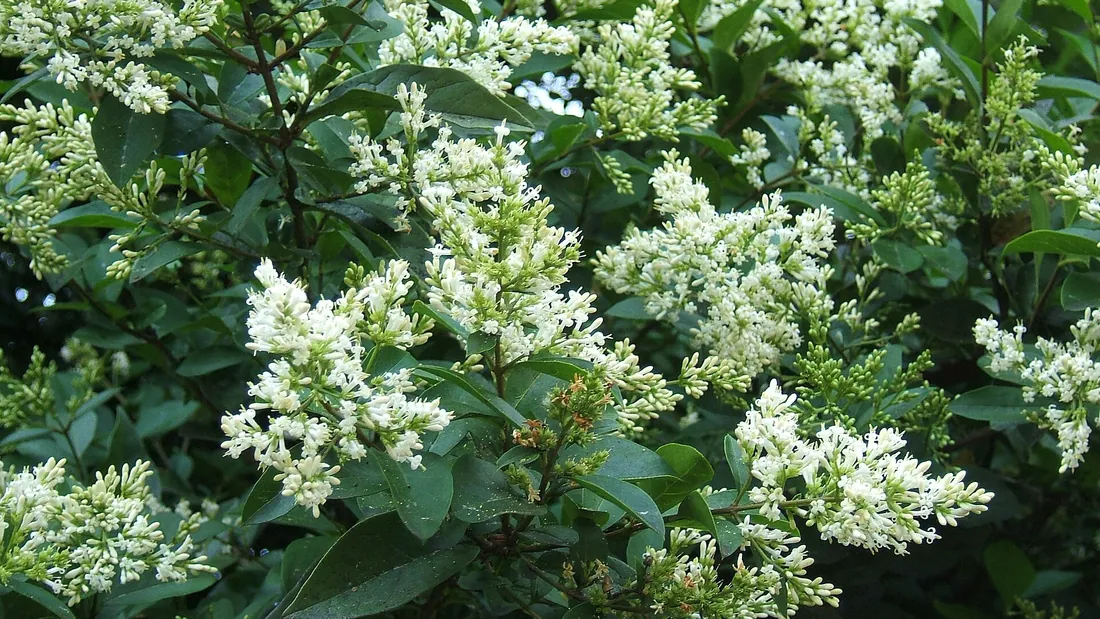

Privet (Ligustrum ovalifolium), often sold as California privet, is a shrub native to Japan that has become one of the most widely planted garden hedges across temperate regions. It is the safe bet for the busy gardener or the tight budget: unfussy about soil, it grows fast, takes pruning without complaint and forms a dense screen within two or three years that blocks prying eyes and breaks the wind. Hardy to around minus twenty degrees Celsius, it keeps much of its foliage through a mild winter and only drops it properly during a hard frost.
Light and exposure
Privet copes with any exposure, from full sun to partial shade under a large tree. That is exactly what makes it a go-to hedge wherever a garden’s orientation is less than ideal: a bank the midday sun never reaches, a back garden shaded by the neighbour’s house, a windy corridor between two buildings, privet takes it all in stride.
In full sun, growth is faster and the foliage denser from top to bottom. In shade, the hedge stays vigorous but fills out a little less at the base: prune it wider at the bottom than at the top so light reaches all the way down and no gaps appear.
Watering
Once well established, privet is happy with the rainfall of a temperate climate and needs almost no watering, even through the dry summers of recent years. That is one of its great strengths for anyone who does not fancy dragging a hose out every evening.
The first year follows a different rule: young bare-root or potted plants need generous, regular watering, especially through their first growing season and the months after planting, while the roots settle in deep. Mulching at the base cuts down evaporation and lets you water less often.
Soil and repotting
Privet grows in almost any soil, including poor, stony or distinctly chalky ground. It even tolerates compacted soil beside a road and copes with pollution better than most evergreen hedges.
Its only real weak point is soil that stays waterlogged, where the roots eventually rot. In heavy clay ground, loosen the planting trench well and add sand or coarse grit to improve drainage before planting.
Temperature and humidity
California privet takes around minus twenty degrees Celsius on the wood, which covers USDA zones 5 to 8. In a mild temperate climate it is semi-evergreen: it keeps much of its green foliage right through the cold season in gentle winters, giving the impression of a fully evergreen hedge. In a harder winter, with prolonged frost below minus five or minus ten degrees, it drops its leaves so it can come back all the stronger once milder weather returns.
This leaf drop in cold weather is never a sign of disease or a dying hedge, it is simply a defence reaction. It starts back up without trouble once the fine days return and regains its full density within a few weeks.
Pruning and upkeep
This is one of the fastest-growing hedges among common garden species, up to sixty centimetres a year in good conditions, which calls for regular pruning to keep it neat. Plan on two to three trims spread across the growing season: a shaping cut in late spring, once the new growth has firmed up a little, a second in midsummer, and a final one in early autumn if growth keeps going.
Privet takes hard pruning very well and comes back without trouble from old wood, even when cut back to a few centimetres from the ground on a hedge that has become too sprawling or thin at the base. It is one of the few hedges you can completely restructure without risking losing it.
Pests and diseases
Privet is known for its toughness and stays healthy most of the time, but a few problems do come back regularly in the garden. Powdery mildew can appear in hot, humid summers, showing up as a white felting on young leaves, with no real harm to the hedge. Thrips and scale insects sometimes settle on the branches, especially on hedges stressed by drought or planted too far into the shade.
The real threat to watch for is the privet moth, whose caterpillars devour the foliage and can strip entire stretches of hedge bare within weeks, particularly since it has been gaining ground across several temperate regions in recent years. Check the foliage in summer and step in as soon as you notice holes or fine silky webbing.
Propagation
Taking cuttings is the simplest and most widely used way to propagate privet, which explains why it is so cheap at the garden centre. Take semi-ripe cuttings about twenty centimetres long in late summer, strip the lower leaves, plant them straight into open ground or a nursery bed: they root without much trouble, often even without rooting hormone.
Planting bare-root stock remains the most economical way to put up a full hedge: bought in bundles during the cold season, these young plants cost a fraction of the price of container-grown ones and establish very well throughout the dormant season, outside of frosty spells.
Toxicity
Privet is toxic. Its black berries, which appear in late summer and hang on through part of the autumn, contain irritant glycosides that cause nausea, vomiting and stomach pain if eaten, in children just as in dogs or cats. The leaves are toxic too, though to a lesser degree. If you have young children or pets that roam the garden, keep an eye on the hedge as autumn approaches and avoid letting fallen berries linger on the ground.
Climate and hardiness
Where and in which climate it thrives
California privet is hardy to roughly minus twenty degrees Celsius, which puts it comfortably in USDA zones 5 to 8. It is the screening hedge of temperate gardens: cheap, tough as nails and quick to grow, it turns a bare garden into a private space within two or three seasons. Reckon on three to four plants per linear metre for a hedge that is already dense from the start.
In a mild, damp oceanic climate it stays semi-evergreen, holding its green through much of the cold season and only shedding leaves below minus five to minus ten degrees, then coming back as soon as milder weather returns. In a continental climate with a hard winter it behaves like an ordinary deciduous shrub and only becomes a solid screen again after budburst, which matters if you want cover all year round. In a Mediterranean or subtropical climate it stays fully evergreen and grows for more of the year, so plan on one extra trim; under dry heat it copes provided you water it through its first two seasons, while the roots go down.
It shrugs off poor, chalky soils, the partial shade of a shaded back garden and even the pollution of a hedge planted along a road. The one thing it refuses is permanently waterlogged ground, and a mild but sodden winter costs it more than a cold, dry one. In early summer it covers itself in small, strongly scented white flowers that bees love, followed by black berries. One thing worth knowing: like any dense, fast-growing hedge, privet draws heavily on the nitrogen in the soil at its base, which is why nothing much grows right underneath it. Do not plan a flower bed there, and instead give neighbouring plantings a bit of compost if they look a little starved.
Growing privet?
Green Hub keeps a dated history of your own plant: its photos, its progress, its repottings. An AI answers about yours specifically, not a generic sheet, for free.
Identify my plantMonth-by-month care calendar
| January | Complete rest for the hedge. This is the best time to plant bare-root stock, frost permitting, taking advantage of the low prices on bundles of young plants. |
|---|---|
| February | Keep planting bare-root stock as long as the ground is not frozen. This is one of the last windows before growth wakes up. |
| March | Sap is rising again, a last chance to plant before budburst. On an established hedge, a light tidying trim is possible. |
| April | Foliage comes back with real vigour, especially after a cold winter that stripped the leaves. Keep an eye on watering for this year’s new plantings. |
| May | First shaping cut at the end of the month, once the new growth has firmed up a little. This is also a good time for taking softwood cuttings. |
| June | Fragrant white flowers appear, much visited by bees. Growth peaks and the hedge can put on several centimetres a week. |
| July | Second trim if growth is still strong. In hot, dry spells, water any hedge planted less than two years ago. |
| August | Take semi-ripe cuttings towards the end of the month. Check the foliage for signs of the privet moth. |
| September | Last trim of the year so the hedge goes into autumn neat and tidy. Black berries begin to ripen. |
| October | Growth slows down noticeably. A good time to plant new container-grown stock before the real cold arrives. |
| November | The bare-root planting season opens, the cheapest way to put up a whole hedge. Foliage yellows and drops if the cold sets in. |
| December | The hedge drops some or all of its leaves in frosty weather, normal behaviour for this semi-evergreen shrub. Keep planting bare-root stock outside of frosty spells. |
Green Hub tips
- Plant bare-root during the dormant season, outside frosty spells: it is the cheapest option and privet establishes without trouble, unlike fussier hedging plants.
- Do not panic if the hedge drops its leaves in a hard winter, that is normal behaviour for a semi-evergreen hedge: it comes back in spring.
- Prune wider at the bottom and narrower at the top so light reaches the base and the hedge stays leafy right down to the ground.
- Never plant a flower bed right at the foot of a privet hedge: it draws off all the available nitrogen and nothing grows well there.
Related species
Forsythia
Forsythia x intermedia
Forsythia (Forsythia x intermedia) is the first shrub of the year to flower: its golden yellow blooms burst out on bare…
Lilac
Syringa vulgaris
Common lilac (Syringa vulgaris) is a deciduous shrub found in almost every old country garden. Its late spring scent is…
Olive tree
Olea europaea
The olive tree (Olea europaea) is a Mediterranean tree whose hardiness stops at around minus 8 to minus 10 degrees, in…
Althea
Hibiscus syriacus
Althea (Hibiscus syriacus) is a hardy deciduous garden shrub that flowers when every other one has finished, from…
Beech
Fagus sylvatica
Beech (Fagus sylvatica) is the most common broadleaf tree in the temperate forests of Europe, just as happy standing…
Begonia
Begonia
Begonia is the star summer flower of window boxes, hanging baskets and shady borders. Hundreds of hybrids exist, but…
The guides that mention it
Which Hedge to Plant, and How to Get It Right
Evergreen, deciduous or marcescent, annual growth, hardiness, soil, shade and sea spray: the real criteria for…
Toxic Plants for Cats and Dogs: Recognising the Danger Rather Than Memorising a List
A list of toxic plants is easily forgotten and always incomplete. What actually protects a cat or dog is recognising…
Improving Clay Soil: Diagnosis, Amendments and Drainage
Ground that clings to your boots in winter and cracks open in summer: a clay soil is not condemned, it changes with the…
Pruning Flowering Shrubs and Roses: Deducing Instead of Memorising
New wood or old wood: this single question gives you the pruning time for any shrub at all, including ones whose name…
Lawn Care: From Seeding to Mowing, and Renovation
Mowing higher changes more than any fertilizer can: turf density, drought resistance, weeds, moss. Everything else in…
How to Attract Birds to Your Garden, Season After Season
Winter feeding, well-positioned nest boxes, clean water and berry hedges: the complete method, season by season, for…
Which Plants to Choose for a Drought-Resistant Garden
Deep roots, silvery foliage, Mediterranean origins: the plants that get through a dry summer without watering, and how…
What to Plant in a Shade Garden, Under Trees and Against Sunless Walls
Under a large tree or against a wall the sun never reaches, shade doesn’t rule out a planting bed: it calls for a…
Updated on
How this sheet is written
Written for Green Hub with the help of language models, then reviewed. It offers gardening guidance, not professional advice: if you are unsure whether a plant is toxic to a child or an animal, ask a vet, a doctor or your national poison centre.