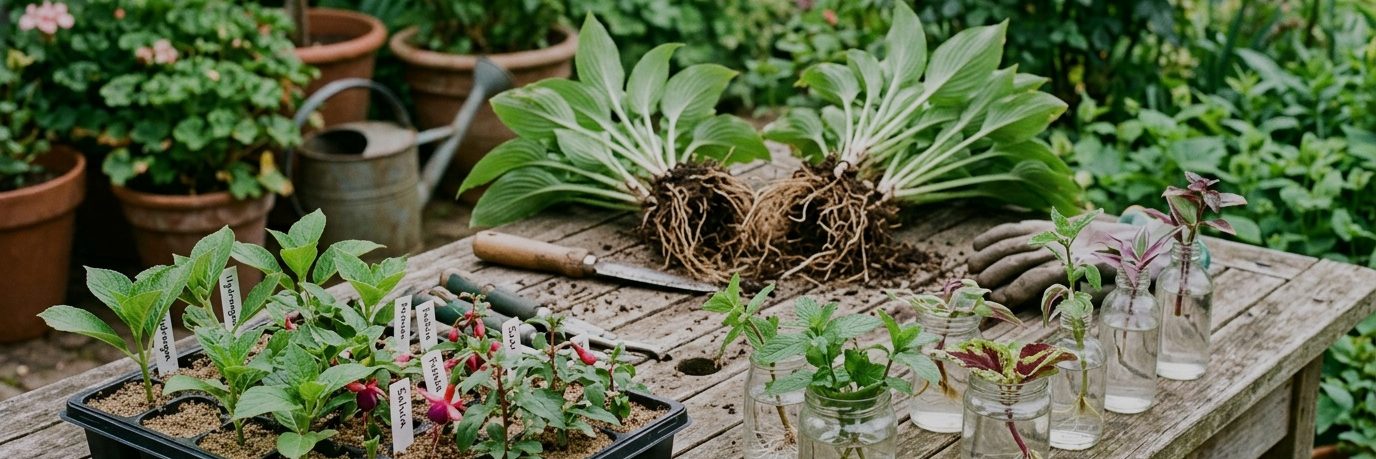
Dividing, Taking Cuttings, Sowing: Multiplying Your Plants for Free
Multiplying your plants without buying anything at all comes down to four techniques: dividing the clump for perennials such as hosta or coneflower, taking stem cuttings for geranium, lavender or box, taking hardwood cuttings in winter for gooseberry and blackcurrant, and layering for stubborn shrubs such as hydrangea or clematis. Each method has its own season and its own precise gesture: a perennial is divided at the season opposite its flowering, a softwood cutting is taken in summer, a hardwood cutting is planted in winter on bare wood. A damp climate with mild winters actually favours rooting straight in open ground.
Dividing a Perennial Clump: Hosta, Coneflower, Peony
The basic rule fits in one sentence: a perennial is divided at the season opposite its flowering. A plant that blooms in spring is divided in autumn, a plant that blooms in autumn like coneflower is split in spring, in March-April, when it re-establishes fastest. Perennials that form a compact clump, hosta, coneflower, oxeye daisy, lend themselves well to the job: a single spade is enough to cut the clump cleanly into several pieces.
Each division must keep three to five buds and a healthy volume of roots; fragments that are too small struggle to take. Hosta, a tough plant, can go four to five years between divisions and is replanted immediately after cutting, as soon as the spring shoots appear. Peony calls for more care: divide it in late August or September, three to four eyes per section, covering those eyes with no more than five centimetres of soil, never more, or you end up with a clump that grows on without ever flowering. Allow a full season before it re-establishes, sometimes two years before it flowers properly.
Summer Cuttings: Softwood and Semi-Ripe Wood
Stem cuttings are taken in two stages depending on the texture of the wood. In early summer, on wood that is still soft and herbaceous, take a flowerless geranium shoot ten centimetres long, cut cleanly below a node, strip the leaves off the lower half, then plant it in an equal mix of sieved potting compost and coarse sand. Without any rooting hormone, geranium already roots at fifty to sixty percent.
From July onwards the wood firms up: this is the semi-ripe stage, ideal for lavender, rosemary, sage and box, Mediterranean plants that fear stagnant damp far more than a lack of hormone. Box, slower to root, is propagated from late August to mid-October and takes two to three months to produce its first fine roots: keep the growing medium moist without waterlogging it. To boost rooting without shop-bought products, willow water remains the most reliable home remedy: soak young willow shoots in water for twenty-four to forty-eight hours, the salicylic acid they release acts as a natural hormone precursor and lifts the success rate to sixty-five or seventy-five percent.
Winter Cuttings: Hardwood, From Gooseberry to Fig
From December to February, sometimes into early March, the sap is dormant and the wood is bare: this is the best time to take hardwood cuttings from shrubs, without going through the delicate stage of rooting in a heated pot. Take twenty-centimetre lengths of this year’s wood, push them two-thirds of the way into loose soil, either directly in the ground or under a cold frame if the winter looks set to be very wet, and leave them all winter to develop roots with no care beyond the occasional watering.
This technique suits soft fruit particularly well: gooseberry takes root in roughly nine cases out of ten, blackcurrant in eight or nine out of ten. Fig, for its part, roots exclusively from hardwood and calls for more patience, six to eight months before any visible growth, but a free mature fig tree is worth the wait. Forsythia, that indestructible shrub of flowering hedges, responds to the same method with an equally comfortable success rate. Out of ten cuttings planted in November, eight or nine take root with no protection and no hormone, which makes this the least effort-intensive method in the whole plant-propagation toolkit.
Sowing Saved Seed: Storage and Cold Stratification
Harvest seed once it is fully ripe, when the capsule or dry fruit has opened well, then leave it to dry flat on paper, in the shade and in the open air, until all moisture has gone. Store it in an unbleached paper envelope or, beyond one season, in an airtight jar with a silica gel sachet to soak up any remaining moisture. Where you store it matters as much as what you store it in: cool, dry, dark, between five and fifteen degrees, always labelled with the variety and the harvest date.
Some seeds, particularly perennials like coneflower, only germinate after a prolonged cold spell that breaks their natural dormancy: this is stratification. The simplest method lets winter itself do the work: sow directly in the ground or in a pot from the start of the cold season, and the cold and damp of the season do the work through to germination the following spring. Coneflower needs about eight weeks of cold, lavender four to six weeks; oxeye daisy, on the other hand, germinates without any stratification and can be sown directly in spring. Failing an autumn sowing, the fridge stands in for winter: damp sand and a sachet of seed for the required length of time.
Layering: The Answer for Stubborn Shrubs
Some shrubs root poorly from cuttings but layer at a success rate close to ninety percent: hydrangea, clematis and viburnum are the classic cases. The principle: you force a shoot that is still attached to the parent plant to produce roots before separating it. Choose a flexible shoot, long and low enough to reach the ground without snapping, strip the leaves from a twenty-centimetre section in its middle, and nick the bark lightly over two centimetres at that exact spot: the new roots will grow from that wound.
Bury this nicked section ten centimetres deep in a mix of garden soil and potting compost, hold it down with a peg or a stone, and let the leafy tip of the shoot stick out above ground. For hydrangea, do this between April and June, while the sap is rising strongly. Rooting generally takes a full season; the new plant is only separated once the roots are well formed, the following autumn or the spring after that depending on how vigorous it looks. The shoot stays fed by the parent plant throughout rooting, which is why the success rate is so much higher for difficult species.
The care sheets to read next
Every plant mentioned has its full sheet: watering, light, soil, pests and a month-by-month calendar.
Hosta
Hosta
The hosta (Hosta spp.) is a perennial native to the damp woodlands of East Asia, from Japan through China to Korea. It…
Coneflower
Echinacea purpurea
Coneflower (Echinacea purpurea) is a tall, sturdy perennial from the prairies of North America, recognisable by its…
Peony
Paeonia
The peony (Paeonia) is a hardy perennial with remarkable longevity: once well settled, it can flower for several…
Oxeye Daisy
Leucanthemum vulgare
The oxeye daisy (Leucanthemum vulgare) is that white flower with a yellow centre that pops up on its own in our…
Geranium
Pelargonium
What is commonly called a balcony geranium is actually a pelargonium, a plant from South Africa, not to be confused…
Lavender
Lavandula angustifolia
True lavender (Lavandula angustifolia) is a hardy Mediterranean plant that scents the air and draws bees all summer…
Rosemary
Salvia rosmarinus
Rosemary (Salvia rosmarinus, long known as Rosmarinus officinalis) is an evergreen Mediterranean shrub with needle-like…
Sage
Salvia officinalis
Common sage (Salvia officinalis) is a small aromatic shrub with evergreen grey-green foliage, originating from the dry…
Box
Buxus sempervirens
Box (Buxus sempervirens) is an evergreen shrub that has been clipped into balls, cones and low borders in formal…
Redcurrant
Ribes rubrum
The redcurrant (Ribes rubrum) is a small bushy fruit shrub that produces those pretty clusters of translucent red…
Blackcurrant
Ribes nigrum
The blackcurrant (Ribes nigrum) is a small hardy fruit shrub that is genuinely happy in a cool climate, down to USDA…
Fig tree
Ficus carica
The fig tree (Ficus carica) is a Mediterranean tree, yet it really can be grown up to USDA zone 7 provided you shelter…
Forsythia
Forsythia x intermedia
Forsythia (Forsythia x intermedia) is the first shrub of the year to flower: its golden yellow blooms burst out on bare…
Hydrangea
Hydrangea macrophylla
The hydrangea (Hydrangea macrophylla) is the flowering shrub for cool, partly shaded gardens, and one of the very few…
Clematis
Clematis
Clematis is the queen of flowering climbers, able to cover a wall, a trellis or an old apple tree with hundreds of…
Viburnum
Viburnum
Viburnum is not one plant but a whole family of more than a hundred and fifty shrubs, broad enough to cover almost…
Frequently asked questions
When should you divide a perennial like hosta or coneflower?
You always divide at the season opposite flowering. A spring-flowering perennial is divided in autumn, an autumn-flowering perennial like coneflower is divided in spring, ideally in March-April. Hosta tolerates either timing and can stay in place four to five years before its first division.
How do you make a homemade rooting hormone?
Willow water is the most effective option without any shop-bought product. Soak young willow shoots in water for twenty-four to forty-eight hours: the salicylic acid they release acts as a natural precursor to auxin and lifts the success rate to sixty-five or seventy-five percent, against eighty to ninety percent for a commercial gel.
How do you store seed harvested from the garden until spring?
First let it dry completely in the shade on a sheet of paper, then store it in an unbleached paper envelope or an airtight jar with a silica gel sachet. Keep it somewhere cool, dry and dark, between five and fifteen degrees, noting the variety and harvest date on the container.
Which shrubs are better propagated by layering than by cuttings?
Hydrangea, clematis and viburnum are the classic candidates for layering, with a success rate close to ninety percent against a far more hit-or-miss result from cuttings. The principle is to bury a shoot that is still connected to the parent plant until it forms its own roots, before separating it.
Green Hub looks after your plants
Photograph a plant: Green Hub identifies it and writes its care sheet, with no account. Sign in afterwards to keep its dated photos and history over time.
Identify a plantUpdated on
How this sheet is written
Written for Green Hub with the help of language models, then reviewed. It offers gardening guidance, not professional advice: if you are unsure whether a plant is toxic to a child or an animal, ask a vet, a doctor or your national poison centre.