Olive tree
Olea europaea
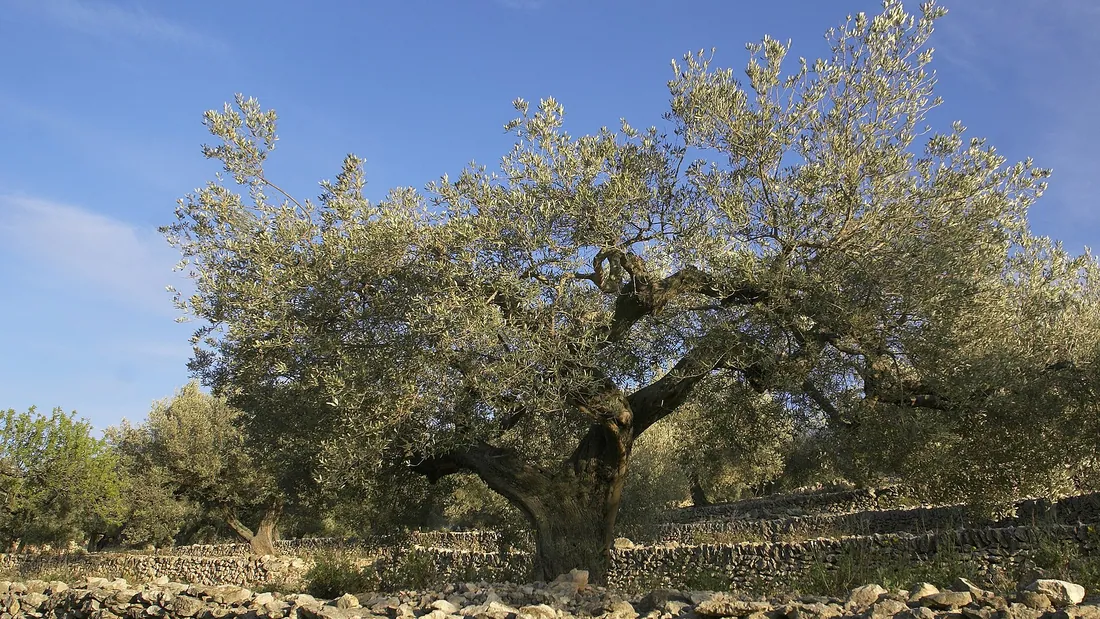

The olive tree (Olea europaea) is a Mediterranean tree whose hardiness stops at around minus 8 to minus 10 degrees, in USDA zone 8, which makes it a pot plant as soon as winters turn harsher. A well-established, dry specimen takes those short frosts, but it is cold combined with damp that kills it, far more than dry cold. The solution that works in an oceanic climate: grow it in a large pot, take it out in the good season and bring it into a frost-free shelter for the winter.
Light and exposure
The olive tree wants full sun, no compromise. Give it the warmest and brightest spot you have: the side of the terrace that catches the midday sun, a well-lit wall, a corner that bakes all day. The less sun it gets, the more it stretches out, thins and loses that dense habit that is its whole charm.
In a pot, the advantage is clear: you follow the light and bring the tree into shelter for the winter. In open ground, keep it for a truly sheltered microclimate, backed against a façade that takes the sun full on and gives its heat back at night. In half-shade, and all the more under an often overcast sky, it just languishes.
Watering
This is where most failures play out. The olive tree fears an excess of water far more than drought. In a pot, water regularly in summer, but let the substrate dry out well between two passes: you wait until the surface is dry over several centimetres before giving water again. A thirsty olive tree holds on without flinching, a drowned olive tree rots at the roots.
In winter, cut back almost everything. In shelter and cool, the tree is ticking over and consumes next to nothing: a soil that stays damp and cold means guaranteed rot. A little water now and then so the root ball does not dry out completely is more than enough.
Soil and repotting
The watchword is drainage. The olive tree grows in the stony, poor soils of its homeland, it hates heavy soils that hold water. In a pot, build a mix that lets the water run through: potting soil, a third of coarse sand or pozzolana, and a good layer of clay balls or gravel at the bottom. In open ground, only a light, raised soil suits it, otherwise correct with gravel and sand at planting.
Repot into a large pot, heavy and stable, with a hole at the bottom. A container that is too tight dries out too fast in summer and tires the tree. Repot every two to three years in spring, renewing the substrate and checking that nothing is blocking the drainage. A pot that keeps water at the bottom, under a rainy climate, kills the olive tree more surely than the cold.
Temperature and humidity
The critical point comes down to one sentence: it is not so much the cold that threatens the olive tree, it is cold combined with damp. Dry and well established, it takes short frosts of minus 8 to minus 10 degrees. But a mild, grey and waterlogged winter is more fatal to it than a genuine dry frost snap, because the water-soaked roots freeze and rot.
In practice, from zone 8a and colder, you do not take chances. For the whole cold season, the potted olive tree spends the winter in cold, bright, frost-free shelter: an unheated conservatory, a cold greenhouse, a bright garage. You are not after warmth, you are after frost-free and light. In open ground, reserve it a very sheltered and drained microclimate, and protect trunk and stump with horticultural fleece and a good mulch on nights of hard frost, without ever guaranteeing that it comes through a harsh winter.
Pruning and upkeep
Prune in late spring, once all risk of frost has passed and growth has clearly resumed. The aim is to open up the centre and keep an open, goblet habit: you remove dead wood, crossing branches and those cluttering the heart, so that light and air circulate. An overly dense olive tree stays damp and attracts trouble.
The rest of the care is light. A feed for citrus or Mediterranean plants from spring to the end of summer supports a potted tree, whose substrate becomes exhausted. Clean up the yellow leaves fallen at the base so as not to leave damp lying around, and watch the underside of the foliage where pests lodge.
Pests and diseases
Under a damp climate, the real danger comes from water. Root rot from excess watering or from a soil that does not drain is the leading cause of death of the olive tree outside its Mediterranean range: dull leaves, a tree that declines for no apparent reason, often too late by the time you notice it. In a damp winter, leaf drop is common, sometimes harmless if the tree is simply stressed, more serious if the roots are suffering.
On the pest side, watch for scale insects, common in pots and under shelter: they cling to the stems and the undersides of the leaves, secrete a honeydew on which sooty mould settles, that black, sticky deposit. The olive moth can also attack leaves, flowers and fruit. Hose down the foliage, apply black soap or a white oil on the scale-insect outbreaks, and ventilate to cut short the damp that favours all this.
Propagation
Cuttings are the most accessible route. In summer, take semi-ripe shoots of fifteen centimetres, remove the lower leaves, dip the base in a rooting hormone and plant in a very free-draining sandy mix, under cover and in the warm. Rooting is slow and temperamental, count on several months and accept failures: that is normal with the olive tree.
Sowing from seed exists but calls for patience and gives trees different from the parent, often long to form. For most gardeners, the simplest thing remains to buy an already-formed specimen at a garden centre and put it in the right conditions. A well-managed olive tree lives a very long time, the initial outlay pays for itself over decades.
Climate and hardiness
Where and in which climate it thrives
The olive tree is hardy to around minus 8 to minus 10 degrees for a well-established, dry specimen, which places it in USDA zone 8; it is fully at ease in zones 9 and 10. The figure alone is misleading, though, because the threshold depends as much on water as on the thermometer: dry, it shrugs off those short frosts without flinching; with waterlogged roots, it freezes and rots at minus 5 degrees.
It is at home in Mediterranean and dry subtropical climates: a long hot summer, a mild winter, dry air, stony ground. It holds up without difficulty in semi-arid climates and on mild temperate coasts. Where it struggles is in cool, rainy oceanic climates, where the winter is not cold enough to kill it but wet enough to drown its roots, and in continental climates with a hard winter, where prolonged frost goes beyond what it can take.
What changes the procedure depending on the climate: under a wet winter, growing it in a large pot brought into cold, bright, frost-free shelter for the cold season is the only reliable route, and watering there drops to almost nothing. Under a dry but severe winter, it is horticultural fleece and a mulch at the base that count. Under a short, cool summer, the tree lives and looks handsome but almost never sets fruit: it lacks the heat and the length of season. Count on the ornament, not on the harvest.
Growing olive tree?
Green Hub keeps a dated history of your own plant: its photos, its progress, its repottings. An AI answers about yours specifically, not a generic sheet, for free.
Identify my plantMonth-by-month care calendar
| January | The tree is in frost-free, bright shelter. You barely water, just enough that the root ball does not dry out. Watch for scale insects in the warm. |
|---|---|
| February | Still under shelter. Check that no saucer is holding stagnant water. Ventilate the conservatory or garage on mild days. |
| March | Nothing to put out yet, it freezes at night. You can resume slightly more regular watering if growth is felt, without excess. |
| April | Repot every two to three years, into a large well-drained pot. Resume watering gently. Do not put it out yet, the frosts come back. |
| May | Out into the garden or on the terrace once the last frosts have passed. Harden it off gradually to the light outside. |
| June | Full sun and full growth. Water regularly but let it dry out well between two. First feed of Mediterranean fertiliser. |
| July | Welcome heat. Watch the underside of the leaves for scale insects, hose down the foliage. Continue the feed. |
| August | The tree enjoys the summer. Take cuttings on semi-ripe shoots if you want to propagate. Keep the watering measured. |
| September | Last feed. The days shorten, space out the watering. Enjoy the tree outside a little longer. |
| October | Cut back the water clearly. Prepare the overwintering spot, clean up the fallen leaves at the base to avoid damp. |
| November | Bring the olive tree into cold, bright, frost-free shelter before the first real frosts. Cut almost all watering. |
| December | Rest in shelter. Water in drops, maximum light, no source of heat. Check that no scale-insect outbreak takes hold. |
Green Hub tips
- Drainage above all: a pot that keeps water at the bottom kills the olive tree more surely than the cold. Sand, pozzolana and clay balls at the bottom, always.
- Do not leave it outside in winter in zone 8a or colder. Bring it in frost-free and bright for the whole cold season, it is the cold damp that kills it, not the dry frost.
- Water little and let it dry out between two. In winter in shelter, almost nothing: a dry olive tree comes through the winter, a drowned olive tree rots.
- Do not aim for an olive harvest outside a Mediterranean climate. It is a fine ornamental tree with silvery foliage, take it for what it is.
Related species
Forsythia
Forsythia x intermedia
Forsythia (Forsythia x intermedia) is the first shrub of the year to flower: its golden yellow blooms burst out on bare…
Lilac
Syringa vulgaris
Common lilac (Syringa vulgaris) is a deciduous shrub found in almost every old country garden. Its late spring scent is…
Privet
Ligustrum ovalifolium
Privet (Ligustrum ovalifolium), often sold as California privet, is a shrub native to Japan that has become one of the…
Althea
Hibiscus syriacus
Althea (Hibiscus syriacus) is a hardy deciduous garden shrub that flowers when every other one has finished, from…
Beech
Fagus sylvatica
Beech (Fagus sylvatica) is the most common broadleaf tree in the temperate forests of Europe, just as happy standing…
Begonia
Begonia
Begonia is the star summer flower of window boxes, hanging baskets and shady borders. Hundreds of hybrids exist, but…
The guides that mention it
Watering Plants Properly: Deciding Rather Than Following a Schedule
Beginners water too often and too little at the same time. How to read the soil instead of the calendar, tell thirst…
Overwintering your plants without losing them
Clivia, lavender, verbena, geranium, olive: which to bring indoors, which to protect outside, which to leave to face…
Repotting your plants and choosing the right potting mix
The right moment, the right technique and the right substrate for each plant, so you can repot without rotting the…
Improving Clay Soil: Diagnosis, Amendments and Drainage
Ground that clings to your boots in winter and cracks open in summer: a clay soil is not condemned, it changes with the…
Garden Mulching: Every Mulch Has an Effect and a Drawback
Mulching is presented everywhere as a benefit with no downside. There is one for every material: what nitrogen drawdown…
Which Plants to Choose for a Drought-Resistant Garden
Deep roots, silvery foliage, Mediterranean origins: the plants that get through a dry summer without watering, and how…
Updated on
How this sheet is written
Written for Green Hub with the help of language models, then reviewed. It offers gardening guidance, not professional advice: if you are unsure whether a plant is toxic to a child or an animal, ask a vet, a doctor or your national poison centre.