Calathea (peacock plant)
Goeppertia (anciennement Calathea)
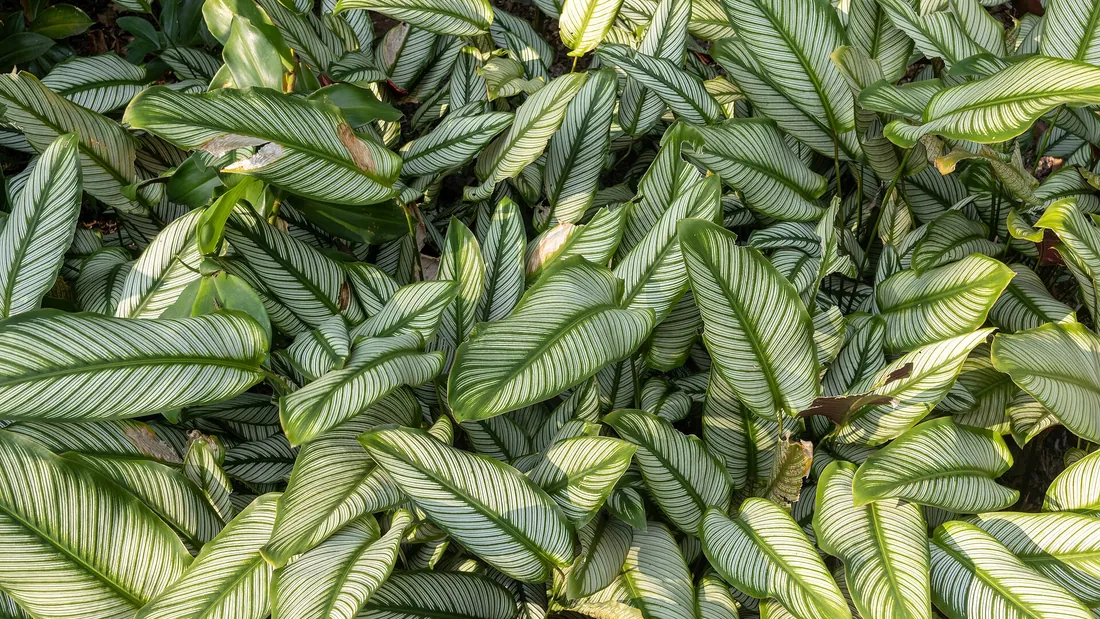

The calathea (genus Goeppertia, long classified under Calathea), or peacock plant, brings together tropical understorey plants from Brazil with spectacular foliage, painted with stripes and purple undersides. Some raise their leaves at night in an audible movement, hence the nickname prayer plant. It is a demanding plant: it needs humidity, soft water and constant warmth. Dry air from heating and hard tap water are its two great enemies. Best kept for those who enjoy pampering their plants.
Light and exposure
The calathea lives in the tropical understorey, in the shade of tall trees, so it wants bright but always filtered light, never direct sun. A spot set back from an east or north window, or behind a sheer curtain at a brighter window, suits it well. Direct sun fades and scorches the patterns that make its whole appeal.
In shade that is too deep, on the other hand, the colours fade and the plant weakens. In weak winter light, when the days are at their shortest, move it a little closer to a bright window while keeping it out of direct sun, which stays rare but low and harsh at that time of year.
Watering
The substrate should stay slightly moist at all times, without ever being waterlogged. Water as soon as the surface starts to dry, roughly twice a week in summer and once a week in winter, adjusting by feel. Neither complete dryness nor excess: the calathea forgives neither.
Above all, the water must be soft. Hard, chlorinated tap water browns the leaf edges over time. Use rainwater, demineralised water or tap water left to stand for twenty-four hours, at room temperature. Cold, hard water is the leading cause of damaged leaves on this plant.
Soil and repotting
Use a light substrate that holds a little moisture without becoming soggy: a potting mix for green plants blended with sphagnum peat or coconut fibre, with a handful of perlite for aeration. The pot must have drainage holes despite the need for constant moisture.
Repot in spring every two years, into a pot only slightly larger. The calathea has a fairly fine root system that dislikes being disturbed or drowned in a large volume of soil. A gentle repotting, without breaking up the root ball, is preferable.
Temperature and humidity
The calathea wants constant warmth, between 18 and 24 degrees, and hates variation. Below 15 degrees it suffers, below 12 it can lose its leaves. It tolerates no cold snap or draught, which rules out single-glazed windowsills and entrance halls.
This is where a heated interior complicates everything. As soon as the heating runs, the air dries out while the calathea, a plant of the humid understorey, demands high humidity. This is the major constraint: without added moisture, the leaf edges brown and curl up. A humidifier, a tray of moist clay pebbles or grouping it with other plants create the microclimate it needs throughout the heating season.
Pruning and upkeep
The calathea is not pruned for shape. You simply cut off at the base any leaves that are entirely yellowed or dried out, with clean scissors. The brown edges of a still-green leaf can be trimmed back following the natural line of the edge, without hoping to make them disappear entirely.
Dust the foliage with a soft, damp cloth, or give the plant a lukewarm shower from time to time. This cleans the leaves, raises humidity and dislodges spider mites before they settle in.
Pests and diseases
The spider mite (Tetranychus urticae) is the number one pest of the calathea in dry winter air: these tiny mites love the warm, dry air of the heating, speckle the leaves with pale dots and spin fine webs. The best prevention is high humidity; in the event of an attack, shower the plant and raise the humidity level. Keep an eye out for scale insects too.
The brown, dry edges of the leaves are not a disease but the signature of air that is too dry or water that is too hard. Soft leaves and a rotting heart, on the contrary, point to excess water. The calathea demands a precise balance, which is what makes it delicate.
Propagation
The calathea is propagated by dividing the clump, at the time of spring repotting. Turn the plant out of its pot, gently separate the well-rooted clumps by hand, keeping roots and several leaves on each, and repot every division separately in a light, moist substrate.
Keep the young divisions warm, sheltered from draughts, in a humid atmosphere, while they recover, which can take a few weeks. Stem cuttings do not work on this plant, division is the only reliable method.
Toxicity
Non-toxic to cats, dogs and children. It is one of the rare highly decorative plants you can keep without worry in a home with pets.
Climate and hardiness
Where and in which climate it thrives
In a temperate climate, the calathea is a demanding houseplant, to be kept indoors all year round. It does not go outside: it fears the cold, draughts and full sun, and nights below 15 degrees would make it suffer even in the warm season.
The real battle is fought through the heating season. Over all those months, radiators dry out the air of the house, while this tropical understorey plant demands high humidity. Without a response, the leaf edges brown and curl, and spider mites settle in. The moves that save the season: place the plant away from radiators and cold windows, run a humidifier or set the pot on a wide tray of moist clay pebbles, group plants together, and water exclusively with rainwater or demineralised water, never with hard tap water. That is the price of keeping the calathea’s foliage flawless until the mild weather returns.
Growing calathea?
Green Hub keeps a dated history of your own plant: its photos, its progress, its repottings. An AI answers about yours specifically, not a generic sheet, for free.
Identify my plantMonth-by-month care calendar
| January | Delicate rest. Keep the plant warm, away from radiators and cold windows. Maximum humidity against the dry air. Water with soft water as soon as the surface dries. |
|---|---|
| February | Still watch the humidity. Keep a close eye on spider mites, encouraged by the heating. Shower the foliage with lukewarm water. |
| March | The light returns, growth slowly resumes. Go back to slightly more regular watering, still with soft water. A good time to divide and repot. |
| April | Regrowth. Ideal for repotting and clump division. First very light feeding. Keep warmth and humidity constant. |
| May | Active growth. Water to keep the substrate slightly moist. Feed every two weeks with a very diluted green-plant fertiliser. |
| June | Fine growing season. Keep up the soft water and humidity. The plant stays indoors, sheltered from direct sun. |
| July | High summer. Water more often, up to twice a week, without waterlogging. Mist or shower in hot weather. |
| August | Growth still active. Keep up the humidity and watering with soft water. Watch for pests. |
| September | Growth slows as the light fades. Space out the watering a little. Last light feeding. |
| October | Prepare for winter. Move the plant away from future cold draughts already and bring it closer to a bright window, without direct sun. |
| November | The heating starts up: this is the beginning of the risky period. Set up the humidifier or the tray of clay pebbles. Cut back on water. |
| December | Winter rest under watch. Dry air to fight as a priority. Away from radiators, maximum humidity, soft water only. |
Green Hub tips
- Never water with the region’s hard tap water: the lime and chlorine brown the leaf edges. Rainwater or demineralised water only.
- The dry air of the heating is enemy number one in winter: a humidifier or a tray of moist clay pebbles is almost indispensable.
- Spider mites love warm, dry air: high humidity is your best prevention, not a treatment.
- To propagate, divide the clump at spring repotting; stem cuttings never take on this plant.
Related species
Prayer Plant
Maranta leuconeura
The prayer plant (Maranta leuconeura) is a houseplant with striking foliage, veined in red or marbled in light and dark…
Aglaonema
Aglaonema commutatum
The aglaonema (Aglaonema commutatum) is a robust, easy houseplant, prized for its foliage variegated with green,…
Alocasia
Alocasia
The alocasia, nicknamed elephant ear, charms with its large, dramatically veined leaves. It is a demanding tropical…
Aloe vera
Aloe vera
Aloe vera (Aloe vera) is a succulent from the Arabian Peninsula, grown since antiquity for the soothing gel of its…
Anthurium
Anthurium andraeanum
The anthurium (Anthurium andraeanum) is a tropical houseplant known for its smooth, waxy red spathe, which people often…
Areca palm
Dypsis lutescens
The areca (Dypsis lutescens) is a tropical palm from Madagascar, frost-tender, grown indoors wherever winter freezes.…
The guides that mention it
Indestructible Houseplants: Tolerating Drought Is Not Tolerating Shade
Tolerating drought and tolerating shade are two different adaptations, and almost every list mixes them up. What these…
Watering Plants Properly: Deciding Rather Than Following a Schedule
Beginners water too often and too little at the same time. How to read the soil instead of the calendar, tell thirst…
Toxic Plants for Cats and Dogs: Recognising the Danger Rather Than Memorising a List
A list of toxic plants is easily forgotten and always incomplete. What actually protects a cat or dog is recognising…
How to Compost in an Apartment with Worm Composting
Tiered bin, red worms and worm tea: how to compost your kitchen scraps without a garden or odor, even in a city…
Updated on
How this sheet is written
Written for Green Hub with the help of language models, then reviewed. It offers gardening guidance, not professional advice: if you are unsure whether a plant is toxic to a child or an animal, ask a vet, a doctor or your national poison centre.