Wisteria
Wisteria sinensis
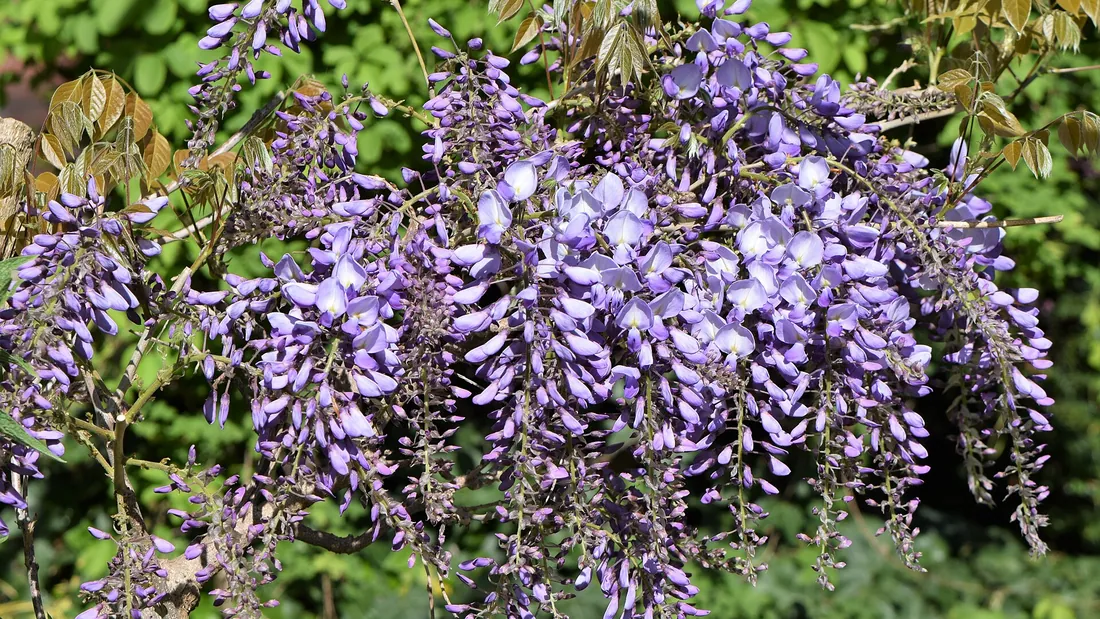

Wisteria (Wisteria sinensis) is a woody climber from China, capable of covering an entire house front within a few years. Its long, fragrant mauve flower clusters open in late spring, before the foliage is even fully out, a display that stops passers-by in their tracks. But it is a plant of formidable vigour that demands strict pruning twice a year, or it will swallow whatever lies within reach, gutters, window frames and roofs included.
Light and exposure
Wisteria wants sun, plenty of it. Plant it against a wall that catches the midday and afternoon sun, as warm as possible, since that is what really triggers flowering. In shade or even partial shade it still grows, producing plenty of foliage, but it sulks on the flowers or gives only a few weak clusters.
A well exposed wall also stores heat that protects the young shoots from late frosts, a real risk once the buds have already swelled at the end of winter. Avoid overly windy spots in open ground, a mature wisteria catches a lot of wind once loaded with foliage.
Watering
A well established wisteria manages on rainfall alone most of the time, its deep roots go looking for water far below the surface. The first two years after planting are different: water it regularly, especially in summer, while the root system develops and explores the soil in depth.
Once mature, extra watering only helps during prolonged drought, when the foliage starts to wilt during the day. In a pot, which remains possible for a few years before it struggles, keep a close eye on the compost in summer, it dries out fast and the plant suffers quietly before showing visible signs.
Soil and repotting
Wisteria is not fussy about soil type, it copes with ordinary garden soil, sandy or clay, as long as it drains well. What it hates is standing water at the roots, which encourages rot.
Soil that is too rich in nitrogen, for instance near fresh compost or a heavily fertilised lawn, pushes the plant to produce foliage all summer at the expense of flowers. On chalky soil, iron chlorosis can appear, yellow leaves with veins still green, and a dose of chelated iron corrects it within a few weeks.
Temperature and humidity
Wisteria is perfectly hardy once established, from USDA zone 5 to zone 9, shrugging off winters down to minus twenty or minus twenty-five degrees without any trouble. The woody stems fear nothing, only the young buds already developed in spring are at risk from a late frost.
That is exactly the trap: a mild end of winter swells the flower buds earlier than expected, then a single frosty night burns them outright and ruins that year’s display. There is nothing to be done about this risk except choosing a sheltered spot that limits sharp temperature swings. In a pot the picture changes: the rootball freezes long before the wood, so protect the container or move it under frost-free shelter.
Pruning and upkeep
This is the gesture that decides everything, wisteria is pruned twice a year and it is not optional if you want flowers. At the end of summer, shorten all the long green shoots of the year, the ones running off in every direction, back to about five or six leaves from their base. This summer pruning stops lengthwise growth and pushes the plant to form flower buds rather than more wood.
In the depth of winter, on the bare plant and before the buds break, go back over those same shortened shoots and cut them harder still, down to just two or three buds. It is these short spurs, built up year after year on the main framework, that carry the flower clusters of the following spring. Skip this second winter pruning and the wisteria just keeps stretching in every direction, flowering less and less as all its energy goes into wood.
Pests and diseases
Wisteria is a tough plant that gets through the seasons with few health problems. On chalky soil, iron chlorosis is the most common issue, showing as yellowing between leaf veins that stay green, and it is not serious once corrected with an iron feed.
Scale insects sometimes settle on the older woody stems, recognisable by small brown shells stuck to the bark and the sticky honeydew that then attracts black sooty mould. A treatment with white oil in late winter, before the buds break, deals with them without much trouble. Aphids occasionally visit the young shoots in spring, with little consequence on a plant of this vigour.
Propagation
Layering is the most reliable way to get a plant that flowers quickly. Bend a long, flexible shoot of the year down into a shallow trench, nick the bark lightly where it will be buried, pin it in place with a hook and cover it with soil, leaving the tip poking out. Roots form within a season, and you can then separate the new plant from the parent.
Semi ripe cuttings taken in summer also work but stay unpredictable, expect a modest success rate. Skip growing from seed if you are in any hurry to see flowers, a seed grown wisteria commonly takes ten to fifteen years before its first bloom, sometimes longer, which is the most common disappointment among gardeners who unknowingly sowed a pod picked from a neighbour’s fine plant.
Toxicity
Every part of wisteria contains toxic compounds, particularly the seeds and pods, and to a lesser extent the bark. Eating them causes digestive upset, nausea, vomiting and diarrhoea, which is especially dangerous for young children drawn to the brown pods that hang from the plant in late summer. Never let a child play with the pods or seeds, and keep pets away if you know they chew on whatever they find.
Climate and hardiness
Where and in which climate it thrives
Chinese wisteria is hardy from USDA zone 5 to zone 9: once well established, its wood takes winters of minus twenty-five degrees without damage. It is never winter cold that ruins the flowering, it is spring cold. A long mild spell at the end of winter swells the flower buds earlier than expected, and a single frosty night burns them outright: that year’s display is lost, the plant is not. This is the main hazard in climates with an unsettled spring, oceanic and continental alike, and the only defence is the position, a sheltered wall that gives back its heat at night and softens sharp swings.
Under a cool, short summer, wisteria flowers less and later: it needs heat to ripen its wood and set its buds, which is why the warmest wall you have matters, along with the summer pruning that forces it into flower. Under a hot climate with mild winters it flowers easily but becomes a problem of another kind: it is so vigorous there that Wisteria sinensis is listed as invasive in several humid subtropical regions, where it smothers trees. Check the local status of the species before planting it, and keep an eye on root suckers.
One last point: a wisteria in a pot under a harsh winter freezes at the roots long before the wood does. Bring the container under frost-free shelter or wrap it, since the rootball has none of the protection the open ground gives.
Growing wisteria?
Green Hub keeps a dated history of your own plant: its photos, its progress, its repottings. An AI answers about yours specifically, not a generic sheet, for free.
Identify my plantMonth-by-month care calendar
| January | Complete rest for the wisteria, the wood is dormant. Take the chance to look at the bare framework and spot badly placed shoots to correct during the winter pruning. |
|---|---|
| February | Second and last chance for the winter pruning if not done yet, cut the shoots already shortened in August back to two or three buds. Do it before the buds break. |
| March | The buds swell visibly with the first mild spells. Watch for still cool nights, a late frost can burn the flower buds that are already well advanced. |
| April | Foliage gets going and the first flower clusters take shape at the shoot tips. One last supportive watering benefits plants established for less than two years. |
| May | The big month, flowering bursts out in long, fragrant mauve clusters cascading along the walls. Enjoy the display, it only lasts three to four weeks. |
| June | Flowering fades and the new green shoots lengthen very fast, sometimes more than a metre in a few weeks. Guide them onto their support to stop them invading gutters and window frames. |
| July | Unchecked growth of foliage and young shoots. Keep tying in and directing the long stems, without cutting them yet, the real pruning waits until late August. |
| August | Time for the summer pruning, as important as the winter one. Shorten all the year’s long shoots to about five or six leaves from their base. |
| September | Growth slows as the days shorten. The green pods from May’s flowers swell, never leave them within reach of young children. |
| October | Foliage turns yellow then drops gradually. The pods turn brown and become quite visible on the bare wood, stay alert if children play in the garden. |
| November | The plant goes fully dormant, nothing to do except check the support is holding firm before the winter storms. |
| December | Winter rest. Use a dry day to check the fixings and cables of the support, a mature wisteria is heavy and the smallest weak point eventually gives way. |
Green Hub tips
- Buy a grafted or layered plant rather than an anonymous seedling, it is the only way to get flowers before ten or fifteen years of waiting.
- Put up a solid support right from planting, wrought iron fixed into masonry or cables stretched across a load bearing wall. A mature wisteria lifts a gutter and warps a light pergola without any effort.
- Never skip the double annual pruning, at the end of summer on the long shoots and again in the depth of winter on those same shoots cut back to two or three buds. That gesture is what makes the plant flower.
- Keep pods and seeds out of children’s reach in late summer and autumn, they are toxic and can attract curiosity.
Related species
Bean
Phaseolus vulgaris
The green bean (Phaseolus vulgaris) is one of the easiest vegetables in the kitchen garden, provided you respect one…
Broad bean
Vicia faba
The broad bean (Vicia faba) is one of the very first vegetables of the year, a rustic, sturdy legume that goes into the…
Pea
Pisum sativum
The pea (Pisum sativum) is a cool-season legume, hardy to cold but hating heat: its seeds germinate from 4 to 5 degrees…
Althea
Hibiscus syriacus
Althea (Hibiscus syriacus) is a hardy deciduous garden shrub that flowers when every other one has finished, from…
Beech
Fagus sylvatica
Beech (Fagus sylvatica) is the most common broadleaf tree in the temperate forests of Europe, just as happy standing…
Begonia
Begonia
Begonia is the star summer flower of window boxes, hanging baskets and shady borders. Hundreds of hybrids exist, but…
The guides that mention it
Toxic Plants for Cats and Dogs: Recognising the Danger Rather Than Memorising a List
A list of toxic plants is easily forgotten and always incomplete. What actually protects a cat or dog is recognising…
Pruning Flowering Shrubs and Roses: Deducing Instead of Memorising
New wood or old wood: this single question gives you the pruning time for any shrub at all, including ones whose name…
Which flowering shrub to choose for a garden in bloom all year round
Viburnum in winter, lilac in spring, buddleia in summer, rose of Sharon in autumn: the method for stringing together…
Updated on
How this sheet is written
Written for Green Hub with the help of language models, then reviewed. It offers gardening guidance, not professional advice: if you are unsure whether a plant is toxic to a child or an animal, ask a vet, a doctor or your national poison centre.