Pea
Pisum sativum
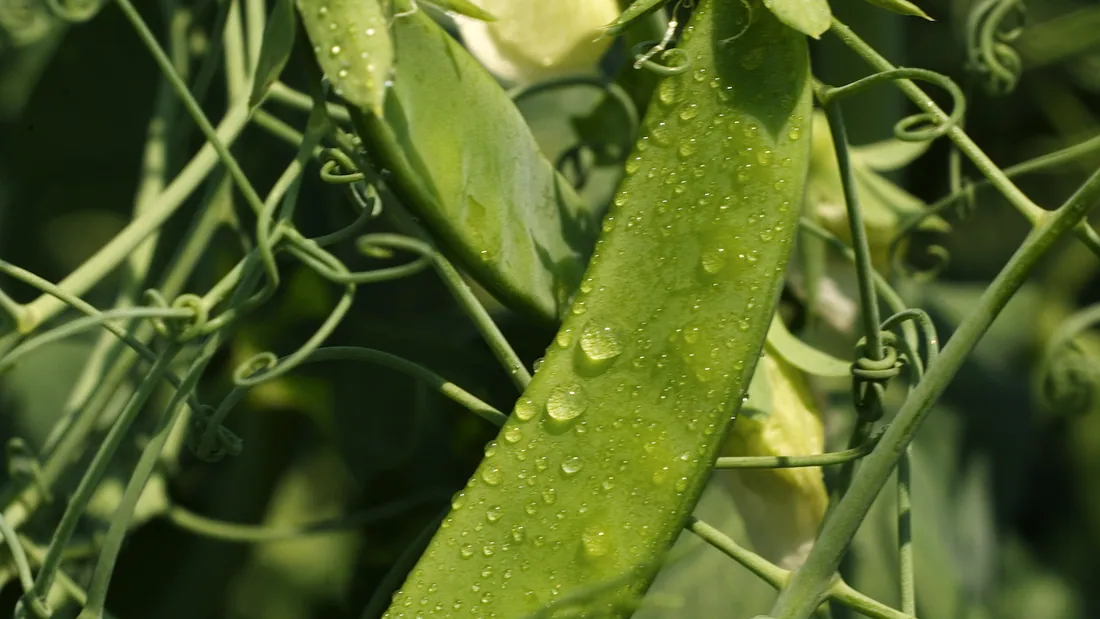
_Cl_J_Weber02_(23975734362).jpg)
The pea (Pisum sativum) is a cool-season legume, hardy to cold but hating heat: its seeds germinate from 4 to 5 degrees and the plant takes small frosts, but it aborts its flowers above 25 degrees. It is sown early, directly in place, as soon as the soil dries out at the end of winter. The harvest comes about three months later, before the big heat brings the plant to a sudden halt. One of the few vegetables that likes a damp, cool start to the season.
Light and exposure
The pea wants full sun to give well-filled pods. Give it a clear corner, with no cast shade, where it will enjoy the morning light that quickly dries the dew. A position that is too hot and sheltered in high summer plays tricks on it, but early in the cool season that is not the problem.
What matters most is an airy spot. The climbing varieties climb to a metre fifty and more, the dwarf ones stay low but always benefit from a little staking. A well-lit, ventilated row limits powdery mildew at the end of the cycle.
Watering
At sowing and during emergence, the cool soil of the end of winter is most often enough, without watering. The pea does not like excess water at the start, which rots the seed before it germinates. Let the rains of the season do the work.
Everything changes from flowering and the formation of the pods. That is when the plant drinks and when watering really counts: a lack of water at this stage gives flat pods and few seeds. Water at the base, regularly, without wetting the foliage so as not to favour powdery mildew in dry, hot weather.
Soil and repotting
The pea requires a cool, loose and well-draining soil. It dreads drought as much as standing water. An ordinary garden soil suits it, provided it is not waterlogged at the time of sowing, otherwise the seeds rot.
Above all, no nitrogen fertiliser. It is a legume: its roots bear nodules that fix nitrogen from the air thanks to bacteria. It therefore feeds itself in nitrogen and even enriches the soil for the following crop. A supply of nitrogen makes it run to leaves at the expense of the pods. A soil that is not too poor, a little mature compost at most, and that is all.
Temperature and humidity
The pea is a cool-season vegetable, unlike the bean. It germinates from 8 to 10 degrees, grows well between 10 and 18 degrees, and withstands small frosts without flinching, especially the round-seeded varieties, the hardiest. That is what allows it to be sown early, as soon as the soil is workable.
Its real enemy is heat. Above 25 degrees, flowering aborts, the pods no longer form and the plant wears out. That is why it is sown early: the harvest needs to be over before the strong heat of high summer. A pea sown too late gives little.
Pruning and upkeep
The pea is not pruned. Maintenance mainly comes down to the support: as soon as the young plants show their first tendrils, put up the stakes or netting for the climbing varieties. The tendrils grab hold on their own, you just need to guide them in the first few days. The dwarf varieties stand almost upright, a row of twigs or a small net helps them not to flop.
Hoe and weed at the base to keep the soil clean and cool, and earth up the young plants slightly to anchor them. Harvest regularly, every two or three days in full season: picking the ready pods pushes the plant to form new ones and clearly prolongs production.
Pests and diseases
Powdery mildew is the most common disease, especially at the end of the season when the weather becomes hot and dry. It covers the foliage with a white mealy felting and weakens the plant. Sowing early to harvest before this period, airing the rows and watering at the base rather than on the leaves clearly limit the problem.
As for pests, the pea moth lays its eggs in the flowers and its little grubs end up in the pods at shelling time, a great classic. Aphids colonise the young shoots. But the real troubles of the cool season are the birds that dig up the seeds and pull out the young seedlings, and the slugs that devour the seedlings in damp weather. Protect the sowings from the moment they go into the ground.
Propagation
The pea is sown directly in place, without transplanting, which makes it simple. Sow in clusters of four to five seeds every thirty centimetres, or in a line spacing the seeds three to four centimetres apart, two or three centimetres deep. Thin little, if at all: the pea likes to grow a bit crowded, in a clump, which helps it hold itself up.
You can also save your own seeds. Let a few fine pods dry out completely on the plant at the end of the season, shell them and keep the seeds dry. They resow the following year, provided you start from a non-hybrid variety.
Climate and hardiness
Where and in which climate it thrives
The pea is a cool-season plant, and it is its heat ceiling that rules, far more than its cold floor. A hardened young stand of a round-seeded variety comes close to -10 degrees without irreversible damage, the stem starting away again even if the leaves burn: that hardiness allows a winter crop from USDA zone 7 upwards, where the winter does not drop lower. At the other end, above 25 degrees flowering aborts and the pods no longer form. The whole job is to fit the cycle into the cool window of the climate you garden in.
In a mild, damp oceanic climate, sow as soon as the soil drains at the end of winter, with the round-seeded varieties such as 'Douce Provence', the hardiest, which take the last frosts without trouble; then spread the sowings over five to six weeks, moving on to the sweeter wrinkled-seeded varieties for the main season. In a Mediterranean or subtropical climate with a mild winter, autumn sowing is the right call: the plant idles through the winter and produces before the heat. In a winter that is mild but very wet, that autumn bet is often paid for in rotted seed and waterlogged plants, and a late-winter sowing stays safer. In a continental climate with a hard winter and a short summer, sow as soon as the ground thaws: the harvest falls in a single slot, with no staggering possible.
Two things change with the climate, not with the country. An early sowing brings the harvest in ahead of the peak flight of the pea moth, whose window of about two months covers main-season flowering. And under a summer that arrives early and dry, the crop has to be picked before the heat spike, or the pods stay flat. Everywhere, the pea fixes nitrogen and leaves the soil enriched: follow it with a hungry vegetable, cabbage or squash, to take advantage of the free work of its nodules.
Growing pea?
Green Hub keeps a dated history of your own plant: its photos, its progress, its repottings. An AI answers about yours specifically, not a generic sheet, for free.
Identify my plantMonth-by-month care calendar
| January | Nothing to sow. Choose your varieties, hardy round-seeded ones for early sowings, wrinkled-seeded ones, sweeter, for the main season. |
|---|---|
| February | Prepare the plot as soon as the soil allows. No nitrogen supply, the pea feeds itself. Gather the stakes and protective nets. |
| March | First sowings in place as soon as the soil drains, with the hardy round-seeded varieties. Sow in clusters or in a line and protect right away from the birds. |
| April | Continue the sowings, including the wrinkled-seeded varieties. Put up the stakes and supports when the tendrils appear. Watch for slugs and birds. |
| May | The plants climb and flower. Hoe at the base, guide the tendrils onto their support. Start watering if the weather dries out. |
| June | Flowering and pod formation: water regularly at the base, this is the key moment. First harvests from the earliest sowings. |
| July | Full harvest. Pick every two or three days to prolong production. Watch for powdery mildew in hot, dry weather. |
| August | End of season. The heat brings the plant to a halt. Let a few pods dry on the plant to harvest your seeds, then pull it up. |
| September | Clean up the plot. Cut the stems at ground level and leave the roots in the soil: their nodules enrich the soil with nitrogen. |
| October | Follow on with a nitrogen-hungry vegetable in the same spot, cabbages or squash, which will benefit from the pea’s work. |
| November | Rest. Put away the stakes and nets. Note the varieties that produced well this year. |
| December | Nothing in the garden. Check that your harvested seeds are properly dry and order what is missing for spring. |
Green Hub tips
- Sow early, as soon as the soil drains at the end of winter. The pea likes the cool and hates the heat: the later you sow, the less you harvest.
- Never any nitrogen fertiliser. It is a legume that fixes its own nitrogen and even enriches the soil for the next crop.
- Protect the young sowings from the birds from the moment they go into the ground, with a net or brushwood. They are crazy about the seeds and the seedlings.
- Harvest every two or three days in full season. Picking regularly pushes the plant to form new pods.
Related species
Bean
Phaseolus vulgaris
The green bean (Phaseolus vulgaris) is one of the easiest vegetables in the kitchen garden, provided you respect one…
Broad bean
Vicia faba
The broad bean (Vicia faba) is one of the very first vegetables of the year, a rustic, sturdy legume that goes into the…
Wisteria
Wisteria sinensis
Wisteria (Wisteria sinensis) is a woody climber from China, capable of covering an entire house front within a few…
Artichoke
Cynara scolymus
The artichoke (Cynara scolymus) is a large perennial with silvery, deeply cut foliage, as striking in an ornamental…
Asparagus
Asparagus officinalis
Asparagus (Asparagus officinalis) is an unusual perennial for a vegetable patch: once established, an asparagus bed…
Beetroot
Beta vulgaris
Beetroot (Beta vulgaris) is an easy root vegetable, one of the most forgiving in the kitchen garden. You sow it…
The guides that mention it
The vegetable garden calendar, from sowing to harvest
Two dates are enough to build an entire vegetable garden year: your last spring frost and your first autumn frost.…
Living soil: the no-dig method for a garden that thrives without a spade
Giving up digging means letting earthworms and mycorrhizae build a living soil that feeds the garden in your…
Gardening with Children: Where to Start in the Vegetable Patch
Radishes that sprout in a week, peas nibbled straight from the row, potatoes dug up like buried treasure: the vegetable…
Square Foot Gardening: Fitting More Crops Into Less Space
A twelve-inch grid and a well-placed trellis: how a square foot garden yields more vegetables than a traditional row on…
Sowing Seeds Successfully: Why It Fails, and What Fixes It
A seed that never comes up was not unlucky. Germination temperatures by species, correct depth, seeds that need light,…
Updated on
How this sheet is written
Written for Green Hub with the help of language models, then reviewed. It offers gardening guidance, not professional advice: if you are unsure whether a plant is toxic to a child or an animal, ask a vet, a doctor or your national poison centre.