Bean
Phaseolus vulgaris
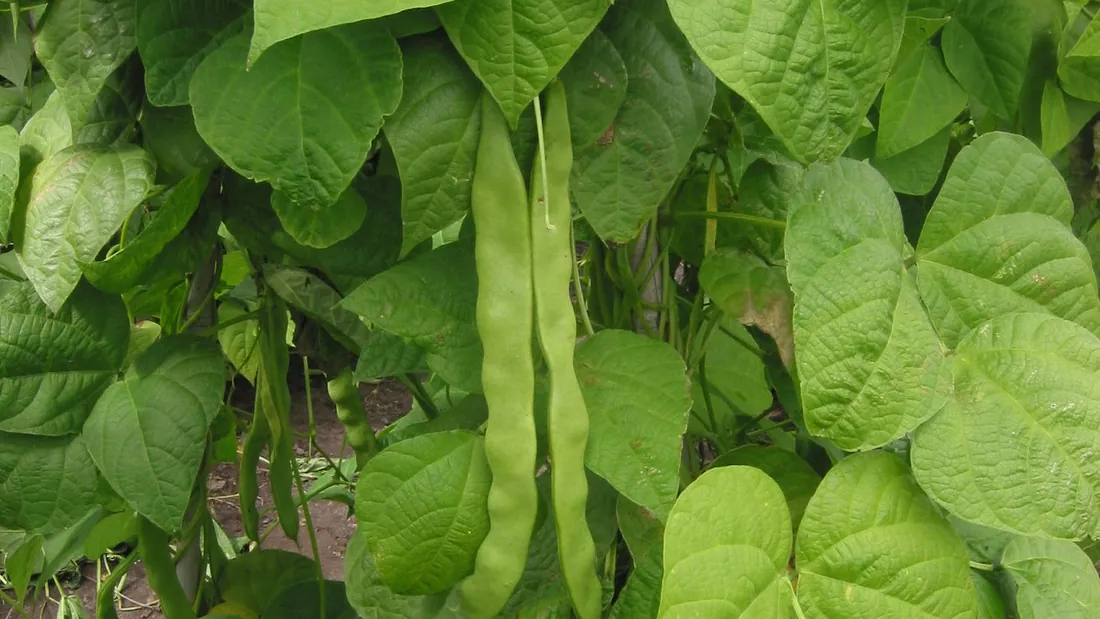

The green bean (Phaseolus vulgaris) is one of the easiest vegetables in the kitchen garden, provided you respect one rule: it is cold-sensitive and tolerates no frost. It is sown only two to three weeks after the last frosts, once the soil has warmed up well. Sown too early in cold ground, it rots before it comes up. Dwarf or climbing, it grows fast and gives a lot for little effort.
Light and exposure
The bean wants sun and warmth. Set aside a well-lit, open bed for it, sheltered from the prevailing cold winds that snap the young stems. The spot that catches the midday sun, or a warm corner of the kitchen garden, gives it the best growth.
Climbing varieties easily reach one metre fifty or two metres. Place them so as not to shade the rest of the kitchen garden, along the side of the bed where their shadow does not fall on the lower vegetables, so that those keep their light.
Watering
The bean needs regular water above all at flowering time and when the pods form. A lack of water at this stage makes the flowers drop and gives short, stringy pods. Water at the base, without wetting the foliage, preferably in the evening in summer.
Before flowering, stay sparing: an excess of water on a young plant favours foliage at the expense of flowers. A light mulch at the base keeps the soil cool during the dry spells of high summer.
Soil and repotting
The bean is not demanding, but it likes a loose, light and well-drained soil, neither too heavy nor waterlogged. Avoid fresh, nitrogen-rich manure: like all legumes, it fixes the nitrogen from the air itself thanks to the bacteria on its roots, and an excess of nitrogen makes leaves grow instead of pods.
Soil that is too cold and wet is its worst enemy at sowing. Wait until it warms above 12 degrees. In the region’s heavy soil, a slight earthing-up or a raised bed helps the soil to dry out and warm up faster in spring.
Temperature and humidity
The bean is decidedly frost-tender. The seed does not germinate below 10 to 12 degrees in the soil, and the slightest frost kills the plant. It is a summer vegetable that needs warmth to come up fast and grow without a check.
Where summers stay temperate, cold is the factor that governs the whole calendar. Nights stay cool late into spring, and a late frost is not rare. So never sow before the last frosts have passed, and often it pays to wait two or three weeks more to be safe. At the other end, the first autumn frosts put an end to the harvest.
Pruning and upkeep
The bean is not pruned, but climbing varieties are trained. Set up poles, netting or supports right at sowing so that the twining stems catch onto them by themselves. Help the first shoots find their support if needed, then they climb on their own.
For dwarf beans, a light earthing-up at the base when the plants are about fifteen centimetres tall steadies them and stops them keeling over under the weight of the pods. Pinch the tip of the poles once they have reached the top of the support, to focus the plant on production rather than on height.
Pests and diseases
The bean fears above all the diseases linked to humidity. Anthracnose (Colletotrichum lindemuthianum) marks the pods with brown ringed spots, and halo blight, a bacterial disease, leaves oily patches on the leaves. Both spread in damp weather. Never touch wet foliage and space the plants well so they dry quickly.
As for pests, slugs devour the young shoots at ground level, especially in a damp spring, and black aphids sometimes colonise the top of the stems. Harvest and remove diseased pods, and practise rotation by not putting beans in the same spot again for three years.
Propagation
The bean is sown directly in place, never transplanted. Sow in clumps of five to six seeds every forty centimetres, or in a row spacing the seeds eight to ten centimetres apart, three centimetres deep. Water well after sowing and wait for emergence, a good week in warm weather.
To harvest your own seed, let a few fine pods dry completely on the plant at the end of the season, until they turn parchment-like. Shell them, let the seeds dry for a few days in the air, and keep them dry for the following year. The bean reseeds very well from one year to the next.
Toxicity
Raw pods and dry seeds contain phasin, a lectin that makes you ill. The green bean is always eaten cooked, never raw.
Climate and hardiness
Where and in which climate it thrives
The bean is a strictly frost-tender annual: the slightest frost kills the plant, and the seed will not germinate below 10 to 12 degrees in the soil. It therefore has no hardiness zone of its own and is grown wherever the good season offers three frost-free months, in practice USDA zones 3 to 11 as a summer crop. Everything hinges on the sowing date: sow two to three weeks after your last frosts, once the soil has warmed above 12 degrees, measured in the morning at five centimetres deep. Sown too early into cold, wet ground, the seed rots without coming up.
It is at ease in a temperate climate with mild summers, oceanic or continental: growth is fast and steady there, and flower abortion from excess heat, which sets in above 30 to 32 degrees, stays marginal, a real advantage for a regular harvest. In a Mediterranean, subtropical or hot-summer continental climate it is that abortion which governs everything: shift the sowings so flowering falls outside the peak of heat, water more generously and mulch at the base.
Two cases change the procedure. Where the summer is short, prefer dwarf varieties, quicker than climbing ones, and sow under a cold frame or fleece to gain a fortnight. Where spring is cool and damp, anthracnose and halo blight settle fast on plantings that are too dense or poorly aired: space widely, rotate the position from one year to the next and never touch wet foliage.
To spread the harvest, sow a new row every two to three weeks, stopping about ten weeks before the average date of your first autumn frosts; the last sowings then crop right up to that frost. Pick regularly, every two or three days at full production: the more young pods you gather, the more the plant makes. At the end of the season the pulled stems, rich in nitrogen thanks to the nodules on their roots, make an excellent addition to the compost rather than waste to throw out.
Growing bean?
Green Hub keeps a dated history of your own plant: its photos, its progress, its repottings. An AI answers about yours specifically, not a generic sheet, for free.
Identify my plantMonth-by-month care calendar
| January | Nothing to do in the kitchen garden. Choose your varieties, dwarf or climbing, and order the seeds. |
|---|---|
| February | Rest. Prepare poles and netting for the climbing varieties. Too early to sow, the soil is cold. |
| March | Prepare the bed: loosen the soil. No nitrogen manure. The bean does not like an excess of nitrogen. |
| April | Still too cold to sow outdoors. The soil must reach 12 degrees. Be patient, a premature sowing rots. |
| May | Direct sowing in place only once the last frosts have passed, in warmed soil. Set up the poles. |
| June | Emergence and fast growth. Earth up the dwarfs, guide the climbers. Sow another row to spread the harvest. |
| July | Flowering and first pods. Water regularly at the base. Last spreading sowing around mid-month. |
| August | Full harvest. Pick every two or three days to boost production. Watch out for slugs and aphids. |
| September | The harvest continues on the last sowings. Let a few fine pods dry on the plant for your seed. |
| October | End of season, the first frosts scorch the plants. Pull them up, save the dry seeds, compost the healthy stems. |
| November | Kitchen garden at rest. The bean has left nitrogen in the soil, plan a hungry crop for that spot next year. |
| December | Stocktaking. Note the varieties that produced well and keep your seeds dry for the following season. |
Green Hub tips
- Never sow before the last frosts have passed: the bean is frost-tender and its seed rots in cold, wet ground.
- Pick often and young. The more tender pods you gather, the more the plant flowers and makes again.
- No manure or nitrogen fertiliser: the bean makes its own nitrogen, an excess gives leaves instead of pods.
- Sow a new row every two to three weeks, stopping about ten weeks before your first autumn frosts, to harvest fresh beans all summer.
Related species
Broad bean
Vicia faba
The broad bean (Vicia faba) is one of the very first vegetables of the year, a rustic, sturdy legume that goes into the…
Pea
Pisum sativum
The pea (Pisum sativum) is a cool-season legume, hardy to cold but hating heat: its seeds germinate from 4 to 5 degrees…
Wisteria
Wisteria sinensis
Wisteria (Wisteria sinensis) is a woody climber from China, capable of covering an entire house front within a few…
Artichoke
Cynara scolymus
The artichoke (Cynara scolymus) is a large perennial with silvery, deeply cut foliage, as striking in an ornamental…
Asparagus
Asparagus officinalis
Asparagus (Asparagus officinalis) is an unusual perennial for a vegetable patch: once established, an asparagus bed…
Beetroot
Beta vulgaris
Beetroot (Beta vulgaris) is an easy root vegetable, one of the most forgiving in the kitchen garden. You sow it…
The guides that mention it
The vegetable garden calendar, from sowing to harvest
Two dates are enough to build an entire vegetable garden year: your last spring frost and your first autumn frost.…
Making Compost: Steering the Thermal Biology of the Heap
A compost heap is not a pile of waste you stir, it is a thermal process you steer. The real carbon/nitrogen ratio of…
Garden Mulching: Every Mulch Has an Effect and a Drawback
Mulching is presented everywhere as a benefit with no downside. There is one for every material: what nitrogen drawdown…
Vegetable Garden Pests: The Natural Method That Holds All Season
A leaf riddled with holes, a lettuce shaved to the ground overnight, a twisted and sticky shoot: every kind of damage…
Garden Diseases: Recognising What Is Attacking Your Plants, and Acting Before the Spot Appears
A white bloom that wipes off on a fingertip, an angular lesion stopped dead by a vein, a fruit browned from the bottom…
Companion Planting in the Vegetable Garden: Which Plants Belong Together
Tomatoes and basil get along beautifully, while potatoes and tomatoes make each other sick: companion planting explains…
Living soil: the no-dig method for a garden that thrives without a spade
Giving up digging means letting earthworms and mycorrhizae build a living soil that feeds the garden in your…
Gardening with Children: Where to Start in the Vegetable Patch
Radishes that sprout in a week, peas nibbled straight from the row, potatoes dug up like buried treasure: the vegetable…
Updated on
How this sheet is written
Written for Green Hub with the help of language models, then reviewed. It offers gardening guidance, not professional advice: if you are unsure whether a plant is toxic to a child or an animal, ask a vet, a doctor or your national poison centre.