Broad bean
Vicia faba
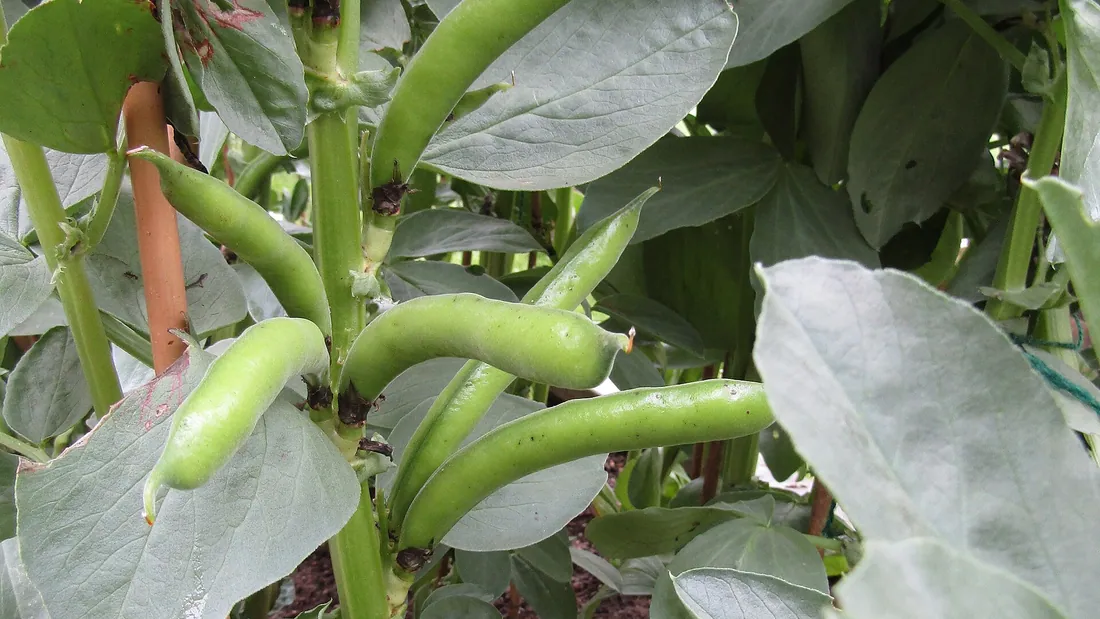

The broad bean (Vicia faba) is one of the very first vegetables of the year, a rustic, sturdy legume that goes into the ground while almost everything else in the vegetable patch is still asleep. It is a bet you win before you even start: it copes with cold better than practically any other vegetable in the garden and needs neither warmth nor blazing sun to get going. Like all legumes, it fixes nitrogen from the air through the bacteria housed in the nodules on its roots, and leaves the soil richer than it found it.
Light and exposure
Broad beans like full sun but do perfectly well without it, as long as the spot stays open and airy. Unlike basil or tomatoes, light is not what limits growth, space is: the stems shoot up fast and tall, often past eighty centimetres, and a row planted in the shelter of a hedge or wall goes down flat at the first proper gust.
Choose a spot that breathes, sheltered from the worst gusts if you can manage it, rather than one that is simply sunny all day. An open spot that is not swept by the prevailing wind already solves half your future staking problems.
Watering
At sowing time, whether autumn or late winter, the soil’s natural moisture is more than enough: broad beans germinate and grow during the wettest season of the year and never ask for watering at that stage. Too much water at the start actually rots the seed before it comes up, especially in heavy, poorly drained soil.
Everything changes at flowering and pod fill. That is when water really matters: a dry spring at the wrong moment gives short, poorly filled pods. Water at the base if rain turns scarce during that period, and never wet the foliage, rust and chocolate spot both love standing moisture on the leaves.
Soil and repotting
Broad beans are not fussy about soil and even tolerate heavy, clay ground, which is unusual for a legume. A deep, cool, well structured soil suits them perfectly, as long as it does not stay waterlogged over winter, or the roots suffocate and the seeds rot.
As with peas, skip the nitrogen fertiliser: broad beans feed themselves through their nodules, and extra nitrogen just pushes them into leaf at the expense of pods. A little well rotted compost worked in during autumn or late winter is plenty, and avoid sowing beans in the same spot several years running, or the same diseases build up in the soil.
Temperature and humidity
This is the broad bean’s strong suit and what sets it apart: it germinates from as little as four or five degrees in the soil, grows well between ten and twenty degrees, and well established plants shrug off light frost down to around minus five without damage. The more tender autumn sown seedlings handle hard frosts a little less well, but usually pull through under a mild winter, especially with a bit of mulch.
The real limit is heat, not cold. Past twenty five degrees the flowers abort, black aphids explode in number, and the plant wears itself out fast. That is exactly why it is sown so early: flowering and pod fill need to be behind it before the hot season sets in.
Pruning and upkeep
Broad beans are not pruned in the usual sense, but two moves really matter. First, earthing up: draw soil around the base of the stems, as you would for potatoes, to stabilise them. Second, staking, which is not optional: the stems are hollow and brittle, and a row of broad beans in full growth goes over at the first properly strong gust. Frame the row with stakes linked by taut string on both sides, or stretch netting alongside it, so the plants lean against it instead of falling.
The single most useful move is topping: as soon as the first pods appear, pinch out and remove the top ten centimetres of each stem. That tender growing tip is exactly where black aphids (Aphis fabae) mass first in spring. Topping stops them settling in their tracks and keeps them from colonising the whole plant, while pushing the bean to put its energy into filling the pods already set rather than growing taller. The removed tips are good eating too, wilted in butter like spinach.
Pests and diseases
Rust (Uromyces viciae-fabae) shows up as small orange pustules on the leaves, mostly late in the cycle in mild, damp weather, very much our specialty. It weakens the plant without necessarily killing it, but cuts the harvest if it takes hold early. Chocolate spot (Botrytis fabae) is more serious: reddish brown blotches, shaped rather like chocolate, appear on leaves and stems in mild, humid weather, often after a stretch of rain. Left unchecked, it can defoliate the plant.
The real classic is black bean aphid (Aphis fabae), which swarms the tops of the stems in spring and forms proper sticky black colonies. It weakens the plant, spreads viruses and draws ants. Topping the plant as the first pods appear is by far the best defence, much more effective than a late treatment. Keep the rows airy, avoid watering the foliage, and do not sow broad beans in the same spot year after year to keep the pressure from these diseases down.
Propagation
Broad beans are sown only in place, straight into the garden: they dislike being transplanted, and pricking out too often damages their fragile roots. Sow in rows about forty centimetres apart, five centimetres deep, spacing the seeds twenty to twenty five centimetres apart, or in stations of two or three seeds every twenty centimetres. Freshly worked soil, neither waterlogged nor bone dry, gives the best emergence.
You can also save your own seed. Let a few good pods dry completely on the plant at the end of the season, until the pod blackens and turns brittle, then shell and store the seeds somewhere dry. They resow very well the following year, provided you start from a non hybrid variety, which most shop bought broad bean varieties are.
Climate and hardiness
Where and in which climate it thrives
The broad bean is the cold season vegetable par excellence. Few crops in the vegetable patch will overwinter or get going this early: once properly established, it shrugs off light frost down to around minus five degrees, more under a mulch, which sets it apart in almost every temperate garden. Overwintering outdoors is realistic wherever frosts stay occasional and moderate, broadly USDA zone 8 and milder, and provided the soil does not stay waterlogged: the broad bean fears winter suffocation far more than the cold itself.
Two strategies exist, and the climate does the choosing. An autumn sowing, a few weeks before the first frosts, banks on a mild winter for a very early harvest, but stays a gamble: a hard or overly wet winter can rot or kill off young plants. The late winter sowing, as soon as the soil can be worked without sticking to the tools, gives a slightly later but far more reliable harvest; it is the default choice in an oceanic climate with a wet winter, and the only option where the ground freezes deep. For the autumn gamble, 'Aquadulce Claudine' remains a safe bet, one of the hardiest varieties on the market; for the late winter sowing, an early variety such as 'Witkiem Manita' makes up much of the lost time by running quickly to harvest.
The real limit is heat, not cold: past twenty five degrees the flowers abort and black aphids explode in number. In a Mediterranean or subtropical climate the broad bean is therefore grown through the cool season, sown as winter comes in and harvested before the first heat. Wherever you are, the calculation is the same: flowering and pod fill must be behind it before the hot season settles in.
Like all legumes, the broad bean fixes nitrogen from the air through the bacteria in its root nodules and leaves the soil richer behind it. Cut the stems at ground level after harvest and let the roots break down in the soil, the next crop planted there, a cabbage or a squash for instance, will benefit directly.
Growing broad bean?
Green Hub keeps a dated history of your own plant: its photos, its progress, its repottings. An AI answers about yours specifically, not a generic sheet, for free.
Identify my plantMonth-by-month care calendar
| January | Nothing to sow outdoors. If an autumn sowing was made, the young plants sit tight in the garden, hardy through light frost. Use the time to pick your varieties and order seed for the late winter sowing. |
|---|---|
| February | As soon as the soil can be worked without sticking to your tools, it is time for the late winter sowing, the safest strategy. If the ground is still waterlogged, wait a little longer rather than sowing into mud. |
| March | The main sowing month in open ground, in rows, five centimetres deep. This is the most reliable window of the year in the region. Autumn sown plants take off properly with the warmer days. |
| April | Emergence and fast growth. Hoe around the base, watch for slugs on the tender young shoots, and put in a few early stakes if the autumn sown plants have passed thirty centimetres. |
| May | Black and white flowers, richly scented. Earth up the base of the plants and put in the permanent staking, posts with taut string on both sides of the row, before the wind flattens everything. As soon as the first pods appear, top the stems to stop black aphids. |
| June | Pods are filling out, the moment when water matters most if spring has been dry. First harvests from the autumn sowings. Watch for rust and chocolate spot in humid weather and keep the rows airy. |
| July | Full harvest from the late winter sowings. Pick the well filled pods regularly, they turn tough and lose quality if left too long on the plant. |
| August | End of harvest. Pull the spent plants, cut the stems at ground level but leave the roots in the soil for their nitrogen rich nodules. Let a few good pods dry on the plant if you want to save seed. |
| September | Clear the bed and prepare the soil for an autumn sowing if you are going for an early harvest. Best followed by a nitrogen hungry crop where the beans stood. |
| October | The autumn sowing window, for mild winters, in rows five centimetres deep. A gamble that pays off with an early harvest if it works, but check the forecast before committing. |
| November | Last chance for an autumn sowing early in the month. Mulch young plants lightly to soften the first hard frosts without smothering them. |
| December | Rest in the garden. Autumn sown plants sit tight, hardy through light frost, needing no watering or particular care. Note what worked this year and order seed for February. |
Green Hub tips
- Sow early, as soon as you can: broad beans shrug off light frost down to around minus five degrees, whether autumn sown under a mild winter or, safer everywhere else, late winter sown as soon as the soil can be worked without sticking to the tools.
- Top the stems as soon as the first pods appear, removing the top ten centimetres. It is the best way to stop black aphids before they settle in, and it speeds up pod fill.
- Stake every row as a matter of course, with posts and taut string on both sides. The hollow stems go over easily in the wind once loaded with pods.
- Never add nitrogen fertiliser: broad beans fix their own through their root nodules and even enrich the soil for the next crop.
Related species
Bean
Phaseolus vulgaris
The green bean (Phaseolus vulgaris) is one of the easiest vegetables in the kitchen garden, provided you respect one…
Pea
Pisum sativum
The pea (Pisum sativum) is a cool-season legume, hardy to cold but hating heat: its seeds germinate from 4 to 5 degrees…
Wisteria
Wisteria sinensis
Wisteria (Wisteria sinensis) is a woody climber from China, capable of covering an entire house front within a few…
Artichoke
Cynara scolymus
The artichoke (Cynara scolymus) is a large perennial with silvery, deeply cut foliage, as striking in an ornamental…
Asparagus
Asparagus officinalis
Asparagus (Asparagus officinalis) is an unusual perennial for a vegetable patch: once established, an asparagus bed…
Beetroot
Beta vulgaris
Beetroot (Beta vulgaris) is an easy root vegetable, one of the most forgiving in the kitchen garden. You sow it…
The guides that mention it
The vegetable garden calendar, from sowing to harvest
Two dates are enough to build an entire vegetable garden year: your last spring frost and your first autumn frost.…
Making Compost: Steering the Thermal Biology of the Heap
A compost heap is not a pile of waste you stir, it is a thermal process you steer. The real carbon/nitrogen ratio of…
Vegetable Garden Pests: The Natural Method That Holds All Season
A leaf riddled with holes, a lettuce shaved to the ground overnight, a twisted and sticky shoot: every kind of damage…
Garden Diseases: Recognising What Is Attacking Your Plants, and Acting Before the Spot Appears
A white bloom that wipes off on a fingertip, an angular lesion stopped dead by a vein, a fruit browned from the bottom…
Updated on
How this sheet is written
Written for Green Hub with the help of language models, then reviewed. It offers gardening guidance, not professional advice: if you are unsure whether a plant is toxic to a child or an animal, ask a vet, a doctor or your national poison centre.