Hyacinth
Hyacinthus orientalis
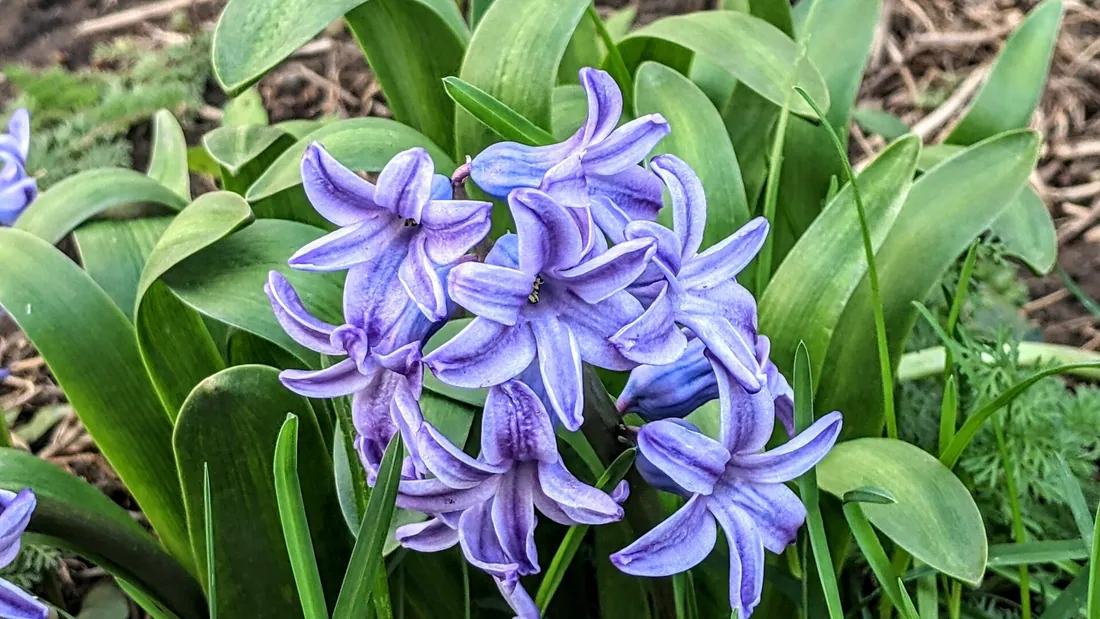

The hyacinth (Hyacinthus orientalis) is a spring bulb whose heady scent announces the return of fine weather in gardens and on windowsills. Its dense spikes of tightly packed bells, in shades of blue, pink, white, purple or yellow, are among the most recognisable spring blooms. It is planted in open ground in autumn for a mid-spring flowering, but it is just as often forced in a pot indoors to bloom right in the middle of winter.
Light and exposure
Hyacinths like full sun or light partial shade. A spot that gets sunshine in early spring, before nearby trees and shrubs come into leaf, suits them perfectly: under a deciduous tree, along a hedge, or at the foot of a wall that catches the midday and afternoon sun.
For forcing in a pot, keep the bulb somewhere cool and dark for several weeks first, then move it gradually towards the light as soon as the shoots appear. Bringing it into bright light too abruptly produces pale, floppy stems that cannot stand up straight.
Watering
Once planted out in autumn, hyacinths are largely happy with natural rainfall and need no particular watering before spring. Water only if autumn is unusually dry, at planting time, to help the roots get established.
In a pot, keep the compost lightly moist without waterlogging it, and always empty the saucer after watering. During indoor forcing, too much water at the bulb stage is by far the main cause of rot, far more common than underwatering.
Soil and repotting
Hyacinths want a light, well-drained soil rather than a rich one. Ordinary garden soil, lightened with a little sand or fine gravel on heavy clay ground, suits them very well.
Drainage is the one non-negotiable point: soil that stays waterlogged through the cold season rots the bulb before it has even had a chance to grow roots. In a pot, use a bulb compost or a compost-and-sand mix, with a drainage hole at the bottom of the pot as an absolute must.
Temperature and humidity
Hyacinths are fully hardy in climates with a proper winter and cope without any trouble with frost once planted out: the cold is in fact essential, it triggers the process that leads to spring flowering.
For forcing in a pot, this need for cold has to be recreated artificially: the prepared bulb spends six to ten weeks somewhere cool and dark, between 5 and 9 degrees (a cellar, an unheated garage or the salad drawer of the fridge), before being brought gradually up to room temperature to flower.
Pruning and upkeep
Once flowering is over, cut off only the faded flower stem, right down at leaf level, so the plant does not waste energy producing seed. Do not touch the leaves at this stage.
Let the foliage yellow and die back completely on its own, which usually takes six to eight weeks after flowering. This is when the bulb is rebuilding its reserves for the following year: cutting the leaves too early weakens flowering for years to come.
Pests and diseases
Bulb rot, whether bacterial or fungal, is the main problem with hyacinths and it almost always affects bulbs planted in soil that is too wet or poorly drained. A bulb that is soft, foul-smelling or brown-stained at planting time should be discarded without hesitation.
In well-drained soil, hyacinths stay a healthy plant with few disease problems. Slugs sometimes attack the young shoots as they emerge from the ground at the end of winter, a minor nuisance compared with the risk of rot.
Propagation
Propagation is done almost exclusively through offsets, the small secondary bulbs that form naturally around the mother bulb over the years. They are detached when the clump is lifted in summer and replanted straight away, though it usually takes two to three years before they flower in their turn.
Growing from seed is possible but stays a curiosity for a home gardener: it takes five to six years of patience before the first flower, and the seedlings are not always true to the parent variety. It is better to put the effort into dividing well-established clumps instead.
Toxicity
The whole plant is toxic, especially the bulb. If eaten, it causes digestive upset (nausea, vomiting, diarrhoea) in people as well as in dogs and cats. The sap contains calcium oxalate crystals that irritate the skin and can trigger itching or contact dermatitis, particularly when handling bulbs bare-handed during planting or forcing. Wear gloves whenever you handle the bulbs, and keep them out of reach of children and pets.
Climate and hardiness
Where and in which climate it thrives
The hyacinth comes from the hills of the Near East: it wants a properly cold winter and a dry summer. In the ground the bulb is rated for USDA zones 4 to 8; buried around ten centimetres deep it comes through winters far harsher than anything its native range throws at it. Cold is what governs flowering, not light: without a long spell below 9 degrees, in the order of ten to fourteen weeks, the bulb throws only a stunted spike, if it throws one at all.
It is at ease in temperate climates with a definite winter, oceanic or continental, and in Mediterranean climates where the dry summer matches its natural dormancy exactly. Where winters stay mild, from zone 9 on, it no longer reflowers by itself: buy prepared bulbs, or give them six to ten weeks between 5 and 9 degrees in the salad drawer of the fridge, and treat them as annuals. It also struggles where summers are hot and wet, since the bulb rots during dormancy: lift it once the foliage has yellowed and keep it dry until the next planting.
What changes the procedure with the climate: plant once the soil has cooled to around 13 degrees, leaving yourself six to eight weeks before frost locks it up, at a depth of roughly twice the height of the bulb, a little deeper in light soil. Where winters are mild and wet, drainage decides everything, not cold. In a pot or a windowbox the compost freezes far faster than open ground: bring the container into a frost-free space rather than into the warm, because a hyacinth given heat too early flowers briefly, on a soft spike that flops over.
Growing hyacinth?
Green Hub keeps a dated history of your own plant: its photos, its progress, its repottings. An AI answers about yours specifically, not a generic sheet, for free.
Identify my plantMonth-by-month care calendar
| January | Bulbs forced in autumn start flowering indoors, right in the middle of winter. Nothing to do in open ground, the planted bulbs are still waiting underground. |
|---|---|
| February | Shoots from autumn-planted hyacinths sometimes break through the soil in mild spells. Protect with fleece if a hard late frost threatens shoots that have come up too early. |
| March | Foliage develops fast in open ground. Last window for planting late bulbs, though flowering will come later and be less vigorous. |
| April | This is the big flowering month outdoors. The scented spikes open, often alongside the early tulips. |
| May | Flowering ends. Cut off only the faded flower stem and leave the foliage in place, it is still busy recharging the bulb. |
| June | The foliage yellows and gradually flops over. Do not cut it until it is completely faded and dry. |
| July | The foliage has finished dying back. You can now lift bulbs from beds that need replanting with other flowers, clean them and store them somewhere cool and dry until autumn. |
| August | A quiet month for bulbs in the ground. Time to buy bulbs for forcing and start preparing them somewhere cool and dark. |
| September | Continue the cool preparation of bulbs for forcing, six to ten weeks before the flowering date you want. Prepare planting spots in open ground. |
| October | The main planting month outdoors, ten centimetres deep in well-drained soil. First forcing pots can move from cold storage into the light for a Christmas flowering. |
| November | Keep planting in open ground as long as the soil is not frozen. New forcing pots can go into the light to spread flowering out from January to March. |
| December | The first bulbs forced back in October come into flower for the festive season. Keep bringing the remaining pots gradually out of the cold. |
Green Hub tips
- Always wear gloves when handling the bulbs, whether planting or forcing: the sap contains irritant crystals that cause itching for a lot of people.
- Plant in well-drained soil or add sand to the bottom of the hole: a hyacinth bulb that sits in water all winter will almost certainly rot.
- For a Christmas flowering, allow around ten weeks of cold and dark for the bulb before bringing it into the light: the earlier you prepare it, the earlier you get flowers.
- Always let the foliage die back completely after flowering before cutting it off: it is what rebuilds the bulb’s reserves for next year.
Related species
Asparagus
Asparagus officinalis
Asparagus (Asparagus officinalis) is an unusual perennial for a vegetable patch: once established, an asparagus bed…
Hosta
Hosta
The hosta (Hosta spp.) is a perennial native to the damp woodlands of East Asia, from Japan through China to Korea. It…
Lily of the valley
Convallaria majalis
Lily of the valley (Convallaria majalis) is the small perennial with white, fragrant bell flowers traditionally given…
Madagascar dragon tree
Dracaena marginata
The Madagascar dragon tree (Dracaena marginata) is a houseplant with a slender trunk and a tuft of strap-like leaves…
Snake plant
Dracaena trifasciata
The snake plant (Dracaena trifasciata), long classed under the name Sansevieria trifasciata and nicknamed…
Spider plant
Chlorophytum comosum
The spider plant (Chlorophytum comosum), also called ribbon plant, is a South African perennial that has become the…
The guides that mention it
Perennial Flowers: Choosing, Planting and Blooming Without a Gap All Season
What genuinely comes back year after year, how to read hardiness by zone rather than by promise, and how to string…
Lawn Care: From Seeding to Mowing, and Renovation
Mowing higher changes more than any fertilizer can: turf density, drought resistance, weeds, moss. Everything else in…
The Cutting Garden: How to Pick Flowers and Make Your Bouquet Last
Dahlias, peonies, hydrangeas: what separates a flower that lasts ten days in a vase from one that droops by the next…
Updated on
How this sheet is written
Written for Green Hub with the help of language models, then reviewed. It offers gardening guidance, not professional advice: if you are unsure whether a plant is toxic to a child or an animal, ask a vet, a doctor or your national poison centre.