Madagascar dragon tree
Dracaena marginata
_Ereke_Buton_Island_02.jpg)
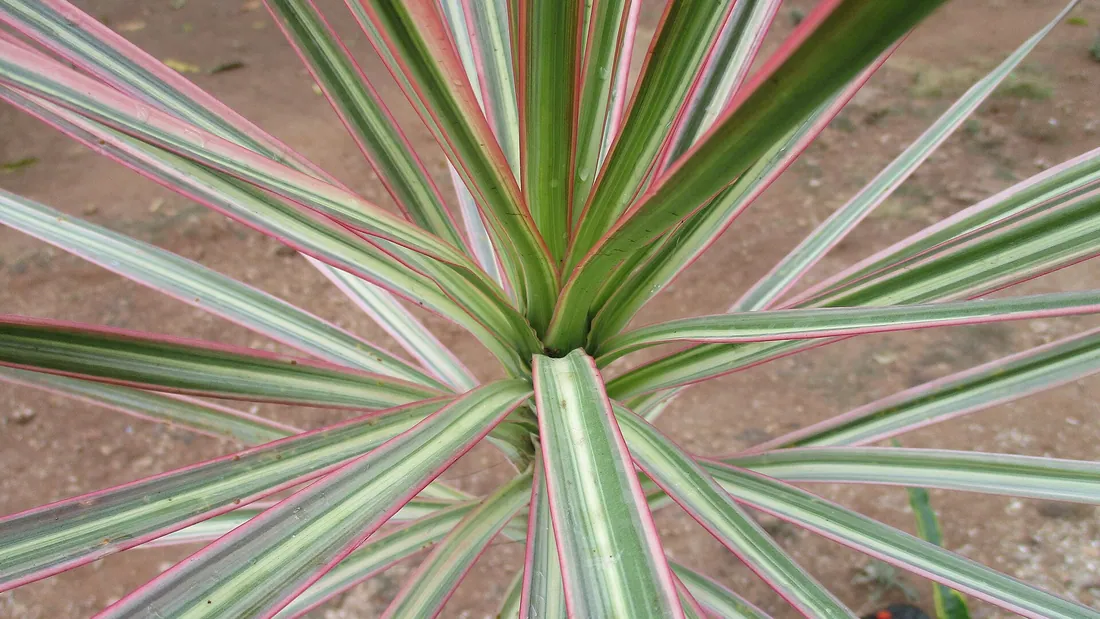
The Madagascar dragon tree (Dracaena marginata) is a houseplant with a slender trunk and a tuft of strap-like leaves edged in red. It lives indoors all year round: it cannot cope with a temperate winter and never goes out into the garden. Reputed easy and tolerant, it forgives missed waterings far better than excess. Its main worry, browning tips, is almost always settled by correcting the water and the ambient air.
Light and exposure
The dragon tree likes medium to bright light, but always indirect. A spot a few metres from a well-lit window suits it, such as an east-facing ledge. Avoid full sun behind a south-facing pane in summer: it scorches and bleaches the foliage.
It also tolerates partial shade, one of the rare plants that hold up in a less bright corner, where it simply grows more slowly. Turn the pot a quarter turn every two or three weeks to keep it upright.
Watering
Water moderately and let it dry between waterings, when the first few centimetres of potting mix are dry to the touch. In practice, one watering a week in summer and one every fifteen to twenty days in winter. Always empty the saucer: what kills the dragon tree is standing water, not thirst.
The plant is sensitive to the fluoride and chlorine in tap water, which brown the leaf tips. Let the water stand overnight before watering, or use rainwater, easy to collect here, at room temperature rather than cold.
Soil and repotting
A potting mix for green plants, light and free-draining, does the job. Loosen it with a handful of perlite or coarse sand so the water passes through quickly. A pot with a drainage hole is essential, with clay pebbles at the bottom.
Repot only every two to three years, in spring, into a barely larger pot: the dragon tree is happy with its roots a little cramped and hates large volumes of soil that stay wet. In the other years, just replace the top few centimetres with fresh potting mix.
Temperature and humidity
The dragon tree wants constant warmth, between 18 and 24 degrees all year. It suffers below 13 degrees and likes neither cold draughts nor sudden changes. Keep it away from a door that opens in winter.
The critical point is the dry air of the heating. Winter may be humid outside, but a heated interior becomes very dry, and that is where the tips brown the most. Move the plant away from radiators, mist once or twice a week, or set the pot on a saucer of damp clay pebbles.
Pruning and upkeep
The dragon tree is pruned without fear. If a trunk has gone bare and carries only a plume at the top, cut it off cleanly at the desired height with clean secateurs: the plant regrows by forming one or more new heads just below the cut. Spring is the best time, when the regrowth is vigorous.
Routine care is minimal. Remove the lower leaves that yellow and dry, this is the normal ageing of the trunk, not a disease. Wipe the foliage with a damp cloth from time to time to remove the dust that dulls the colours.
Pests and diseases
The dragon tree rarely falls ill, and its troubles almost always come from too much water. Watering that is too generous or a saucer never emptied causes root rot, then trunk rot that turns soft and brown at the base. This is the real fatal risk: if the base softens, repot urgently into dry potting mix after cutting away the affected parts.
As for pests, watch out for mealybugs, small white cottony clusters in the leaf axils, common in heated, dry interiors. Spider mites also appear when the air is too dry, foliage stippled with yellow dots. In both cases, misting and cleaning the foliage settles a good part of the problem.
Propagation
Head cuttings are the simplest. Cut the tuft of leaves with about ten centimetres of stem, let the wound dry for a day, then plant in a light, moist potting mix, or root it in a glass of water. In warmth and indirect light, roots appear within a few weeks.
Stem sections can also be taken as cuttings. When you top an old trunk, cut the remaining part into pieces of ten to fifteen centimetres, noting the direction (the bottom towards the potting mix). Planted upright and kept warm, they put out new shoots. A single bare plant thus yields several young dragon trees.
Toxicity
Toxic to cats and dogs. The leaves contain saponins that cause, if ingested, vomiting (sometimes with blood), excessive salivation, loss of appetite and dejection. Cats are particularly sensitive and may have dilated pupils. Place the plant out of reach of animals that nibble the foliage.
Climate and hardiness
Where and in which climate it thrives
The dragon tree is a houseplant and nothing else. Far too frost-tender for the garden, it spends the whole year in the house. It copes very well with an ordinary interior and gets by in a moderately lit room, which is why it is seen everywhere, from the living room to the office.
The real appointment of the year is the heating season. The heating then runs and the air in the houses becomes very dry, while the plant grows slowly for lack of light. Two gestures make the difference: cut back watering sharply, since a barely active dragon tree rots quickly if you keep to the summer rhythm, and move it away from radiators, the main cause of brown tips. When the light returns it picks up on its own: repot, take cuttings, resume regular watering. In the warm season it can be put out on a shaded balcony, but it is brought in as soon as nights drop below 13 degrees.
Growing madagascar dragon tree?
Green Hub keeps a dated history of your own plant: its photos, its progress, its repottings. An AI answers about yours specifically, not a generic sheet, for free.
Identify my plantMonth-by-month care calendar
| January | Minimal watering, every fifteen to twenty days, potting mix well dry beforehand. Mist against the dry air of the heating and keep the pot away from radiators. |
|---|---|
| February | Still ticking over slowly. Check for the absence of mealybugs in the leaf axils. Clean the foliage with a damp cloth. |
| March | The pick-up begins with the longer days. Gradually resume regular watering. A good time to repot if the roots overflow. |
| April | Full pick-up. Repotting and head or stem cuttings are ideal this month. Top a bare trunk, it will regrow. |
| May | Active growth. Water as soon as the first few centimetres are dry, with stood or rainwater. Turn the pot for upright growth. |
| June | Full vegetative summer. About one watering a week. It can be put out on a shaded balcony, never in full sun. |
| July | The potting mix dries faster in strong heat, keep an eye on it. Mist if the air is dry. Bright but indirect light. |
| August | End of the fine season. Continue regular watering. Watch for spider mites, foliage stippled with yellow dots. |
| September | Bring it in if you had put it out, as soon as nights drop below 13 degrees, rarely after mid-September. Space out the water. |
| October | Growth slows. Reduce watering. Set it in its winter spot, bright and away from heat sources. |
| November | The heating starts. Switch to winter watering, very spaced out, and start misting against brown tips. |
| December | Rest. Little water, never a full saucer. Move away from radiators, the foliage stays decorative all year. |
Green Hub tips
- Leaf tips browning: it is almost always the water or the air. Switch to rainwater or let tap water stand overnight, and move the plant away from radiators.
- In winter, water three times less than in summer. A dragon tree ticking over slowly rots at the trunk if you keep watering it as in full growth.
- Trunk too tall and bare: cut it off cleanly in spring. The plant regrows by forming new heads just below the cut.
- Toxic to cats and dogs. If an animal nibbles the foliage, place the plant up high, out of its reach.
Related species
Asparagus
Asparagus officinalis
Asparagus (Asparagus officinalis) is an unusual perennial for a vegetable patch: once established, an asparagus bed…
Hosta
Hosta
The hosta (Hosta spp.) is a perennial native to the damp woodlands of East Asia, from Japan through China to Korea. It…
Hyacinth
Hyacinthus orientalis
The hyacinth (Hyacinthus orientalis) is a spring bulb whose heady scent announces the return of fine weather in gardens…
Lily of the valley
Convallaria majalis
Lily of the valley (Convallaria majalis) is the small perennial with white, fragrant bell flowers traditionally given…
Snake plant
Dracaena trifasciata
The snake plant (Dracaena trifasciata), long classed under the name Sansevieria trifasciata and nicknamed…
Spider plant
Chlorophytum comosum
The spider plant (Chlorophytum comosum), also called ribbon plant, is a South African perennial that has become the…
The guides that mention it
Indestructible Houseplants: Tolerating Drought Is Not Tolerating Shade
Tolerating drought and tolerating shade are two different adaptations, and almost every list mixes them up. What these…
Toxic Plants for Cats and Dogs: Recognising the Danger Rather Than Memorising a List
A list of toxic plants is easily forgotten and always incomplete. What actually protects a cat or dog is recognising…
How to Compost in an Apartment with Worm Composting
Tiered bin, red worms and worm tea: how to compost your kitchen scraps without a garden or odor, even in a city…
Updated on
How this sheet is written
Written for Green Hub with the help of language models, then reviewed. It offers gardening guidance, not professional advice: if you are unsure whether a plant is toxic to a child or an animal, ask a vet, a doctor or your national poison centre.