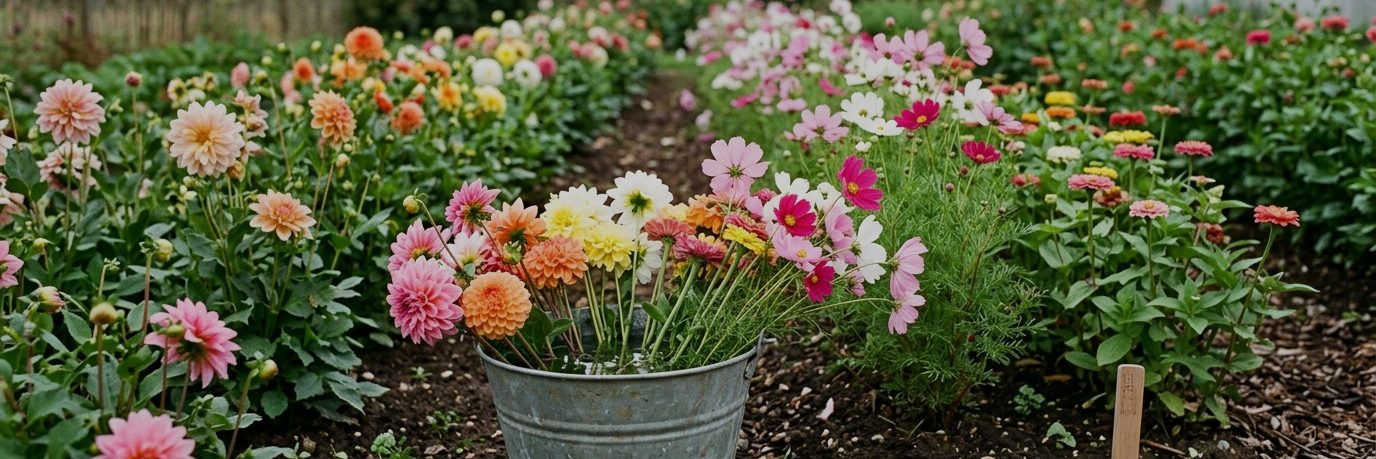
The Cutting Garden: How to Pick Flowers and Make Your Bouquet Last
A cutting garden is meant to be harvested, not just admired: dahlias, peonies, coneflowers, tulips and hydrangeas can last five to ten days in a vase, provided they’re cut at the right moment and conditioned immediately after picking. The rule that applies to all garden flowers is simple: cut early in the morning when the stems are full of water, strip off any leaves that would sit below the waterline, and treat latex-producing or woody stems, dahlia, hydrangea, lilac, separately, since each demands its own particular technique. Everything else comes down to changing the water often and planning a succession of blooms that runs from spring through autumn.
Which garden flowers last longest in a vase
Not all garden flowers are equal once cut. The most generous are the coneflower and the oxeye daisy: seven to ten days for the former, ten to fourteen for the latter, provided every leaf that would touch the water is stripped away. Peonies cut at the right stage last seven to ten days; tulips last about a week but keep growing in the vase, one to two centimetres a day. Decorative dahlias last five to six days, seven with good conditioning; open-centred varieties should be cut nearly fully open, since they stop developing once picked. Lily of the valley lasts five to seven days, two to three weeks if the stem is re-cut daily. Daffodils are a case apart: their sap damages neighbouring flowers and needs an isolated spell before joining a bouquet; hyacinths behave more considerately for a comparable vase life. Hydrangeas and lilacs, with their woody stems, wilt within hours without a precise cutting technique. Snowball viburnum, cut in the morning in May, holds up well and keeps deepening in colour in the water. Only crocus has no place here: its stem is too short, so it stays in the garden.
Getting the cut right
Timing matters as much as technique. Pick early in the morning, once the dew has dried but before the heat sets in, or late in the evening: at those times the stems are full of water, unlike those picked at high noon, which are already dehydrated. The right cutting stage then depends on the flower. Peonies are cut at the marshmallow stage, when a bud gives slightly under gentle finger pressure, like a fresh marshmallow; ants drawn to the sweet nectar on the sepals are harmless, a quick rinse in cold water sends them on their way before the flower comes indoors. Dahlias, on the other hand, stop developing once picked: cut them nearly fully open, never as a closed bud. Lilac is harvested once a third to half of the florets on the cluster have opened. In every case, cut at a forty-five-degree angle with a sharp tool: an angled cut offers a larger surface to draw up water than a straight one, and a dull blade crushes the vessels instead of slicing them cleanly. Cut the stem longer than you actually need, you can always trim it to fit the vase later, and plunge it into a bucket of water the moment it’s cut, never leaving it exposed to the air.
Conditioning stems right away
Conditioning happens in the minutes right after cutting. Stand each stem in lukewarm water, which is absorbed faster than cold water and suits most flowers, except the tulip, which prefers cold water to slow down its opening. For woody stems, hydrangea and lilac above all, split the base two to four centimetres with secateurs rather than crushing it with a hammer, which destroys the vessels instead of opening them. Strip off most of the leaves on these two shrubs too, since they draw off water the flowers themselves need. Dahlias, and to a lesser extent garden poppies, exude a latex that clogs the stem: sear the tip for a few seconds over a lighter flame, or soak it for an hour in water at seventy degrees. Daffodils need separate treatment: their milky sap clogs the vessels of neighbouring flowers. Isolate them for twenty-four hours in their own bucket of water before adding them to a bouquet, and don’t re-cut them afterwards, or the sap would start flowing again. For every flower, finally, strip off any leaves that would sit below the waterline, since they rot and feed bacteria.
Making the bouquet last once it’s in the vase
Even a well-cut bouquet can fade fast if the water in the vase turns. The simplest homemade recipe is one litre of lukewarm water, two tablespoons of sugar to feed the flowers, two tablespoons of white vinegar or lemon juice to slow bacteria, then half a teaspoon of household bleach once the sugar has fully dissolved. Never pour the vinegar and the bleach together before diluting them, mixing them directly releases dangerous chlorine fumes: dilute the acid first, add the bleach last. Change the vase water every two days, and use the opportunity to re-cut each stem by a centimetre at an angle, since a tip left too long in water clogs up and stops absorbing anything. Check at every water change that no leaf is left submerged. Finally, keep the vase away from a radiator, a sun-facing window, and a bowl of ripening fruit: apples, pears and bananas release ethylene, a gas that speeds up the ageing of cut flowers even from a distance.
Planning a succession of blooms to cut
To never run short of flowers to cut, think in terms of a calendar rather than a shopping list. The season opens in March and April with daffodils, hyacinths and tulips, provided you’ve planted a batch dedicated to cutting, denser than an ordinary decorative bed, since every bulb picked won’t flower again until the following season. May brings lilac and snowball viburnum, then peonies close out the spring stretch in late May or early June. Summer takes over with roses, hydrangeas, coneflowers and oxeye daisies, which bloom continuously from June to September as long as you keep cutting them: with both the daisy and the coneflower, regular cutting spurs the production of new stems rather than exhausting the plant. Dahlias bring up the rear, flowering from July until the first frosts of October or November. One rule protects these plants from exhaustion, and it applies to perennials and flowering shrubs alike: never take more than a third of the foliage or flowering stems in a single season, so the plant has enough left to bloom again the following year.
The care sheets to read next
Every plant mentioned has its full sheet: watering, light, soil, pests and a month-by-month calendar.
Dahlia
Dahlia
The dahlia (Dahlia) is a tuberous plant that offers one of the longest and most spectacular displays of the summer…
Peony
Paeonia
The peony (Paeonia) is a hardy perennial with remarkable longevity: once well settled, it can flower for several…
Coneflower
Echinacea purpurea
Coneflower (Echinacea purpurea) is a tall, sturdy perennial from the prairies of North America, recognisable by its…
Tulip
Tulipa
The tulip (Tulipa) is a spring-flowering bulb, come from the mountains of Central Asia and become the emblem of Dutch…
Hydrangea
Hydrangea macrophylla
The hydrangea (Hydrangea macrophylla) is the flowering shrub for cool, partly shaded gardens, and one of the very few…
Lily of the valley
Convallaria majalis
Lily of the valley (Convallaria majalis) is the small perennial with white, fragrant bell flowers traditionally given…
Rose
Rosa
The rose (Rosa) is a hardy flowering shrub that overwinters outdoors without trouble, down to about -20 °C for most…
Oxeye Daisy
Leucanthemum vulgare
The oxeye daisy (Leucanthemum vulgare) is that white flower with a yellow centre that pops up on its own in our…
Lilac
Syringa vulgaris
Common lilac (Syringa vulgaris) is a deciduous shrub found in almost every old country garden. Its late spring scent is…
Daffodil
Narcissus
The daffodil (Narcissus) is the first big signal of spring in the garden. Long before the tulips, its yellow trumpets…
Hyacinth
Hyacinthus orientalis
The hyacinth (Hyacinthus orientalis) is a spring bulb whose heady scent announces the return of fine weather in gardens…
Viburnum
Viburnum
Viburnum is not one plant but a whole family of more than a hundred and fifty shrubs, broad enough to cover almost…
Crocus
Crocus
Crocus is the very first splash of colour in the garden as winter loosens its grip. It is not unusual to see it push…
Frequently asked questions
Which garden flowers last longest once cut?
The oxeye daisy and the coneflower come out on top, lasting seven to fourteen days depending on conditions. Peonies cut at the right stage last seven to ten days, and decorative dahlias five to seven days with good conditioning. Lilac and open-centred dahlias, by contrast, fade faster, around five days.
Why does my cut hydrangea wilt within hours?
Hydrangea produces a sap that quickly clogs its stem and cuts off the water supply to the flowers. Split the base of the stem two to four centimetres, strip off almost all the leaves, and plunge the flower into cold water right after cutting. Dipping the stem for around thirty seconds in very hot water, then putting it straight back into cold water, also helps reopen the passage.
Can daffodils be mixed with other flowers in a bouquet?
Yes, but never right after cutting. Daffodils release a milky sap that clogs the stems of neighbouring flowers and shortens their vase life. Leave them alone for twenty-four hours in their own bucket of water, without re-cutting them, before adding them to a mixed bouquet.
When should peonies be cut to last longest in a vase?
Cut them at the marshmallow stage, when the coloured bud gives slightly under finger pressure without yet being open. Cut at this stage, peonies then open up in the vase and last seven to ten days, compared with three or four days for a flower picked already wide open.
Green Hub looks after your plants
Photograph a plant: Green Hub identifies it and writes its care sheet, with no account. Sign in afterwards to keep its dated photos and history over time.
Identify a plantUpdated on
How this sheet is written
Written for Green Hub with the help of language models, then reviewed. It offers gardening guidance, not professional advice: if you are unsure whether a plant is toxic to a child or an animal, ask a vet, a doctor or your national poison centre.