Snake plant
Dracaena trifasciata
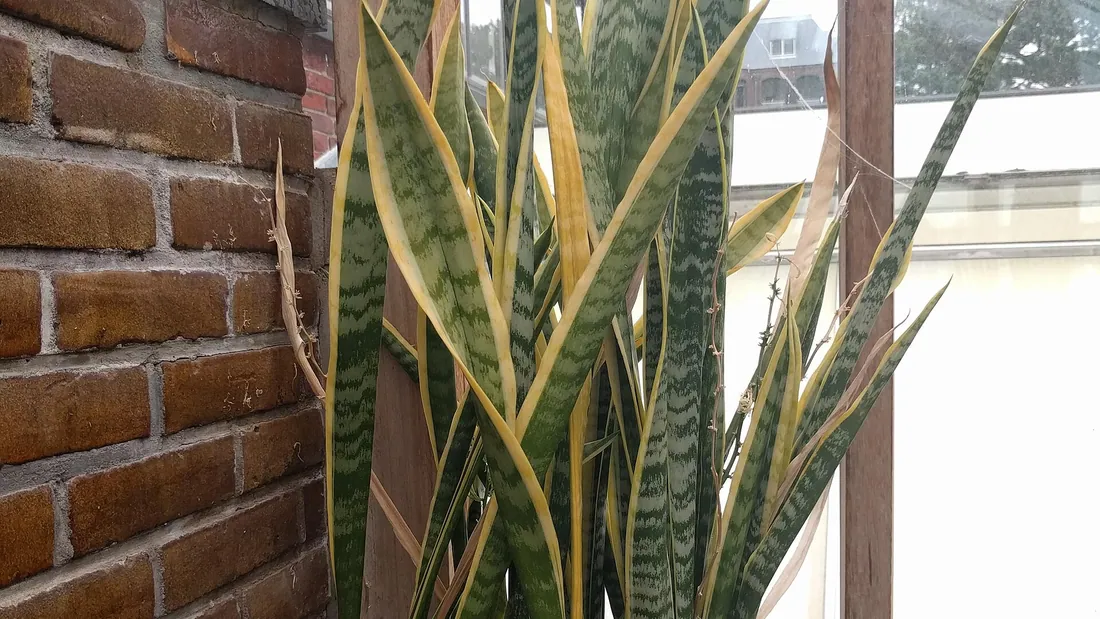

The snake plant (Dracaena trifasciata), long classed under the name Sansevieria trifasciata and nicknamed mother-in-law’s tongue, is an African succulent with upright, thick and rigid leaves. It is probably the toughest houseplant there is: it takes forgotten watering, dim light and dry air without flinching. Wherever winter freezes, it spends the year indoors and gets through the dark, heated season better than any other, on one single condition, never to have its roots sitting in water.
Light and exposure
The snake plant adapts to everything, from bright light to a decidedly dark corner. In bright filtered light, it grows faster and its markings show up well. In a poorly lit hallway, it slows down but holds on where almost every other plant gives up.
It even tolerates a little gentle direct sun, in the morning or late afternoon, once it is used to it. Just avoid moving it abruptly from shade to full summer sun, which would scorch it. Its tolerance of dim light makes it an ideal candidate for dark rooms, and for interiors in the season when the day grows short.
Watering
This is the point that decides everything. The snake plant stores water in its thick leaves and dreads excess moisture above all. Let the substrate dry out completely, top to bottom, before watering again. In practice, that means watering every two to three weeks in summer, and only once a month in the cold season.
When the plant is dormant and the light is weak, it is better to water too little than too much. Soft, yellow leaves that rot at the base are the classic sign of overwatering. A plant forgotten for two months, on the other hand, survives unharmed. When in doubt, do not water.
Soil and repotting
It needs a very free-draining substrate, on pain of rot. Use a soil for cacti and succulents, or cut a classic potting soil with a good third of coarse sand and perlite. The pot must absolutely have a drainage hole.
The snake plant likes pots that are a little tight and is rarely repotted. Wait until it cracks its pot or the roots overflow, generally every three or four years, and do it in spring. A terracotta pot, which lets the rootball breathe, suits it better than a plastic one that holds moisture.
Temperature and humidity
It thrives between 18 and 27 degrees and copes with warmer spells without trouble. The critical point is the cold: below 10 degrees, it suffers, and frost kills it outright. Never leave it against an icy pane in winter.
Its great quality is coping very well with the dry air of heating throughout the heating season, where most tropical plants brown. No misting is needed, it is made for dry environments. The only real danger of winter is overwatering it out of reflex, when it is dormant and asks for almost nothing.
Pruning and upkeep
The snake plant is not pruned in the usual sense of the word. If a leaf is broken, marked or damaged, cut it off entirely at the base with a clean knife: it will not regrow from a partial cut, and a truncated leaf stays ugly.
Wipe the dust off the leaves now and then with a damp cloth. Their broad, upright surface accumulates it quickly. Otherwise, this plant needs no shaping: it grows straight and is content to be left alone.
Pests and diseases
The snake plant is very rarely sick. The only serious enemy is rot, caused by excess water: the base of the leaves softens, yellows and smells bad. You then have to take the plant out, cut away everything that is soft, let the healthy parts dry and repot in a dry, free-draining substrate.
As for pests, you sometimes come across mealybugs or scale insects, on the leaves or at their base. Remove them with a cotton bud soaked in diluted methylated spirit. They remain far rarer than on plants with soft foliage, the snake plant being unappetising.
Propagation
Division is the simplest and safest method. When repotting in spring, separate the rootball by pulling on the offsets that grow on the sides, each with a piece of roots and rhizome, then repot them. Recovery is almost guaranteed.
Leaf cuttings are possible but unpredictable. Cut a leaf into five- to seven-centimetre sections, let the cuts dry for two days, then plant them in a free-draining potting soil, respecting the growth direction. Careful: on yellow-edged varieties, leaf cuttings lose the variegation and regrow all green. To keep the markings, you have to divide.
Toxicity
The foliage contains saponins that cause vomiting and drooling in cats and dogs if chewed. Harmless to simple contact, but keep it away from animals that nibble plants.
Climate and hardiness
Where and in which climate it thrives
The snake plant is happy between 18 and 27 degrees and takes warmer spells without flinching. Below 10 °C it suffers and growth stops; frost kills it outright. In the open ground it can therefore only be grown in a frost-free climate, USDA zones 10 to 12, where it forms dense colonies. Everywhere else it is a year-round houseplant, which can go out onto a warm terrace in summer and comes back in as soon as nights drop below 12 °C.
Its rare quality is being indifferent to what makes other indoor tropicals suffer: air dried out by heating does nothing to it, and no misting is needed, as it comes from dry environments. Low light does not stop it either, even if it then grows much more slowly.
The only real danger of the cold season is not the cold, it is the watering reflex. At rest, in low light, the snake plant consumes almost nothing: space it out to one watering a month while the days are short, and let the substrate dry from top to bottom. Soft leaves rotting at the base are the signature of excess water; a plant forgotten for two months, on the other hand, risks nothing.
Growing snake plant?
Green Hub keeps a dated history of your own plant: its photos, its progress, its repottings. An AI answers about yours specifically, not a generic sheet, for free.
Identify my plantMonth-by-month care calendar
| January | Complete rest. Water barely, once in the month, and only if the substrate is dry all the way through. No misting. |
|---|---|
| February | Still at rest. A single watering is enough. Take the chance to dust the leaves with a damp cloth. |
| March | Growth restarts gently with the light. Resume slightly more frequent watering. A good time to divide and repot if the pot is cracking. |
| April | Clear recovery. Divide the offsets to propagate the plant. First very light fertilising, diluted cactus feed. |
| May | Active growth. Water roughly every two weeks, letting it dry well between times. Fertilise once in the month. |
| June | Fine growth. You can put the plant out on a warm, sunny terrace, getting it used to bright light gradually. |
| July | Height of summer. Water every two to three weeks. The plant copes very well with heat and a little direct sun. |
| August | Still sustained growth. Last division possible. Prepare to bring it back inside if the plant is outdoors. |
| September | Bring the plant back in as soon as the nights drop below 12 degrees. Start spacing out the waterings. |
| October | Growth slows. Last light fertilising. Clearly reduce the water as winter approaches. |
| November | Entering rest. Switch to monthly watering. Cut out the feed. Keep the pot away from cold panes. |
| December | Winter rest. Minimal watering in the month. This is the season when excess water is most dangerous: refrain at the slightest doubt. |
Green Hub tips
- The golden rule: when in doubt, do not water. The snake plant dies from too much water, never from being forgotten.
- In winter, a single watering per month is enough. Dormant and in the weak light of the dark season, the plant consumes almost nothing.
- To propagate while keeping the markings, divide the offsets. Leaf cuttings lose the yellow edge and regrow all green.
- A broken leaf will not mend or regrow: cut it at the base rather than keep an unsightly stump.
Related species
Asparagus
Asparagus officinalis
Asparagus (Asparagus officinalis) is an unusual perennial for a vegetable patch: once established, an asparagus bed…
Hosta
Hosta
The hosta (Hosta spp.) is a perennial native to the damp woodlands of East Asia, from Japan through China to Korea. It…
Hyacinth
Hyacinthus orientalis
The hyacinth (Hyacinthus orientalis) is a spring bulb whose heady scent announces the return of fine weather in gardens…
Lily of the valley
Convallaria majalis
Lily of the valley (Convallaria majalis) is the small perennial with white, fragrant bell flowers traditionally given…
Madagascar dragon tree
Dracaena marginata
The Madagascar dragon tree (Dracaena marginata) is a houseplant with a slender trunk and a tuft of strap-like leaves…
Spider plant
Chlorophytum comosum
The spider plant (Chlorophytum comosum), also called ribbon plant, is a South African perennial that has become the…
The guides that mention it
Indestructible Houseplants: Tolerating Drought Is Not Tolerating Shade
Tolerating drought and tolerating shade are two different adaptations, and almost every list mixes them up. What these…
Watering Plants Properly: Deciding Rather Than Following a Schedule
Beginners water too often and too little at the same time. How to read the soil instead of the calendar, tell thirst…
Repotting your plants and choosing the right potting mix
The right moment, the right technique and the right substrate for each plant, so you can repot without rotting the…
Toxic Plants for Cats and Dogs: Recognising the Danger Rather Than Memorising a List
A list of toxic plants is easily forgotten and always incomplete. What actually protects a cat or dog is recognising…
How to Compost in an Apartment with Worm Composting
Tiered bin, red worms and worm tea: how to compost your kitchen scraps without a garden or odor, even in a city…
Updated on
How this sheet is written
Written for Green Hub with the help of language models, then reviewed. It offers gardening guidance, not professional advice: if you are unsure whether a plant is toxic to a child or an animal, ask a vet, a doctor or your national poison centre.