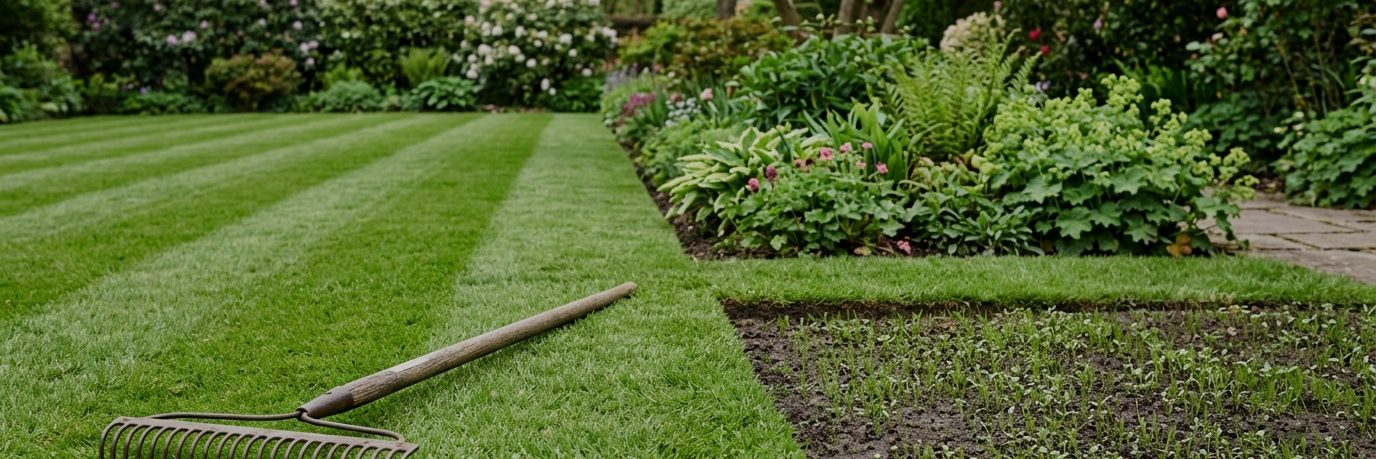
Lawn Care: From Seeding to Mowing, and Renovation
Mowing height is the most underrated setting in the garden: mowing high gives a denser lawn, more resistant to drought and noticeably less invaded by weeds, because root depth follows leaf height. Everything else in lawn care follows from that choice, from the seed mix you sow to your watering rhythm, and is timed by soil temperature rather than a date on the calendar.
Lawn care comes down to five steps that drive one another. Start by choosing a seed mix suited to the climate and the actual use of the ground: no amount of care makes up for the wrong species. Mow high next, 5 to 8 centimeters for a cool-season lawn, never removing more than a third of the blade height in one cut, because root depth follows leaf height and a dense turf lets far fewer weed seeds germinate. Leave the clippings on the lawn, since they return part of the nitrogen, and water rarely but generously, enough to moisten the top fifteen centimeters. Finally, treat moss as a symptom: shade, compacted soil, poor drainage, excess acidity, or fertility that is too low. As long as the cause goes uncorrected, it comes back.
Choosing Your Seed Mix: The Decision That Drives Everything Else
A lawn is never a single species but a mix, and that mix decides what you can ask of it for the next ten years. The first sort, even before the names, is by season: cool-season grasses, perennial ryegrass, fescues, and Kentucky bluegrass, grow when the soil is mild without being hot, dig in through midsummer, and take off again once the heat breaks. Warm-season grasses, bermudagrass and zoysia chief among them, germinate only above 18°C of soil temperature, peak between 24 and 32°C, then brown off and go dormant below 13°C. In temperate climates you sow cool-season grass; in hot or dry Mediterranean climates, warm-season grass carries the summer without irrigation but leaves you with a straw-colored lawn in winter. Between the two lies a transition zone where no single family is comfortable year-round.
What remains is the trade-off between species. Perennial ryegrass comes up within days but grows in bunches: it never fills its own bare patches. Kentucky bluegrass does the opposite, slow to establish but able to send out rhizomes that close damaged areas on their own, the only turf species that truly self-repairs. Red and sheep fescues are the reference for shade and poor soil, with very low nitrogen needs. Tall fescue sends its roots down 60 or even 90 centimeters and gets through dry summers when the others stall.
| Species | Establishment | Foot Traffic | Drought | Shade | Rate for a Pure Stand |
|---|---|---|---|---|---|
| Perennial ryegrass | Very fast, comes up in 5 to 10 days | Excellent, the benchmark | Poor, also suffers in cold | Poor, wants full sun | 30 to 40 g/m² |
| Kentucky bluegrass | Slow, comes up in 14 to 30 days | Good, and it self-repairs via rhizomes | Moderate, shows heatwave stress | Poor to moderate | 25 to 30 g/m² |
| Red and sheep fescues | Moderate, comes up in 7 to 14 days | Poor, dislikes repeated traffic | Good, holds up on poor soil | The best of the lawn grasses | 20 to 30 g/m² |
| Tall fescue | Moderate, comes up in 7 to 12 days | Good, but coarser blade | The best, roots down to 60 or even 90 cm | Moderate | 20 to 30 g/m² |
Read the composition on the back of the bag rather than the marketing name: “sports lawn” means nothing until you know the percentages behind it.
Seeding: Soil Temperature Calls the Shots
Seeds do not read the calendar, they read the thermometer. Cool-season grasses germinate between 10 and 18°C of soil temperature, measured 5 to 8 centimeters deep, not the air temperature. Two windows meet that condition: late summer into early autumn, when the soil is still warm as the rain returns and annual weeds have finished setting seed, and spring once the soil holds durably above 10°C. The first is the better of the two, because the young lawn then gets a full cool season to root in before its first real summer. In the southern hemisphere, the same logic applies, shifted by half a year.
Germination speed varies a great deal between species, which is exactly why mixes are blended the way they are: five to ten days for perennial ryegrass, seven to fourteen for fescues, fourteen to thirty for Kentucky bluegrass. A mix of all three therefore comes up in several waves, and that is not a seeding fault.
Seeding rate is measured in grams per square meter, never scattered by eye: 25 to 35 g/m² for a typical mix on bare ground, 20 to 25 g/m² for overseeding. Sow in two crossed passes, half the rate in each direction: it is the only reliable way to avoid pale streaks. Cover with 3 to 6 millimeters of fine soil, raking very lightly, since a seed buried too deep never reaches the surface, then firm the seedbed with a light roller, 25 to 35 kilograms.
During germination only, the watering routine is the opposite of an established lawn’s: little water, often, so the top centimeter never dries out.
Mowing Height: The Most Underrated Lever
This is the setting that changes the most, and the one almost nobody touches. The principle: root depth follows leaf height. A grass plant mowed short has little leaf surface, so little photosynthesis and little energy to send downward. It builds a shallow root system that hunts for water in the very top centimeters, precisely the layer that dries out first. The same lawn mowed two or three centimeters higher pushes its roots deeper and gets through dry spells without yellowing as fast.
The second effect is mechanical and matters just as much. A tall, dense turf shades the soil surface, and crabgrass, the classic full-sun weed, needs direct light and warmed soil to germinate. Several American studies on tall fescue and bluegrass lawns agree on the principle: raising the cutting height pushes crabgrass back noticeably, with a marked gap between a low cut and a cut around 8 to 9 centimeters. The effect is less clear-cut on white clover and especially on dandelion, where some studies find no clear link to mowing height alone: for these two weeds, turf density matters more than mowing height by itself. Against crabgrass, though, mowing high still counts as serious preventive weed control.
The ideal height is not, however, the highest one possible: it depends on the species and how the lawn is used.
| Situation | Cutting Height | Mow When the Grass Reaches |
|---|---|---|
| Typical ornamental lawn, cool-season grasses | 5 to 8 cm | 7.5 to 12 cm |
| Dry, shaded, or weed-prone area | 8 to 10 cm | 12 to 15 cm |
| Heavily trafficked play area, ryegrass-dominant | 4 to 6 cm | 6 to 9 cm |
| Warm-season lawn, bermudagrass or zoysia | 1.5 to 4 cm | 2 to 6 cm |
One detail that costs more than it looks: a dull blade tears the leaf instead of cutting it. The wound browns over a millimeter or two, which is why the lawn looks gray-veiled two days after mowing.
The One-Third Rule, and Why It Is Not Just a Slogan
The rule says never remove more than a third of blade height in a single mow. Stated on its own, it sounds like an aesthetic preference. It actually rests on work published by Crider in 1955 that remains the reference: beyond 30 to 40 percent of leaf surface removed at once, root growth stops for several days. The plant no longer has enough leaf area to produce energy, so it draws on its carbohydrate reserves and redirects them toward rebuilding foliage, at the expense of roots. Every overly harsh mow is therefore a brake on rooting, and a lawn scalped every three weeks spends its life repairing itself.
The practical consequence is simple. Your target cutting height sets a trigger height, roughly one and a half times the target: aim for 6 centimeters and mow at 9; aim for 8 and mow at 12. The mowing schedule is therefore not set by the calendar but by growth speed: twice a week during the spring flush, once every two weeks or not at all during the depths of summer.
Then there is the concrete case of a lawn found at fifteen centimeters after three weeks away. The temptation is to bring it straight back down to five centimeters in one pass, and that is exactly the scenario the rule forbids: the lawn ends up bare, yellowed, with stripped stems and exposed soil. The right move is three passes over about ten days, dropping the mower one notch each time.
Mulch Mowing: Returning Clippings to the Soil Instead of Bagging Them
Fresh clippings are 80 to 85 percent water, and of the remaining dry matter, roughly 4 percent nitrogen, 2 percent potassium, and 1 percent phosphorus. Left on the lawn, they break down in seven to fourteen days and give those elements back. That order of magnitude is not a minor detail: measurements taken at Penn State on Kentucky bluegrass found that clippings returned 46 to 59 percent of the nitrogen applied through fertilizing. An established lawn whose clippings are left in place every year needs roughly a quarter less nitrogen over the first decade, and the saving grows as the lawn ages.
One worry keeps coming back: that clippings cause thatch. They do not. Thatch is made of stems, crowns, stolons, and roots rich in lignin, which break down slowly, unlike grass blades, soft and full of water, which vanish within one to two weeks. Thatch comes from excess nitrogen, compacted soil, or a depleted soil microbial life, not from the mower.
Mulch mowing still has its conditions. The grass must be dry, or clippings clump and smother the turf; the one-third rule must be respected, since eight-centimeter blades do not shred fine enough; the blade must be sharp, and a mulching kit noticeably improves the result. Two situations call for bagging instead: an active leaf disease, and weeds that have already gone to seed and should not be scattered everywhere. The same mower does double duty in autumn, shredding a moderate layer of fallen leaves into fragments that break down on the lawn.
Moss Is a Symptom, Never a Disease
Moss does not compete with grass, it occupies the space grass has left empty: it attacks nothing, it simply moves in where the grasses have given up. A moss-covered lawn is telling you something about its soil, something a moss killer only papers over for one season. Six conditions encourage it, often in combination: excessive shade, acidic soil, poor drainage, compacted soil, overly generous watering, and fertility that is too low.
The pH reading deserves a word of its own, since it is the one cause of the six you cannot diagnose by eye. Most lawn grasses prefer a pH of 6.0 to 6.5, and moss is noticeably more common on moderately to strongly acidic soil than on neutral soil. A test kit, or better yet a lab analysis, settles the question. Liming should only be decided after that measurement, at a calculated rate, six to eight weeks apart from any nitrogen fertilizing. Liming blind sometimes pushes pH past the target and blocks iron and manganese uptake, which produces a yellow lawn for exactly the opposite reason.
Iron sulfate treatments blacken moss within days, which looks dramatic. They change nothing about the shade, the compaction, or the drainage: moss comes back the following season, often more widespread, because the causes kept doing their work. The only sequence that holds up: identify the real causes, correct them, remove the dead moss, and overseed the bare patches right away.
| Likely Cause | What Gives It Away | Lasting Fix |
|---|---|---|
| Shade too dense | Moss under a tree or on the north side of a wall, thin leggy grass | Prune to let in light, overseed with fescues, or plant a shade bed instead |
| Compacted soil | A screwdriver will not go 10 cm into drained soil | Hollow-tine aeration during active growth, followed by topdressing |
| Poor drainage | Water sits in low spots long after rain | Regrade, work in organic matter, install drainage |
| Acidic soil | pH below 6.0, blueberries and heathers thriving nearby | Liming at a rate set by soil analysis, well apart from any fertilizing |
| Fertility too low | Pale, slow-growing grass, moss in the thinnest areas | Nitrogen feed at the end of the growing season, clippings left on the lawn |
| Too much water | Daily watering, or runoff from a downspout | Space out waterings and make them generous, redirect the runoff |
One case is worth accepting rather than fighting: under a dense tree, where even a shade fescue wears itself out, no amount of care will keep grass growing there long-term.
Thatch, Scarifying, and Aeration: Three Different Things
These three words get mixed up constantly, and the machine comes out at the wrong time on a lawn that did not need it. Thatch is the layer of poorly decomposed debris between the soil and the green growth, and it can be measured: cut a plug of turf with a spade and look at the cross-section. Under a centimeter it is useful, cushioning foot traffic and limiting evaporation. Past about one and a half to two centimeters it becomes a problem, because water and fertilizer no longer get through the layer and roots grow into it instead of into the soil.
Scarifying removes that thatch with vertical blades. The real window is not a date but a state: the lawn must be actively growing, on soil that has drained, so it can close the grooves within a few weeks. That means either the recovery period after winter, once the first mow is done, or late summer as the heat breaks. Scarifying a dormant or drought-stressed lawn just opens up bare soil with no way to heal, right in time for weeds to germinate. If you have naturalized bulbs in the lawn, wait until their foliage has yellowed: cutting it green robs the bulb of its reserves.
Aeration addresses a completely different problem, compaction, which you can test by pushing a long screwdriver into soil that is neither dry nor waterlogged. Only hollow-tine aeration actually works, pulling out plugs about 5 to 8 centimeters long and roughly one and a half centimeters across, which are left to break down on the surface. Physically removing volume is the only way to lower the apparent density of a clay soil, whereas spike rollers just compress the soil around the hole. Do it during active growth, and it pays to follow up with topdressing, a thin layer of fine soil worked in with a broom or the back of a rake.
Water Deep and Infrequently, or Not at All
The starting benchmark is about 25 millimeters of water a week, rain included, more in extreme heat or on sandy soil. The important point is not the volume but how it is spread out: one generous watering a week beats seven light ones. The goal is to moisten the top fifteen centimeters, then let the top centimeter dry out before the next watering.
The reason is simple: roots follow water. Light watering every evening keeps a thin surface layer continuously damp, and roots have no reason to grow down into it: they stay right where the lawn will be most vulnerable the moment watering stops. That saturated layer creates a second, less visible problem: roots breathe oxygen from the pores in the soil, and waterlogged soil starves them of it. Add wet foliage every night and leaf diseases have everything they need.
A free way to measure beats a sprinkler timer set by guesswork: set out three or four straight-sided containers, an empty tin can works fine, and time how long it takes to collect 25 millimeters. Once you know that, you will know for good how long your sprinkler needs to run.
There is also the option of not watering at all. An unirrigated cool-season lawn goes into summer dormancy: it browns, stops growing, and waits for rain to return before greening up again, which has nothing to do with a dead lawn. Two precautions make this approach safe. The first is to commit either way, water properly or not at all: irregular, insufficient watering pulls the plant out of dormancy without giving it enough to hold on, which exhausts it. The second is to limit foot traffic on a dormant lawn, which cannot repair itself before the rain returns.
What If You Do Not Need an English-Style Lawn?
A close, uniform lawn is one goal among others, not the definition of a successful garden. Plenty of gardens maintain, at real cost, dozens of square meters that nobody ever walks on, simply because they have always been lawn.
The first step down is a rustic, fescue-dominant lawn: roughly 5 to 10 grams of nitrogen per square meter per year, tolerant of shade and poor soil, mowed higher and less often. It looks less fine-textured and takes heavy traffic poorly, but the drop in maintenance load is considerable. Micro-clover, a dwarf form of white clover, goes further still: it fixes nitrogen from the air for the benefit of neighboring grasses and holds its color through dry spells better than they do. Its flowers attract bees, worth planning around if children play barefoot on it.
A wildflower meadow changes the logic entirely: you stop mowing, cut once or twice a year, and remove the hay, because it is the resulting poorer soil that lets flowers get the upper hand over coarse grasses. A four-year study counted roughly three times more plant and insect species in the section left as meadow than in the section kept mowed. The trade-off is real: a meadow cannot be walked on like a lawn, goes through unattractive phases, and needs patience for the first two years.
The most workable solution stays in between: differentiated mowing. Keep the area that actually gets used, terrace, play area, path, cut close, and let the rest grow up. The detail that changes everything is the path: one clean mowed strip cut through the tall section reads the whole thing as a deliberate choice rather than neglect.
Common pitfalls to avoid
MistakeMowing very short to space out mowings.
Why :The logic actually runs backward. Less leaf means less photosynthesis, so shorter roots, so a lawn that draws its water from the soil layer that dries out first. The bare soil that results warms up and fills with weed seedlings.
Do this instead :Raise the cutting height by two to three centimeters and accept mowing more often at first, until the turf thickens up. The density you gain then cuts down on weeding.
MistakeRaising the mower deck during a heatwave to help the lawn cope.
Why :The link between leaf height and root depth is real, but it only operates while roots are actively growing, in spring and autumn for a cool-season lawn. In midsummer that growth has stopped: raising the cut adds leaf area to feed with an unchanged root system, which makes water stress worse. Jumping straight from 4 to 8 centimeters also breaks the one-third rule.
Do this instead :Pick the highest cutting height acceptable for how the lawn is used as soon as growth resumes, and keep it there all season. Raising the height in midsummer is only worthwhile on a lawn that is genuinely being irrigated.
MistakeApplying moss killer every year without ever measuring pH or looking for the cause.
Why :Moss is a symptom, not an aggressive organism: it occupies the space a weakened lawn has left open. Iron sulfate blackens it without changing anything about the shade, the compaction, the drainage, or the acidity, and the lawn does not recolonize the bare patches on its own.
Do this instead :Take a pH reading, aim for 6.0 to 6.5, and work through the six possible causes before any treatment. Fix what can be fixed, remove the dead moss, and overseed the bare patches right after.
MistakeScarifying hard and early, before the lawn has started growing again.
Why :Scarifying is a deliberate wound: it only makes sense if the lawn can close the grooves within a few weeks. Done on a dormant lawn, it leaves the soil open at the exact moment weeds are germinating. Plenty of lawns scarified every year never had enough thatch to justify it in the first place.
Do this instead :Measure the thatch on a plug cut with a spade and only act once it is past one and a half centimeters. Wait for active growth, on soil that has drained, and overseed immediately after scarifying.
MistakeWatering for ten minutes every evening through summer.
Why :Such a short watering only moistens the top centimeter of soil. Roots follow water and stay near the surface, which makes the lawn dependent on daily repetition, and the constantly damp layer starves them of oxygen from the soil pores.
Do this instead :Group the water into one generous weekly watering, around 25 millimeters, calibrated once and for all using straight-sided containers. The only time light, frequent watering is correct is while a new seeding is germinating.
The care sheets to read next
Every plant mentioned has its full sheet: watering, light, soil, pests and a month-by-month calendar.
Crocus
Crocus
Crocus is the very first splash of colour in the garden as winter loosens its grip. It is not unusual to see it push…
Daffodil
Narcissus
The daffodil (Narcissus) is the first big signal of spring in the garden. Long before the tulips, its yellow trumpets…
Hyacinth
Hyacinthus orientalis
The hyacinth (Hyacinthus orientalis) is a spring bulb whose heady scent announces the return of fine weather in gardens…
Tulip
Tulipa
The tulip (Tulipa) is a spring-flowering bulb, come from the mountains of Central Asia and become the emblem of Dutch…
Oxeye Daisy
Leucanthemum vulgare
The oxeye daisy (Leucanthemum vulgare) is that white flower with a yellow centre that pops up on its own in our…
Coneflower
Echinacea purpurea
Coneflower (Echinacea purpurea) is a tall, sturdy perennial from the prairies of North America, recognisable by its…
Hosta
Hosta
The hosta (Hosta spp.) is a perennial native to the damp woodlands of East Asia, from Japan through China to Korea. It…
Lily of the valley
Convallaria majalis
Lily of the valley (Convallaria majalis) is the small perennial with white, fragrant bell flowers traditionally given…
Lavender
Lavandula angustifolia
True lavender (Lavandula angustifolia) is a hardy Mediterranean plant that scents the air and draws bees all summer…
Rose
Rosa
The rose (Rosa) is a hardy flowering shrub that overwinters outdoors without trouble, down to about -20 °C for most…
Hydrangea
Hydrangea macrophylla
The hydrangea (Hydrangea macrophylla) is the flowering shrub for cool, partly shaded gardens, and one of the very few…
Peony
Paeonia
The peony (Paeonia) is a hardy perennial with remarkable longevity: once well settled, it can flower for several…
Dahlia
Dahlia
The dahlia (Dahlia) is a tuberous plant that offers one of the longest and most spectacular displays of the summer…
Box
Buxus sempervirens
Box (Buxus sempervirens) is an evergreen shrub that has been clipped into balls, cones and low borders in formal…
Privet
Ligustrum ovalifolium
Privet (Ligustrum ovalifolium), often sold as California privet, is a shrub native to Japan that has become one of the…
Spirea
Spiraea
Spirea (Spiraea) is one of the easiest and most rewarding flowering shrubs you can plant. It shows up in almost every…
Blueberry
Vaccinium corymbosum
The cultivated blueberry (Vaccinium corymbosum) is the large shrubby cousin of the wild bilberry, also called the…
Frequently asked questions
What mowing height gives the densest lawn?
For a cool-season lawn, aim for 5 to 8 centimeters in everyday use, and up to 10 in a dry, shaded, or weedy area. That is where the density comes from: more leaf means more photosynthesis and deeper roots, and a tall turf shades the soil enough to block a large share of weed germination. Warm-season lawns, bermudagrass or zoysia, are managed the opposite way, low, between 1.5 and 4 centimeters.
Should you bag clippings or leave them on the lawn?
Leave them, in the vast majority of cases. Fresh clippings are 80 to 85 percent water, break down within one to two weeks, and give their nitrogen back to the soil: measurements on Kentucky bluegrass found that clippings returned 46 to 59 percent of the nitrogen applied through fertilizing. They do not cause thatch, despite the common belief. Bag them only if the grass is wet, a leaf disease is active, or weeds have already gone to seed.
Why is my lawn full of moss even though I mow it regularly?
Because mowing does not fix any of the real causes. Moss moves in wherever the grass has given up, driven by one or more conditions: too much shade, compacted soil, poor drainage, pH too low, overly generous watering, or fertility that is too low. As long as those persist, moss killer only buys you one season. Start with a pH reading, aim for 6.0 to 6.5, and test for compaction with a screwdriver in soil that has drained.
When should you seed or overseed a lawn?
When soil temperature, measured 5 to 8 centimeters deep, sits between 10 and 18°C for cool-season grasses, and above 18°C for warm-season ones. Two windows meet that condition: late summer into early autumn, when the soil is still warm as the rain returns, and spring once the soil holds durably above 10°C. The first is the better window: the young lawn then gets a full cool season to root in before its first summer.
Should you water a lawn that is yellowing in summer?
You need to pick a side, and above all avoid doing both halfway. An unirrigated cool-season lawn goes into summer dormancy: it browns, stops growing, then greens back up once rain returns. That is not a dead lawn. If you do water, do it generously and rarely, about 25 millimeters a week, enough to moisten the top fifteen centimeters. Irregular watering pulls the plant out of dormancy without giving it enough to hold on, which exhausts it.
Can you skip mowing part of the garden altogether?
Yes, and it is often the better trade-off. Differentiated mowing means keeping the area that actually gets used, terrace, play area, path, cut short, and letting the rest grow up with one or two cuts a year. A four-year study counted about three times more plant and insect species in the section left as meadow than in the section kept mowed. The detail that changes everything is a clean mowed path cut through the tall section: it reads the whole area as a deliberate choice, not neglect.
Green Hub looks after your plants
Photograph a plant: Green Hub identifies it and writes its care sheet, with no account. Sign in afterwards to keep its dated photos and history over time.
Identify a plantUpdated on
How this sheet is written
Written for Green Hub with the help of language models, then reviewed. It offers gardening guidance, not professional advice: if you are unsure whether a plant is toxic to a child or an animal, ask a vet, a doctor or your national poison centre.