Lily of the valley
Convallaria majalis
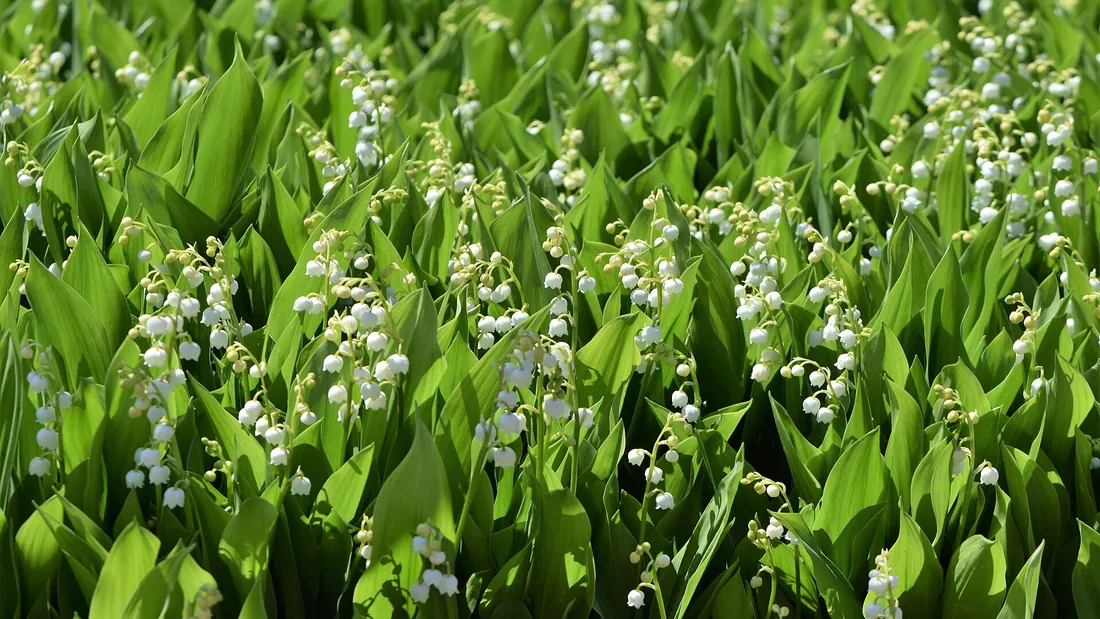

Lily of the valley (Convallaria majalis) is the small perennial with white, fragrant bell flowers traditionally given as a good luck charm on the first of May in several European countries. It is the classic woodland groundcover: it colonises the cool shade under trees and hedges where many other plants give up. Its hardiness and ease of growing make it a safe bet for the shade garden, but the whole plant, and especially its red berries, is highly toxic.
Light and exposure
Lily of the valley is a shade and part-shade plant, built to live under the cover of trees and large shrubs. It is there, in the dappled light of woodland or at the foot of a wall that stays shaded all day, that it gives its finest carpet of leaves and its most generous flowering.
It copes with a little more sun if the soil stays permanently moist, for instance on the shaded side of a hedge or under a deciduous tree that still lets light through in spring before coming into full leaf. In full sun with dry soil, on the other hand, the foliage scorches quickly and the flowering gets poorer year after year.
Watering
Once established, lily of the valley manages very well on its own in woodland soil that stays naturally moist. Watering is really only needed in the first year after planting, while the rhizomes root in, and during very dry summers, which are becoming more common across temperate climates.
In the full heat of summer it is normal for the foliage to yellow and flop to the ground: this is the plant’s natural summer dormancy, not a sign that it lacks water. Watering at this point changes nothing, the lily of the valley will come back from its rhizomes the following year regardless.
Soil and repotting
Lily of the valley wants a humus rich, cool soil, close to what it finds naturally in woodland: full of decomposed leaves, loose and well drained without ever drying out. Working in some compost or leaf mould at planting recreates these ideal conditions.
It tolerates neutral soils just as well as slightly chalky ones, and it is one of the few woodland perennials that does not insist on acid ground, which opens up most gardens to it. Only dry, sandy soil in full sun really causes problems: the foliage scorches within a couple of summers and the clump weakens.
Temperature and humidity
Lily of the valley is among the hardiest plants in the garden, from USDA zone 2 to zone 7. It withstands, with no protection at all, cold down to minus thirty-five degrees, since the rhizomes sit safely underground. No winter frost, however hard it bites, troubles it.
It actually needs that winter cold to flower well the following year, much like a spring flowering bulb: count on several weeks below five degrees. A winter that stays too mild clearly delays or weakens the flowering, and that is the whole difficulty with lily of the valley in a warm climate. Beyond zone 7 it needs the deepest shade in the garden and constantly moist soil to see the summer through.
Pruning and upkeep
Lily of the valley is not really pruned. Leave the green foliage in place after flowering: it keeps feeding the rhizome through photosynthesis and sets up next year’s flowers, exactly as with a daffodil.
In late summer or autumn, once the foliage has fully yellowed and died back, you can cut it down to ground level to tidy the bed. If young children or pets use the garden, also cut off the faded flower stems before the red berries form, since they are the most toxic part of the plant.
Pests and diseases
Lily of the valley is a tough plant, not prone to serious disease. In hot, humid summers, fungal leaf spots can appear on the oldest leaves, without any real consequence for the clump as a whole.
In spring, the tender young shoots sometimes attract slugs and snails, especially after wet spells as they push through the soil. A mulch of dead leaves, which otherwise suits it very well, can also shelter these pests: keep an eye on the young shoots as they break through the soil.
Propagation
Dividing the rhizomes, known as pips, is by far the simplest and fastest method. Split them in autumn, once the foliage has yellowed and died down, or right at the start of spring before growth resumes, keeping at least one well formed bud on each piece.
Space the pips ten to fifteen centimetres apart, they will fill in the gap within two or three years thanks to their spreading rhizomes. Sowing the seeds found inside the berries is possible but very slow, expect several years before the first flowers: division remains far preferable for anyone who wants quick results.
Toxicity
Lily of the valley is one of the most toxic plants found in gardens. The leaves, flowers, rhizomes and above all the red berries that appear in summer contain cardiac glycosides, notably convallatoxin, which act directly on the heart. Ingestion can cause nausea, vomiting, heart rhythm disturbances and, in severe cases, cardiac arrest, in people as well as in dogs and cats. Even the water in a vase that lily of the valley stems have stood in becomes toxic and should never be drunk or left within reach of a child or a pet. The sweet, tempting red berries cause a number of accidents every year: it is safer to cut the flower stems before the berries form if young children use the garden.
Climate and hardiness
Where and in which climate it thrives
Lily of the valley is hardy from USDA zone 2 to zone 7: its rhizomes, tucked safely underground, come through winters of minus thirty-five degrees with no protection at all. Cold is in fact what drives its flowering. It needs a genuine cold dormancy, several weeks below five degrees, to form the following year’s buds; under a winter that stays mild, the clump stays green and flowers less and less.
Its real limit is heat. In zones 8 and 9 it only succeeds in deep shade and in soil that never dries out, and it slips into summer dormancy very early, as soon as the heat settles in. Beyond that, under a hot humid summer, it barely establishes at all. It is at its best in a temperate climate with a distinct winter, oceanic or continental, where the woodland floor stays cool all summer. In a Mediterranean climate, save it the shaded side of a wall or the foot of a deciduous tree, with a thick mulch.
Where it is happy, it is too happy: its creeping rhizomes form a dense carpet that smothers its neighbours, and it is listed as an invasive plant in several US states, especially in regions with cold, damp winters. Bury a rhizome barrier at planting, or give it a bed of its own where you let it run.
Flowering comes in spring, a few weeks after growth resumes, which is exactly what earns it its place in the European tradition of the lucky sprig of lily of the valley.
Growing lily of the valley?
Green Hub keeps a dated history of your own plant: its photos, its progress, its repottings. An AI answers about yours specifically, not a generic sheet, for free.
Identify my plantMonth-by-month care calendar
| January | Complete rest underground. The frozen soil protects the rhizomes, nothing to do in the garden except plan a new shady corner if you want to expand the carpet. |
|---|---|
| February | Still dormant. If the soil thaws, this is a good window to prepare the ground for a future bed with compost or leaf mould. |
| March | The first spear shaped shoots break through the soil. Last chance to divide and plant pips before growth really gets going. |
| April | Rapid growth, the leaves unfurl and the flower stems rise. The first white buds appear towards the end of the month. |
| May | Full flowering, the white, fragrant bells open around the first of May. No particular care needed, just enjoy the scent. |
| June | The flowers fade. Cut the stems if you do not want toxic red berries, otherwise let them be but watch for their appearance later in summer. |
| July | In hot weather the foliage starts to yellow and flop over: this is natural summer dormancy, not a sign of drought that needs fixing. |
| August | The foliage keeps dying back. Any red berries ripen now: highly toxic, watch closely if young children or pets are around. |
| September | A good time to divide a carpet that has become too dense and replant the surplus pips elsewhere in the garden. |
| October | Continue planting pips, the still warm soil helps them root well before winter. Clear away foliage that has fully died back. |
| November | A light mulch of dead leaves mimics its natural woodland habitat, though it is not essential given how hardy it is. |
| December | Total winter dormancy. The rhizomes wait underground for the cold they need to flower well the following spring. |
Green Hub tips
- An unbeatable shade groundcover under trees and hedges, in spots where almost nothing else will grow and flower reliably every year.
- Contain the spreading rhizomes from the moment you plant with a buried barrier, or lily of the valley will take over an entire perennial bed within a few years.
- Never confuse its leaves with wild garlic when foraging: the two plants grow in the same woodland and look alike, but lily of the valley is highly toxic.
- The whole plant is dangerous, especially the red autumn berries: keep children and pets away, and never drink the water from a vase that lily of the valley stems have stood in.
Related species
Asparagus
Asparagus officinalis
Asparagus (Asparagus officinalis) is an unusual perennial for a vegetable patch: once established, an asparagus bed…
Hosta
Hosta
The hosta (Hosta spp.) is a perennial native to the damp woodlands of East Asia, from Japan through China to Korea. It…
Hyacinth
Hyacinthus orientalis
The hyacinth (Hyacinthus orientalis) is a spring bulb whose heady scent announces the return of fine weather in gardens…
Madagascar dragon tree
Dracaena marginata
The Madagascar dragon tree (Dracaena marginata) is a houseplant with a slender trunk and a tuft of strap-like leaves…
Snake plant
Dracaena trifasciata
The snake plant (Dracaena trifasciata), long classed under the name Sansevieria trifasciata and nicknamed…
Spider plant
Chlorophytum comosum
The spider plant (Chlorophytum comosum), also called ribbon plant, is a South African perennial that has become the…
The guides that mention it
Perennial Flowers: Choosing, Planting and Blooming Without a Gap All Season
What genuinely comes back year after year, how to read hardiness by zone rather than by promise, and how to string…
Toxic Plants for Cats and Dogs: Recognising the Danger Rather Than Memorising a List
A list of toxic plants is easily forgotten and always incomplete. What actually protects a cat or dog is recognising…
Lawn Care: From Seeding to Mowing, and Renovation
Mowing higher changes more than any fertilizer can: turf density, drought resistance, weeds, moss. Everything else in…
The Cutting Garden: How to Pick Flowers and Make Your Bouquet Last
Dahlias, peonies, hydrangeas: what separates a flower that lasts ten days in a vase from one that droops by the next…
What to Plant in a Shade Garden, Under Trees and Against Sunless Walls
Under a large tree or against a wall the sun never reaches, shade doesn’t rule out a planting bed: it calls for a…
Updated on
How this sheet is written
Written for Green Hub with the help of language models, then reviewed. It offers gardening guidance, not professional advice: if you are unsure whether a plant is toxic to a child or an animal, ask a vet, a doctor or your national poison centre.