Spider plant
Chlorophytum comosum
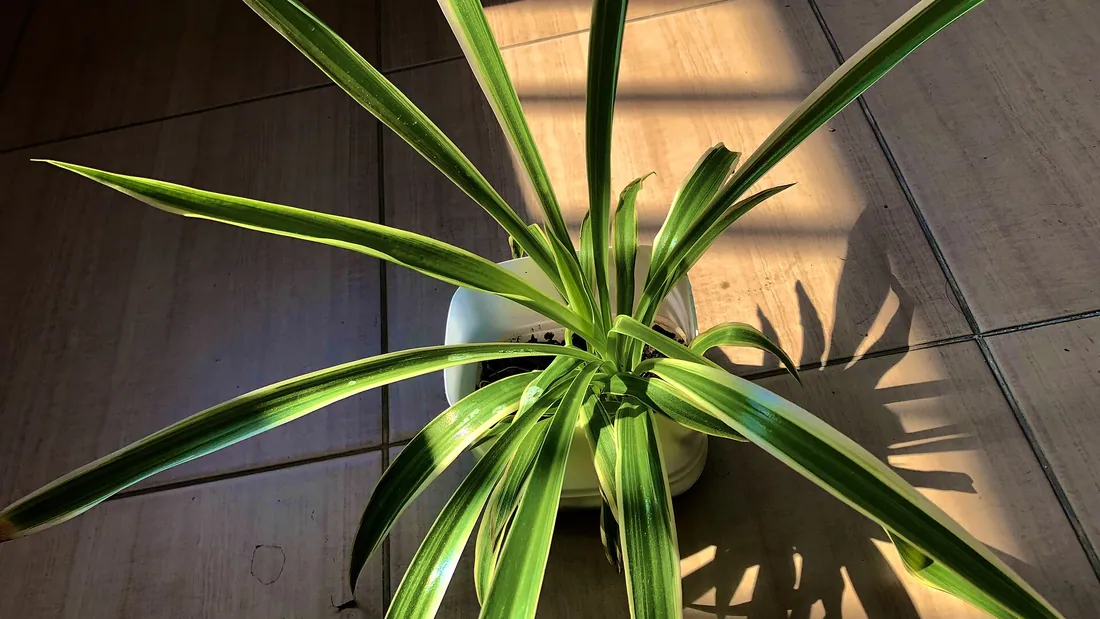

The spider plant (Chlorophytum comosum), also called ribbon plant, is a South African perennial that has become the unkillable classic of interiors. It sends out long arching stems bearing plantlets that look like little spiders, hence its name. In a temperate climate, it spends the whole year in a pot indoors, tolerates missed waterings and the average light of a flat, and copes better than most with the dry air of heating. It is the ideal plant for beginners.
Light and exposure
The spider plant likes bright light without direct sun. A spot near an east or west window, or slightly set back from a south window, suits it perfectly. It is in this light that the cream variegation of the leaves stays well marked. The scorching midday sun in summer yellows and burns the foliage.
It also survives in a darker corner, but the contrast of the leaves fades and plantlets become rare. In weak winter light, when the days are at their shortest, bring the pot closer to a bright window so the plant keeps its look until the light returns.
Watering
Water when the top two centimetres of the substrate have dried, roughly once a week in spring and summer, then every ten to fifteen days in winter. The spider plant stores water in its fleshy roots and readily forgives a missed watering, far more than an excess.
Empty the saucer after each watering, because the roots hate to sit in water. If the leaf tips brown and dry out, two causes often combine here: the dry air of the heating and the fluoride or chlorine in the tap water. Water left to stand overnight or rainwater solves part of the problem.
Soil and repotting
A simple potting mix for green plants, lightened with a handful of perlite for drainage, is amply enough. The spider plant is not demanding about soil, it mostly needs a pot with drainage holes to let the water out.
It grows fast and fills its pot with thick roots in a season or two. Repot in spring as soon as the roots lift the root ball or spill out of the drainage holes, into a pot only slightly larger. A plant a little cramped actually produces more plantlets.
Temperature and humidity
The spider plant is happy between 15 and 25 degrees, the usual range of an interior. It tolerates cool down to 8 degrees without harm, but does not withstand frost. Keep it away from scorching radiators and the cold draughts of single-glazed windows.
The challenge is the air dried out by heating through the whole heating season, which browns the leaf tips. This does no harm to the plant’s health, but is unsightly. A little moisture in the air, a spray from time to time or the pot set on moist clay pebbles, limits the problem.
Pruning and upkeep
Upkeep comes down to cutting off at the base the yellowed or damaged leaves and trimming the dry tips with a snip of the scissors, following the shape of the leaf to stay discreet. Nothing more is needed.
The long flower stems bearing the plantlets can be left for the trailing effect, very pretty in a hanging pot, or cut off if you prefer a compact clump. Every plantlet taken turns into a new plant, so nothing is wasted.
Pests and diseases
The spider plant is robust and rarely falls ill. In winter, when the air is dry, watch for spider mites (Tetranychus urticae), tiny mites that spin fine webs under the leaves and speckle them yellow. A shower with lukewarm water and more humid air get rid of them. Mealybugs, small cottony clusters, are removed with a cotton bud soaked in diluted methylated spirit.
Brown tips almost always reflect dry air or tap water, not a disease. Soft foliage and black roots, on the contrary, signal excess water: cut back the watering and repot in a dry substrate.
Propagation
It is one of the easiest plants to propagate. Every plantlet at the end of the arching stems already bears small forming roots. Set the plantlet, still attached to the mother plant, on a small pot of moist potting mix beside it, and let it root before cutting the cord. It takes almost every time.
You can also cut off the plantlet and place it in a glass of water for one to two weeks, until the roots lengthen, before potting it up. Finally, a large clump is simply divided in two at spring repotting.
Toxicity
Non-toxic to cats, dogs and children. It is even one of the rare houseplants you can leave within reach of a cat without worry, which does not stop it nibbling the leaves for fun.
Climate and hardiness
Where and in which climate it thrives
Wherever winter freezes, the spider plant lives indoors all year round. It does not spend the cold season outside: frost kills it and a wet winter does it no good. It is a houseplant, not a garden plant.
At the height of the warm season, you can give it a holiday outside, in the light shade of a sheltered terrace or balcony, where it will make fine plantlets. Bring it in as soon as the nights drop below 10 degrees. Its great asset is its tolerance: it takes the weak winter light and the dry air of the heating far better than most green plants, which makes it a safe bet for getting through the bad season without trouble.
Growing spider plant?
Green Hub keeps a dated history of your own plant: its photos, its progress, its repottings. An AI answers about yours specifically, not a generic sheet, for free.
Identify my plantMonth-by-month care calendar
| January | Rest. Water little, every 12 to 15 days. Place the plant in the brightest light possible, away from radiators. Watch for spider mites in the dry air. |
|---|---|
| February | Still at rest. Cut off the dry tips and yellowed leaves. Mist from time to time to counter the air of the heating. |
| March | The light returns and growth resumes. Go back to more regular watering. A good time to repot if the roots spill out. |
| April | Full regrowth. Repot, divide the large clumps, pot up the plantlets. First light feeding. |
| May | Active growth. Water about once a week. Feed every two weeks with a diluted green-plant fertiliser. |
| June | You can put the plant out in light shade on a sheltered terrace. It produces many plantlets in the fine season. |
| July | High summer. Water as soon as the surface has dried, mist in hot weather. Keep up the light feeding. |
| August | Good period for plantlets. Root them in small pots. Prepare the return indoors at the end of the month. |
| September | Bring the plant in as soon as the nights drop below 10 degrees. Gently reaccustom it to indoor light. |
| October | Space out the watering. Last light feeding of the year. Clean up and cut off the damaged leaves before winter. |
| November | Going into rest. Bring the pot closer to a bright window. Stop the fertiliser and cut back the water. |
| December | Winter rest. Watch out for the dry air of the heating: mist or set the pot on moist clay pebbles. |
Green Hub tips
- Brown tips most often come from the fluoride and chlorine in tap water: water with rainwater or water left to stand overnight to avoid them.
- A plant a little cramped in its pot makes more plantlets than a plant repotted too large.
- To take a cutting safely, let the plantlet root in a neighbouring pot before cutting the stem that links it to the mother.
- It is one of the rare plants non-toxic to cats: handy when your cat likes to chew the leaves.
Related species
Asparagus
Asparagus officinalis
Asparagus (Asparagus officinalis) is an unusual perennial for a vegetable patch: once established, an asparagus bed…
Hosta
Hosta
The hosta (Hosta spp.) is a perennial native to the damp woodlands of East Asia, from Japan through China to Korea. It…
Hyacinth
Hyacinthus orientalis
The hyacinth (Hyacinthus orientalis) is a spring bulb whose heady scent announces the return of fine weather in gardens…
Lily of the valley
Convallaria majalis
Lily of the valley (Convallaria majalis) is the small perennial with white, fragrant bell flowers traditionally given…
Madagascar dragon tree
Dracaena marginata
The Madagascar dragon tree (Dracaena marginata) is a houseplant with a slender trunk and a tuft of strap-like leaves…
Snake plant
Dracaena trifasciata
The snake plant (Dracaena trifasciata), long classed under the name Sansevieria trifasciata and nicknamed…
The guides that mention it
Indestructible Houseplants: Tolerating Drought Is Not Tolerating Shade
Tolerating drought and tolerating shade are two different adaptations, and almost every list mixes them up. What these…
Toxic Plants for Cats and Dogs: Recognising the Danger Rather Than Memorising a List
A list of toxic plants is easily forgotten and always incomplete. What actually protects a cat or dog is recognising…
How to Compost in an Apartment with Worm Composting
Tiered bin, red worms and worm tea: how to compost your kitchen scraps without a garden or odor, even in a city…
Updated on
How this sheet is written
Written for Green Hub with the help of language models, then reviewed. It offers gardening guidance, not professional advice: if you are unsure whether a plant is toxic to a child or an animal, ask a vet, a doctor or your national poison centre.