Orchid
Phalaenopsis
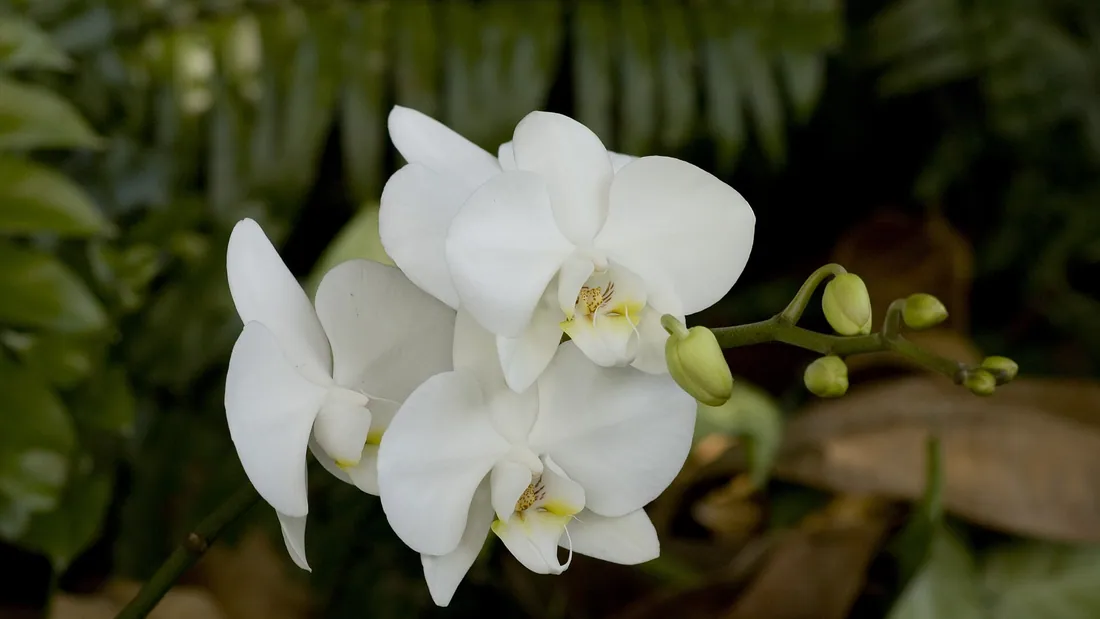

The moth orchid (Phalaenopsis) is the queen of houseplants, and for good reason: it flowers for months on end and copes well with apartment life. Be careful, though, this is not a soil plant. It is a tropical epiphyte that lives clinging to trees, its roots in the open air. Outside the tropics it is grown indoors only, never outside, and the first reflex to unlearn is watering it too much.
Light and exposure
The orchid likes plenty of light, but never direct sun, which burns its leaves and leaves brown marks. The ideal is an east-facing window, or a window that catches the midday sun veiled by a light curtain. Light green leaves signal good light, dark green ones that it is lacking some.
Its aerial roots, grey and fleshy, turn green after watering: they photosynthesise too. It is normal that they spill out of the pot, do not try to bury them. A transparent pot is in fact recommended, it lets the light reach the roots and allows you to monitor their colour.
Watering
This is where most failures play out. The orchid does not want stagnant water. The good method is soaking: once a week, plunge the pot into a container of room-temperature water for ten to fifteen minutes, then let it drain thoroughly before putting it back in place. Never a full saucer under the pot.
Between two soakings, the substrate must dry out. Roots that go from green back to silvery grey tell you it is time to soak again. In winter, space it out to one soaking every ten to fifteen days. Too much water rots the roots, soft and brown: this is mistake number one, far more common than a lack of water.
Soil and repotting
Forget potting soil, it would smother the roots and rot them. An orchid is grown in a substrate based on pine bark, airy and coarse, sometimes mixed with sphagnum. This mix retains a little moisture while letting the air circulate around the roots, as on a tree trunk.
You repot every two to three years, in spring, when the substrate breaks down and packs together. Choose a barely larger pot, transparent and with a hole. Take the opportunity to cut off with a clean blade any soft, hollow or blackened root, and keep only the firm roots.
Temperature and humidity
The moth orchid is happy in ordinary indoor rooms, between 18 and 24 degrees during the day. It appreciates a small drop at night, a few degrees less, which reproduces its native climate. Below 15 degrees it sulks, and it tolerates no sharp cold: never leave it against a cold pane on a winter night.
The air in heated homes in winter is very dry, which hardly suits it. Set the pot on a bed of damp clay balls, without the base sitting in water, or group your plants to create a more humid microclimate. Above all, avoid the direct proximity of a radiator, which dries out the foliage and makes the buds drop.
Pruning and upkeep
Routine care comes down to a few gestures. Wipe the dust off the leaves from time to time with a soft, damp cloth, remove the faded flowers as you go and monitor the colour of the roots through the pot.
The key move comes when flowering ends. Do not cut the stem right down. Spot the small swellings along the stem, the eyes, and cut just above the second eye from the bottom. Often, the plant sets off again from that eye and reflowers in the following weeks. If the stem yellows and dries out entirely, then cut it at the base.
Pests and diseases
The main pest of the orchid indoors is the mealybug, those small white cottony clusters nestled in the leaf axils and on the aerial roots. It weakens the plant and leaves a sticky honeydew. Dab each outbreak with a cotton bud soaked in methylated spirits and inspect the undersides of the leaves regularly.
The real trouble comes above all from excess water. Root rot, soft and brown, follows over-generous watering or a saucer that stays full. Soft black spots on the leaves betray a rot favoured by water stagnating in the heart of the plant: water the substrate, not the foliage.
Propagation
The moth orchid does not propagate easily at home, best to know it. The most accessible route is the keiki, a small offshoot that sometimes grows all by itself on a flower stem, with its own leaves and roots. Let its roots reach three to four centimetres, then detach it gently and repot it in fine bark.
Sowing from seed is a laboratory matter: the tiny seeds need a sterile medium to germinate, not realistic at home. For the amateur, then, you rely on keikis when the plant is willing to make them, and otherwise you keep and reflower the same plant year after year.
Climate and hardiness
Where and in which climate it thrives
The moth orchid lives between 18 and 29 degrees by day and does not like dropping below 16 degrees at night under normal circumstances. It tolerates no frost and can only be grown outdoors in a humid tropical or subtropical climate, USDA zones 11 and 12; everywhere else it is a year-round houseplant that does not go out, not even in summer.
Its difficulty is not the heat, it is the light of the dark season. When the day shrinks to eight or nine hours, the orchid is short of brightness: move it closer to the brightest window then, even if that means relocating it, without ever leaving it against a cold pane at night. Heating also dries out the air; set it on a tray of moist clay balls rather than misting it.
Reflowering, for its part, is commanded by temperature and not by the calendar. A new spike is triggered after three to four weeks of nights between 13 and 16 degrees, with a day-night gap of around ten degrees. In a temperate climate those nights arrive on their own in autumn, before the heating is turned up; elsewhere, it is enough to find the coolest room in the house. Once the buds have formed, bring it back into the warmth and stop moving it, as an abrupt change makes the buds drop.
Growing orchid?
Green Hub keeps a dated history of your own plant: its photos, its progress, its repottings. An AI answers about yours specifically, not a generic sheet, for free.
Identify my plantMonth-by-month care calendar
| January | Light at its minimum. Move the pot closer to the brightest window, away from the radiator. A single soaking every ten to fifteen days is enough. |
|---|---|
| February | Still little light and dry air. Keep up the tray of damp clay balls and watch the buds on the rising stems. |
| March | The days lengthen, the plant sets off again. This is the good time to repot in fresh bark if the substrate is packed or the roots are spilling out. |
| April | Growth resumes. Return to a weekly soaking and resume the diluted orchid feed, once every two or three weeks. |
| May | Full light without direct sun. Veil the south window with a light curtain. Continue soaking and light feed. |
| June | Active growth. Watch the drying of the substrate, which goes faster with the heat, and keep an eye out for the mealybug in the leaf axils. |
| July | Move the pot away from the burning afternoon sun. The orchid stays indoors, never outside even in fine weather. Regular soaking. |
| August | Continue the summer care. Wipe the dust off the leaves and check that the aerial roots stay firm and green after watering. |
| September | The touch of cool at night sets off reflowering. Place the plant in a cooler room at night to trigger a new stem. |
| October | The flower stems form. Cut the old faded stem above an eye to encourage a restart. Space out the feed. |
| November | The light drops. Move the pot towards the brightest window and take it away from the heating that has just started. |
| December | Relative rest. Water little, let it dry out well between two soakings, and enjoy the stems that often flower for the holidays. |
Green Hub tips
- Never leave water in the saucer. Root rot from excess water kills more orchids than everything else combined.
- Do not bury the aerial roots. Grey and fleshy, they photosynthesise and live very well in the open air, it is normal.
- After flowering, cut the stem just above an eye and not right down: the plant often sets off from there and reflowers.
- When the days grow short, move it closer to the window and away from the radiator. Lack of light and dry air are its two enemies of the dark season.
Related species
Aglaonema
Aglaonema commutatum
The aglaonema (Aglaonema commutatum) is a robust, easy houseplant, prized for its foliage variegated with green,…
Alocasia
Alocasia
The alocasia, nicknamed elephant ear, charms with its large, dramatically veined leaves. It is a demanding tropical…
Aloe vera
Aloe vera
Aloe vera (Aloe vera) is a succulent from the Arabian Peninsula, grown since antiquity for the soothing gel of its…
Anthurium
Anthurium andraeanum
The anthurium (Anthurium andraeanum) is a tropical houseplant known for its smooth, waxy red spathe, which people often…
Areca palm
Dypsis lutescens
The areca (Dypsis lutescens) is a tropical palm from Madagascar, frost-tender, grown indoors wherever winter freezes.…
Boston fern
Nephrolepis exaltata
The Boston fern (Nephrolepis exaltata) is a hanging indoor fern, born in the humid undergrowth of the tropics. Here,…
The guides that mention it
Watering Plants Properly: Deciding Rather Than Following a Schedule
Beginners water too often and too little at the same time. How to read the soil instead of the calendar, tell thirst…
Repotting your plants and choosing the right potting mix
The right moment, the right technique and the right substrate for each plant, so you can repot without rotting the…
Updated on
How this sheet is written
Written for Green Hub with the help of language models, then reviewed. It offers gardening guidance, not professional advice: if you are unsure whether a plant is toxic to a child or an animal, ask a vet, a doctor or your national poison centre.